

Multivitamin with Folic Acid: A Practical UK Guide
You're standing in a chemist, or scrolling through a UK supplement shop, comparing bottles labelled “multivitamin”, “women's formula” and “pregnancy support”. They all look broadly similar, but one detail changes the decision: how much folic acid each daily serving provides, and whether the product is suitable for your situation.
Folic acid is not just another ingredient to count on a label. For people who are trying to conceive or could become pregnant, UK guidance recommends a specific daily amount, and some people need a prescription dose instead. A general multivitamin may contain folic acid, but that does not automatically make it the right choice. Knowing how to check the dose, read the intended-use wording and account for medicines can help you shop with more confidence.
Table of Contents
- Why a Multivitamin With Folic Acid Matters in the UK
- What Folic Acid Does Inside a Multivitamin
- The UK Folate Gap in Real Numbers
- How Much Folic Acid You Actually Need
- Choosing Between Formulation Formats
- Why Flour Fortification Does Not Replace a Supplement
- Safety, Interactions, and Smart UK Buying Habits
- Your Quick Decision Checklist Before You Buy
Why a Multivitamin With Folic Acid Matters in the UK
At a UK pharmacy, two products labelled “multivitamin” can look similar while providing different amounts of folic acid. If you could become pregnant, check this nutrient separately from the rest of the formula. UK NHS guidance recommends 400 micrograms of folic acid daily when trying to conceive or if you could become pregnant. Start before pregnancy if possible and continue until the end of the first 12 weeks. The neural tube, which develops into the brain and spinal cord, forms very early, often before pregnancy is confirmed.
The product name alone cannot tell you whether a dose suits your needs. Read the amount in the daily serving and the directions on the label. One multivitamin may provide the recommended amount, while another may contain a different quantity or be intended for another group.
Supplements serve different purposes, much like medicines: choose according to the job you need the product to do, not the category printed on the pack. For example, someone seeking general nutrient coverage may have different priorities from someone preparing for pregnancy. As with when hair vitamins actually work, the purpose, ingredients and dose matter more than a broad product label.
A pregnancy-focused product may offer a practical way to take folic acid alongside other nutrients. It does not replace individual clinical advice, and a standard multivitamin may not provide the dose needed by someone with a particular condition or taking certain medicines. Ask a pharmacist or clinician before choosing if either applies to you. The useful label check is simple: does this product provide the folic acid amount that's appropriate for me?
What Folic Acid Does Inside a Multivitamin
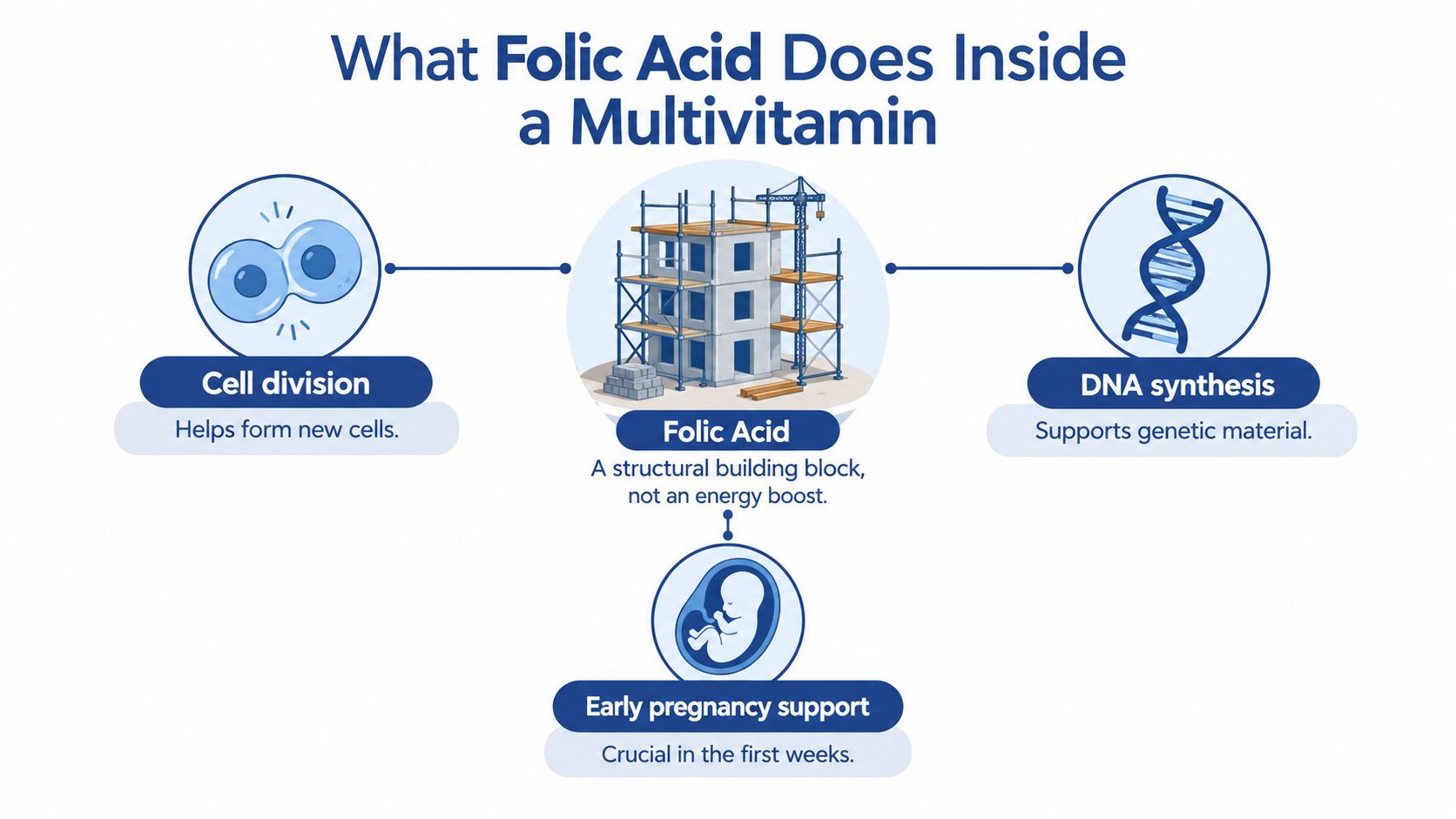
When you check a multivitamin label, folic acid is one specific nutrient, not a general promise of pregnancy support. It is the supplement form of vitamin B9. The body uses folate in making new cells and genetic material, and adequate folic acid in early pregnancy helps reduce the risk of neural tube defects, including spina bifida. It may also help prevent some cleft-lip-and-palate and heart conditions.
The neural tube closes in the first weeks of pregnancy, often before someone knows they are pregnant. Folic acid supports this early development, rather than acting as an energy boost or a way to make pregnancy happen. The Bornbir's pregnancy guide covers wider health considerations during pregnancy preparation.
Folic acid, folate and the rest of the formula
Folate occurs naturally in foods such as leafy green vegetables. Folic acid is the form used in supplements, where the amount can be measured. The terms are related, but the label matters: check how much folic acid the daily serving provides instead of assuming that a food source or the word “folate” tells you the supplement dose.
A multivitamin may also contain other B vitamins, vitamin D or iron. These ingredients do not change its folic acid amount, and a longer list does not necessarily make a formula a better fit. Check the amount of each nutrient and whether the combination suits your needs.
Royal jelly belongs to a separate supplement category. BioBees Fresh Royal Jelly - Natural Energy & Immune Support is described as containing proteins, amino acids, essential fatty acids and B vitamins. It does not replace a product with a clearly labelled folic acid dose.
The UK Folate Gap in Real Numbers
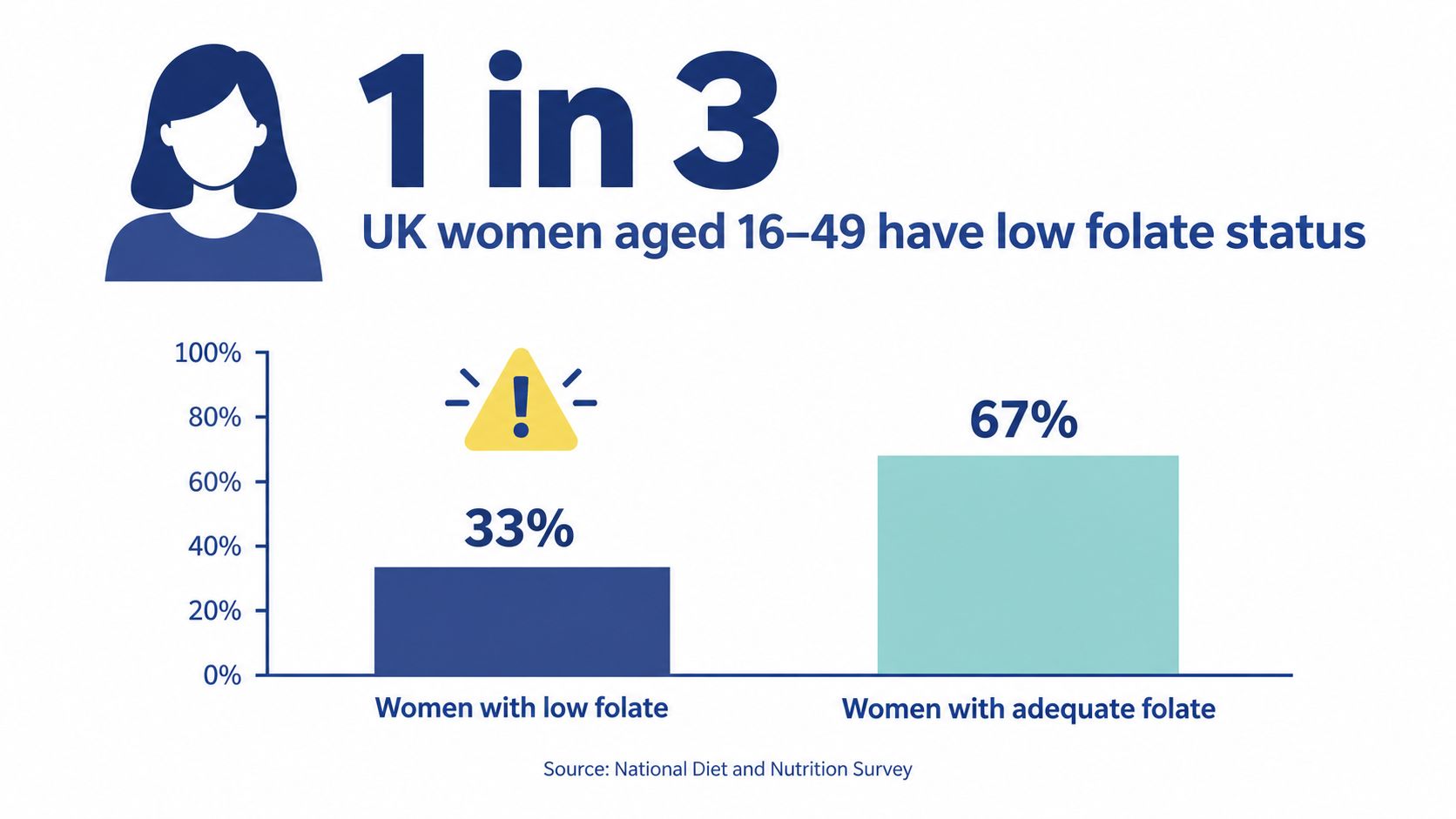
A diet can look varied and still leave questions about folate status. The National Diet and Nutrition Survey for 2019–2023 found that 83% of women aged 16–49 had red-blood-cell folate concentrations below 748 nanomoles per litre, a threshold associated with increased risk of a pregnancy affected by a neural tube defect. It also found that 7% of women in this age group were below 305 nanomoles per litre, indicating particularly low folate status.
These are population measurements, not a diagnosis for any one person. A result below either threshold does not mean that someone will develop a deficiency or pregnancy complication. The findings do, however, show why diet alone cannot be assumed to provide a reliable, measured intake of folic acid for early pregnancy.
The survey also reported that 12% of 11–18-year-olds, 4% of adults aged 19–64, and 2% of adults aged 65 and over had red-blood-cell folate below 305 nanomoles per litre. These figures describe groups, rather than predicting an individual's result.
What this means at the shelf: a product label showing the folic acid amount tells you what a daily serving provides. It cannot tell you your personal folate status, but it can help you follow UK supplement guidance if it applies to you.
Food choices still matter as part of a balanced diet. For practical information on diet and nutrition, see Vitamin Planet's guide. Use the survey as context, not a reason to panic: population figures cannot show your own status, while a clearly labelled supplement provides a measured amount.
How Much Folic Acid You Actually Need
For those who are planning pregnancy or could become pregnant, the NHS recommends 400 micrograms daily, ideally beginning before conception and continuing until the end of the first 12 weeks of pregnancy. This is the routine supplement amount, not a treatment dose for every circumstance.
Some people need a higher dose. A clinician may prescribe 5 milligrams daily for specific risk factors, including certain anti-epilepsy medicines, diabetes, obesity, malabsorption conditions or a previous pregnancy affected by a neural tube defect. If you're in one of these groups, don't try to reach the prescribed dose by combining ordinary multivitamins. Ask a clinician or pharmacist what to take and how to take it.
| Situation | Daily folic acid | Product type to look for |
|---|---|---|
| Trying to conceive or could become pregnant, without a known higher-risk factor | 400 micrograms | A supplement or multivitamin that clearly states the folic acid amount per daily serving |
| A clinician has identified a higher-risk situation | 5 milligrams, if prescribed | The prescribed high-dose product, with advice from your clinician or pharmacist |
| Unsure which situation applies | Confirm before choosing | Ask a pharmacist or clinician to check your circumstances and current medicines |
The important distinction is that 5 milligrams is not a stronger everyday option. It's a prescribed dose for particular circumstances, while the routine recommendation is the lower daily amount. Don't assume that a high-strength multivitamin is an appropriate substitute for a prescribed product.
When comparing formulas, focus on the dose per daily serving, not just the number printed beside the product name. Vitamin Planet's guide to the best prenatal vitamins in the UK can provide additional product-selection context, but your own medical history and prescription take priority.
Choosing Between Formulation Formats
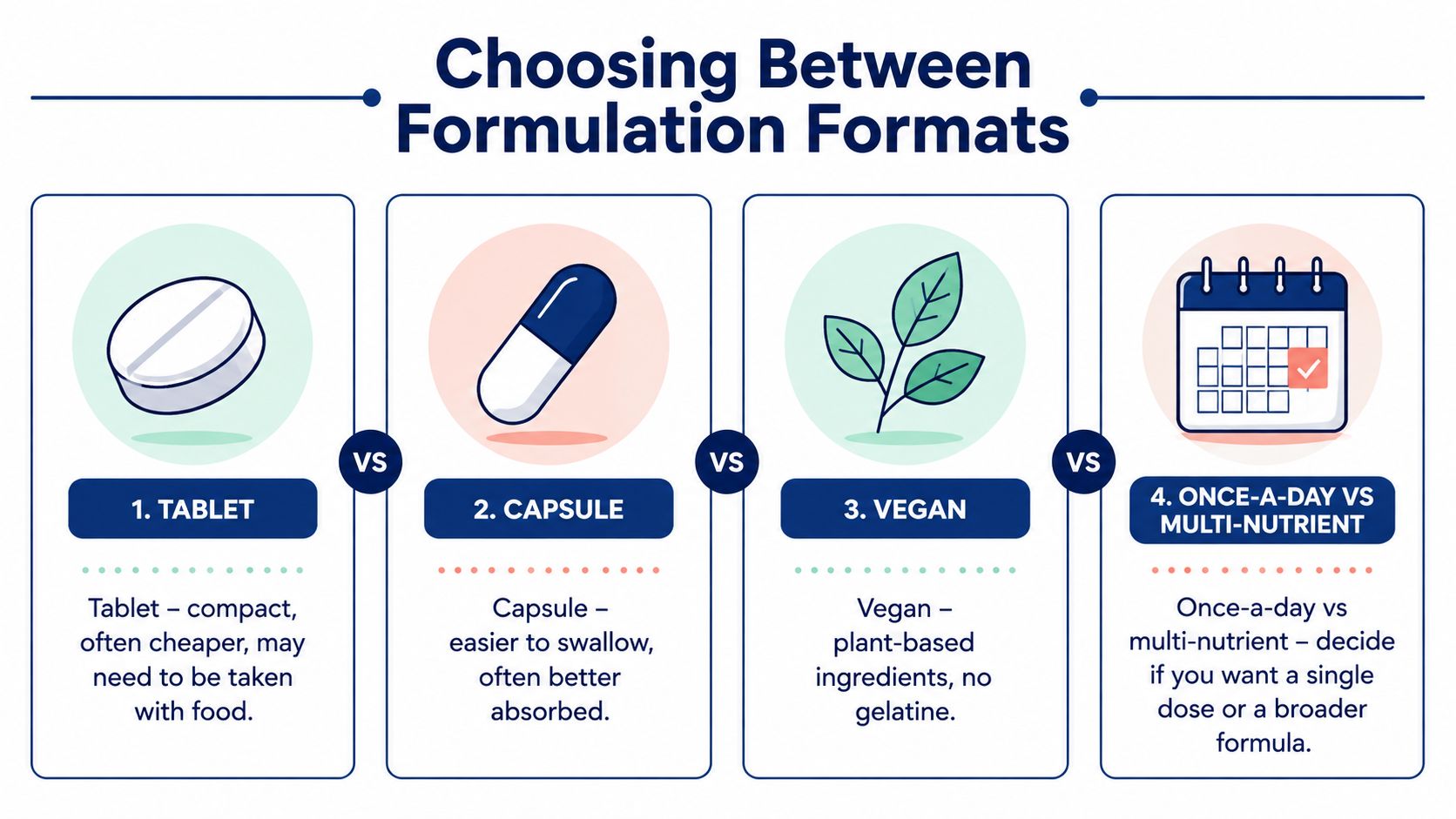
Once you know the dose you need, choose a format you can take consistently. A tablet may be familiar and compact; a capsule may feel easier to swallow for some people. Neither format guarantees that the product is more effective. The ingredient panel and directions tell you what it provides and how to use it.
| Choice | What to check |
|---|---|
| Tablet or capsule | Pick the form you can swallow and fit into your routine; check the directions and serving size |
| Vegan or standard | Look for clear suitability information and check ingredients if you avoid animal-derived materials |
| Single-dose or broader formula | Decide whether you want folic acid alone or a multinutrient product, then compare all included amounts |
| Daily or higher-strength product | Match the dose to guidance or a prescription, rather than choosing by “strength” claims |
A “vegan” label can matter if you avoid ingredients such as gelatine or other animal-derived materials, but check the ingredient list rather than relying on one front-label word. Likewise, a broad formula may include nutrients you don't need, or overlap with another supplement you already use. Make a note of your current products before buying another one.
People comparing supplements for reproductive health may also find top supplements for egg quality useful as broader reading, but such products don't replace folic acid guidance. A different supplement format, BioBees Fresh Royal Jelly Capsules, is listed with fresh royal jelly, propolis extract and bee pollen. It's not a folic acid product, so don't use it to meet a folic acid target.
Why Flour Fortification Does Not Replace a Supplement
Fortification can add folic acid to foods, but it doesn't guarantee that you receive the amount recommended for pregnancy planning. The UK Government has legislated for mandatory folic acid fortification of non-wholemeal wheat flour, with implementation planned for the end of 2026; the policy is expected to reduce neural tube defects by about 20%. These are policy details and projections, not a promise about any one person's intake or outcome. The UK Government's information on folic acid explains the fortification approach.
The food affected matters. Fortification applies to non-wholemeal wheat flour, so your intake will depend on what you eat, the type of flour used and how much of those foods you consume. People who avoid certain foods or follow a diet with fewer products made from that flour may get a different contribution from fortified foods.
That's why fortification and supplementation serve different purposes. Fortified foods can contribute to background intake, while a supplement provides a measured amount that you can compare with the recommended daily dose. The Government's announcement on folic acid fortification frames fortification as a way to help prevent neural tube defects, not as a replacement for supplement advice.
For a practical purchase, check the label for the folic acid quantity in the daily serving and follow the guidance for your circumstances. Don't assume that eating bread or other flour-based foods means you've reached the recommended amount, and don't use fortification as a reason to stop a supplement advised for you.
Safety, Interactions, and Smart UK Buying Habits
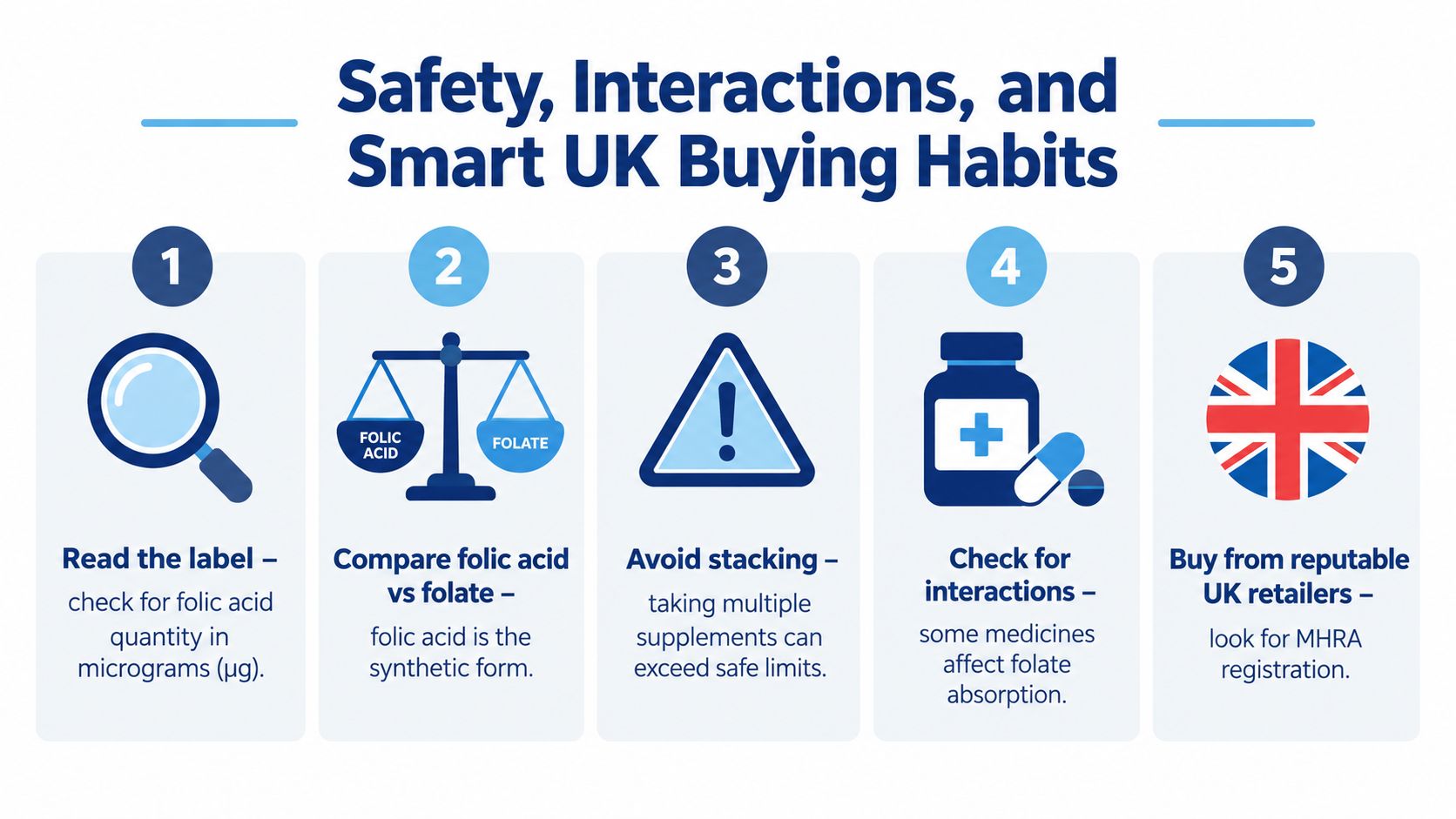
Start with the label, not the marketing. Find the serving size, the folic acid amount per serving and the product's directions. If you take more than one supplement, compare the full ingredient panels so you can spot nutrients that appear in both. A multivitamin's broad formula can make duplication less obvious.
Check medicines before adding a supplement
Folic acid doesn't combine straightforwardly with every medicine. NHS information lists epilepsy medicines such as phenytoin, phenobarbital and primidone, along with sulfasalazine, chloramphenicol, co-trimoxazole, lithium and aspirin, among medicines that may interact. The NHS guidance on folic acid medicines is a useful starting point for checking.
Phenytoin needs particular care because folic acid can reduce its blood levels. The Specialist Pharmacy Service advises that professional monitoring may be needed, so don't start or change a supplement without checking with your prescriber or pharmacist if you take it. If you use other prescribed medicines, including methotrexate-related treatments, ask a pharmacist whether the product's ingredients, dose and timing are suitable for you.
A simple buying check can make that conversation easier:
- Read the dose: Confirm the folic acid amount per daily serving, in micrograms or milligrams.
- Check the full formula: Note other nutrients, especially if you already take a separate supplement.
- Review your medicines: Tell the pharmacist the names of your medicines and the supplement you're considering.
- Follow the directions: Don't exceed the labelled serving or combine products to create a higher dose.
- Ask when uncertain: A pharmacist can help you check whether the product fits your medication and circumstances.
For general context on unwanted effects and supplement use, Vitamin Planet's guide to multivitamin side effects may also be useful. When medicines are involved, though, a pharmacist or clinician is the right person to assess your particular combination.
Your Quick Decision Checklist Before You Buy
Keep these checks in mind as you compare bottles online or in a shop:
- Purpose: Is the product intended for general use, pregnancy planning or another specific need?
- Dose: If you're trying to conceive or could become pregnant, does the daily serving provide the recommended 400 micrograms, unless a clinician has advised a different amount?
- Prescription: If you've been told you need a higher dose, are you using the prescribed product rather than trying to make up the dose with standard multivitamins?
- Label: Can you identify the folic acid amount and daily serving without guessing?
- Format: Is it a tablet, capsule or other form you can take as directed?
- Overlap and medicines: Have you checked your other supplements and asked a pharmacist about relevant prescriptions?
A suitable multivitamin with folic acid isn't necessarily the one with the longest ingredient list or the strongest-sounding label. It's the one whose stated dose and formulation fit your needs, and whose use doesn't conflict with medical advice or medicines. If anything about the dose or interaction feels unclear, take the product details to a pharmacist before buying.
Vitamin Planet offers vitamins, minerals and pregnancy-support products through its UK online store, giving you options to compare by category and format. Visit Vitamin Planet to browse the range and check product labels before choosing a supplement.