

Best Prenatal Vitamins UK: A Practical Buying Guide
You're standing in a Boots aisle with a positive pregnancy test in your bag, scanning rows of pink boxes that all promise “complete” support. One lists folate, another highlights iron, and a third looks impressive because it contains a long list of ingredients. The problem is simple: the most expensive-looking prenatal isn't automatically the right one.
The best prenatal vitamins UK shoppers can buy are the ones that match UK guidance, your pregnancy risk profile, and your diet. Start with the label, not the brand name. Check the key doses, identify any gaps, and only then compare capsule size, ingredients, price, and convenience.
Table of Contents
- What UK Shoppers Actually Need from a Prenatal Vitamin
- The Core Nutrients and the Daily Doses That Matter
- Comparing Capsule, Tablet, Liquid, and Vegan Formats
- Matching Prenatal Formats to Real UK Lifestyles
- Safety, Contraindications, and the 5 mg Folate Exception
- Pack Sizes, Value, and a Smart Buying Checklist
- Prenatal Vitamin Questions UK Buyers Ask Most
What UK Shoppers Actually Need from a Prenatal Vitamin
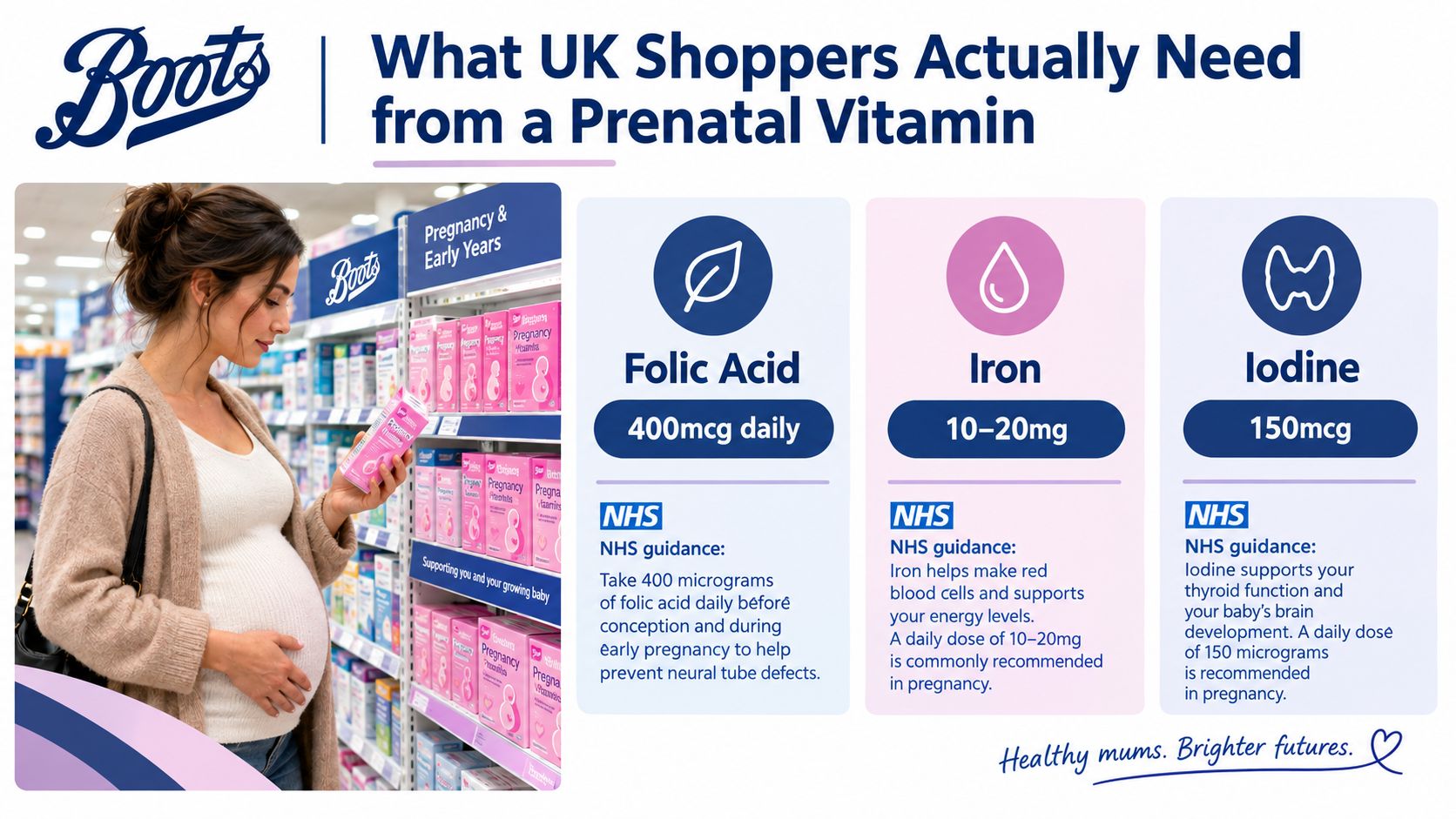
The starting point is a short list, not a marketing brochure. UK guidance advises people who are pregnant or trying to conceive to take 400 micrograms of folic acid daily, ideally beginning three months before conception and continuing through at least the first 12 weeks of pregnancy. Folic acid in early pregnancy helps reduce the risk of neural tube defects. The UK government's folic acid guidance also discusses potential benefits for outcomes including cleft lip and palate and some heart conditions.
Vitamin D belongs in the routine plan too. The NHS recommends 10 micrograms daily during pregnancy and breastfeeding, with extra attention needed for people who have limited sun exposure or darker skin. Iodine deserves a place on the label as well, particularly if your diet contains little dairy, fish, or eggs. It's often missing or under-represented in general multivitamins, so don't assume that a product labelled “pregnancy” automatically contains it.
Read the front after the back
Turn the box around and find the daily serving. Then check:
- Folic acid: Look for 400 micrograms for routine use during the preconception period and early pregnancy.
- Vitamin D: Look for 10 micrograms daily.
- Iodine: A product containing around 150 micrograms is a practical benchmark used in UK prenatal formulation.
- Vitamin A: Prefer pregnancy-specific formulas that use a suitable form of vitamin A and avoid unnecessary retinol exposure.
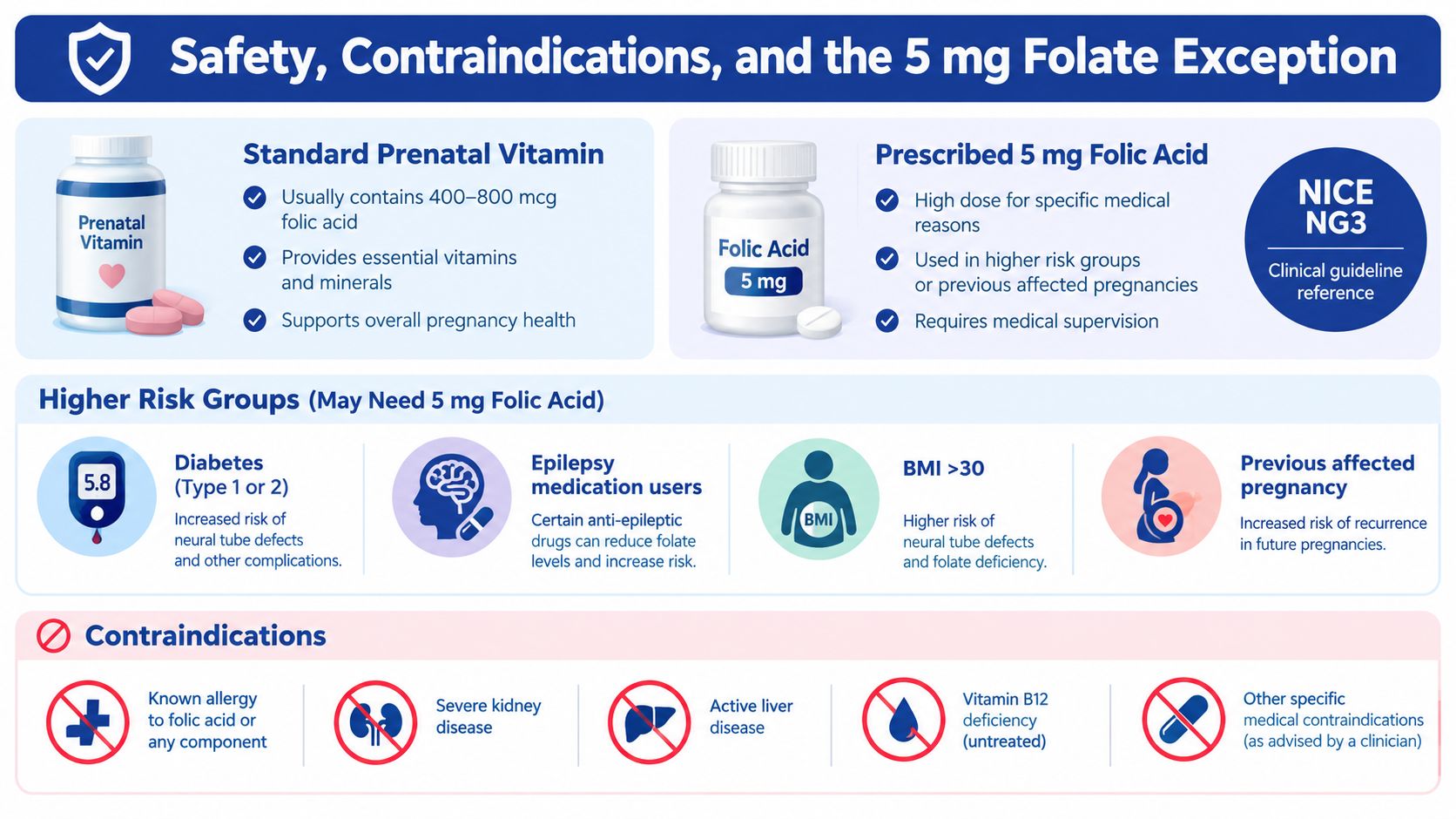
A standard prenatal is not a substitute for clinical advice. NICE recommends a prescribed 5 mg daily folic acid dose for higher-risk pregnancies, including a previous pregnancy affected by a neural tube defect, a personal or family history of neural tube defects, type 1 or type 2 diabetes, or certain blood conditions requiring folate support. That's a different clinical decision from choosing a stronger supermarket multivitamin.
Practical rule: If you may need 5 mg folic acid, don't try to create that dose by stacking retail products. Speak to your GP or maternity team.
Your diet changes the shortlist. A vegan shopper may need to prioritise B12, iodine, and algae-based DHA. Someone eating little dairy or fish should inspect iodine and calcium-related support more closely. A person who already takes separate folic acid or vitamin D may not need a costly all-in-one formula.
For a practical overview of pregnancy tablet choices, compare this pregnancy care tablets guide, but keep the clinical thresholds above as your filter. Price and format come later. First, make sure the product covers the nutrients that matter to you.
| Priority | Routine UK benchmark | Label decision |
|---|---|---|
| Folic acid | 400 micrograms daily | Confirm the amount per daily serving |
| Vitamin D | 10 micrograms daily | Check the product is intended for pregnancy |
| Iodine | Around 150 micrograms is a useful formulation benchmark | Don't assume it's included |
| Higher-risk folate | 5 mg when clinically indicated | Ask a GP or maternity professional about prescription treatment |
The Core Nutrients and the Daily Doses That Matter
A prenatal label should answer a practical question: what gap is this product closing? It doesn't need the longest ingredient panel. It needs the right nutrients in sensible amounts, presented clearly enough for you to compare the daily serving with UK guidance.
| Nutrient | NHS or UK guidance | What to look for on the label |
|---|---|---|
| Folic acid | 400 micrograms daily before conception and through at least the first 12 weeks | 400 micrograms for routine use, or clinical advice about prescribed 5 mg |
| Vitamin D | 10 micrograms daily during pregnancy and breastfeeding | At least 10 micrograms in the daily serving |
| Iodine | UK pregnancy products commonly use around 140 to 150 micrograms | A clearly stated iodine amount, ideally around 150 micrograms |
| Iron | Needs vary with diet, blood results, and tolerance | Check the amount and the iron form, rather than assuming more is better |
| Vitamin B12 | Especially relevant to vegan and some vegetarian diets | A clearly stated B12 dose |
| Choline and DHA | Useful completeness checks, particularly where the diet is restricted or low in oily fish | Check whether they're included and whether the source suits your diet |
Folic acid and vitamin D come first
Folic acid is the essential starting point because it helps reduce neural tube defect risk during early development. A product containing methylfolate may appeal to shoppers who prefer that form, but don't let a “bioactive” claim distract you from checking the actual folate amount and whether the product is suitable for pregnancy.
Vitamin D supports the body's calcium and phosphate regulation, which matters for bones, teeth, and muscles. The NHS pregnancy vitamin guidance gives the routine 10 microgram daily benchmark. If you're comparing products, make sure the number refers to the full daily serving, not one capsule in a multi-capsule pack.
Iodine, iron, and diet-specific gaps
Iodine is the ingredient I'd check next because many shoppers overlook it. UK nutrition guidance commonly discusses around 140 to 150 micrograms in pregnancy products, while NHS guidance doesn't treat iodine supplementation in exactly the same universal way as folic acid and vitamin D. If you eat little or no dairy, fish, or eggs, ask a midwife or GP whether your diet needs additional attention. British Dietetic Association guidance on supplements is a useful UK reference point.
Iron deserves a more individual approach. A label with iron may be helpful, but iron can worsen nausea, constipation, or stomach discomfort. Don't select a product just because its iron number is high. Check your blood results and discuss a suitable form with a clinician if standard iron causes problems. Our guide to magnesium supplements in pregnancy may help with broader mineral-label questions, but it isn't a substitute for pregnancy-specific advice.
A separate energy product isn't a prenatal replacement. For example, BioBees Fresh Royal Jelly - Natural Energy & Immune Support is described as a fresh royal jelly supplement containing proteins, amino acids, essential fatty acids, and B vitamins. It also carries a warning for people allergic to bee products, so it should be considered separately from the folic acid, vitamin D, and iodine checks that define a prenatal.
Comparing Capsule, Tablet, Liquid, and Vegan Formats
The right format is the one you can take consistently without worsening nausea. A theoretically excellent formula is useless if its tablet is too large, its taste makes you gag, or its iron upsets your stomach every morning.
| Format | Ease of swallowing | Nausea friendly | Vegan friendly | Typical UK price |
|---|---|---|---|---|
| Capsule | Usually smooth, but may be large | Often easier than a dry tablet | Depends on shell and ingredients | Varies by formula |
| Tablet | Can be compact and convenient | Coating and iron may affect tolerance | Usually depends on formulation | Varies by formula |
| Liquid | No large pill to swallow | Useful for some people, though taste matters | Often available, but check the label | Varies by formula |
| Chewable or gummy | Easy to take for some shoppers | Sweetness can help or irritate | Depends on ingredients | Varies by formula |
| Vegan capsule or tablet | Similar to standard formats | Depends on size and mineral content | Yes, if clearly certified or stated | Varies by formula |
Capsules often suit shoppers who dislike chalky tablets. They can also accommodate oil-based ingredients such as DHA, although the label still needs to confirm the source and amount. Tablets are practical for high-street shopping and can be easier to store, but binders, coatings, or concentrated minerals may not suit a sensitive stomach.
Liquids and chewables make sense when pill aversion or early-pregnancy nausea is the main barrier. Taste is personal, and some liquid formulas require careful storage, so read the directions rather than leaving the bottle beside a warm window.
Vegan does not mean complete
A vegan logo answers one question, not every question. Check whether the product contains iodine, B12, and DHA from algae oil rather than fish oil. Also check the capsule shell, because a product can contain plant-based ingredients while still using a non-vegan capsule.
The format can also affect iodine coverage. Some gummies and small chewables leave out minerals to improve taste and texture. That doesn't make them useless, but it means you may need a separate, clinically appropriate plan for nutrients they don't provide.
Matching Prenatal Formats to Real UK Lifestyles
A label should fit your day. If you wake with nausea, work early shifts, follow a vegan diet, or already take separate supplements, your best choice may look very different from the product with the most polished packaging.
| Lifestyle profile | Best fit format | Key priorities | Watch for |
|---|---|---|---|
| Plant-based diet | Vegan capsule, tablet, or algae-DHA formula | B12, iodine, folate, and suitable DHA source | Vegan branding without iodine or B12 |
| Early-morning nausea | Liquid, chewable, or smaller capsule | Tolerability and a manageable daily serving | Sweeteners, strong flavours, and missing minerals |
| Iron-sensitive shopper | Lower-burden formula or clinician-guided separate iron | Blood results and a tolerable iron form | Adding extra iron without advice |
| Large-pill aversion | Liquid, sachet, chewable, or split serving | Actual nutrient coverage per full daily dose | A small serving that leaves out iodine |
| Budget-led routine | Separate folic acid and vitamin D, where appropriate | Meeting the UK baseline without duplication | Buying multiple products with overlapping ingredients |
| Busy household | One clearly labelled daily pack | Simplicity and reliable storage | Assuming “one a day” means complete |
A plant-based buyer should not stop at the word “vegan”. B12 is particularly important to investigate, while iodine and DHA may require a closer look at diet and product sourcing. If you already take a B12 product, BetterYou Boost B12 Oral Spray 25ml is described as a vegan and vegetarian oral spray with B12, chromium, and green tea extract. It should be assessed alongside, not automatically added to, a prenatal formula.
Iron-sensitive shoppers often do better when they stop chasing maximum potency and start checking tolerance. A clinician may recommend a separate iron product or a different form after reviewing blood results. That approach can be more sensible than choosing a broad prenatal that makes you feel unwell and gets abandoned.
A budget-led couple may reasonably choose separate folic acid and vitamin D, provided the doses match UK guidance and a pharmacist, GP, or midwife has no concerns about the plan. The saving is only real if you avoid duplicate products and remember which nutrients your diet still needs.
Safety, Contraindications, and the 5 mg Folate Exception
The biggest prenatal isn't automatically the safest prenatal. Pregnancy is the wrong time to stack several “high strength” products because each label may contain overlapping vitamins and minerals.
Routine products and prescription folic acid serve different purposes. People planning pregnancy or in the first 12 weeks need 400 micrograms of folic acid daily. NICE recommends 5 mg daily for certain higher-risk pregnancies, including a previous neural tube defect-affected pregnancy, relevant personal or family history, type 1 or type 2 diabetes, or certain blood conditions requiring folate support. The dose should come from a clinician, not from combining retail supplements.
Remove the risky assumptions
Be cautious with general adult multivitamins. Pregnancy products should make their intended use clear, and you should avoid unnecessary retinol-containing vitamin A products unless a clinician has told you otherwise. Don't add high-dose iodine, herbal blends, or another mineral product just because the front of the pack says “maximum strength”.
Methylfolate marketing also needs perspective. A different folate form doesn't remove the need to check the pregnancy dose, timing, or clinical risk profile. If you have a condition, take prescribed medication, or have been told you're at higher risk, ask your GP or maternity team before changing products.
The NICE recommendations on maternal and fetal health are the right reference for risk-based decisions. If iron causes digestive problems, read about iron bisglycinate compared with ferrous sulfate, then discuss options with a professional rather than switching blindly.
Contact a midwife or GP if you have unexplained bleeding, severe nausea, or a known allergy to an ingredient such as iron or soy. Those situations call for assessment, not another trip to the supplement aisle.
Pack Sizes, Value, and a Smart Buying Checklist
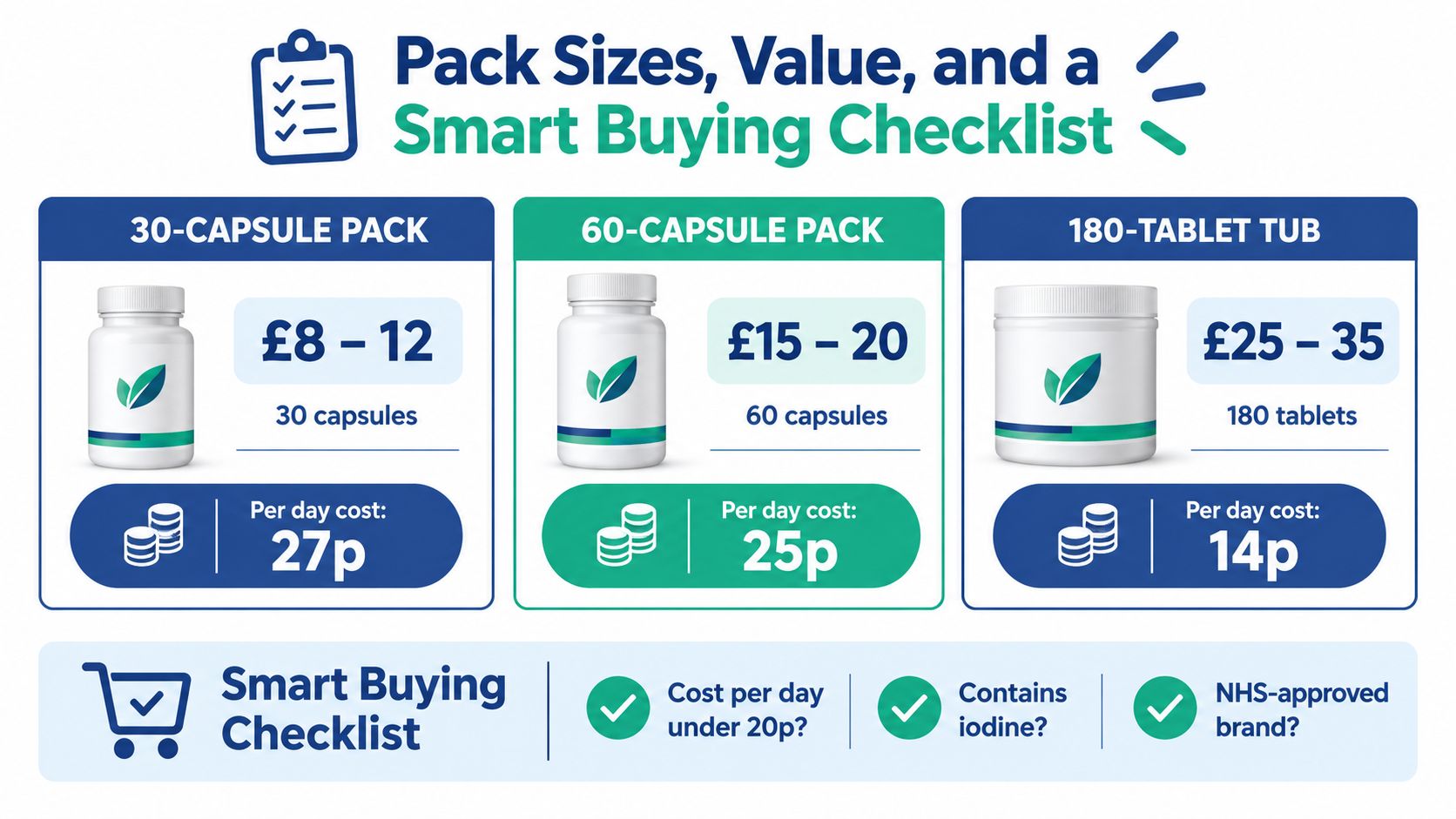
Headline price tells you very little. A product can look cheap because it contains fewer daily servings, or look expensive because it combines nutrients you don't need. Work out the cost per daily serving, then check whether the product covers your priorities.
The exact pack-size examples shown in the comparison visual below are useful for understanding how retailers present value, but don't treat a large tub as a reason to ignore the label. A longer supply is only better if you tolerate the formula and can use it before its expiry date.
Buy in this order
- Confirm folic acid first. Look for 400 micrograms for routine use, or speak to your GP if you may need prescribed 5 mg folic acid.
- Check vitamin D. The routine UK benchmark is 10 micrograms daily.
- Find iodine. Prefer a product that states its iodine amount clearly, especially if your diet is low in dairy, fish, or eggs.
- Assess iron sensibly. Consider tolerance, blood results, and the form of iron. More isn't automatically better.
- Match your diet. Vegans should check B12 and investigate the source of DHA and iodine.
- Inspect vitamin A. Avoid general products that contain unsuitable retinol levels for pregnancy.
- Check the serving size. Confirm whether the label's nutrient amounts apply to one tablet, several capsules, or a full daily pack.
- Compare storage and returns. This matters for liquids, chewables, and products you may need to change if nausea develops.
Third-party testing can be a useful extra quality signal where it's documented, but it doesn't replace checking the pregnancy formulation. A certification mark won't compensate for missing iodine or an unsuitable folate dose.
For readers comparing prenatal approaches across markets, this complete prenatal vitamins guide Australia offers a useful international comparison. UK shoppers should still use NHS and NICE thresholds as the final reference point.
Eligible low-income shoppers may also be able to access vitamins through the NHS Healthy Start scheme. Check the current eligibility rules through official NHS or government channels rather than assuming every applicant qualifies.
Prenatal Vitamin Questions UK Buyers Ask Most
| Question | Best practice answer |
|---|---|
| When should I start a prenatal vitamin? | Ideally start folic acid three months before conception. Continue through at least the first 12 weeks, and follow advice about vitamin D during pregnancy and breastfeeding. |
| Do I need a premium prenatal? | No. A clear, well-labelled product that matches your needs is more useful than a prestigious brand with unnecessary extras. |
| Can I switch from tablets to liquid? | Yes, if the new product is suitable for pregnancy and still covers the nutrients you need. Recheck the full daily serving after switching. |
| Are gummies enough? | They can be easier to take, but many don't provide a complete mineral profile. Check folic acid, vitamin D, iodine, and iron rather than relying on the format. |
| How long does a pack last? | Divide the number of tablets or capsules by the stated daily serving. A “one month” pack may not last a month if the daily serving contains several capsules. |
| Can I take separate supplements? | Sometimes, but check for duplication, particularly with folic acid, vitamin D, iodine, iron, and vitamin A. Ask a pharmacist, GP, or midwife if you're combining products. |
| How should I store supplements in summer? | Follow the pack instructions, keep products dry and away from direct heat, and refrigerate liquids only when the label requires it. |
| When should I ask for 5 mg folic acid? | Ask your GP or maternity team if you have a previous affected pregnancy, relevant family or personal history, type 1 or type 2 diabetes, or a blood condition requiring folate support. |
The NHS Healthy Start scheme can provide vitamins for eligible pregnant people, including those who meet its age or low-income criteria. Because eligibility and delivery arrangements can change, check the current official information before buying a full supply.
If nausea makes your usual product impossible, changing to a liquid or chewable is reasonable, but don't assume a more pleasant format is nutritionally equivalent. Compare the new label with the old one, especially for iodine and iron.
Your shortlist should now be clear: 400 micrograms of folic acid for routine use, 10 micrograms of vitamin D, a thoughtful iodine decision, and a formula that suits your diet and tolerance. For higher-risk folate needs, speak to a clinician rather than self-prescribing.
Vitamin Planet offers pregnancy-support supplements alongside vitamins, minerals, vegan formulas, tablets, capsules, and other daily formats, so you can compare products by nutrient profile and delivery method. Review the label carefully, then visit Vitamin Planet to browse options that fit your routine and discuss any clinical concerns with your GP, pharmacist, or midwife.