

Vitamin D K2: Benefits, Dosage and Who Needs It
How much vitamin K2 should you take with your vitamin D?
Search that question and you'll meet confident answers. A ratio of 10 to 1. A fixed microgram dose. A warning that you should never take one without the other. Then look at what UK health authorities publish, and something odd appears. There is a specific, well-justified daily intake for vitamin D. For vitamin K2 there is nothing at all.
That silence isn't a gap in the paperwork. It tells you something useful about how strong the evidence is on each side of the pairing, and it's the difference between a health claim you can rely on and a mechanism that sounds convincing but hasn't yet been shown to change outcomes.
The two nutrients do work as a team, and the biology is elegant. But "these two belong together in your body" is not the same statement as "you need them together in a tablet, in a set ratio". Untangling those two ideas is what follows: what each nutrient does, where the evidence is strong, where it thins out, what UK guidance sets, and how to check a label without being misled.
Table of Contents
- Vitamin D and K2 at a Glance
- How Vitamin D and K2 Work Together
- Health Benefits and How Strong the Evidence Is
- Food Sources That Supply Vitamin D and K2
- Vitamin D and K2 Dosage Guidance for the UK
- Who Should Supplement and Safety Checks
Vitamin D and K2 at a Glance
Vitamin D helps your gut pull calcium and phosphate out of food and into your bloodstream. Vitamin K2 activates the proteins that decide where that calcium ends up, steering it into bone and away from the walls of your arteries. One raises the supply; the other directs the traffic.
The forms matter the moment you turn a bottle over. Vitamin D3 (cholecalciferol) is the version your skin makes from sunlight and the one most supplements use. Vitamin D2 (ergocalciferol) comes from plant and fungal sources, including UV-treated mushrooms. Both raise blood levels, though D3 does it more efficiently. On the K2 side you'll see MK-4, found in animal foods such as egg yolk and butter and cleared from the blood within hours, and MK-7, made by bacterial fermentation, most famously in natto, which stays in circulation far longer. That longer stay is why most once-daily K2 products use MK-7.
Neither is the same nutrient as the vitamin K in your bag of spinach. Vitamin K1 (phylloquinone) comes from leafy greens and does most of its work in the liver, supporting the proteins that let blood clot. K2 operates further out in the body, at bone and blood vessel walls.
The figures the UK does set: 10 micrograms (400 IU) of vitamin D a day for everyone aged four and over, including pregnant and breastfeeding women. There is no equivalent reference intake for vitamin K2, so there is no official D:K2 ratio to follow.
The UK's Scientific Advisory Committee on Nutrition vitamin D report defines adequacy through a blood test for 25-hydroxyvitamin D, and treats concentrations below 25 nmol/L as the point where the risk of poor musculoskeletal health climbs, including rickets in children, osteomalacia and muscle weakness in adults, and falls. The committee also asks that these recommendations aren't stretched into claims that vitamin D prevents unrelated conditions in people who already have enough.
That's the frame for everything else here. One nutrient has a national target and a measurable threshold. The other has a plausible mechanism, a lot of marketing, and no official number. The rest of this guide keeps those two facts in separate boxes.
How Vitamin D and K2 Work Together
Think of calcium handling as a delivery operation. Vitamin D is the van: it loads calcium from your gut and drives it into the bloodstream. Vitamin K2 is the site foreman: it stands at the destination and tells each cell where to unload, into the bone framework or away from the artery wall. A van with no foreman still delivers. The load just ends up in the wrong places.
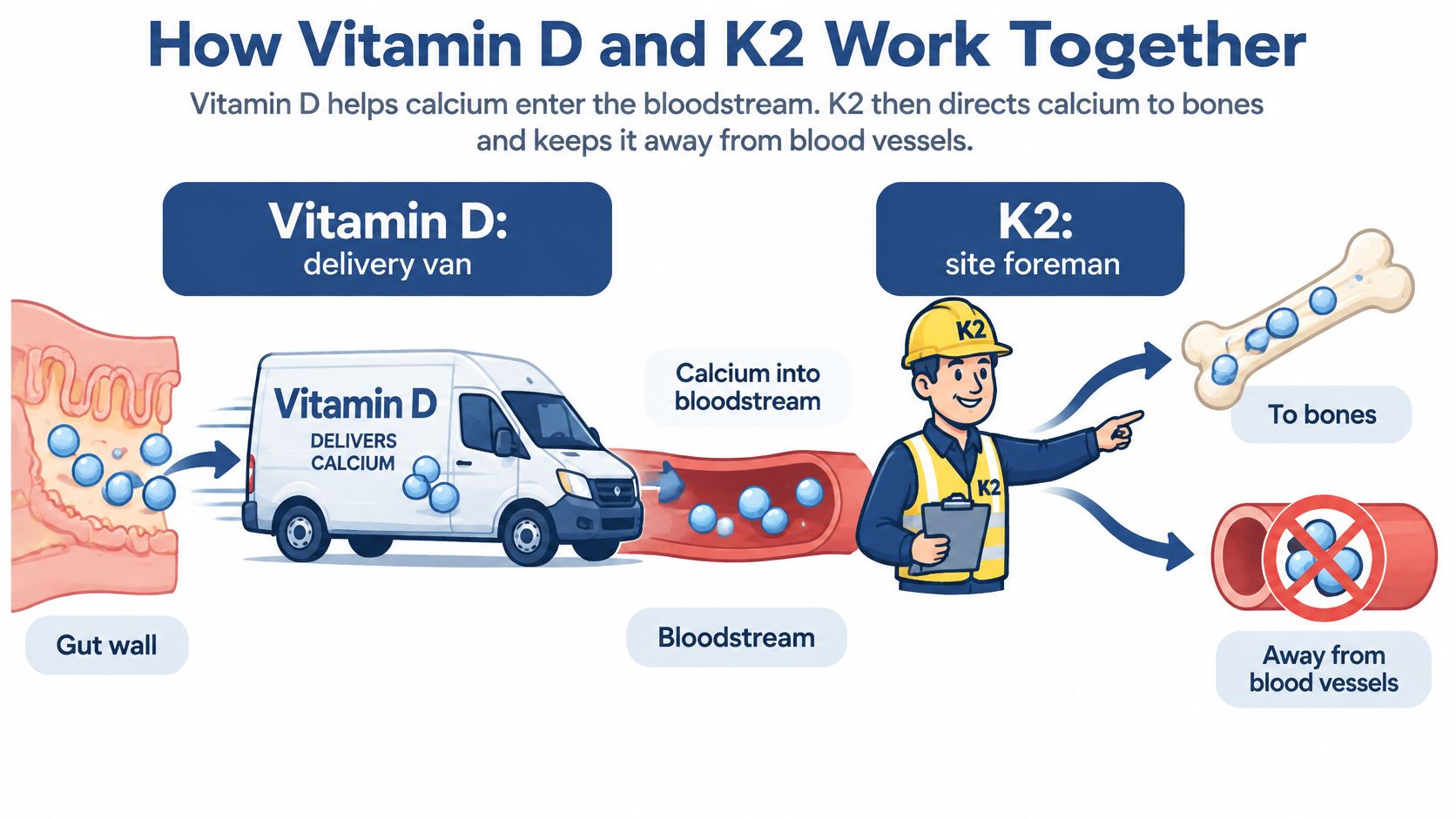
The chain runs in five stages, and each one is worth knowing because it tells you where a supplement can and can't act.
- Conversion. Your liver and kidneys turn vitamin D into its active form, calcitriol. This is why liver or kidney problems can leave someone with normal-looking intake and low active vitamin D.
- Absorption. Calcitriol signals the intestine to take up more calcium from your meals. Eat a calcium-rich diet with low vitamin D and you absorb only a fraction of it.
- Circulation. Calcium enters the bloodstream. At this point nothing has decided where it will settle.
- Activation. Vitamin K2 acts as a cofactor in a chemical step called carboxylation, which switches on proteins such as osteocalcin, made by bone-building cells, and matrix Gla protein, made in blood vessel walls.
- Placement. The activated proteins bind calcium. Osteocalcin pulls it into bone. Matrix Gla protein helps keep it out of artery walls.
Without enough K2, those proteins are built but not switched on, like a key that has been cut but never turned in the lock. Your body keeps producing them regardless. They sit there only partly functional.
The mechanism is real and well described in laboratory and animal work. What it doesn't do on its own is prove that swallowing a capsule of each changes fracture rates or heart outcomes in people.
That distinction matters when a product page finishes the story for you. If you want to go deeper on the calcium side specifically, this guide to supporting bone strength with calcium covers how intake, absorption and bone tissue fit together.
Here's the map of which supplement affects which stage. Vitamin D works at stages 1 to 3: it raises how much calcium reaches the blood. K2 works at stages 4 and 5: it shapes what happens to that calcium afterwards. Neither replaces the other, and neither compensates for a low vitamin D level.
Health Benefits and How Strong the Evidence Is
Start with the case that isn't in doubt. Vitamin D deficiency causes rickets in children and osteomalacia in adults, and it weakens muscle. Correcting a deficiency treats and prevents those conditions. That isn't a marketing claim, it's the reason the UK sets a population intake in the first place.
Everything beyond that needs grading, and the honest grades vary a lot. Bone density gains with K2 show up in some trials, largely Japanese work using high-dose MK-4, but a reduction in fractures across the general population hasn't been confirmed. Arterial health has the clearest mechanism and the shakiest trial record: observational links exist, randomised results on calcification are mixed. Vitamin D does influence immune signalling, yet supplementing people who are already replete hasn't clearly stopped infections. Mood findings swing about between studies.
| Claimed benefit | What the evidence supports | Confidence |
|---|---|---|
| Bone health in people with vitamin D deficiency | Corrects rickets and osteomalacia; may reduce falls and fracture risk in older adults with deficiency | Strong |
| Bone density with vitamin D plus K2 | Small density gains in some trials, mainly with MK-4 at high doses; fracture reduction not confirmed in the general population | Moderate, not proven |
| Arterial health from K2 | Activates matrix Gla protein, which helps keep calcium out of artery walls; trial results on calcification are mixed | Weak to moderate, unproven |
| Immune function from vitamin D | Vitamin D influences immune signalling; supplementation has not clearly prevented infections in people with sufficient levels | Mixed |
A three-question test for any vitamin D K2 claim
Before you accept a headline, run it through three questions. They take ten seconds and they filter most of the noise.
- What was measured? A blood marker or a real-world event is the dividing line. A rise in a lab value, such as lower undercarboxylated osteocalcin, is a mechanistic result. A fall in fractures or heart attacks is an outcome. Headlines often dress the first up as the second.
- Who was studied? People who were deficient behave differently from people who were already sufficient. Trials in older adults with diagnosed deficiency tell you little about a healthy 35-year-old.
- For how long, and at what dose? K2 trials frequently use pharmaceutical-level doses of MK-4 that no shop-bought capsule matches. A result from that setting doesn't transfer to a 90-microgram daily tablet.
The final safeguard comes from the UK committee itself, which is explicit that vitamin D recommendations exist to prevent deficiency-related bone and muscle disease, and shouldn't be presented as protection against unrelated conditions in people who already have adequate levels.
That's not a reason to skip vitamin D if you need it. It's a reason to be sceptical of any product that lists a dozen diseases on the front of the bottle.
Food Sources That Supply Vitamin D and K2
A plate that covers both looks unremarkable and does a fair amount of work.
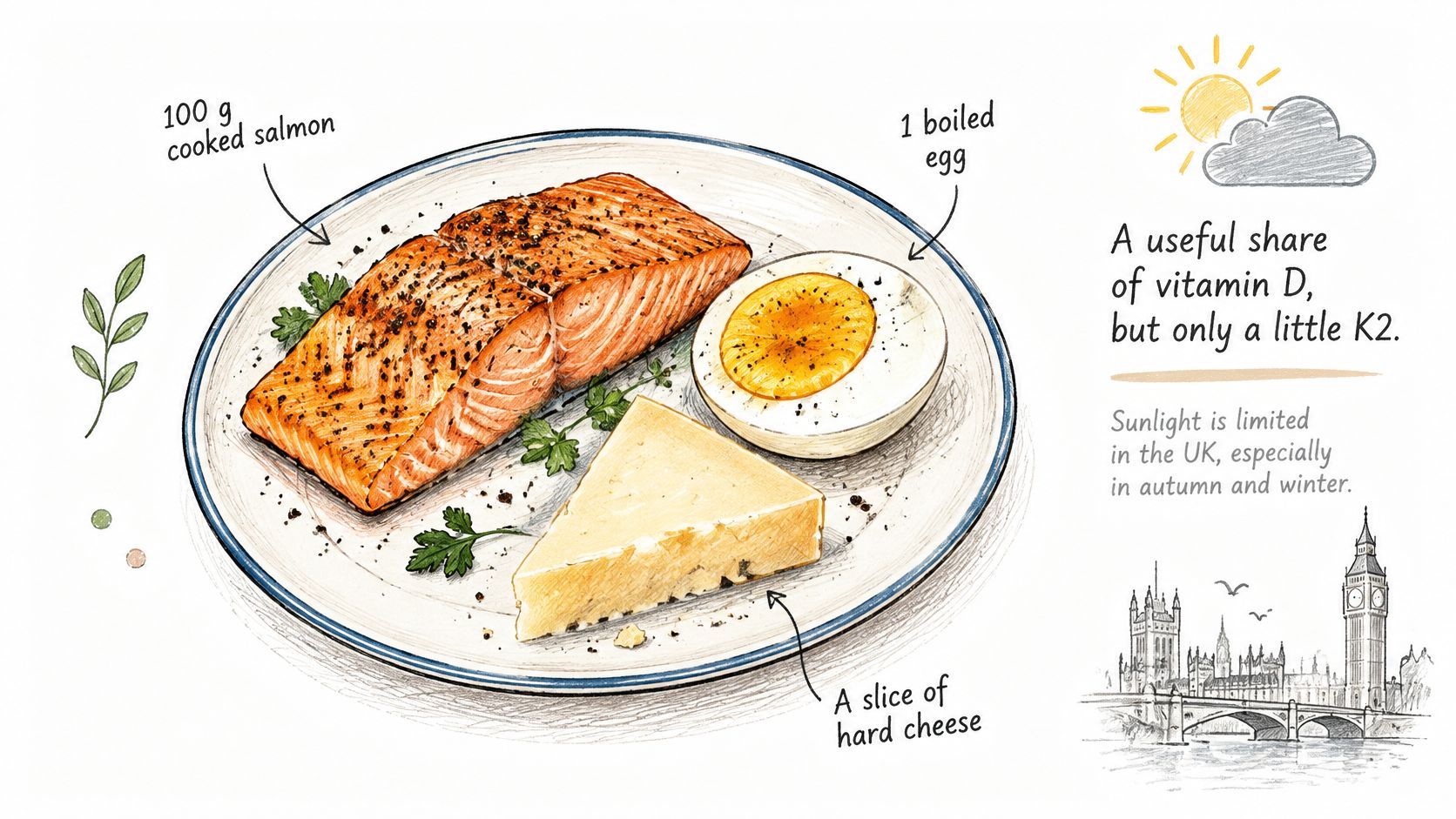
Take 100 g of cooked salmon, one boiled egg and a slice of hard cheese. The salmon carries a meaningful share of a day's vitamin D and the egg adds a little more, along with a small amount of MK-4. The cheese contributes a modest amount of K2, mostly from the bacteria involved in ripening. Add it up and you've made real progress on vitamin D. On K2, you've made a dent at best.
Sunlight is the other half of the vitamin D story, and in the UK it's a seasonal supplier. From around October to March, the angle of the sun means your skin makes little usable vitamin D no matter how long you stay out. Food and supplements carry those months.
| Food | Vitamin D (approx.) | Vitamin K2 (approx.) |
|---|---|---|
| Salmon, cooked (100 g) | about 10 to 15 mcg | low |
| Sardines, canned in oil (100 g) | about 4 to 5 mcg | low |
| Egg yolk (1 large) | about 1 mcg | small amounts of MK-4 |
| Natto (50 g) | low | high, mostly MK-7 |
| Mushrooms exposed to UV light (100 g) | varies widely, check source | none meaningful |
Treat those as ballpark figures. Brand, season, feed and cooking method all move the numbers, and oily fish caught at different times of year won't match to the microgram.
How much time people spend outside is a big part of the problem. In 2024, 37% of more than 100,000 UK Boots customers said they spent minimal time outdoors, a result the retailer published in its advice on vitamin D ahead of winter. If more than a third of a large sample barely gets outside, the sunlight route can't be the plan for everyone.
Here's a short walk-through of why the food route alone rarely closes the gap.
Two practical rules follow. First, check both units on the label. Fortified foods and supplements often list IU only, and 400 IU means 10 micrograms, so you need the conversion in your head rather than a guess. Second, don't assume "fermented" means K2-rich. A spoonful of sauerkraut isn't natto, and a small portion of natto changes the K2 picture entirely.
Vitamin D and K2 Dosage Guidance for the UK
The core number is deliberately unglamorous, and it's the same for a 25-year-old office worker and a 70-year-old who gardens every day.
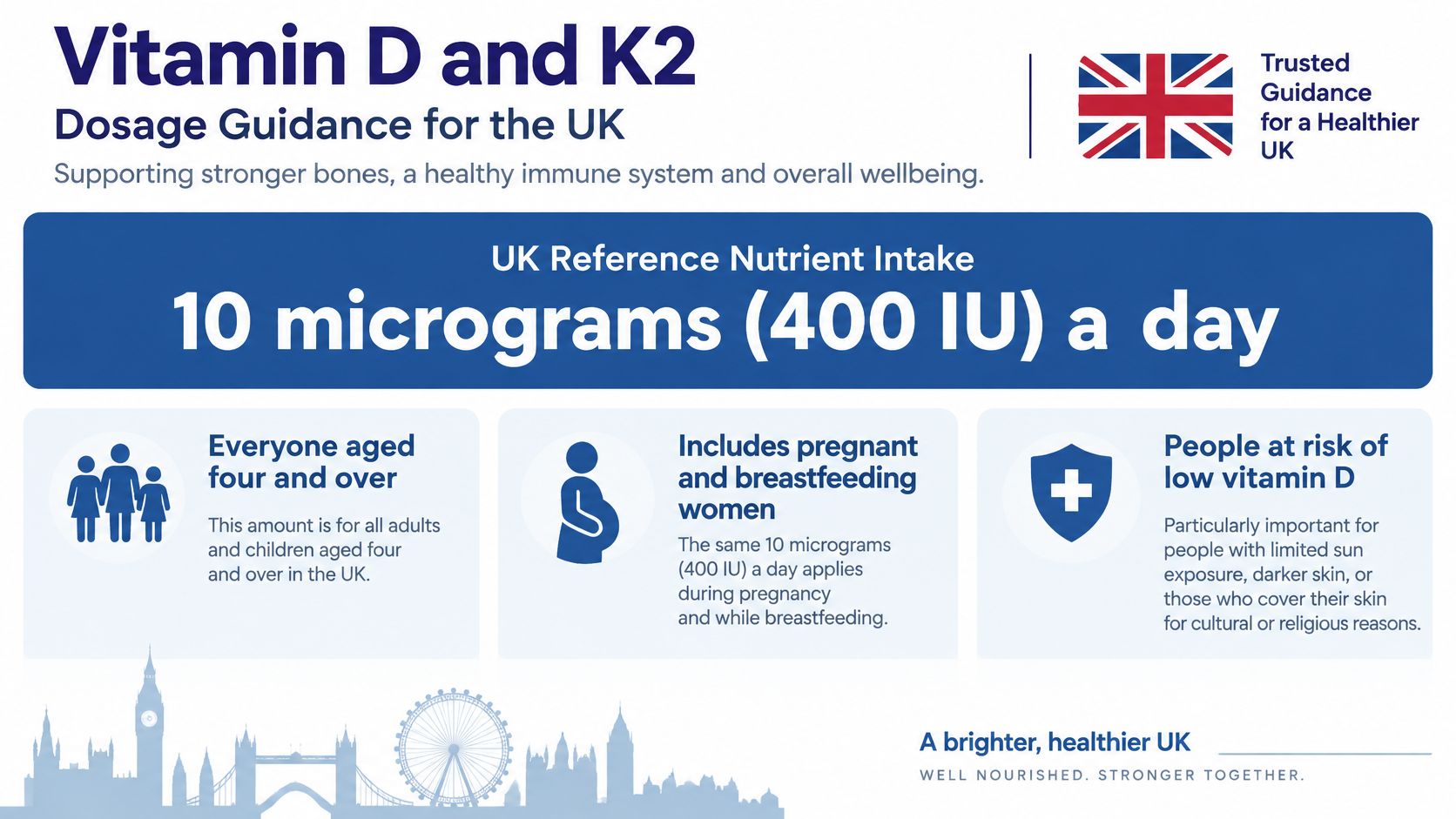
The figure comes from the committee's 2016 review, which concluded that blood levels below the deficiency threshold are linked to poorer musculoskeletal health, and that UK sunlight can't be relied on through autumn and winter. The SACN report on fortifying food and drink with vitamin D sets out that reasoning and the resulting reference nutrient intake. It also confirms that vitamin D fortification of food in the UK is currently voluntary, which is why supplements do so much of the work in practice.
| Group | Daily vitamin D (mcg) | Notes |
|---|---|---|
| Infants, 0 to 1 year | 8.5 to 10 | check whether infant formula already supplies vitamin D |
| Children, 1 to 4 years | 10 | same daily figure as adults |
| Adults and children aged 4 and over | 10 | winter and low-sun groups need it year-round |
| Pregnant and breastfeeding women | 10 | same reference intake as other adults |
| Adult tolerable upper limit | 100 | sustained intake above this risks hypercalcaemia |
| Vitamin K2 supplements | No UK reference intake | follow the product label and your clinician's advice |
Converting micrograms to IU without a calculator
The label arithmetic trips people up more than the dose does. 10 micrograms equals 400 IU, and the long-term adult ceiling of 100 micrograms equals 4,000 IU, ten times the reference intake. If a bottle says 1,000 IU, that's 25 micrograms. If it says 4,000 IU, that's 100 micrograms, which is the ceiling, not the target.
Say a 70-year-old who rarely goes outside takes 10 micrograms of vitamin D daily and eats oily fish twice a week. Their intake sits near target without any high-dose product, and their GP can check a blood level if symptoms suggest something's off. Someone with diagnosed deficiency, or a condition affecting absorption, may be advised to take considerably more for a period. That's a clinical decision with a review date attached, not a permanent upgrade.
K2 sits outside this framework entirely. UK authorities specify an intake for vitamin D and no ratio with K2, so anything you take on the K2 side is set by the label and by whoever is advising you. If you want to see how a single-nutrient product presents its dose, this vitamin D3 2,000 IU option shows the unit labelling to look for.
Don't double up to speed things up. Vitamin D is stored rather than flushed out, so repeating a dose builds towards the ceiling instead of getting you there faster. Correction of a real deficiency is a scheduled course, not a sprint.
Who Should Supplement and Safety Checks
Most healthy adults who eat a varied diet and get regular outdoor time in summer don't need a supplement by default. UK guidance still recommends vitamin D for everyone through autumn and winter, and year-round for anyone with little sun exposure. The honest answer to "do I need this?" depends on which of those groups you're in.
Who the UK advice is really aimed at
Deficiency isn't spread evenly. The National Diet and Nutrition Survey 2019 to 2023 found low vitamin D status in 16% of adults aged 19 to 64, 13% of adults aged 65 and over and 19% of children aged 11 to 18, against 2% of children aged 4 to 10. Food alone supplied roughly a quarter to a third of the reference intake in adults, and supplement use was reported by 17% of adults aged 19 to 64.
The same survey analysis found a steep deprivation gradient: 34% of adults aged 19 to 64 in the most deprived quintile had a blood level below the deficiency threshold, compared with 9% to 17% in the other groups. Access and cost shape this as much as knowledge does.
The checklist below is the practical version. If any line sounds like you, the standard daily amount is worth taking, and a blood test is worth asking about.
- Little time outdoors, or a job that keeps you inside through daylight hours.
- Skin that's covered for cultural or occupational reasons, or darker skin, which needs more sun to make the same vitamin D.
- Care home residence or housebound status, where both sun exposure and dietary variety tend to drop.
- Pregnancy or breastfeeding, where the reference intake applies as it does to other adults.
- Age over 65, given the survey figures above and the muscle and bone consequences of low status.
- A blood test showing low 25-hydroxyvitamin D, which settles the question faster than any symptom list.
Check your medicines before you start
UK government guidance is clear that anyone taking prescribed medicines, or managing a medical condition, should speak to a healthcare professional before starting supplements. Some interactions are worth knowing by name.
- Warfarin and similar anticoagulants: vitamin K directly affects how well these work, so a new K2 supplement, or even a big shift in your greens intake, can change your clotting control. This doesn't mean you can never take vitamin K. It means your prescriber needs to know first.
- Thiazide diuretics and some heart and blood pressure medicines: these can push calcium higher, and adding vitamin D works in the same direction.
- Corticosteroids, anti-seizure medicines and orlistat: these can lower vitamin D levels, so someone on them may need their level checked rather than guessed at.
- Kidney disease, sarcoidosis and hyperparathyroidism: each changes how the body handles calcium and vitamin D, and each deserves a clinical conversation rather than a shop-bought fix.
Excess vitamin D causes hypercalcaemia, which affects the kidneys, heart and bones. The warning signs to take seriously are nausea, unusual thirst, frequent urination and confusion. High-dose K2 does not make high-dose vitamin D safer, and UK public health guidance does not recommend routine K2 co-supplementation for the general population.
If you have a bone condition, or you're weighing up K2 for a specific reason, raise it with your GP rather than adding it quietly. If you're comparing products for joint comfort more broadly, it's worth looking at how joint support supplement options differ in what they actually contain.
Worth knowing where combination products sit. Our Vitamin D3 & K2 (MK-7) tablets pair 4,000 IU of vitamin D3 with 200 micrograms of MK-7, supplied as 365 vegan tablets for £17.99. That's ten times the population reference intake, so it suits someone a clinician has advised to take a higher dose rather than a daily default for everyone.
If you're trying to work out whether your own levels are low in the first place, this guide to the signs of vitamin D deficiency walks through what tends to show up and what doesn't.
Your next steps are simple and don't need a new bottle to start. Read the label in both micrograms and IU, take your current medicines to a pharmacist for a five-minute review, and ask your GP about a blood test if risk factors or symptoms apply. Do that first, and any supplement decision afterwards is a much better informed one.
Vitamin Planet stocks vitamin D3 and K2 in the forms this guide has walked through, including our own Vitamin D3 & K2 (MK-7) combination and single-nutrient vitamin D options at several strengths, so you can match the dose to your own situation rather than the other way round. Every formula is checked by our Nutritional Research Department and quality control laboratories, and UK orders ship from London with Royal Mail tracking. Have a look at the range at Vitamin Planet when you're ready to compare labels.