

What Do Protein Powders Do? Uses, Types and Risks
If a tub of powder did something food couldn't, would you still need to train, eat enough overall, and sleep? That question exposes the gap between marketing and reality. Many people ask what do protein powders do, expecting a special effect. The honest answer is narrower and more useful. They add a measured dose of protein to your day, conveniently. Whether that helps depends entirely on whether you're short of protein in the first place.
Table of Contents
- What Protein Powder Does in Your Diet
- How Protein Supports Muscle Repair and Growth
- Protein Types Compared by Digestion and Source
- Who Gains Most from a Protein Shake
- When to Take Protein Powder Around Training and Meals
- Possible Downsides and Who Should Avoid It
- Confirm You Need Protein Powder Before You Buy
What Protein Powder Does in Your Diet
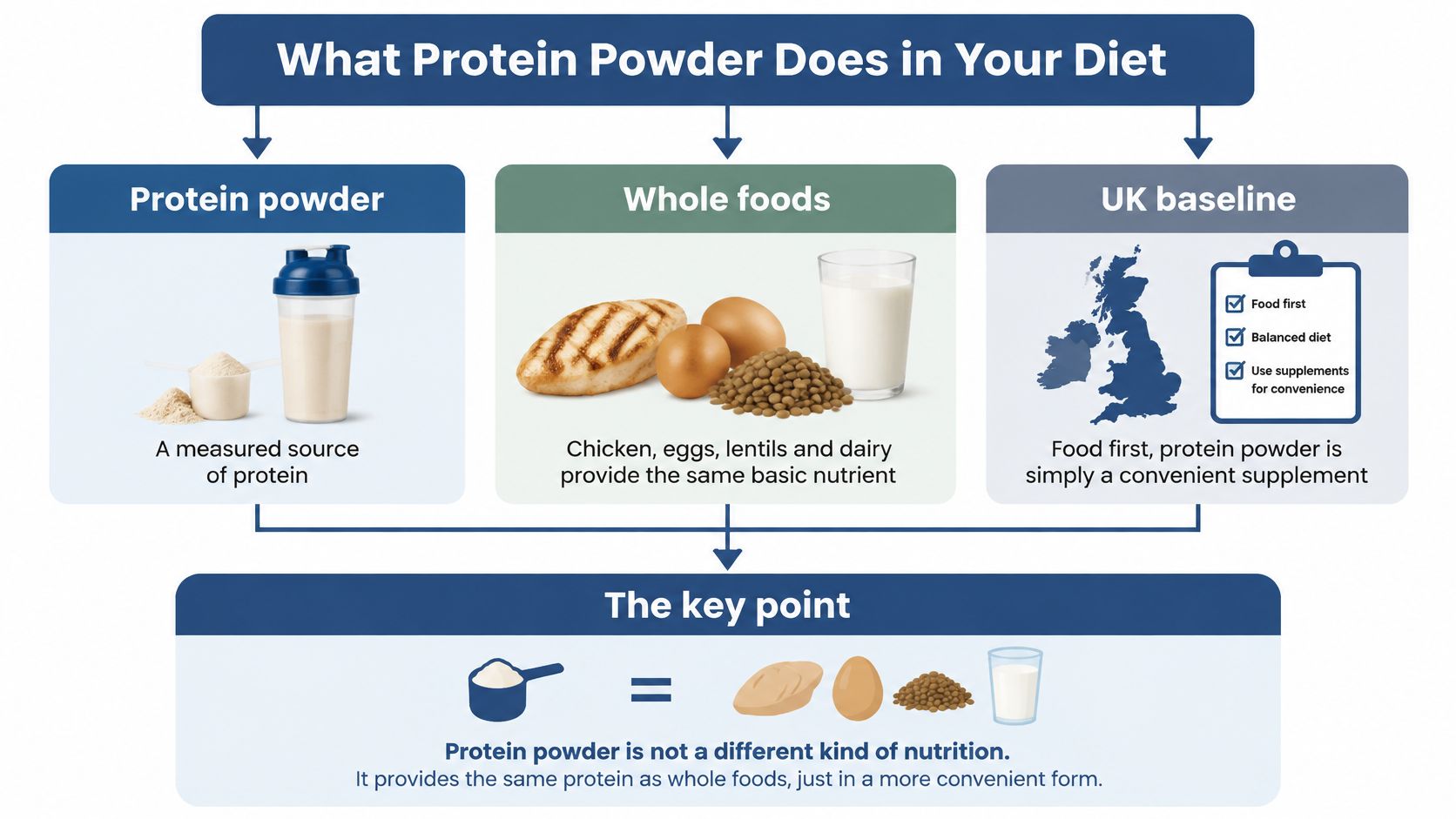
Protein powder is a measured source of protein, not a different kind of nutrition. Your body breaks it into amino acids, just as it does with chicken, eggs, lentils, fish, dairy, beans or nuts. The powder doesn't bypass digestion or deliver a unique signal because it comes from a scoop. It helps make hitting a daily total easier when meals fall short.
The British Nutrition Foundation protein guide reports an adult Reference Nutrient Intake of 0.75 grams of protein per kilogram of body weight per day, approximately 56 grams daily for a 75-kilogram man and 45 grams for a 60-kilogram woman. Average intakes already sit above that baseline. Adults aged 19 to 64 consume about 76.0 grams per day on average, while adults aged 65 and over consume approximately 67.0 grams. For ordinary activity, extra protein is unlikely to be required, though regular strength or endurance athletes may need roughly 1.2 to 2.0 grams per kilogram daily, counting food and supplements together.
Three Jobs, Not One Miracle
| Function | What It Does | Typical Serving | Suits |
|---|---|---|---|
| Muscle repair and growth | Supplies amino acids, especially leucine, for tissue damaged in training | 20-30 g | People doing structured strength training |
| Recovery | Tops up protein used across the day after sessions | 20-30 g with a meal | Athletes training most days |
| Meal replacement | Gives a measured portion when a meal is missed or appetite is low | 20-30 g in water or milk | Busy adults and people eating less |
Read the table as convenience in three settings. A shake after training helps if lunch was small. A serving stirred into porridge helps if you struggle to eat much in the morning. A portion mixed with semi-skimmed milk helps if you've skipped a meal entirely. In each case, food could do the same job. Powder just removes cooking, chewing and timing friction.
Practical rule: Powder supplements a varied diet. It doesn't replace the fibre, vitamins and minerals that whole foods bring with their protein.
That makes protein powder an optional tool for most healthy UK adults, rather than a necessity. Its value rises when appetite is low, your schedule is tight, dietary restrictions narrow your options, or training raises your target. Before you buy anything, ask yourself one question. How much protein do you already eat on a typical day?
How Protein Supports Muscle Repair and Growth
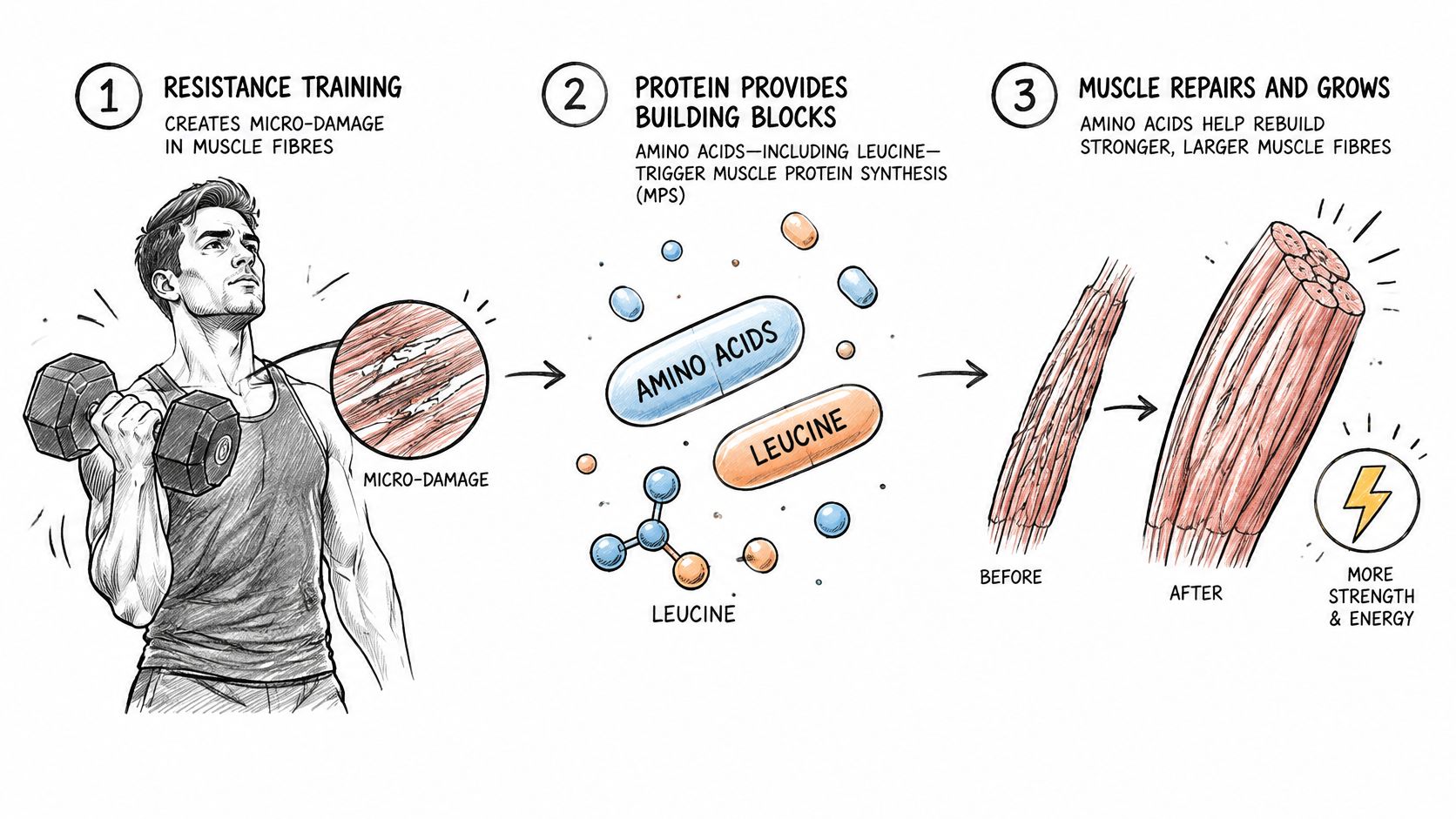
Muscle growth follows three steps, and they have to happen in that order.
First, resistance training creates the stimulus. Lifting, pressing or pulling against a load strains muscle fibres slightly and tells your body to rebuild them stronger. Without that signal, extra amino acids have nowhere useful to go.
Second, absorbed essential amino acids, particularly leucine, feed muscle-protein synthesis. That is the rebuilding process. Third, total energy, sleep and progressive overload decide whether rebuilding becomes measurable growth over weeks. Eat too little overall, train without progressing, or recover poorly, and a shake will not fix the bottleneck.
What the Evidence Shows, and Where It Levels Off
A systematic review hosted by Coventry University and summarised in The Conversation's analysis of protein and muscle analysed 46 randomised controlled trials involving 2,049 healthy participants. Protein supplementation was associated with a statistically significant increase in muscle mass, with a weighted mean difference of 0.47 kilograms and a 95% confidence interval of 0.18 to 0.75 kilograms. Benefits appeared for some strength measures too, across younger and older adults and both sexes.
There is a ceiling. Once daily protein intake is already adequate, extra protein during resistance training gives diminishing returns. Another shake then adds cost more reliably than muscle.
Older adults show why context matters. Protein on its own has not outperformed a carbohydrate supplement in healthy older people. Supplementation combined with heavy resistance training produced more meaningful benefits. Training drove the change. Protein supported it.
A building site makes the limit concrete. Training works like the blueprint and the instruction to build. Protein works like the bricks. A shake only matters if bricks are short on site. If deliveries are already sufficient, ordering more bricks does not produce a bigger building.
Prioritise progressive training and your total daily intake first. Use sensible tips to maximise muscle recovery around sleep and workload, then use powder to close a real gap. Powder works as a supporting tool alongside training.
Protein Types Compared by Digestion and Source
Two tubs can look almost identical on the shelf and still behave differently once you mix them. Source mainly changes digestion speed and amino acid profile. If your total intake is already adequate, it rarely changes the overall result. That distinction saves money. You are mostly choosing on tolerance, diet, taste and timing, not hunting for a dramatically superior powder.
| Type | Typical Protein per 100 g | Digestion Speed | Best Suited To |
|---|---|---|---|
| Whey concentrate | 70-80 g | Fast | Everyday use and budget buyers |
| Whey isolate | 85-95 g | Fast | Lactose-sensitive readers and low-carb diets |
| Casein | 75-85 g | Slow | Overnight or long gaps between meals |
| Soy protein isolate | 85-90 g | Medium | Vegans wanting a complete protein |
| Pea protein | 75-85 g | Medium | Vegans who avoid soy |
| Egg white protein | 80-85 g | Medium | Dairy-free and lactose-free diets |
Whey concentrate is the everyday default for many regular users. It digests quickly and usually offers good value. Whey isolate is filtered further, so it is higher in protein and lower in lactose, which suits some sensitive stomachs. Casein forms a slower-digesting gel, so people often take it before bed or during long gaps between meals. Whey works like a fast train through digestion. Casein is closer to a slow local service that stays with you for hours.
Plant options still contribute, though the route is different. Soy protein isolate is a complete protein, meaning it provides all essential amino acids. Pea protein suits vegans who avoid soy, and blends often combine pea with other plant sources to round out the amino acid profile. Egg white protein gives dairy-free readers a lactose-free alternative with a medium digestion speed.
How Bioavailability Fits In
Speed and amino acids are easy to mix up. Fast digestion means amino acids appear in the blood sooner. It does not mean the powder builds more muscle if the rest of the day already covers your needs. Whey is rapidly digested and typically rich in leucine, which can produce a strong short-term muscle-protein-synthesis response. Casein digests more slowly. Soy and other plant proteins can also contribute when enough total protein and essential amino acids are consumed.
If you want to compare how well different sources are absorbed and used, the Tecton Ketones™ guide to protein bioavailability sets sources side by side in a chart you can scan quickly. Use it as background, then return to your own total intake. A typical serving supplying roughly 20 to 40 g protein is commonly used in sports-nutrition research, yet extra powder is unlikely to add much benefit if dietary protein is already adequate.
When you compare two tubs, read five things in under a minute. Check protein per serving, the amino acid or leucine profile if listed, carbohydrate and sugar content, allergens, and any independent quality controls. Words on the front matter less than those numbers on the back.
Who Gains Most from a Protein Shake
Powder earns its place when there's a specific, measurable shortfall. Older adults are the clearest example. The Scientific Advisory Committee on Nutrition report on nutrition and older adults reports that 27% of adults aged 65 to 74 and 33% of those aged 75 and over had intakes below the reference of approximately 0.75 g of protein per kg of body weight per day when expressed per kilogram. If appetite has shrunk and meals have become smaller, a shake can add protein without demanding a large plate of food.
Three People, Three Different Gaps
Say a busy office worker skips lunch most days and manages only about 40 g of protein across breakfast and dinner. One 25 g serving in the afternoon closes much of that gap. A pot of Greek yoghurt with nuts could do a similar job, but it needs a fridge, a spoon and a break she doesn't reliably get. The shake wins on logistics, not biology.
Say a vegan is training for a half-marathon and eating well, but her protein comes from fewer concentrated sources. Lentils, tofu and beans cover a lot, yet she still lands short on heavy training days. A pea or soy serving after a long run fills the shortfall without forcing another full meal. She could also add a larger tofu portion at dinner. Either route works if the daily total rises.
Say a strength trainer weighs 70 kg, eats three solid meals, and reaches about 90 g a day against a working target near 112 g. He's not far off. One serving after training, or stirred into his evening snack, bridges the difference. Without that gap, the same serving would add little.
Powder doesn't have a unique anabolic effect simply because it's powdered. It supplies amino acids for tissue maintenance and repair, and training plus total energy decide what happens next.
Notice the pattern in each case. There's a number, a target, and a reason food alone is awkward. If you can't name your gap in grams, you probably don't need to guess with a tub. Measure first, then decide.
When to Take Protein Powder Around Training and Meals
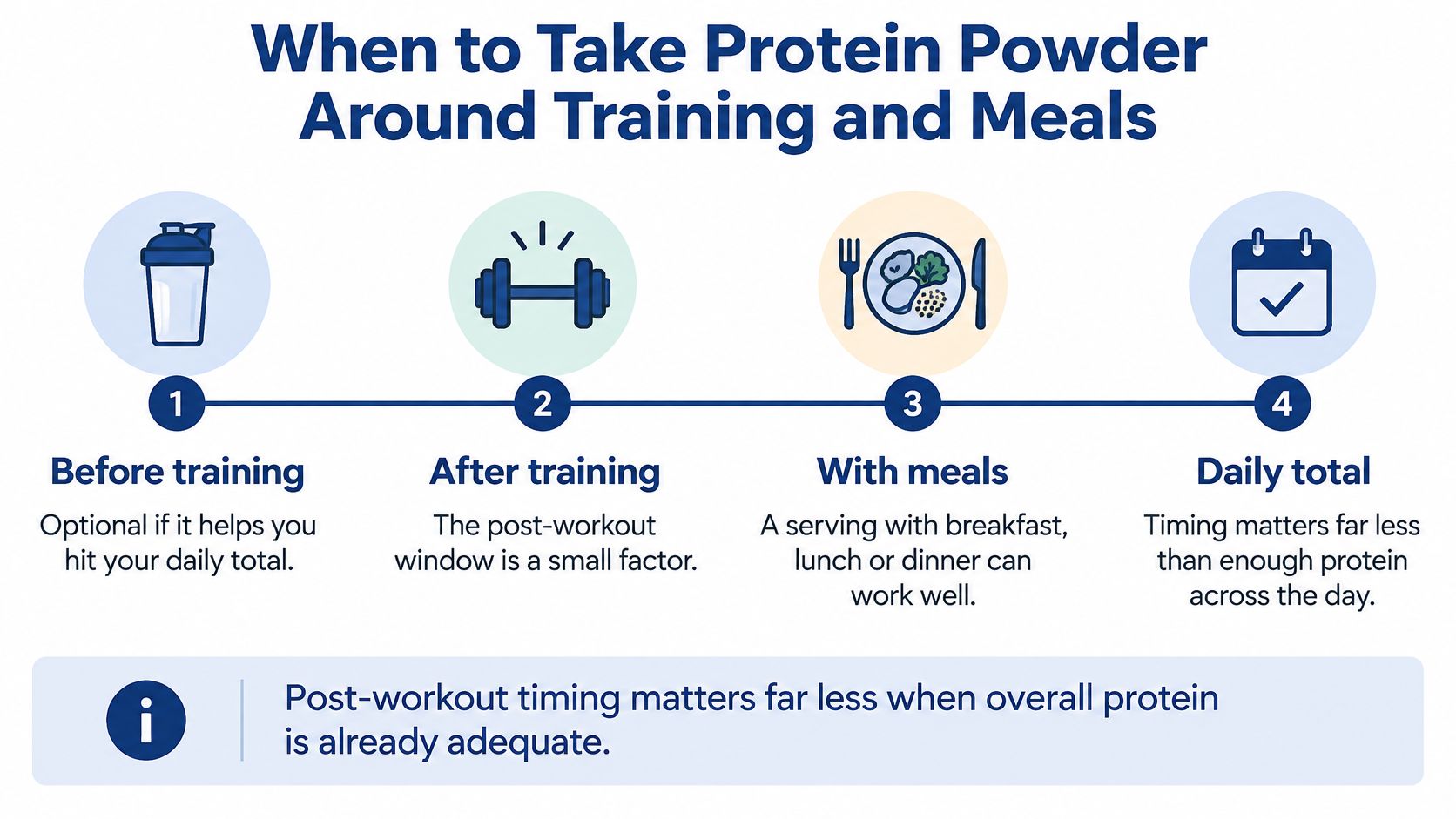
Timing matters far less than your daily total. The post-workout window gets most of the attention, but it's a small factor when protein across the whole day is already adequate. Chasing a shake within minutes of your last set won't compensate for a low-protein breakfast, lunch and dinner.
This timeline puts each option in its proper place.
A Simple Way to Spread Servings
| Situation | Serving Size | When to Take It |
|---|---|---|
| Strength training day | 20-30 g | Spread with meals, one serving within a few hours after training |
| Missed meal | 20-30 g | In place of the missed meal, mixed in water or milk |
| Overnight gap | 30-40 g casein | Before bed, when meals are far apart |
| Endurance block | 20-30 g | After long sessions to top up the daily total |
Use the table as a scheduling aid, not a rulebook. A serving with breakfast spreads intake early if you usually eat toast and little else. A serving after training makes sense if your next meal is hours away. Casein before bed suits long overnight gaps. Each choice serves the daily total. None of them overrides it.
For endurance work, keep claims modest. In 2024, a UK research study listed by the UK Health Research Authority summary on protein intake and endurance exercise compared protein intakes of 1.0 g/kg/day with 1.7 g/kg/day to examine whether increased protein intake supports muscle-protein synthesis during prolonged cycling. That tells you researchers are testing higher intakes in endurance settings. It doesn't prove every cyclist needs the higher figure, and it doesn't make timing around a ride the main lever.
This video walks through the timing question in practical terms, so you can compare it with your own routine.
Stacking large doses around every session adds cost without clear benefit. Set your total from your body weight and training, spread servings across meals you already eat, then pick the timing you'll stick to. Consistency beats precision here.
Possible Downsides and Who Should Avoid It
Protein powder isn't automatically harmless just because it's sold as a health product. For healthy adults, the common problems are practical rather than dramatic. Flavoured shakes can contain added sugars, sweeteners and thickeners you wouldn't choose in food. Whey concentrate contains lactose, so it can cause bloating or digestive upset if you're sensitive. Reading about whey protein and lactose-free options helps if dairy is your sticking point.
Calories count too. A shake added on top of meals you already eat in surplus still adds energy, even if the tub looks virtuous. Cost per gram of protein also varies widely. Two products can look similar on the shelf while one delivers far more protein for your money once you divide price by actual protein content, not scoop size.
The Kidney Question Needs a Careful Answer
You've probably heard two opposite claims, that protein damages kidneys or that it's entirely harmless for everyone. Neither is a useful blanket statement. Healthy consumers and people with reduced kidney function are different groups, and the advice shouldn't be merged.
UK clinical guidance in the British Dietetic Association guide on diet and chronic kidney disease for primary care says high protein intake and protein supplements can place additional strain on people with chronic kidney disease (CKD), while NICE advises against very-low-protein diets below 0.6 to 0.8 g/kg/day for adults with CKD. NHS kidney guidance also notes that protein supplements may be prescribed or recommended by a dietitian when a patient cannot eat enough protein. The right answer depends on kidney function, medical status and total daily intake, not just on whether a powder is used.
Don't self-prescribe a high-protein regime after an abnormal eGFR result. Discuss supplements with your GP or a renal dietitian first.
Formulation matters for this group as well. Shakes can contain added sugars and other ingredients that may be unsuitable for people with kidney disease, so a clinician may recommend a specific product rather than a general sports shake.
Check with a professional first if any of these apply to you:
- Kidney disease or reduced kidney function: Get individual advice before raising protein intake.
- Under 15 years old: Supplements aren't the starting point for children and young teenagers.
- A restricted or prescribed diet: Your supplement needs to fit the wider plan, not sit outside it.
- Previous reactions to dairy or soy: Choose the source carefully and stop if symptoms recur.
Confirm You Need Protein Powder Before You Buy
Would a shake close a gap you can measure in grams, or would it only replace food you already eat? If you cannot name the shortfall, pause before you spend.
The NHS sports supplements guidance from FYI Norfolk states that adults generally need about 0.75 g of protein per kg of body weight daily, approximately 56 g for men and 45 g for women. It also says similar benefits can often come from ordinary food, and that excessive intake may contribute to health problems.
A tub is closer to a spare tin of beans than to a training programme. It supplies amino acids when meals fall short. It does not add muscle by itself if you are not doing resistance work, and a bigger scoop does not raise your target.
A Three-Step Check You Can Do Today
- Tally one typical day: Write down meals and snacks, then add grams of protein from labels or standard food tables. Use an ordinary day, not your best one.
- Compare with your target: Use the reference above if you are generally active. If you are unsure how targets shift with training, read our guide on how much protein you need per day and apply that figure to your tally.
- Name your barrier: Decide whether low appetite, little time to eat, a vegetarian or vegan diet, or difficulty eating after training makes food alone hard to manage.
Suppose you weigh 70 kg and your food tally lands near 40 g. That is a real gap against the general adult reference, so a shake can fill the missing grams. If the tally already matches your target, or a larger lunch would close it, change the meal first.
The same test applies outside protein. If you are reviewing supplements for a longevity-focused wellness routine, ask what is missing and how you will know the gap has closed.
If You Do Buy, Check These Details
- Protein per serving: Compare grams, not scoop size or front-of-pack claims.
- Sugar and carbohydrate: Flavoured products vary more than the front label suggests.
- Allergens and sweeteners: Confirm the source suits your diet and stomach.
- Price per 100 g of protein: Divide cost by actual protein so two tubs can be compared fairly.
- Independent testing: Look for brands that publish test results and quality standards.
Vitamin Planet products are manufactured and packaged in the UK to ISO9001 standards following GMP (Good Manufacturing Practice). Independent ISO certified laboratories periodically recheck the results. Whatever brand you choose, that level of checking is worth looking for.
Write down one day of intake and set it beside your target. Use that number to decide.
If the tally shows a real gap, browse the whey and vegan protein options at Vitamin Planet and compare protein per serving, sugar content and price per 100 g of protein before you choose. Sports nutrition sits alongside everyday vitamins and minerals, so the product can match the shortfall rather than a guess. Start with one product that closes the gap, track intake for a fortnight, and keep it only if the numbers improve.