

How Much Protein to Build Muscle: Daily Targets Explained
Aim for 1.6–1.7 g of protein per kg of body weight per day for muscle gain. For a 70 kg adult, that works out as 70 × 1.6–1.7 = 112–119 g daily.
That doesn't mean you should automatically add a protein shake to everything you already eat. The popular advice to eat more protein skips the most useful question: are you short? Some people can meet their muscle-building needs through ordinary meals, without buying anything extra.
Working out how much protein to build muscle starts with a body-weight calculation, but the practical answer comes from comparing that target with your usual food. Training, appetite, dietary preferences and total food intake all matter.
Table of Contents
- Daily Protein Targets by Body Weight
- Why the UK Reference Figure Falls Short for Muscle
- Check Whether You Already Eat Enough
- How to Spread Protein Across the Day
- Adjusting Your Target for Diets, Age and Plant-Based Eating
- Confirm Your Daily Protein Number This Week
Daily Protein Targets by Body Weight
For adults doing resistance training, the British Dietetic Association's sport and exercise nutrition guidance recommends approximately 1.6–1.7 g/kg/day for muscle gain, provided energy and carbohydrate intake are adequate.
The calculation is one multiplication done twice: your weight in kilograms times the lower end of the range, then times the upper end. For a lifter weighing 70 kg, that is 70 × 1.6 = 112 g and 70 × 1.7 = 119 g. Your daily target sits somewhere between those two numbers.
Calculate a range, not a perfect number
The table applies those multipliers alongside the UK baseline of 0.75 g/kg/day. Each cell is body weight multiplied by the column's stated rate, so you can check any row yourself: 80 × 0.75 = 60 g at baseline, and 80 × 1.6–1.7 = 128–136 g for muscle gain.
Daily protein targets for muscle gain by body weight
| Body weight | UK baseline (0.75 g/kg) | Muscle-gain target (1.6–1.7 g/kg) |
|---|---|---|
| 60 kg | 45 g | 96–102 g |
| 70 kg | 53 g | 112–119 g |
| 80 kg | 60 g | 128–136 g |
| 90 kg | 67.5 g | 144–153 g |
| 100 kg | 75 g | 160–170 g |
Treat your result as a planning range. There is no pass mark to hit every evening; a day that lands a few grams low matters little if the pattern across the week stays inside the range.
A target also needs a training context. Regular resistance exercise provides the stimulus for adaptation; eating extra protein without a suitable programme isn't an equivalent substitute.
What the target looks like on a plate
Grams per kilogram can feel abstract until they are converted into food. These typical values show how quickly ordinary portions add up:
| Food | Portion | Typical protein |
|---|---|---|
| Chicken breast, cooked | 100 g | 30–32 g |
| Eggs | 2 medium | 12–14 g |
| Greek-style yogurt | 170 g pot | 15–18 g |
| Tinned tuna, drained | 100 g | 23–25 g |
| Cooked lentils | 150 g | 12–14 g |
| Semi-skimmed milk | 300 ml | 10–11 g |
Add a few of these together and the muscle-gain range often looks less distant than it first appears. A chicken breast at lunch, a yogurt as a snack and two eggs at breakfast give a 70 kg lifter roughly 60 g (31 + 17 + 13) before dinner is even counted. That reframes the practical question: before buying anything extra, find out whether you are short at all.
Account for the training goal
The BDA places broader athletic needs at approximately 1.4–2.0 g/kg/day, with the upper end potentially relevant during demanding training or when preserving lean mass is a priority. That wider range isn't an instruction for every recreational lifter to aim as high as possible.
If you're deliberately losing weight, Maximum Health Products' guide to preserving muscle in a calorie deficit offers useful context for balancing protein with a weight-management goal. Eating to gain muscle and eating to retain muscle while reducing body fat are different tasks, and the target shifts accordingly.
Write your own daily range somewhere accessible, such as your phone's notes app. You will use it to compare your existing meals against the numbers.
Why the UK Reference Figure Falls Short for Muscle
The UK Reference Nutrient Intake, or RNI, is 0.75 g of protein per kilogram of body weight per day, according to the British Nutrition Foundation's protein guidance. The working is simple: a 75 kg man's baseline is 75 × 0.75 = 56.25 g, approximately 56 g daily, and a 60 kg woman's is 60 × 0.75 = 45 g.

Maintenance and growth are different questions
The RNI comes from the UK Dietary Reference Values framework. It's designed to meet ordinary physiological needs for tissue maintenance and repair in healthy adults. It answers a different question from the one a lifter is asking.
A car idling uses only enough fuel to keep the engine running, while a long drive calls for a fuller tank. The comparison isn't exact, but it captures the gap: covering normal needs and supporting the extra demand of training are separate tasks.
Resistance exercise raises muscle-protein synthesis, the process of building new muscle proteins. Dietary protein supplies the amino acids that act as raw materials. Growth follows when more muscle protein is built than broken down over time, which is why a high-protein label on a single food tells you little on its own. The video below covers the same ground for readers who prefer a visual format.
What national averages can't tell you
National surveys put average protein intake among UK adults above the RNI baseline. That sounds reassuring, and sometimes it is. An adult who eats ordinary, varied meals can already sit inside the muscle-gain range without counting a gram. For others, the same average hides a shortfall. No population figure can see your body weight, your training or whether you skipped lunch twice this week.
Body weight alone changes the picture. A lighter adult eating a modest amount of protein may land inside the muscle-gain range, while a heavier adult eating the same amount falls well short of it. The only figure that matters is your intake set against your own target.
Useful distinction: Eating enough to avoid inadequacy doesn't necessarily mean eating enough to optimise a muscle-building programme.
Total food matters too. When energy availability is low, your body can burn amino acids for fuel instead of retaining them for tissue construction. Extra protein can't fully compensate for an otherwise under-fuelled diet.
So the reference figure sets a floor for health rather than a ceiling for growth. Whether you sit above the muscle-building line depends on your own plate, your own weight and your own training.
Check Whether You Already Eat Enough
You may already reach your muscle-gain target through ordinary food. That's a possibility to test, not an assumption to make from national averages or the appearance of your meals.
There's a reason not to keep adding protein indefinitely. A meta-analysis published in the British Journal of Sports Medicine, covering 49 trials and 1,863 participants, found no further fat-free-mass gains from supplementation once total intake exceeded approximately 1.6 g/kg/day.
That finding describes diminishing returns across the included trials, not an exact biological ceiling for every individual. It also doesn't mean that eating above the threshold is automatically harmful or that everyone responds identically. It means more isn't reliably better for muscle gain once you're already eating enough.
Audit your meals before adding a shake
Use a short food record to replace guesswork with something you can act on.
- Choose representative days. Include ordinary working days and weekend eating rather than recording only your most organised meals.
- Record portions with care. Use kitchen scales where helpful, and note the amount eaten rather than the serving pictured on the packet.
- Total the protein. Read food labels or use a nutrition database, checking whether entries describe cooked or uncooked food.
- Compare your average with your target. Add the daily totals and divide by the number of days recorded.
- Address a consistent gap. Adjust meals first, then repeat the check once the new routine feels normal.
Use this checklist as a prompt to assess the whole eating pattern, not protein alone.
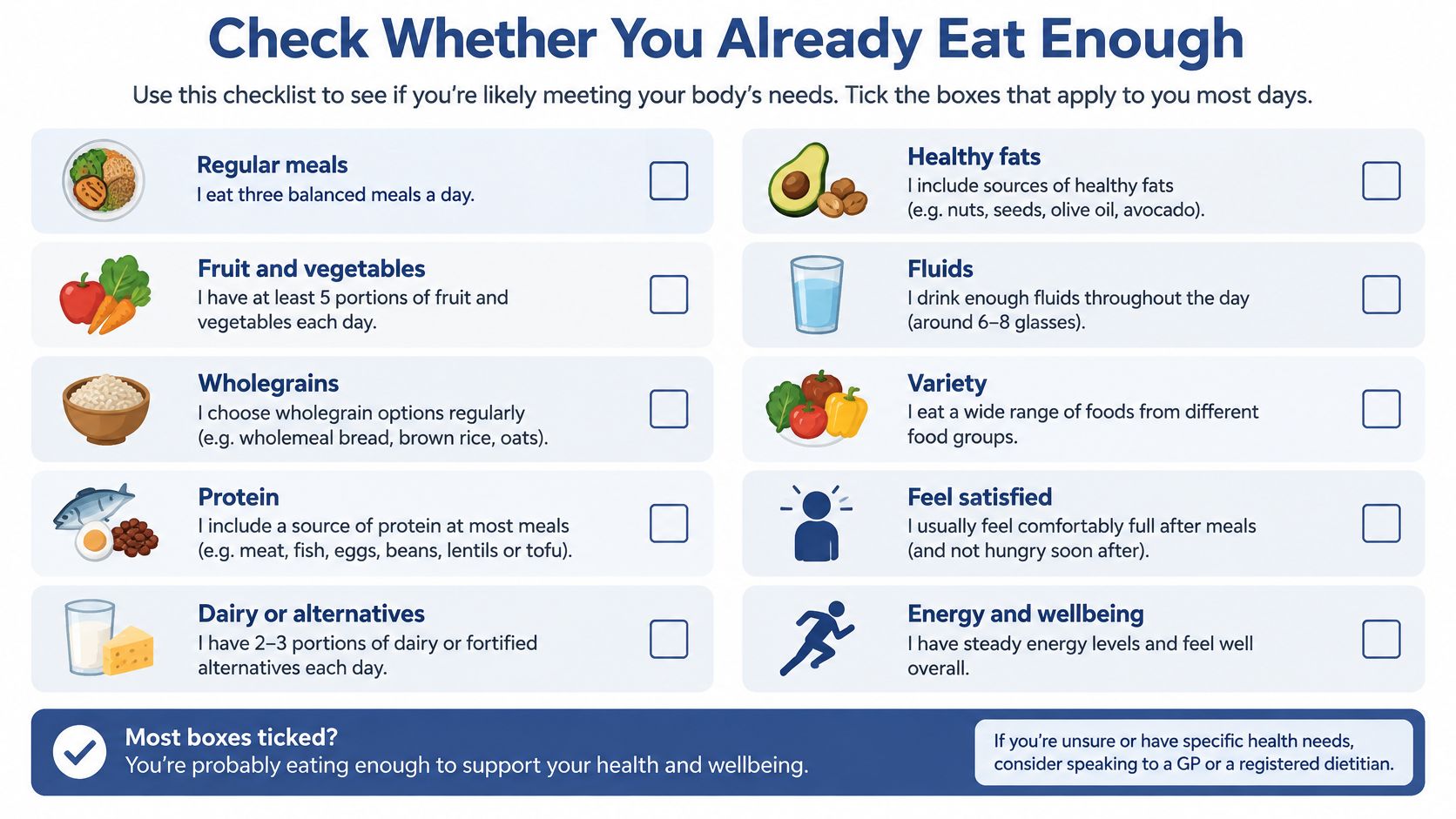
Let the result change the shopping list
If you're already within your range, there's no clear reason to add a daily shake solely for extra muscle gain. Look instead at whether your training progresses and whether your meals are sustainable.
If you're consistently short, identify the meal that's easiest to improve. Breakfast without a substantial protein source is often more practical to change than an already filling evening meal.
Our guide to what protein powders do explains their role as a convenient way to fill a gap. Convenience is a valid reason to use powder, but it isn't proof that you need more protein.
How to Spread Protein Across the Day
A 100 g cooked chicken breast delivers roughly 30 g of protein before anything else reaches the plate. Two or three ordinary meals can carry most of a daily target on their own, which is why spreading protein across the day works a lot like spreading a budget across the week's shops: the total matters more than which day you spend it.
The British Nutrition Foundation's protein overview describes 20–25 g of high-quality protein after exercise as enough to maximise the acute muscle-protein-synthesis response, while also noting that larger servings of around 30–60 g per meal can still be used. Protein eaten beyond a small serving is still absorbed and put to work.
That acute response is a short-term measurement, and it doesn't guarantee long-term growth by itself. Total daily intake matters more than precise timing. An even split across meals is a useful organising tool, and a meal near training is a handy slot to fill, but no single feeding window decides the outcome.
Build meals from portions you can count
Start with a recognisable protein food, then build the rest of the meal around it. Approximate values make the planning easier:
Protein in common foods per typical portion
| Food | Portion | Protein (g, approx.) |
|---|---|---|
| Chicken breast, cooked | 100 g | About 30 g |
| Salmon, cooked | 100 g | About 25 g |
| Eggs | 2 large | About 12 g (6 g per egg) |
| Plain Greek yoghurt | 150 g pot | About 15 g |
| Semi-skimmed milk | 200 ml | About 7 g |
| Firm tofu | 100 g | About 17 g |
| Lentils, cooked | 100 g | About 9 g |
| Whey protein powder | 1 scoop, about 30 g | About 20–25 g |
These are working figures, and labels can differ. A scoop's weight isn't its protein content, and a strained yoghurt carries more protein per gram than a product described as Greek-style, so check the pack when precision matters.
A quick worked example: a 150 g pot of Greek yoghurt (about 15 g) plus a 30 g whey scoop (about 20–25 g) gives roughly 35–40 g. The same arithmetic applies to meals: add the main source, then the smaller contributions from bread, rice or vegetables, and compare the total with your daily target. If a typical day already adds up, this table is a checking tool rather than a shopping list.
Make the distribution fit your diet
- Set your daily total. Keep the target visible while planning.
- Divide it across your usual meals. If breakfast is small, allow for a substantial lunch, dinner or snack.
- Include a protein source at each main meal. A meal near training is a convenient slot, though any meal can carry the load.
- Fill any remaining gap. Choose a snack or adjust a meal according to appetite and preference.
Lentils with rice or tofu served with a soya-based drink are practical combinations when meat is off the menu, and for a vegetarian diet eggs and dairy widen the options further. Distribution is arithmetic across the day; no single food group needs to appear at every meal.
A larger evening meal still counts towards the total. Spreading food more evenly may simply make the daily target easier to reach.
For more detail on where a shake fits into this kind of plan, our guide to whey protein benefits explains it. Meal timing is also only one part of recovery, and practical movement ideas such as MEDISTIK's active recovery tips for athletes sit alongside the food planning.
Adjusting Your Target for Diets, Age and Plant-Based Eating
Dieting changes the problem you're trying to solve. Rather than supporting muscle gain with ample food, you may be trying to retain muscle while eating less.
A higher protein intake within the broader athletic range may be useful, but don't assume that the highest possible target is always the best choice. You still need room for carbohydrate, fats and a varied diet, particularly when your food budget or appetite is limited.
When calories are restricted
Keep resistance training in the plan and review how the whole diet supports it. If you've increased protein by removing most of your carbohydrate foods, you may find the eating pattern harder to sustain around demanding sessions.
Protein also contributes energy. Adding shakes without adjusting anything else can work against an intended calorie deficit, even when the product is marketed for fitness.
Older adults and plant-based eaters
For an older adult, appetite, meal size, activity and health conditions deserve individual attention. A general population reference isn't a personalised muscle-preservation prescription, but neither should every older person be assigned the same training target without considering their circumstances.
Resistance exercise and a dependable meal routine belong alongside protein planning. If appetite is limited, use manageable meals containing foods you enjoy rather than relying on an oversized dinner.
Plant-based eating changes food selection more than the basic calculation. Include a mixture of tofu, soya foods, beans, lentils and other protein-containing foods, and check portions rather than assuming a meal labelled vegan is protein-rich.
Protein intake by situation
| Situation | Suggested intake (g per kg per day) | Why it changes |
|---|---|---|
| Muscle gain with adequate calories | Use the muscle-gain range calculated from body weight | Supports the goal alongside resistance training |
| Dieting or calorie deficit | Consider the upper end of the broader athletic range | Retaining lean mass becomes a priority |
| Older adult aged 65 and over | Set an individual target with a dietitian when needed | Appetite, health and activity affect the plan |
| Plant-based diet | Use the muscle-gain calculation as a starting point | Meet it through a varied, portion-aware food pattern |
A vegan lifter might organise meals around tofu, lentils and soya milk, then use a plant protein powder if a measured shortfall remains. There's no need to assume that every plant-based meal requires supplementation.
Clinical caution: If you have kidney disease or have been given a protein restriction, discuss a higher-protein target with your clinician before changing your intake.
Personal advice is also worthwhile when unintentional weight loss, persistent poor appetite or a complex medical condition makes a standard calculation unsuitable.
Confirm Your Daily Protein Number This Week
Write down the range calculated from your body weight, then compare it with a representative record of your meals. Your next action should follow the gap you find, not the amount of protein promoted on a tub.
If your usual intake is below target, change something specific: add a substantial protein source to breakfast, increase the tofu in a main meal, or choose a yoghurt-based snack. Use labels and weighed portions to check whether the change closes the shortfall.
Review the whole routine
If food alone remains inconvenient, a whey or vegan powder can fill the remaining gap. Size the portion to what you need rather than automatically adding a full scoop on top of an already adequate diet.
Keep a training log alongside your food notes. Review strength, body-weight trends, appetite and how well you're recovering before deciding that a lack of progress means you need more protein.
- If training isn't progressing, review exercise selection, effort and progression.
- If meals are inadequate overall, address total food rather than protein alone.
- If recovery feels poor, consider sleep and training demands alongside nutrition, using our practical tips to maximise muscle recovery.
You don't need a perfect eating day to begin. Write your gram target down today and log tomorrow's first meal against it.
Vitamin Planet offers whey and vegan proteins alongside sports nutrition and everyday food options. Visit Vitamin Planet to compare products if your food record shows a shortfall, and choose a serving that fits the gap rather than adding protein you don't need.