

Vitamin a Function in the Body: What It Does and Why
You're driving home at half six, the kerb keeps sliding out of view as you reverse into a space, and you find yourself squinting more than you did a few months ago. Nothing dramatic. Just a small question at the back of your mind about whether you're short of vitamin A.
That question deserves a careful answer rather than a quick supplement. Vitamin A is one nutrient doing several jobs that don't look related at first glance, and eyesight is only the most famous of them. Following vitamin A function in the body means tracking a single raw material as the body converts it into two quite different tools, then noticing that the same systems react when levels run low and when they run high.
Most explainers stop at carrots and night vision. The fuller picture is more useful, and it's the one that tells you when to check your diet and when to see a GP.
Table of Contents
- What Vitamin A Does Across the Body
- How Vitamin A Works Inside the Cells
- Vitamin A at Work in Everyday Life
- Foods That Supply Vitamin A
- Intake Levels and When Too Much Becomes a Risk
- Check Your Vitamin A Intake Before You Buy a Supplement
What Vitamin A Does Across the Body
You switch off the bedroom light, walk towards the door, and for two or three seconds the room is a grey blur. Everyone gets that. What matters is whether the blur is lasting longer than it used to, because dark adaptation is one of the first things to suffer when vitamin A runs low.
The nutrient itself is fat-soluble, which means it travels and stores in body fat rather than being flushed out in urine. That single property explains a lot of what follows, including why the body can hold a reserve and why large doses can build up. The UK government's vitamin A deficiency guide sets out three foundational roles: maintaining the visual system, supporting cell growth and development, and preserving the integrity of epithelial tissue such as skin and mucous membranes.
Those three headings cover more ground than they suggest. Epithelial tissue is the body's lining material, the sheets of cells that face the outside world in your airways, your gut and the surface of your eye. The table below spreads the roles across the systems you'd notice.
| Body system | Main role | What low intake can affect |
|---|---|---|
| Eyes | Forms visual pigment used for low-light vision | Night vision and dark adaptation |
| Skin and mucous membranes | Keeps epithelial tissue intact | Dry skin and weaker airway and gut linings |
| Immune system | Supports frontline immune-cell activity | Greater susceptibility to infection |
| Growth and development | Regulates gene activity in developing tissue | Slowed growth in children |
| Reproduction and pregnancy | Supports embryonic and fetal development | Risk from both low and excessive intake |
Read the rows together and a pattern appears. These systems share tissue types and signalling pathways, so a shortfall rarely announces itself in one place. The same person can have trouble seeing in dim light, dry patches on the arms and a winter of chest infections that never quite clears.
Dry, gritty eyes are the symptom people most often pin on a vitamin shortfall, and they're usually nothing to do with it. Tear quality, screen time, central heating, blepharitis and some medicines all play a part, and a guide to dry eye syndrome from Style Site Optical walks through the common causes before you spend money on capsules.
Practical rule: treat symptoms as questions for a GP or optometrist, not as instructions to buy a supplement.
Night-vision changes, persistent dry skin or infections that keep returning are all worth a conversation with your GP. Each has a long list of possible causes, from a changed glasses prescription to eczema to asthma, and none should be self-treated with high-dose vitamin A.
How Vitamin A Works Inside the Cells
Take a bag of plain flour out of the cupboard. With water and heat you get bread. With fat and sugar you get pastry. Same starting material, two finished products that share nothing on the plate.
Vitamin A works like that bag of flour. The body takes one family of molecules, the retinoids, and converts it into forms with separate jobs. SACN's review of dietary advice on vitamin A describes two of them in detail. Retinaldehyde is the vision form: inside the retinal photoreceptors it combines with a protein called opsin to build the visual pigments you use to detect light in dim conditions. Retinoic acid is the signalling form: it acts through nuclear retinoid receptors to regulate gene transcription, the process that decides which proteins a cell makes.
That second job sounds abstract and isn't. Gene transcription is the mechanism behind epithelial-cell differentiation, embryonic development, growth, immune function and ongoing tissue maintenance, all of which the same SACN review ties to retinoic acid. In plain terms, one form of vitamin A catches light, and the other tells cells what kind of cell to become and what work to do.
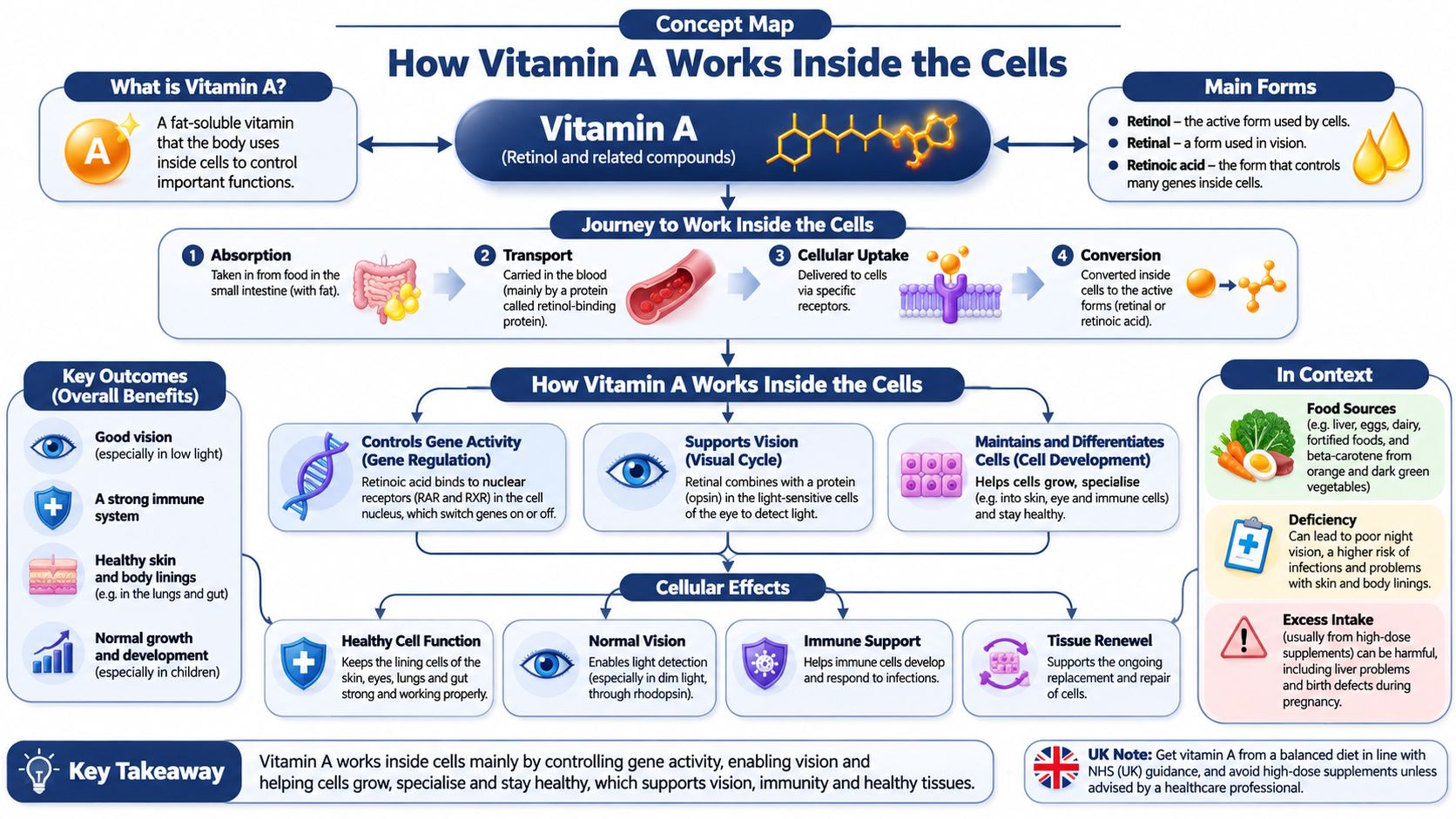
Why one shortage shows up in two places
Here's a question worth sitting with. If you ate too little vitamin A for a few months, why would your eyes and your skin complain at the same time?
Because they're drawing on the same supply. The retina needs retinaldehyde to rebuild visual pigment, and the skin needs retinoic acid to keep replacing its surface cells. When intake drops, the body prioritises, and the visible results land in both places. SACN also counts provitamin-A carotenoids from plants as part of total vitamin A, since the body converts them into the active forms as needed, which is why plant foods count even though they contain no retinol at all.
One reassuring detail from the same review: deficiency is extremely rare among people born in the UK, so routine high-dose supplementation isn't generally justified without a clinical reason. The mechanism explains the symptoms; it doesn't make a shortage likely for most readers.
One vitamin, two tools. That's why a shortfall rarely stays inside a single system.
Vitamin A at Work in Everyday Life
Three everyday scenes show the mechanism at work, and each points to a practical next step that is not a supplement. The two converted forms of vitamin A explain why one shortfall can surface in unrelated systems.
The driver at dusk. An office worker leaves at half five through autumn and finds oncoming headlights harder to handle than they used to be. The glare lingers, and the road takes a second longer to come back. Dark adaptation depends on vitamin A because the retina constantly rebuilds visual pigment, and that rebuild needs retinaldehyde. The same complaint can also come from a changed prescription, early cataracts, dry eye or plain screen fatigue. The next step is an eye test, not a bottle. If the problem is gritty, tired eyes rather than true night blindness, Vitamin Planet's eye health articles cover the everyday causes in more detail.
The toddler with repeat infections. A two-year-old keeps bringing home a cough, then a stomach bug, then another cough. Mucous membranes line the airways and gut, and they depend on epithelial tissue staying intact, which is where retinoic acid comes in. Frontline immune-cell activity also draws on vitamin A, so a poorly maintained barrier and a slower immune response tend to arrive together. Nursery exposure, asthma and reflux produce a similar pattern, though, so persistent infections need a GP looking at the whole child.
A symptom is a starting point for a conversation, not a diagnosis you make in the kitchen.
The home cook. Someone who eats carrots, sweet potato and spinach most days is taking in carotenoids rather than retinol. The body converts those plant pigments into the active forms as needed, so intake and conversion stay in step. Add a little oil or a knob of butter and absorption improves, because the conversion products are fat-soluble. A varied diet of this kind normally covers the need without a supplement, though symptoms that persist deserve a doctor's view.

If you would rather watch the conversions happen than read them, this short video walks through the same process.
People who eat a varied diet meet their needs without giving vitamin A a thought, and that is the outcome to aim for.
Foods That Supply Vitamin A
Vitamin A reaches your plate in two forms, and the difference explains most of the confusion around food sources.
Preformed retinol comes from animal foods and arrives ready to use. Carotenoids come from plants and have to be converted, which the body does at its own pace and only as far as it needs. Neither form is better in absolute terms. They behave differently, and that difference shapes how you cook and combine them.
| Food group | Form of vitamin A | Example foods | Practical note |
|---|---|---|---|
| Liver and liver products | Preformed retinol | Lamb's liver, liver pâté | Most concentrated source in the diet |
| Dairy and eggs | Preformed retinol | Whole milk, cheese, eggs | Steady everyday source for many people |
| Oily fish | Preformed retinol | Mackerel, salmon, herring | Fish also provides other nutrients |
| Orange vegetables | Carotenoids (beta-carotene) | Carrots, sweet potato | Eat with a little fat and cook lightly |
| Dark green vegetables | Carotenoids (beta-carotene) | Spinach, kale | Lightly cooking improves absorption |
| Fortified products | Preformed retinol | Some spreads and breakfast cereals | Check the label for vitamin A |
Three habits do most of the work:
- Pair carotenoid vegetables with a little fat. A drizzle of olive oil on roasted carrots, or spinach wilted in butter, gives the fat-soluble nutrients something to dissolve into.
- Cook the orange and green vegetables lightly rather than raw. A short steam or sauté softens the plant cell walls and releases more of what's inside. Raw carrot sticks are fine, but they give up less.
- Read the label on fortified spreads and cereals. Fortification levels differ between products, and a cereal that supplies a meaningful share of your day is worth knowing about.
A sample day that meets needs without effort: eggs or fortified cereal at breakfast, a lunch built on carrot and sweet potato, and spinach or oily fish at dinner. Nothing exotic, and no single food carrying the whole load.
Cost shouldn't be a barrier here. Carrots, frozen spinach, eggs, milk and tinned mackerel are among the cheapest items in the shop, and a cheap healthy shopping list shows how far they stretch across a week. If you want to build meals around that pattern, Vitamin Planet's diet and nutrition articles cover the wider picture of everyday nutrient intake.
Variety does the work. No single food is compulsory, and a diet that rotates through a few of these groups week to week is enough for many people.
Intake Levels and When Too Much Becomes a Risk
Two reference points make sense of any intake figure you meet. The reference nutrient intake (RNI) is the amount that meets the needs of nearly everyone in a group. The lower reference nutrient intake (LRNI) is the amount likely to be too little for almost everyone in that group. One is a target, the other a warning line, and confusing them causes most of the anxiety around this nutrient. Meeting the RNI is the aim. Falling near the LRNI is the signal to look harder at your diet.
| Group | RNI (µg per day) | LRNI (µg per day) | Practical note |
|---|---|---|---|
| Men aged 19-64 | 700 | 300 | Most men meet RNI through a varied diet |
| Women aged 19-64 | 600 | 250 | Most women meet RNI through a varied diet |
What the intake figures actually show
The gap between the target and what people eat is the interesting part. UK dietary surveys have generally placed median vitamin A intakes above the reference intakes for both men and women, so the typical national diet is not short of this nutrient. Deficiency still turns up in individual cases, which is why the LRNI earns its place in the table. Notice that the same body systems sit at both ends of the problem. Dim-light vision and immune defence are what suffer when intake falls, and what public-health advice protects when intake climbs.
Liver deserves its own line. A portion carries more preformed vitamin A than almost any other food on the plate, so women who eat liver or liver products regularly can take in far more retinol than a mixed diet ever supplies. That is the group where the conversation shifts from enough to too much.
Why more isn't better
Vitamin A is fat-soluble, so it accumulates rather than clearing quickly. It behaves like a bank account that takes deposits and rarely pays out, which is fine while the balance stays sensible and a problem when deposits keep arriving. The active metabolite retinoic acid helps regulate fetal growth and embryonic development. Too much preformed vitamin A during pregnancy can harm the unborn baby, which is why UK public-health advice separates vitamin A from ordinary foods from high exposure to retinol-rich foods and supplements, as the lay summary on the effects of excess vitamin A on maternal health sets out.
The practical steps for anyone pregnant or planning a pregnancy are short. Avoid liver and liver products, and check any supplement containing vitamin A with a GP, midwife or pharmacist before taking it. UK guidance also sets a daily upper limit for preformed vitamin A from supplements, so read the label and count every product you take, including a multivitamin that may already contain it. Two products with the same nutrient add up.
The calm version: most adults in the UK get plenty from food. The people who need to think hardest about intake are those eating liver regularly and those who are pregnant or planning a pregnancy.
For anything individual, your GP is the right person to ask, particularly if you take medication or have a liver condition.
Check Your Vitamin A Intake Before You Buy a Supplement
You can settle most of this in ten minutes with a pen and no purchases. Work through the steps in order.
- List what you ate yesterday and tick anything from the food groups above: liver, dairy, eggs, oily fish, carrots, sweet potato, spinach, kale, or a fortified spread or cereal.
- Look at the pattern across a few days, not one meal. Compare it with 700 micrograms a day for men and 600 for women, and the lower reference intakes of 300 and 250 micrograms. A varied week usually clears the target without effort.
- Read the supplement label for the amount of vitamin A per dose. Then check whether your multivitamin already contains it. Two products with the same nutrient add up, and stacking is where people accidentally overshoot.
- If you're pregnant, planning a pregnancy, or taking other vitamin A-containing products, speak to a GP, midwife or pharmacist before adding more, and avoid liver and liver products. This is a conversation, not a restriction to guess at.
- If you notice trouble seeing in dim light, dry eyes or repeated infections, book a GP appointment rather than starting high doses. Those symptoms have many causes and deserve a proper look.
If you're weighing up several products at once, the side effects of multivitamins explains what happens when doses overlap. It helps to know that every Vitamin Planet product is manufactured and packaged in the UK to ISO9001 standards following GMP, so the amount on the label is the amount you're working with.
Those who eat a varied diet already meet their needs. For any symptom that worries you, a GP is the right first step.
If you'd rather spend your effort on food than on label arithmetic, the simplest approach is to build meals around a few reliable sources and only look at supplements when a GP or pharmacist suggests one. When you do need a top-up, Vitamin Planet stocks vitamin A and multivitamin options made in the UK to ISO9001 and GMP standards, so you can check the dose on the label and see exactly what you're taking. Visit Vitamin Planet to compare the range and choose a product that fits the rest of your diet.