

What Do BCAAs Do for Muscle and Recovery
BCAAs are the three essential amino acids leucine, isoleucine and valine, which your body cannot make; their main proposed job is to help signal muscle-protein building after exercise, especially through leucine. They can nudge that process, but they do less than a complete protein that supplies all the essential building blocks.
That challenges the familiar advice to buy a recovery drink as soon as you start lifting weights. An ingredient can have a genuine biological role without being a necessary addition to your shopping basket.
The useful question isn't whether BCAAs work. It's whether an isolated amino-acid supplement solves a problem your meals or a complete protein shake haven't already addressed.
Table of Contents
- What BCAAs Do for Muscle After Exercise
- How Leucine Signals Muscle Protein Building
- BCAAs Compared with a Complete Protein
- Who May Notice a Difference from BCAAs
- Circulating Levels Are Not the Same as a Powder
- Cover Protein from Food Before Any BCAA Scoop
What BCAAs Do for Muscle After Exercise
BCAAs may nudge muscle-protein building after training, but a drink is not a complete recovery meal. After squats and presses, you might be heading to the changing room while dinner is still some way off. A BCAA drink offers selected amino acids, not the full range of materials your muscles use to build protein.
“Branched-chain” refers to the amino acids' chemical structure. “Essential” means your body needs to get them from food or supplements. It does not mean you need to buy them separately.
What each BCAA is proposed to do
The three amino acids have related roles, but they are not interchangeable. Leucine is the clearest signal for starting muscle-protein building. Isoleucine and valine have other roles, and neither stands in for leucine.
| Amino acid | Made in the body? | Main proposed job | Place in a powder labelled two parts leucine to one part each of the others |
|---|---|---|---|
| Leucine | No, it is essential | Main signal that starts muscle-protein building | Twice the amount of isoleucine or valine |
| Isoleucine | No, it is essential | Involved in muscle metabolism, including glucose handling | Equal to valine |
| Valine | No, it is essential | Contributes to energy use in working muscle; less prominent as a synthesis signal | Equal to isoleucine |
A label showing that ratio describes the blend, not a proven ideal dose. More leucine may sound like a stronger signal, but the ratio alone cannot show whether the powder improves your training results.
Put the drink in its proper place
Start by identifying the problem you want to solve. Finding it difficult to eat after training differs from dealing with persistent soreness, and neither automatically means you need more BCAAs.
For a broader view, these practical tips to maximise muscle recovery cover food, training demands and recovery habits. Consider those factors together. A single ingredient cannot make up for everything else.
A product description can help you assess what a recovery formulation contains and what it claims to do. You can browse bounce back faster supplements, but treat the description as information to assess, not proof that its recovery claims apply to you.
A BCAA drink may be a convenient, light option when food feels impractical. That convenience has a limit: it does not provide the same nutritional range as a meal containing protein. If you can eat a protein-containing meal after training, the drink is not automatically the more advanced choice.
How Leucine Signals Muscle Protein Building
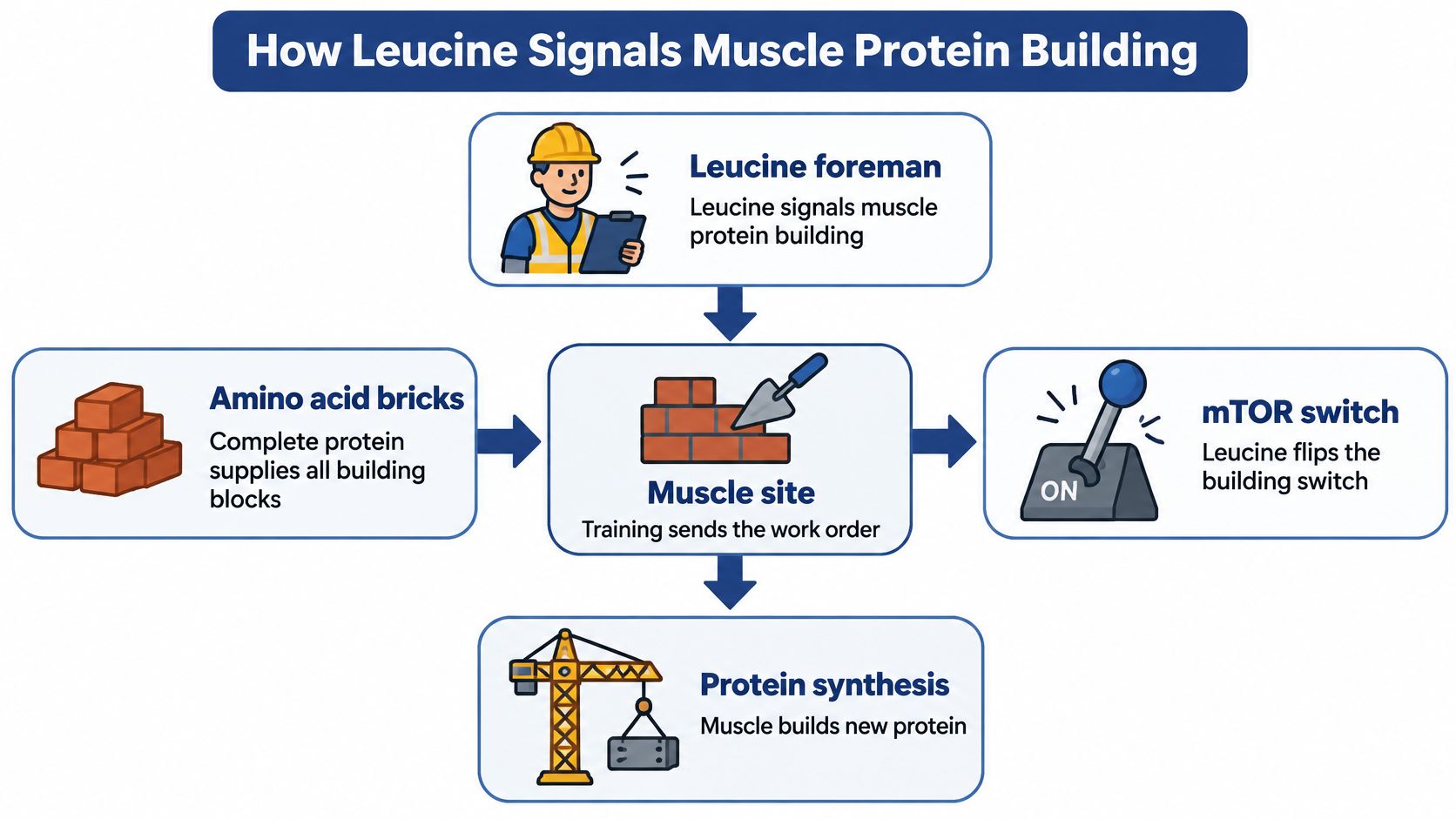
Think of muscle as a building site. Resistance training sends the work order, while amino acids provide the materials for repair and new protein.
Leucine has an additional role: it acts rather like a foreman giving the instruction to begin. It helps activate mTORC1, a nutrient-sensitive pathway that regulates the start of protein assembly inside muscle cells.
The diagram shows how the signal and the supply of materials fit together.
Starting construction isn't finishing it
The technical term translation means that cells use genetic instructions to assemble a protein. You don't need to memorise the pathway to understand the practical limitation: an instruction to build isn't the same thing as a complete delivery of materials.
Leucine, isoleucine and valine can contribute to the process. But new muscle protein also requires the other indispensable amino acids. If those aren't available in sufficient amounts, supplying a stronger start signal doesn't remove the shortage.
Practical rule: Judge a supplement by what it helps your body complete, not just by the switch it activates.
This distinction explains why a laboratory finding can be genuine without supporting an expansive claim on a tub. Researchers can measure a short-term increase in protein assembly without demonstrating larger muscles after a training programme.
What the Stirling experiment actually found
In a University of Stirling human study, 10 resistance-trained men, with an average age of 20.1 years, consumed 5.6 g of BCAAs or a placebo after resistance exercise; across the following four hours, myofibrillar muscle-protein synthesis was 22% higher with BCAAs.
“Myofibrillar” refers to the proteins involved in the muscle's contractile machinery. That makes the measurement relevant to muscle, rather than merely showing that an ingredient reached the bloodstream.
Nevertheless, the comparison was BCAAs versus placebo, not BCAAs versus a protein-containing meal. It demonstrates a short-term response in a small, specific group. It doesn't establish the best supplement for everyone who exercises.
Nor does a higher synthesis rate directly translate into an equivalent increase in muscle size. Long-term growth depends on what happens repeatedly across training, nutrition and recovery, not just during a measurement window after a workout.
The sensible interpretation is neither that BCAAs do nothing nor that the drink is essential. The signal is biologically meaningful, but the available building materials still matter. Complete protein addresses both parts of that problem.
BCAAs Compared with a Complete Protein
If both products contain leucine, why choose complete protein? Because the choice isn't between different ways to deliver the same signal. It's between a limited amino-acid mixture and a source that supplies the full essential amino-acid set.
Whey, milk, eggs, meat, fish and soy provide complete protein. BCAAs are already part of those proteins, so choosing food or a complete shake doesn't mean missing out on leucine.
This comparison summarises the practical difference.
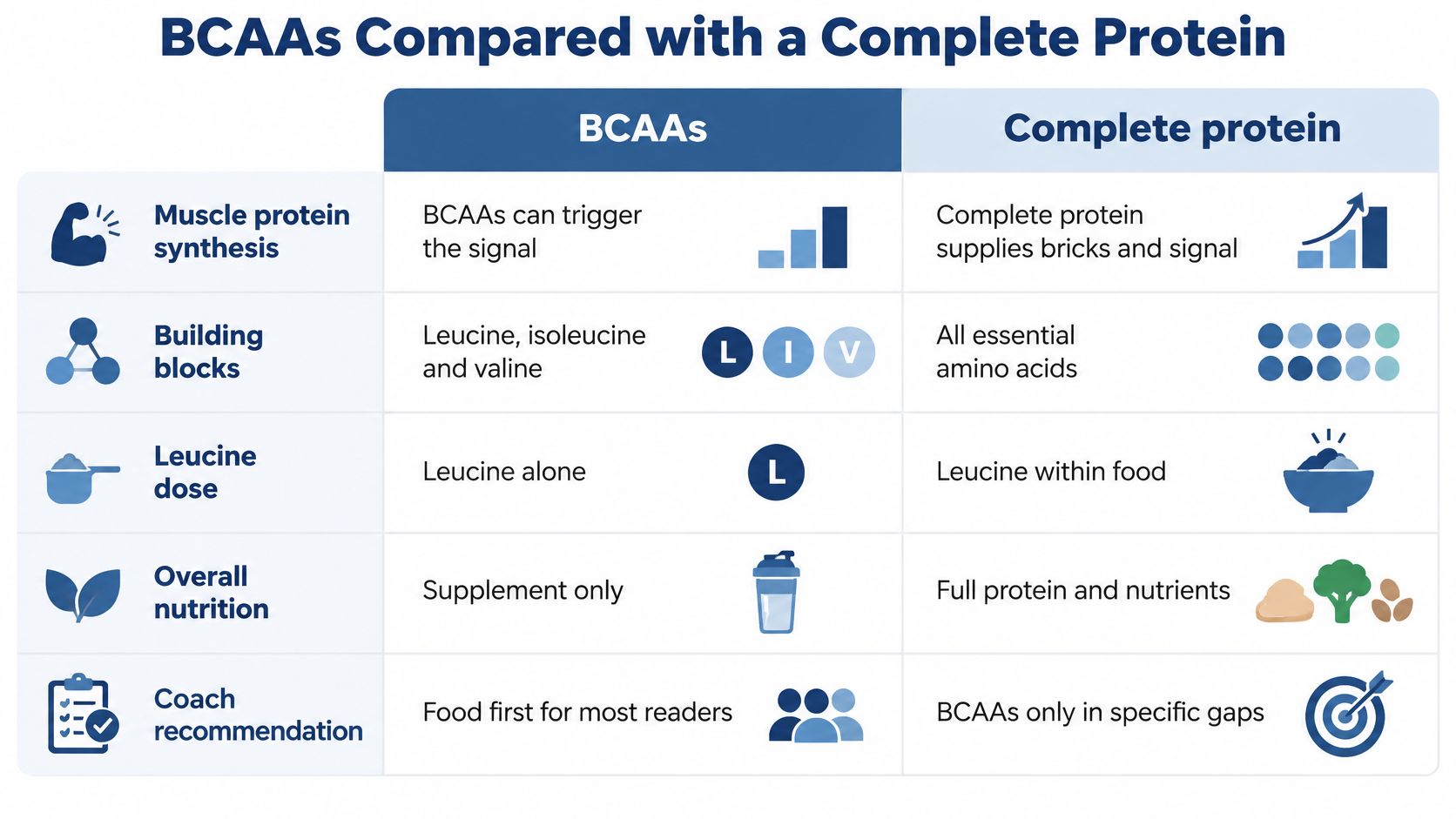
Isolated BCAAs versus complete protein after training
| Question | Isolated BCAAs | Complete protein |
|---|---|---|
| Muscle-protein synthesis after training | Can produce a short-lived rise compared with placebo | Produces a fuller response by supplying all indispensable amino acids |
| Blood leucine after consumption | Supplies leucine directly as part of the mixture | Supplies leucine within the food or shake |
| Other amino acids supplied | Leucine, isoleucine and valine only | All indispensable amino acids needed to assemble protein |
| What the evidence supports | A limited signalling effect, not proof of superior long-term gains | The stronger default for meeting protein needs |
| Sensible use | A possible stopgap when complete protein is impractical | First choice after training and across the day |
The first distinction is effect size versus ingredient presence. A product containing leucine can activate a relevant process without producing the same overall response as complete protein.
The next distinction is nutritional coverage. A BCAA drink supplies selected amino acids. A protein-containing meal can also supply energy and other nutrients, although exactly what you get depends on the food. A plain protein powder is convenient, but it shouldn't automatically be treated as nutritionally identical to a meal.
Choose according to the job
If you need something portable after lifting, a complete shake is usually the more rational purchase. Our explanation of whey protein benefits can help you decide whether whey fits your preferences and routine.
If you're training for endurance, don't confuse muscle nutrition with fuelling and hydration. Atlanta Hyperbaric Center's guide to carbohydrates and electrolytes for endurance is a separate resource for thinking about those needs, rather than treating an amino-acid drink as an all-purpose sports drink.
For an additional explanation of the protein question, the video below offers another way to approach the comparison.
Faster strength gains, greater muscle size and better performance are separate claims. A brief increase in protein synthesis doesn't settle any of them, and neither a diagram nor a product's ingredient list substitutes for trials measuring those outcomes.
Someone who won't eat or drink complete protein after training might still choose BCAAs as a limited bridge. Someone who can manage a shake, yoghurt or meal has a more complete option available.
Choose the product that fills the nutritional gap, not the one with the most specialised-sounding label.
Who May Notice a Difference from BCAAs
A resistance-trained young man, an older adult worried about weakness, and a recreational runner may all ask, “What do BCAAs do?” They aren't necessarily asking the same practical question, and evidence from one group shouldn't automatically become advice for the others.
The important distinctions are who took the supplement, what they were compared with, and what researchers measured. Feeling less sore isn't the same outcome as getting stronger.
These different starting points matter when interpreting supplement claims.
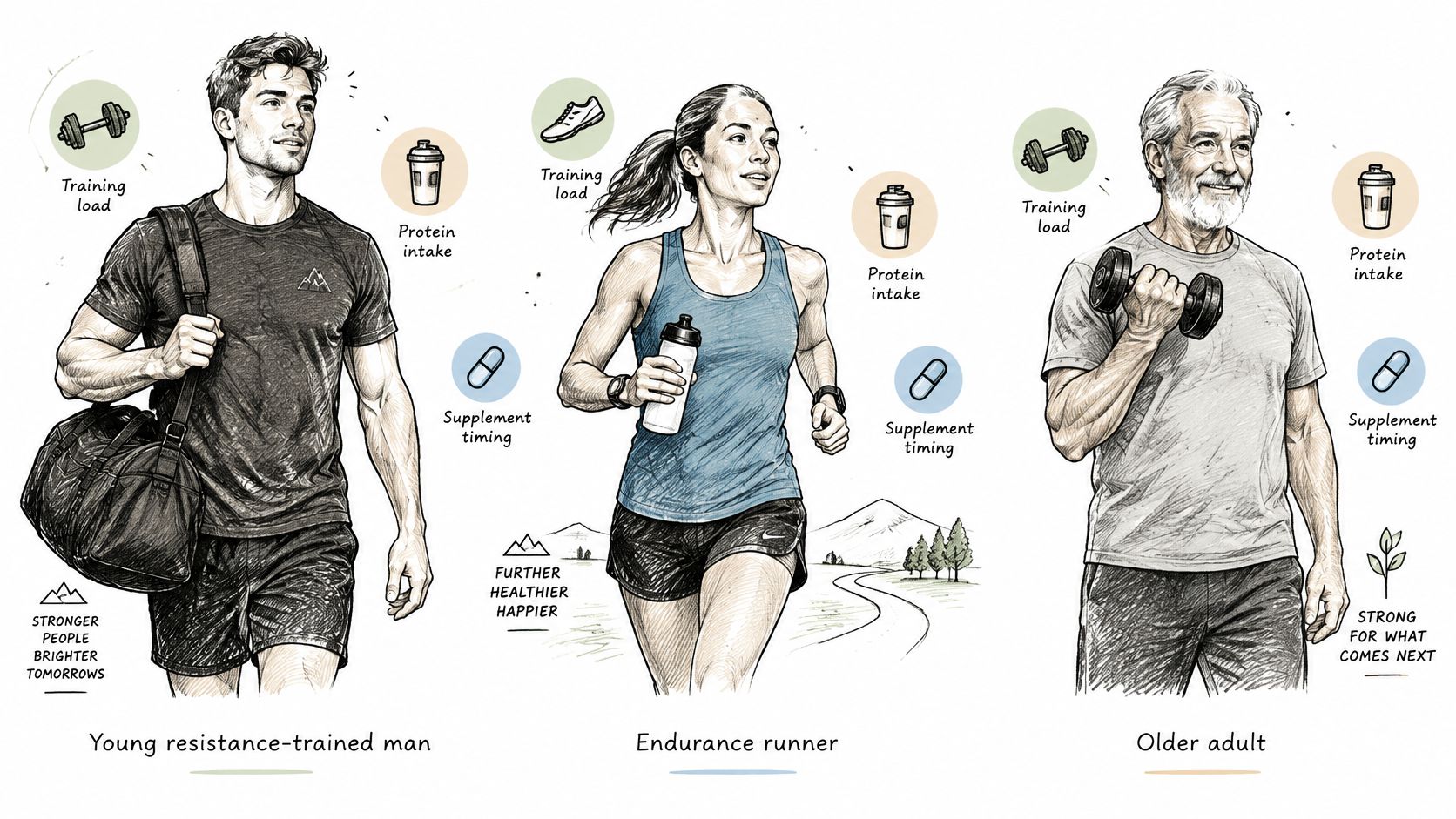
The trained lifter and the older adult
Small supplement trials in resistance-trained men offer limited support for changes in muscle-damage markers and short-term recovery. Those are potentially useful findings, but they don't establish that the men gained more muscle or performed better over a sustained training programme.
For an older person, the question is more consequential: can a supplement preserve independence? A 2024 study in BMC Geriatrics involving 108,017 UK adults found that higher circulating total BCAAs, leucine and valine were associated with greater muscle mass and strength, while higher valine was associated with 47% lower odds of sarcopenia.
Sarcopenia concerns loss of muscle strength and muscle quantity or quality. However, this was cross-sectional research, meaning the investigators examined measurements at a particular point rather than assigning people supplements and following the results.
It therefore can't show that buying BCAA powder prevents sarcopenia, increases strength or stops falls. A blood measurement associated with better muscle status isn't a treatment recommendation.
Keep the outcomes separate
When reading a claim about recovery, check what the word means:
- Perceived soreness: How uncomfortable someone feels after exercise.
- Damage markers: Laboratory measurements that may change after strenuous activity.
- Hypertrophy: An increase in muscle size.
- Strength: The ability to produce force.
- Sports performance: A meaningful improvement in the activity itself.
- Fall prevention: A practical health outcome requiring direct assessment.
Limited evidence for the earlier items doesn't establish the later ones. A lower damage marker isn't automatically a better race result or a safer walk downstairs.
For women, endurance athletes, recreational gym users and people already eating adequate protein, a benefit shouldn't be assumed from a small trial in trained men. That doesn't prove nobody in those groups could benefit; it means the claim hasn't been established for them.
BCAAs are most plausible as a modest extra when hard training coincides with a genuine nutrition gap. Even then, filling the gap with complete protein is generally the more useful question to investigate first.
Circulating Levels Are Not the Same as a Powder
A blood BCAA reading and a BCAA drink are different exposures. A laboratory test measures what's circulating in your blood. A supplement is something you swallow, with a particular composition and pattern of use.
Confusing the two can turn a health headline into an unjustified warning or sales pitch. Higher blood BCAAs don't, by themselves, prove that a powder built muscle or caused disease.
The amino acids don't share every health association
In a UK Biobank analysis of 97,469 people, 44% of significant phenotype associations applied to only one BCAA; examples included valine's links with diabetic eye disease and albuminuria, and isoleucine's link with angina.
A phenotype is a measurable trait or health characteristic. These distinct associations are a reason not to discuss leucine, isoleucine and valine as though they were a single substance with a single effect.
Genetic analyses also suggest that increased circulating BCAAs can be a consequence of poorer metabolic health rather than its cause, although a possible relationship with abnormal blood fats remains an exception worth investigating. These methods help examine cause and effect, but they aren't supplement trials.
Blood BCAA levels versus a BCAA supplement
| Question | Circulating blood BCAAs | BCAA supplement |
|---|---|---|
| What it is | A measured level in the blood | A dose of leucine, isoleucine and valine |
| Are the amino acids the same? | No; some health links concern only a particular amino acid | Packaged together, despite their different roles |
| Higher level and metabolic health | May mark poorer metabolic health rather than cause it | Supplement use isn't equivalent to that blood pattern |
| Does it prove muscle gain? | An association with muscle status doesn't prove a powder works | Short-term synthesis findings don't establish lasting gains |
| Can it prove a drink causes disease? | Observational associations can't establish that | The drink isn't the exposure those studies measured |
The contrasting headlines make the distinction especially important. A 2024 UK Biobank study in Frontiers in Nutrition followed 247,753 participants for 12 years and associated higher total circulating BCAAs with a 49% lower gastric-cancer risk, with a hazard ratio of 0.51.
Meanwhile, a 2025 UK Biobank cardiovascular analysis found that participants in the highest circulating-BCAA quintile had a 7%–12% higher risk of major adverse cardiovascular events than those in the second quintile.
Neither finding establishes what happens when you add a training drink. They don't justify selling BCAAs as cancer protection, and they don't prove that a scoop causes heart events.
For your own decision, adequate high-quality protein is more useful to assess than an isolated headline. If you have kidney disease, metabolic illness or another medically managed condition, discuss supplementation with your clinician or dietitian first.
Cover Protein from Food Before Any BCAA Scoop
Start with your plate, not the supplement shelf. Dairy, whey, eggs, meat, fish and soy already contain BCAAs within complete protein, so you may be consuming the ingredients you're considering buying separately.
The practical task is to identify a real shortfall. A breakfast with little protein, a missed lunch and an amino drink after training aren't the same as a day built around adequate meals.
Use the checklist as a prompt to review your routine, rather than as a personalised prescription.
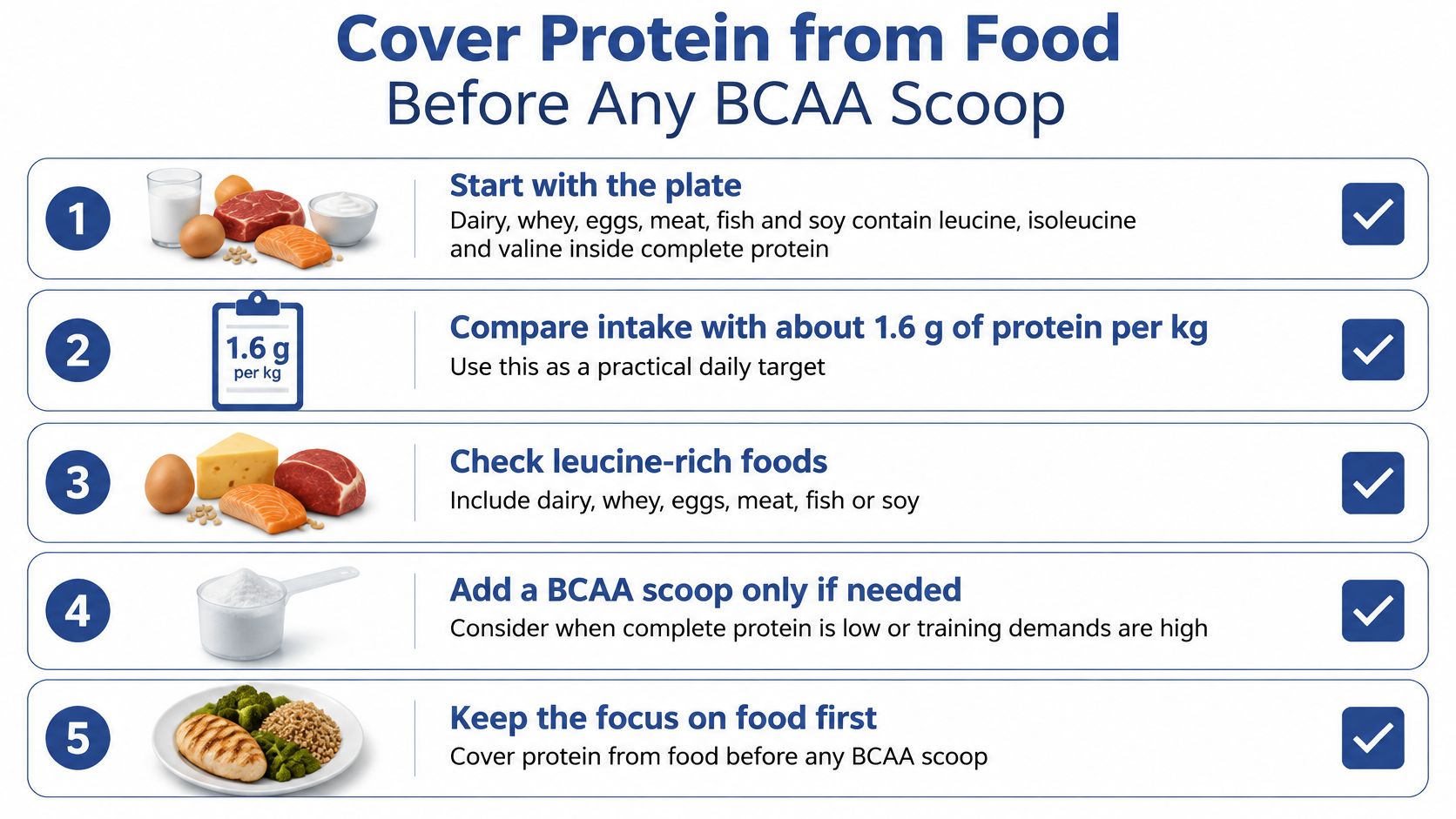
Check what you're actually eating
Write down your usual meals, snacks and drinks, then use food labels to estimate their protein contribution. Include ordinary rest days as well as training days, because a carefully planned post-workout shake can hide an otherwise inconsistent routine.
For help interpreting your needs, use our guide to how much protein you need per day. Your training, body size, age, appetite and medical circumstances matter, so don't treat a general target as an individual prescription.
- Find the weak meal: If breakfast is toast and tea, consider yoghurt, eggs or a suitable soy option rather than adding an amino drink later.
- Plan for your training location: Keep a complete shake available if you regularly leave the gym without access to food.
- Match the choice to your preferences: A food you enjoy and can reliably eat is more useful than an elaborate plan you abandon.
Fill the gap with complete nutrition
If the main difficulty is eating after exercise, choose something manageable: yoghurt and fruit, eggs on toast, a soy-based snack or a complete protein drink. You don't need a special recovery meal if an ordinary meal fits comfortably into your day.
For outdoor sessions, portability deserves some thought. HYDAWAY's trail-ready dairy nutrition tips offer a food-focused resource, but check storage requirements and keep perishable foods appropriately chilled.
A BCAA drink may be easier to tolerate when appetite is low. Treat that as a convenience choice, not evidence that it provides everything you need. If poor appetite repeatedly prevents adequate eating, seek dietary advice rather than continually replacing food with a flavoured drink.
Shopping check: Read the individual amino-acid amounts, not just the total blend weight or the recovery slogan.
If you still want an isolated product, our sports nutrition range includes BCAA options alongside complete proteins. Compare the label's leucine, isoleucine and valine amounts, and be sceptical of instant-muscle or fat-loss promises.
Don't copy a research dose as though it were a universal daily requirement. The evidence doesn't establish an ideal BCAA schedule for every training routine, and precise timing won't correct an inadequate diet.
The best purchase may therefore be a convenient protein food, a complete shake or nothing additional. Choose after you've identified the problem, and get professional advice before changing protein or amino-acid intake if a clinician manages your kidney or metabolic health.
We offer whey and vegan proteins, BCAA supplements, and hydration and recovery products to help you compare options for your training routine. Visit Vitamin Planet to check ingredient labels and choose a product that fills a genuine gap, with complete protein as your starting point.