

Probiotics for Gut Health UK How to Choose Wisely
You're standing in a UK chemist or browsing online after another bout of bloating, constipation, or unpredictable digestion. The shelf offers capsules labelled with billions of bacteria, multiple strains, added fibre, delayed-release technology, and promises of “balance”. One product says it supports everyday digestion, another focuses on women's health, and a third appears designed for use after antibiotics. Choosing can feel less like shopping and more like decoding a laboratory report.
This guide takes a calmer approach to probiotics for gut health in the UK. It won't present probiotics as a cure-all or tell you that one formula suits everyone. Instead, it explains what probiotics are, why strain names matter, how to read CFU information, what UK shoppers should check on a label, and how to use a product sensibly for general maintenance, IBS considerations, or antibiotic-related needs.
The NHS describes probiotics as “friendly bacteria” found naturally in the gut. Its guidance also says there's some evidence they may help with IBS, while evidence for many other health claims remains limited (NHS guidance on probiotics). A few practical principles can make the crowded shelf much easier to manage.
Table of Contents
- Introduction to Probiotics for Everyday Gut Health
- What Probiotics Are and How They Work in Your Gut
- Where the Evidence for Probiotics Is Strongest and Where It Falls Short
- Key Strains CFU Guidance and How They Differ
- How to Choose a Probiotic Product in the UK
- Dosage Timing Side Effects and Practical Use for Different Needs
- Making a Confident Choice and Next Steps for Your Gut
Introduction to Probiotics for Everyday Gut Health
The first useful question isn't “Which probiotic is strongest?” It's “What am I trying to achieve?” Someone looking for general digestive support may make a different choice from someone discussing IBS with a GP, or someone considering a probiotic around an antibiotic course. Without that starting point, a high CFU number or a long list of strains can look persuasive without telling you whether the product fits your situation.
Think of probiotics as one possible tool within a wider routine. They're live microorganisms, usually bacteria or yeasts, supplied through foods or supplements. They may interact with the existing gut microbiome, but taking a capsule doesn't mean you're permanently replacing your resident bacteria or repairing every digestive problem.
A sensible expectation: a probiotic may support a specific purpose for some people, but it isn't a substitute for diagnosis, treatment, fibre, fluids, or a varied diet.
The NHS takes a particularly important position for UK consumers. It doesn't present probiotics as an essential daily supplement for healthy people, and it highlights the limited evidence behind many broad claims. If you have an existing condition or a weakened immune system, the NHS advises checking with a doctor before trying one (NHS advice on suitability and use).
For many people, the practical process is straightforward:
- Define the need. General gut support, a diagnosed condition, or a specific antibiotic-related question requires different levels of caution.
- Identify the formulation. Look for named strains, a clearly stated CFU amount, storage instructions, and a meaningful expiry date.
- Use it consistently. If you choose to try one, the NHS advises daily use for at least four weeks before judging whether it's useful.
- Review your response. Track symptoms rather than assuming that a more expensive or higher-strength product must be better.
Vitamin Planet's broader guide to supporting a healthy digestive system can sit alongside this approach, particularly if you're also reviewing food, fluids, and daily habits. The aim is simple: understand enough to choose deliberately, then know when a pharmacist or GP should be involved.
What Probiotics Are and How They Work in Your Gut
Probiotics are a practical tool within a wider routine for digestive wellbeing. Your gut microbiome is an ecosystem, not a single “good bacteria” switch. The microbes already living there occupy different spaces and interact with their surroundings. A probiotic introduces selected live microorganisms that may influence this environment while they pass through, without necessarily becoming permanent residents.
Prebiotics have a different role. They are types of fibre that provide food for microbes already present. A probiotic capsule therefore cannot replace a fibre-rich diet. This organic tea and probiotics connection explains how prebiotics and probiotics can work alongside each other.
Why the strain matters
A label showing Lactobacillus or Bifidobacterium identifies the genus, but not the complete organism. The species and strain give a more specific identity. Two products may contain bacteria from the same species while differing in their research evidence, manufacturing characteristics, and intended use.
Strain information is therefore more useful than a large headline count on its own. Effects can depend on the specific strain or combination, the dose, the formulation, and the person taking it. Since the microorganisms may pass through the gut rather than permanently colonise it, follow the product directions when assessing whether it suits you.
Understanding CFU
CFU means colony-forming units. It estimates the viable microorganisms capable of forming colonies under testing conditions. A careful label should make clear whether the stated amount is guaranteed through the expiry date, rather than measured only when the product was made.
Storage can change viability too. Heat, moisture, oxygen, and time may affect a formulation. Some products need refrigeration, whereas others are designed for room-temperature storage. Follow the manufacturer's instructions. A higher CFU figure does not correct for unsuitable storage.
Reusable label rule: read the strain identity, viable count at expiry, storage guidance, and intended use together. A headline number on its own tells you very little.
Reading the label this way also separates products designed for different purposes. For example, BrainQuick Brain Support Supplement is described as a vegetarian vitamin and mineral blend for focus and brain function, not as a probiotic. A product displayed in the supplement aisle is not automatically relevant to every health goal.
Where the Evidence for Probiotics Is Strongest and Where It Falls Short
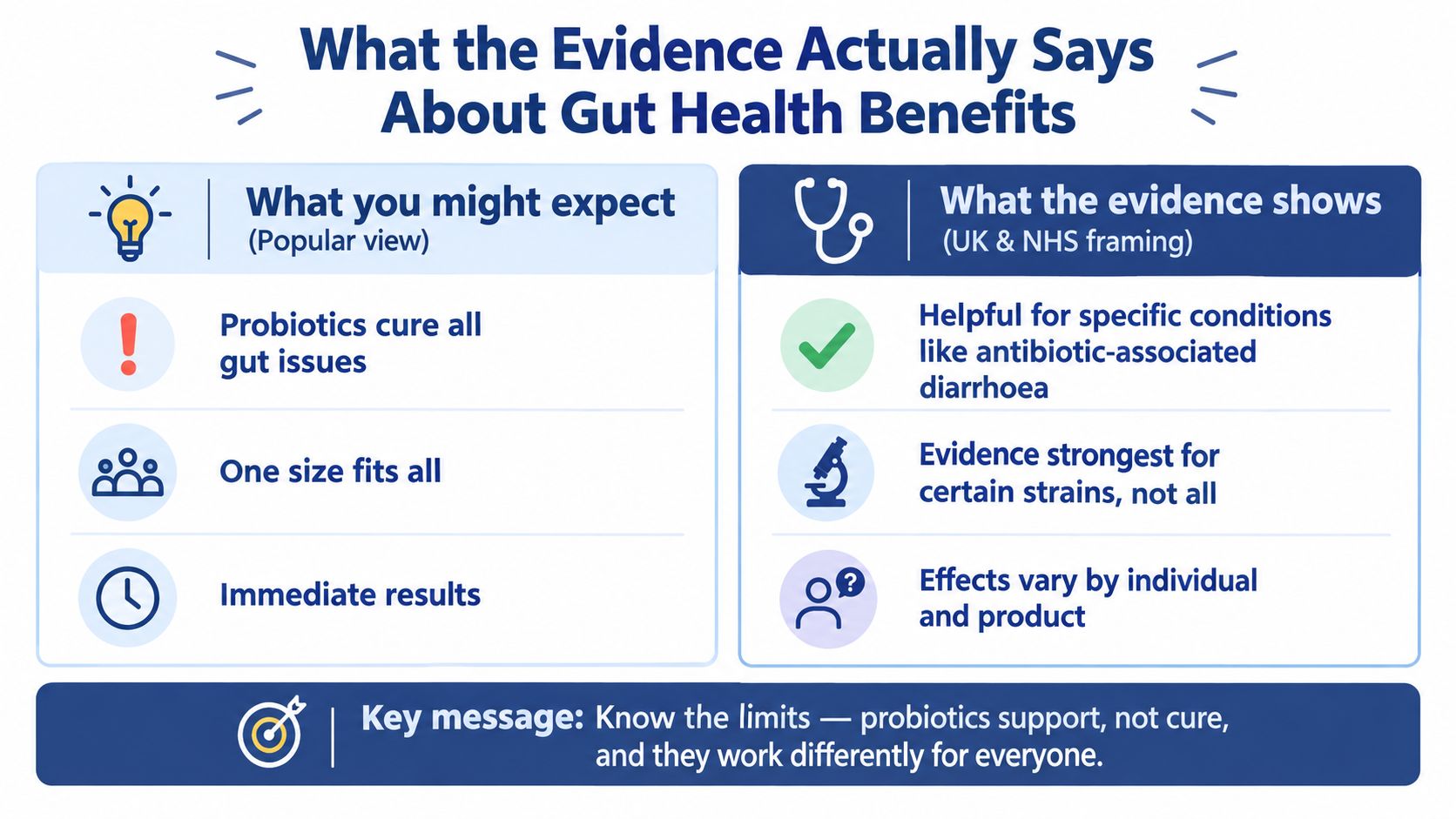
UK shoppers show strong interest in probiotics, while reported benefits remain less certain. A 2025 UK report cited annual consumer spending of about three quarters of a billion pounds and described one in five UK adults as regular users (Good Housekeeping's UK discussion of probiotic use). Among those regular users, 56% of women said they took probiotics for “general gut health and digestion”, while 77% reported no significant health improvements, according to the same source.
These figures do not prove that probiotics are ineffective. They show why a broad promise such as “better gut health” needs careful interpretation. Someone may buy a product for everyday digestive wellbeing, yet the supporting evidence may apply only to a particular condition, formulation, or named strain.
Where the NHS framing is strongest
The NHS says there is some evidence that probiotics may help with IBS, while evidence for many other health claims is limited. “May help” describes a possibility, not a guaranteed result. Evidence linked to one strain or condition cannot automatically be applied to every capsule on a UK shelf.
The NHS also advises a daily trial lasting at least four weeks if you choose to use a probiotic. This creates a sensible point for reviewing whether it seems useful, although improvement is not guaranteed within that time. Stop if symptoms worsen or the product causes problems, and seek appropriate advice rather than continuing to complete the trial.
Why everyday claims can sound bigger than the evidence
Labels and adverts may use phrases such as “gut balance”, “detox”, or “immune support”. These can describe how a product is positioned, rather than a clinically established outcome for every person. Before buying, ask:
- Is the claim linked to a named strain?
- Is the intended use clear?
- Does the label state the viable count and storage requirements?
- Am I addressing a diagnosed condition or trying general support?
- Could my symptoms have another cause that needs medical assessment?
This checklist turns evidence into a shopping decision. It also helps separate a product's marketing language from what research has specifically examined.
UK prescribing guidance indicates that probiotics are not routinely recommended in primary care for many indications because the evidence is insufficient. Some local protocols support prophylactic use only for narrowly defined high-risk patients taking broad-spectrum antibiotics, rather than giving a general instruction for everyone (South West London probiotic position statement).
The balanced conclusion is practical: probiotics may be reasonable for a defined purpose, but they are not a routine requirement for every healthy adult. A cautious trial, clear labelling, and professional advice for vulnerable people offer a safer basis for choosing than promises of universal transformation.
Key Strains CFU Guidance and How They Differ
Probiotic labels often group organisms by genus, species, and strain. You may see names from the Lactobacillus, Bifidobacterium, or yeast groups, including Saccharomyces. These labels help you identify what's in the capsule, but they don't automatically prove that the product will suit your symptoms.
The most useful comparison is not “Which group is best?” It's “Which named organisms and formulation match the purpose I'm considering?” Evidence is strain-specific, and a product containing several organisms isn't automatically more appropriate than a carefully selected single-strain product.
A practical comparison
The CFU bands below describe the kinds of figures shoppers commonly encounter on UK labels. They're a shopping aid, not a universal prescription or proof of effectiveness.
| Strain Group | Example Strains | Commonly Discussed For | Typical CFU Range on UK Labels |
|---|---|---|---|
| Lactobacillus group | L. acidophilus, L. rhamnosus | General digestive formulations and products discussed around antibiotic-related use | From millions to many billions |
| Bifidobacterium group | B. bifidum, B. longum | Multi-strain digestive products and formulations aimed at broader microbiome support | From millions to many billions |
| Saccharomyces group | S. boulardii | Some products discussed for antibiotic-associated digestive concerns | Often stated in billions, with the exact amount varying by product |
| Multi-strain blends | Several named bacterial strains | General formulations where manufacturers combine different organisms | May range from a modest total to a high total CFU |
What the number can and can't tell you
A larger CFU figure doesn't automatically mean a stronger result. Different strains may have been studied at different amounts, and viability at expiry, protective packaging, and storage can matter as much as the headline count.
Look for the full designation where available. A label that says only “probiotic blend” gives you less information than one that names the genus, species, and strain code. Check whether the CFU amount applies to each strain or to the total blend, because those are very different descriptions.
Diversity can be useful in some formulations, but complexity also makes a product harder to evaluate. If you're choosing for a specific medical purpose, discuss the named strain and dose with a pharmacist or clinician rather than selecting by the biggest “billions” claim.
Decision shortcut: a clearly identified, suitably stored product with a relevant strain profile is more informative than an impressive CFU number without context.
How to Choose a Probiotic Product in the UK
You are standing in a chemist comparing two probiotic tubs. One highlights billions of live cultures, while the other lists several strain codes in smaller print. The clearer choice comes from reading the label in context, then checking whether the product suits your purpose, routine, and storage options.
Start with the identity
Look for the genus, species, and strain designation. “Contains probiotics” provides too little information for a useful comparison. Check whether the CFU figure is guaranteed through the expiry date or measured only at manufacture. A guarantee at expiry gives a better indication of what you are expected to receive near the end of the product's shelf life.
The most useful question is which named organisms and formulation match the purpose you're considering. Use the label as a checklist:
- Strain disclosure: Named organisms are easier to assess than an unnamed proprietary blend.
- Total versus individual CFUs: Confirm whether the figure applies to the whole serving or to each strain.
- Storage: Follow instructions about refrigeration, heat, moisture, and opening.
- Expiry: Buy an amount you can sensibly use before the product goes out of date.
- Allergens: Check milk, soya, gluten, and other declarations relevant to you.
- Dietary suitability: Look for clear vegan or vegetarian information instead of assuming from the capsule shell.
- Delivery conditions: UK dispatch from London with tracked services can make the delivery journey easier to follow. Store the product correctly when it arrives.
Match the format to your routine
A refrigerated capsule may be awkward if you travel often. A shelf-stable product can fit a cupboard-storage routine, provided you follow its instructions. Delayed-release coatings, delivery technology, and protective packaging may support viability, but they do not replace checking the actual label.
For example, Bio-Kult Mind 60 capsule is a multi-strain formulation with added zinc and does not require refrigeration. That may suit someone who wants simpler storage. Convenience alone cannot show whether the product matches a particular symptom or condition.
Vitamin Planet categorises products across supplement and wellbeing needs, which can help narrow a search before you compare detailed labels. Its catalogue includes own-label and third-party products, with some UK-made own-label products manufactured to GMP standards. Treat those details as background, then assess each product using its ingredient panel and instructions. For considerations that may be specific to women, see this guide to probiotics for women.
If you are also considering fibre, read about inulin powder in the UK. Prebiotic fibre can affect digestion differently from a probiotic, especially when increased quickly. Introducing several new products together can make your response difficult to interpret.
Dosage Timing Side Effects and Practical Use for Different Needs
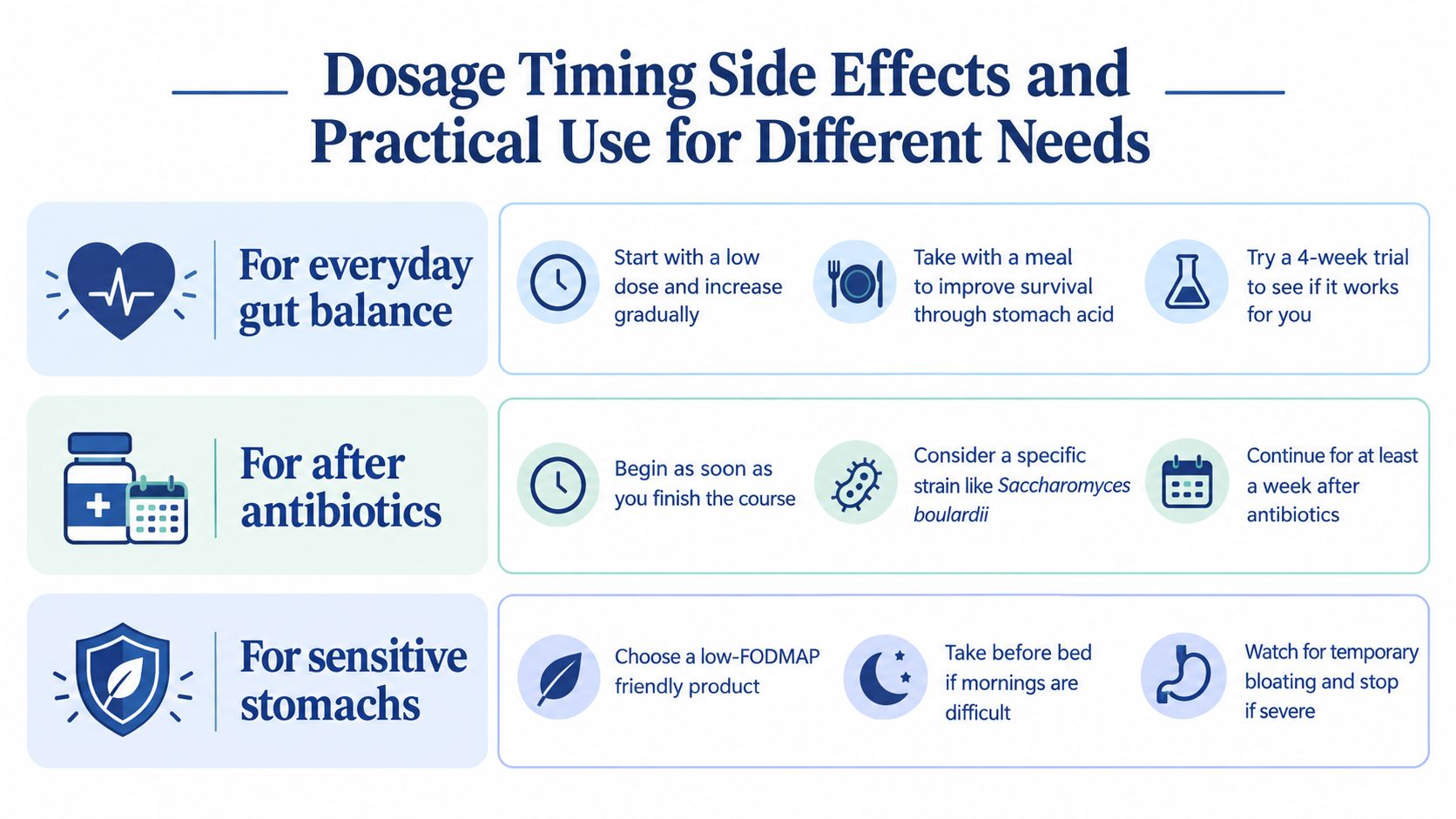
The most useful routine is one you can follow consistently and evaluate calmly. Start with the manufacturer's recommended serving, rather than increasing the dose because a product seems mild. Taking several new supplements together can also make it hard to identify what caused a change in bloating, stool pattern, or discomfort.
For general maintenance, choose a clear daily routine linked to something you already do, such as breakfast. Some people find taking a capsule with food easier on the stomach, but the product's own instructions should take priority. Keep a short diary noting the product, serving, bowel pattern, bloating, pain, and any other relevant change.
Three common reasons for trying one
General digestive support calls for modest expectations. The NHS advises a daily trial for at least four weeks if you decide to use a probiotic, so assess the pattern over time rather than judging it after a single dose. If nothing improves, that's useful information, not a reason to keep escalating the dose indefinitely.
IBS needs a more individual approach. The NHS acknowledges some evidence for probiotics in IBS, but doesn't present every product as interchangeable. If you have persistent, severe, or unexplained symptoms, speak with a GP instead of relying on a supplement trial.
Antibiotic-related use requires particular care. One NHS-linked local protocol advises taking a probiotic two hours before or after antibiotics because concurrent administration can reduce the effect, and continuing for seven days after the antibiotic course in high-risk cases (the NHS-linked timing protocol). That protocol is for narrowly defined high-risk situations, so don't treat it as a universal instruction. Ask a pharmacist whether it applies to you.
What to do about side effects
Temporary gas or bloating can occur when introducing a new digestive supplement. Stop and seek advice if symptoms are severe, persistent, or concerning. Anyone with a weakened immune system or an existing medical condition should check with a doctor before using probiotics, as advised by the NHS.
Gut health is also influenced by ordinary habits. Add fibre gradually, drink enough fluid for your needs, and include a varied diet if you tolerate it. Fermented foods may suit some people, but they aren't mandatory, and dietary changes should be adapted if you have diagnosed IBS or known food triggers.
A product such as BioBees Fresh Royal Jelly is a separate supplement rather than a probiotic. Its directions say to take the recommended serving preferably in the morning, store it in a cool place, refrigerate after opening, and avoid it if you're allergic to bee products. Keeping products with different purposes separate helps you avoid assuming that every wellness supplement supports the gut in the same way.
Making a Confident Choice and Next Steps for Your Gut
A sensible probiotic decision follows a clear order. First, identify the reason you're considering one. Then check the named strain or strains, the CFU statement, the serving instructions, the expiry basis, and the storage requirements. Finally, ask whether the product fits your routine well enough for you to use it consistently and review the result.
For general wellbeing, probiotics should sit alongside everyday gut-supportive habits rather than replace them. Gradually increasing tolerated fibre, drinking fluids, eating a varied range of foods, and including fermented foods where suitable can provide broader dietary support. If you have IBS, use personalised guidance because foods that are helpful for one person may aggravate symptoms in another.
Keep the NHS position in view. Evidence is more specific than the marketing category, and a lack of improvement doesn't mean you chose badly. It may mean the product, strain, dose, or purpose wasn't a match, or that your symptoms need a different explanation.
Seek medical advice for severe or persistent symptoms, or before using probiotics if you have an existing condition or weakened immune system. For antibiotic-related use, ask a pharmacist whether a local protocol applies to your circumstances rather than copying someone else's schedule.
Vitamin Planet provides a UK-based catalogue of probiotics and other supplements, with products dispatched from London using tracked services. Compare the full labels, choose a product that matches your reason for use, and record how you respond before deciding whether to continue.
Explore the Vitamin Planet probiotic range to compare named strains, CFU information, formats, and storage instructions in one place. Choose cautiously, follow the product directions, and speak with a pharmacist or GP when your symptoms or health history call for personalised advice.