

Vitamin D3 Magnesium
If you already take vitamin D3 every winter, have you ever stopped to ask a simpler question: is vitamin D really the only gap you're trying to fill?
A lot of UK shoppers take a daily D3 tablet because that's the familiar advice. They're not wrong to do that. But many never check the other half of the equation. Magnesium often gets treated like an optional extra, when the more useful question is this: given that UK diets commonly fall short on both nutrients, which one is your real weak point, and should that change what you buy?
That's where the vitamin D3 magnesium conversation becomes practical. Not trendy. Not abstract. Practical. If D3 is already in your routine, magnesium is worth a proper look, especially if your diet is patchy, you rely on convenience foods, or you've assumed that one small vitamin D capsule covers the whole job.
Table of Contents
- Why Vitamin D3 and Magnesium Are Often Talked About Together
- What UK Intake Data Tells Us About Both Nutrients
- How Magnesium Supports Vitamin D3 in the Body
- Recommended Doses and Safe Upper Limits in the UK
- Choosing the Right Magnesium Form for Your Goal
- When and How to Take D3 and Magnesium Together
- Spotting Low Intake Versus True Deficiency
- Your Practical D3 and Magnesium Checklist
Why Vitamin D3 and Magnesium Are Often Talked About Together
If a D3 tablet is already part of your winter routine, is vitamin D really the only gap that matters?
For a lot of UK shoppers, the pattern is familiar. A bottle of vitamin D3 sits by the kettle, and one small tablet becomes part of the morning. That habit makes sense. The NHS advises that everyone aged 4 and over should consider taking 10 micrograms of vitamin D each day during autumn and winter, and some people at higher risk are advised to take it year-round, as set out in NHS vitamin D guidance.
The part that often goes unchecked is magnesium intake.
Shoppers who already take daily D3 rarely stop to ask a more practical question. If D3 is covered, is magnesium the weak point, and would that change what you buy?
That question comes up because these two nutrients are linked inside the body. Vitamin D3 is the nutrient you swallow. Magnesium helps the enzymes that convert vitamin D into the forms your body can use. Enzymes are small proteins that speed up body processes. You can picture them as workers on an assembly line. If enough workers are missing, the raw material still arrives, but processing slows down.
Practical rule: D3 is the nutrient you take. Magnesium helps your body put that D3 to work.
This is why the pairing gets attention. Not because everyone needs a second supplement by default, but because a D3-only routine can miss the more useful buying question. Are you low in vitamin D intake, low in magnesium intake, or low in both?
That distinction matters in the UK. Vitamin D gets the headlines because sunlight is unreliable for much of the year, especially in autumn and winter. Magnesium is quieter. There is no equivalent seasonal reminder, so it is easy to assume your intake is fine without ever checking your diet.
A two-part system: D3 and magnesium
D3 and magnesium do different jobs. D3 is the nutrient added to your routine. Magnesium helps with the behind-the-scenes processing. A simple way to view it is this. Buying D3 gives your body the material. Having enough magnesium helps the body handle that material properly.
That does not automatically mean you need a magnesium supplement. It means the smart next step is to work out where your actual gap is, rather than assuming the answer is always “more D3.”
What UK Intake Data Tells Us About Both Nutrients
UK data tells a blunt story. These are two separate intake problems, and they often overlap in the same person.
The strongest national picture comes from UK dietary survey work. For magnesium, mean intakes from food were below the Reference Nutrient Intake in several age groups, including adults aged 19 to 64 at 89% of the RNI and adults aged 65 and over at 87%, according to the National Diet and Nutrition Survey report. The same report found 19% of adults aged 19 to 64 and 13% of adults aged 65 and over had magnesium intakes below the Lower Reference Nutrient Intake.

For vitamin D, the base diet is even weaker. Analysis of UK intake patterns found that more than 99% of the UK population failed to meet the vitamin D RNI from the base diet, while magnesium shortfalls affected 42% of the total population on a base diet, with especially high shortfalls in older children and teenagers, as reported in this Cambridge analysis of UK micronutrient intakes.
UK Intake Snapshot: Magnesium and Vitamin D
| Nutrient | Adults 19–64 (% of RNI/RNI target) | Adults 65+ (% of RNI/RNI target) | Common dietary sources |
|---|---|---|---|
| Magnesium | 89% of RNI | 87% of RNI | Nuts, seeds, wholegrains, pulses, leafy greens |
| Vitamin D | More than 99% fail to meet RNI from base diet | More than 99% fail to meet RNI from base diet | Oily fish, eggs, fortified foods |
What these numbers mean in real life
Shoppers get confused. They assume “low” means “clinically deficient”. It doesn't. Often it means your everyday intake isn't enough.
A person can take D3 faithfully every winter and still have a low-magnesium diet. That might look like skipping nuts and seeds, eating few beans or wholegrains, and relying on a small range of foods. In that situation, your D3 habit may still be sensible, but it might not be the only purchase worth reviewing.
If you use multi-ingredient products, check the label rather than assuming a broad formula covers everything. For example, BrainQuick Brain Support Supplement (30 Capsules) is described as a vegetarian vitamin and mineral blend for focus and brain function, which means a shopper would still need to read the nutrient panel closely instead of assuming it supplies the same vitamin D3 magnesium support as a dedicated product.
The practical takeaway isn't “everyone needs more supplements”. It's “don't guess which gap you have”.
How Magnesium Supports Vitamin D3 in the Body
Why can someone take vitamin D3 every morning and still miss part of the picture?
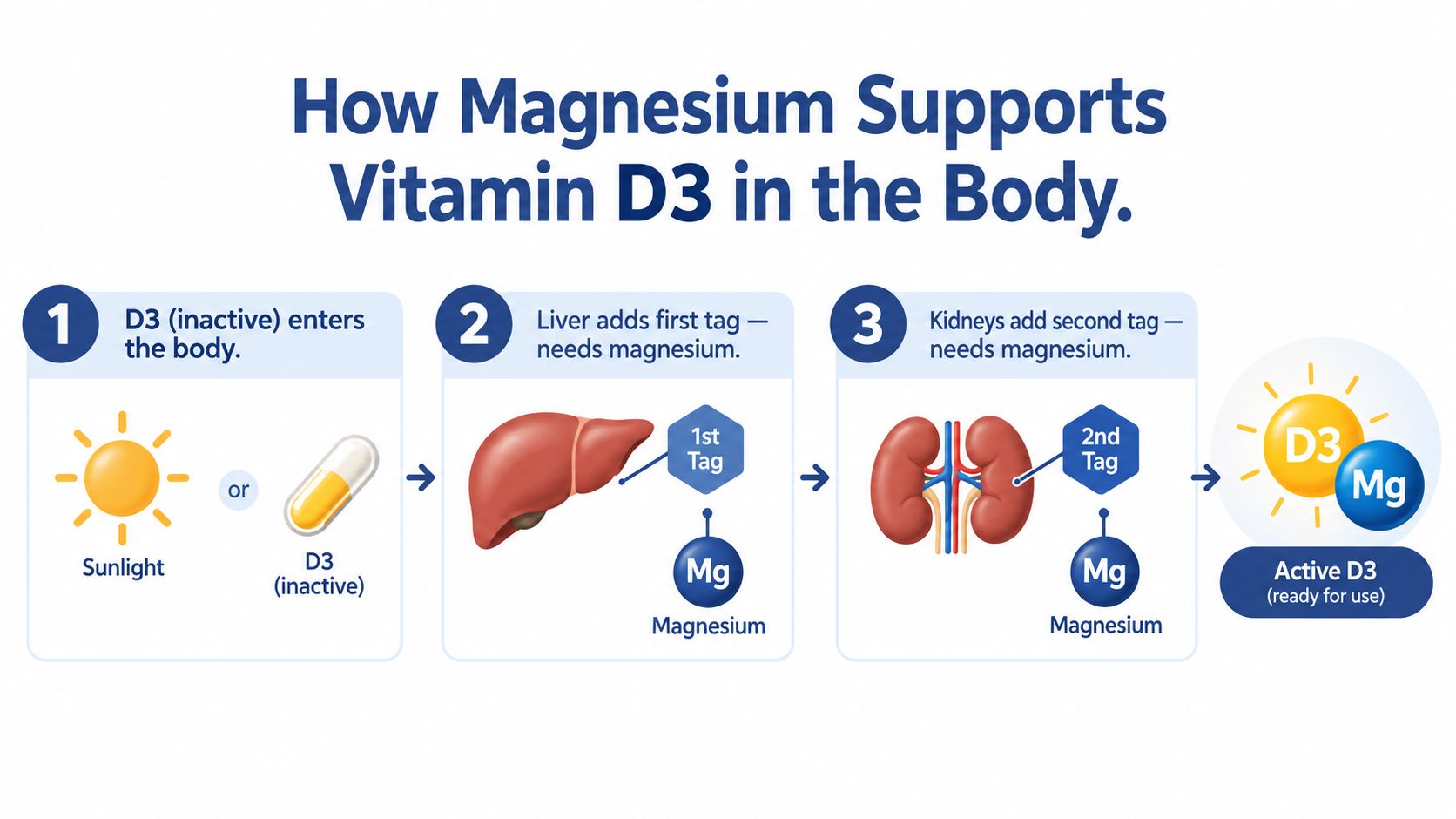
Because swallowing D3 is only the first step. Your body still has to convert it into forms it can use, first in the liver and then in the kidneys.
The two-step activation process
Vitamin D3 starts out in a less active form. The liver changes it into one form, and the kidneys convert it again into the form the body uses to help regulate calcium and support normal muscle and immune function.
Magnesium helps with that process because it acts as a cofactor for the enzymes involved. Cofactor sounds technical, but the idea is simple. These enzymes work with magnesium alongside them.
So the D3 and magnesium link is not just about taking two nutrients in the same capsule. It is about whether your body has what it needs to process the D3 you already bought.
Why this matters in practice
This matters most for the UK shopper who already takes D3 but has never checked magnesium intake.
If your usual diet includes few nuts, seeds, pulses, wholegrains or leafy greens, magnesium may be the more obvious gap. In that case, buying a higher-strength D3 product may not be the smartest next move. Reviewing your magnesium intake could be more useful.
That does not mean magnesium replaces vitamin D3. It means the two jobs are different. D3 supplies the nutrient. Magnesium helps the body handle it properly.
A simple way to frame it is this:
- If you already take D3 regularly, ask whether magnesium intake from food is adequate.
- If your diet is limited, the shopping question may be whether you need magnesium support, not just more D3.
- If you use several supplements or fortified foods, check the total mix rather than assuming more is better.
The practical point is easy to miss. The question is rarely “Do these go together?” The more useful question is which gap you are trying to fix.
Recommended Doses and Safe Upper Limits in the UK
UK guidance is clear on vitamin D and more individual on magnesium.
For vitamin D, the NHS advises 10 micrograms (400 IU) daily during autumn and winter for people aged 4 and over, and some people at risk may need that amount year-round, according to NHS vitamin D guidance. The NHS also states that the upper limit for adults is 100 micrograms (4,000 IU) a day.
For magnesium, the NHS lists adult reference values of 300 mg a day for men and 270 mg a day for women aged 19 to 64, and says that 400 mg or less a day from supplements is unlikely to cause harm, as outlined in NHS guidance on other vitamins and minerals.
UK Reference Intakes and Safe Upper Limits
| Nutrient | Daily Reference Intake (Adults) | Safe Upper Limit | Source |
|---|---|---|---|
| Vitamin D | 10 micrograms (400 IU) | 100 micrograms (4,000 IU) per day | NHS |
| Magnesium | 300 mg for men, 270 mg for women aged 19–64 | 400 mg or less per day from supplements is unlikely to cause harm | NHS |
Add up your intake from three places
Most confusion comes from forgetting that supplements aren't the only source.
Check these three buckets:
- Food. Oily fish, eggs and fortified foods for vitamin D. Nuts, seeds, wholegrains and pulses for magnesium.
- Fortified products. Plant milks, breakfast cereals and some nutrition drinks may add small amounts.
- Supplements. Standalone D3, magnesium tablets, multivitamins and blends all count.
A typical maintenance routine might be a moderate D3 supplement plus a magnesium supplement that stays within the NHS supplement boundary. The key is not to stack products blindly.
Who should be more careful
Some people shouldn't self-direct this casually.
- Kidney conditions: Magnesium handling can be affected.
- Prescription medicines: Some medicines can change how supplements fit into your plan.
- Specialist vitamin D treatment: If a clinician has already put you on a specific protocol, don't layer extra products on top without checking.
Label reading matters more than marketing. A “bone”, “immune”, or “energy” formula may already include one or both nutrients.
Choosing the Right Magnesium Form for Your Goal
Once people decide to look at magnesium, they often hit the next problem fast: which type makes sense?
The word “magnesium” on the front of a tub doesn't tell you much. The form matters because different types are used for different practical goals.
Four common forms in plain language
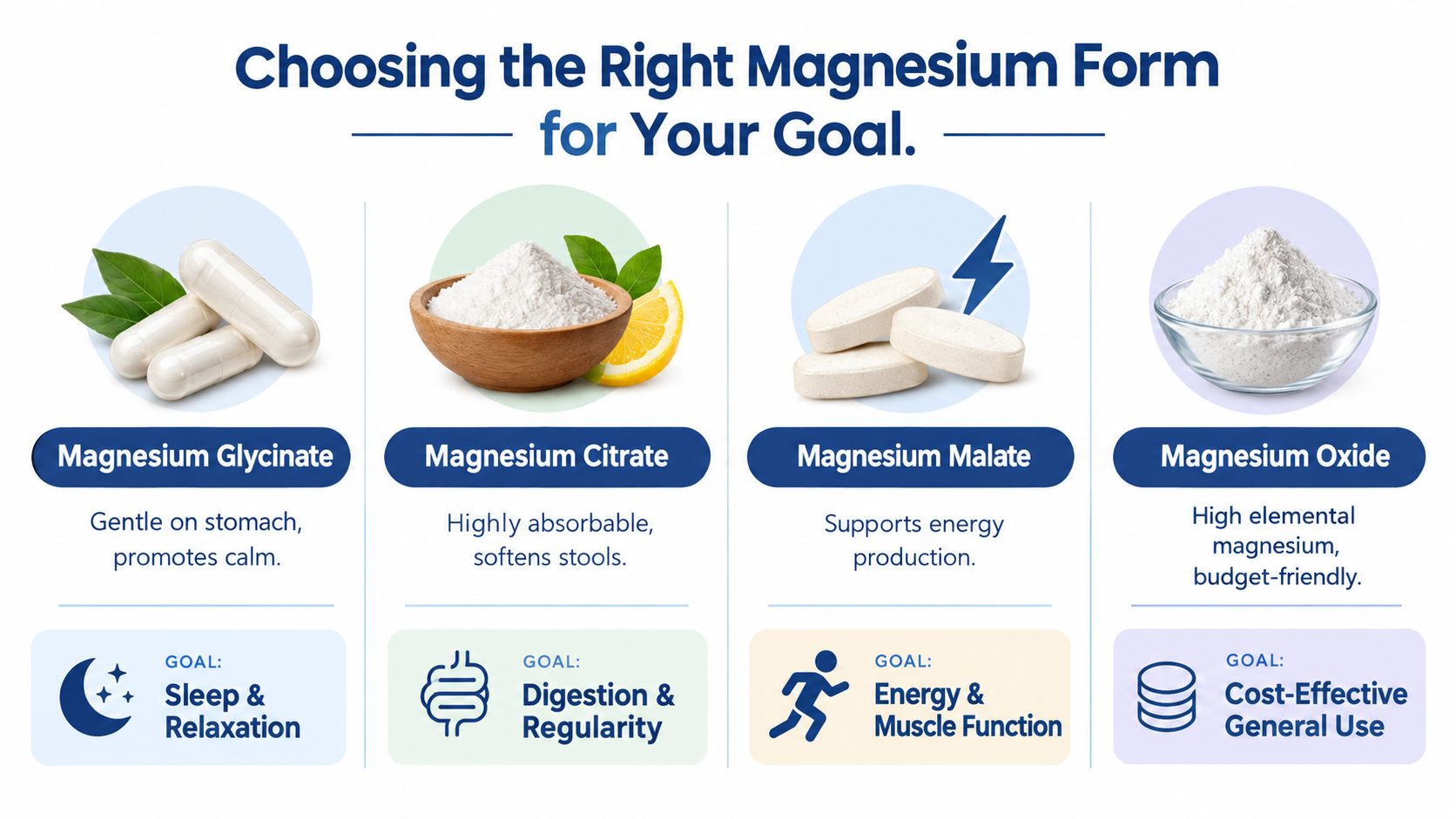
Magnesium glycinate is often the one people choose when sleep, evening relaxation, or a gentler gut feel matters most. It tends to suit people who want magnesium without much digestive disruption.
Magnesium citrate is a common general-purpose choice. It's often picked for everyday top-up use and can also have a looser-stool effect in some people.
Magnesium malate is often chosen by people thinking about daytime use, muscle function, or general energy support.
Magnesium oxide is usually the budget option. It appears in many low-cost products, but shoppers often buy it thinking “more milligrams must be better” without checking whether it's the form they want.
Match the form to the reason
A simple buying guide helps:
- Poor sleep or evening tension: glycinate is often the first form people look at.
- General daily support: citrate is a common middle-ground option.
- Muscle-focused or daytime use: malate may fit better.
- Occasional constipation: oxide may be chosen for that purpose more often than for general repletion.
If sleep is your main reason for adding magnesium, this guide to compare magnesium types for sleep gives useful context on how glycinate, citrate and related forms are commonly weighed up.
You can also read more about timing and product types in this overview of magnesium sleep tablets.
One label-reading trick
Don't just read the front of the pack. Turn it over.
Check the form and the elemental magnesium amount. A big capsule weight can sound impressive, but what you need to know is how much actual magnesium you're getting per serving. If magnesium oxide is listed first, that tells you something important about the product style.
A better magnesium purchase starts with your goal, not with the biggest number on the label.
When and How to Take D3 and Magnesium Together
Timing doesn't need to be complicated. Consistency matters more than perfection.
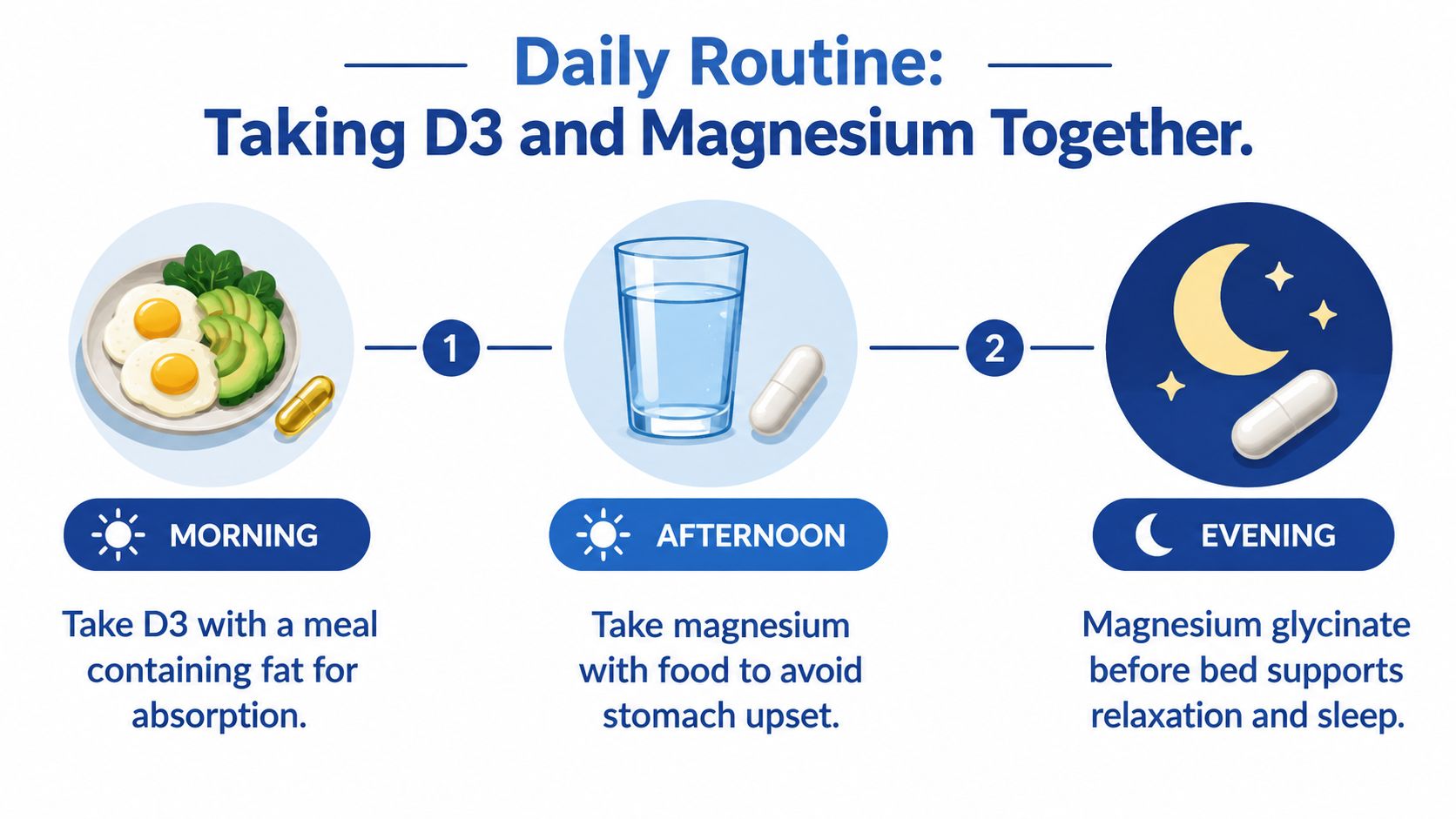
Vitamin D3 is fat-soluble, so it's usually best taken with a meal that contains some fat. Magnesium is often taken later in the day because many people find that routine easier to tolerate and easier to remember.
A simple daily routine
A practical UK pattern could look like this:
- Morning: take vitamin D3 with breakfast that contains some fat, such as eggs, yoghurt, nut butter, avocado, or oily fish.
- Evening: take magnesium with food or later in the day if that feels gentler on your stomach.
- Keep it repeatable: linking supplements to meals usually works better than relying on memory alone.
D3 and magnesium don't need to be swallowed in the same mouthful to “work together”. You can split them across the day without losing the point.
What to avoid stacking at the same moment
If you take several minerals, spacing them can make life simpler. High-dose iron or zinc supplements are often better taken separately from other minerals rather than all at once.
Tea with breakfast doesn't stop vitamin D3 being taken with food, but if you also use several mineral supplements, crowding them all into one sitting isn't always the neatest approach.
For a fuller look at how minerals can sit alongside each other, this guide on calcium and magnesium is useful.
A quick visual recap helps if you like routines more than theory:
A one-week starter plan
Try this for seven days:
- Put your D3 beside breakfast.
- Take magnesium with your evening meal or later in the evening.
- Keep the form and dose consistent for the week.
- Notice whether the routine feels easy enough to continue.
If a plan is fiddly, many people drop it. The best schedule is the one you'll keep.
Spotting Low Intake Versus True Deficiency
Many supplement conversations go off course. Low intake is common. True deficiency is a medical issue.
They are not the same thing.
Low intake is common
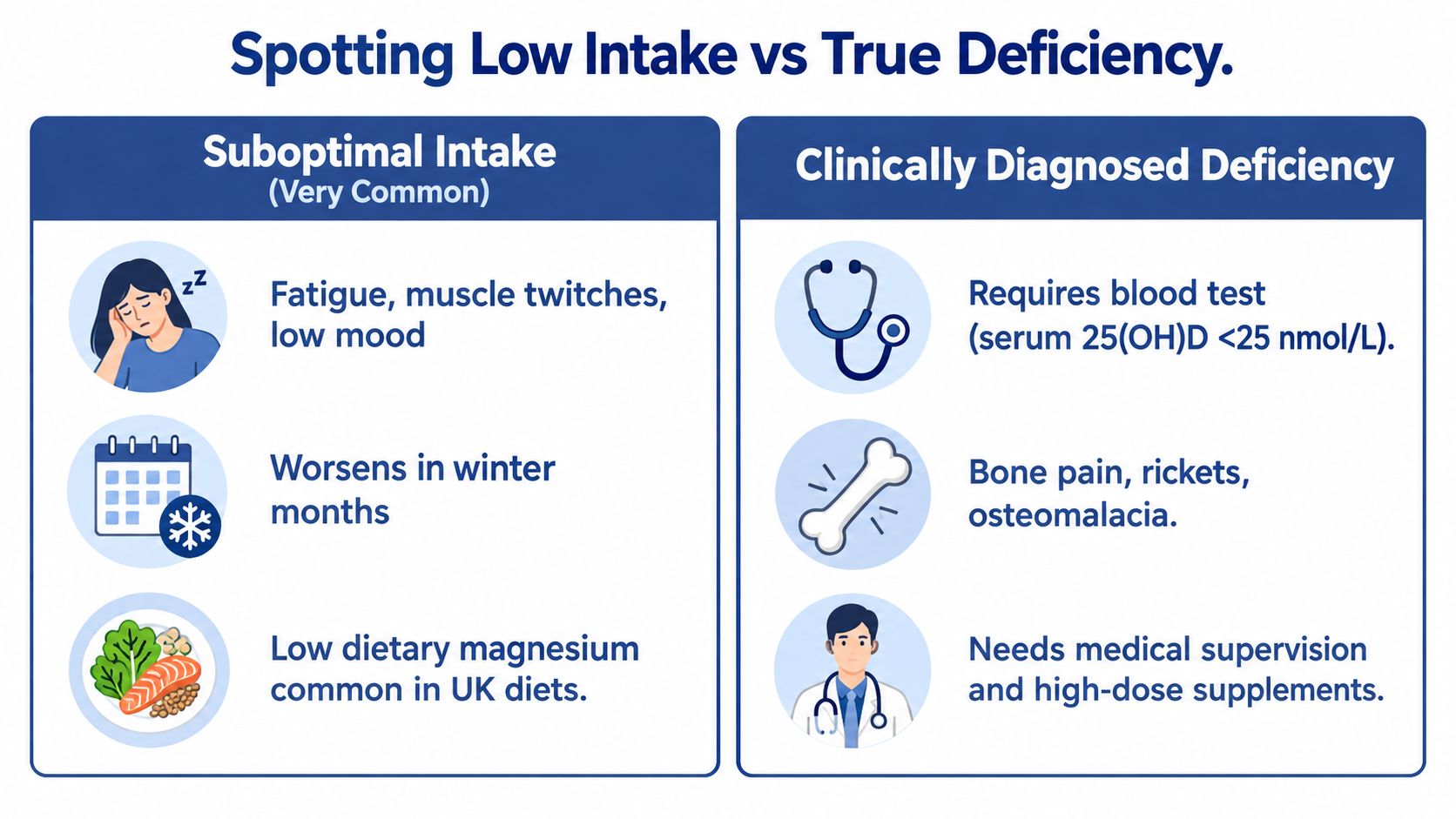
A lot of adults sit in the grey zone of “not eating enough of this consistently” rather than “having a diagnosed deficiency disease”.
That might look like:
- Tiredness that doesn't fully shift with rest
- Muscle twitches or cramps
- Low mood during darker months
- A limited diet with few magnesium-rich foods
- Taking D3 regularly but never reviewing the wider picture
These signs are non-specific. They can overlap with stress, poor sleep, low iron, low calorie intake, or other issues. That's why symptoms alone can't confirm a deficiency.
True deficiency needs medical input
For vitamin D, deficiency is usually discussed in relation to blood testing and symptoms that warrant proper assessment. In UK survey reporting, serum 25-hydroxyvitamin D below 25 nmol/L remains a key threshold, and the National Diet and Nutrition Survey 2019 to 2023 report found this level in 18% of adults aged 19 to 64 and 12% of adults aged 65 and over, with higher rates in younger age groups as well.
That's useful population data, but it still doesn't mean everyone needs testing. In practice, testing is usually led by symptoms, risk, or clinical judgement.
If symptoms are persistent, severe, or don't fit a simple diet gap, it's time to speak to your GP rather than keep experimenting alone.
A sensible self-check
Ask yourself:
- Do I already take D3 but eat very little magnesium-rich food?
- Am I relying on one supplement to solve a broad diet problem?
- Have symptoms carried on despite a steady routine?
- Am I in a higher-risk group or on medication that changes the picture?
Book medical advice if you have ongoing bone pain, marked muscle weakness, unusual neurological symptoms, or anything that feels more than mild and occasional.
Your Practical D3 and Magnesium Checklist
If you want the short version, use this.
Start with the real gap
Don't begin by asking whether vitamin D3 and magnesium are “good together”. Ask which nutrient you're more likely to be missing.
- If you already take D3 every winter, review magnesium intake from food before buying a stronger D3 product.
- If your diet is narrow, magnesium may deserve just as much attention as vitamin D.
- If you take several formulas already, check labels so you don't duplicate nutrients by accident.
Build a simple buying plan
Use this sequence:
- Choose your D3 dose sensibly. For routine seasonal use, align with UK guidance unless a clinician has told you otherwise.
- Pick magnesium by goal. Sleep and calm often push people towards glycinate. General top-up often points to citrate. Muscle or daytime support may lead you to malate.
- Take them in a way you'll remember. D3 with a meal containing some fat. Magnesium later in the day if that suits you.
- Review after a few weeks. Look at consistency first, then at whether the routine feels useful.
Know when not to self-manage
Get advice first if any of these apply:
- Pregnancy or breastfeeding
- Kidney conditions
- Prescription medicines
- Specialist treatment for vitamin D or mineral balance
- Symptoms that persist despite consistent use
The main lesson is simple. The vitamin D3 magnesium question isn't really about whether they pair well. It's about whether your shopping matches your actual nutritional gap.
If you're reviewing your routine, Vitamin Planet offers UK-shipped vitamins, minerals and targeted supplement formulas, including products that can help you compare standalone D3, magnesium, and broader blends in one place. That makes it easier to read labels properly, match a product to your goal, and build a simpler daily plan rather than guessing.