

Inulin Powder UK Guide: Benefits, Dosage and Buying Tips
You've bought a tub labelled inulin powder, stirred a little into your morning coffee, and are now wondering whether it's meant to support regularity, feed your gut bacteria, or add fibre to an otherwise ordinary diet. That confusion is understandable. UK shoppers see chicory fibre, prebiotic fibre, FOS and “dietary fibre” used on nearby labels, but these products don't behave identically.
The practical question is usually more important than the theory: how can you use inulin powder to move towards the UK fibre target without inviting bloating? This guide explains what inulin is, what the evidence supports, how to increase your dose carefully, and which label details deserve attention before you buy.
Table of Contents
- What Inulin Powder Is and Why UK Buyers Are Adding It to Their Routine
- Prebiotic Benefits and the Evidence Behind Inulin
- Dosage, Tolerability and the UK Fibre Gap
- How to Use Inulin Powder in Everyday Cooking and Drinks
- Inulin vs Other Fibres and Prebiotics
- Buying Inulin Powder in the UK
- Your Practical Plan and Common Buyer Questions
What Inulin Powder Is and Why UK Buyers Are Adding It to Their Routine
You are trying to add more fibre to breakfast without changing the whole meal. A small amount of inulin powder stirred into porridge, yoghurt or a smoothie can provide a convenient extra source, provided you increase it gradually.
Inulin is a soluble plant fibre, most often extracted from chicory root. Chicory is the source crop, while inulin is a fibre fraction separated from it. Jerusalem artichoke and agave also contain inulin, although chicory-root powder is the option commonly seen on UK supplement shelves.
The finished ingredient is usually a fine, white or cream-coloured powder with mild sweetness. It mixes more readily than a coarse husk, especially in warm drinks, and can fit into yoghurt, porridge, smoothies and baking without taking over the flavour. It is not a medicine or an instant solution for digestive problems. Treat it as a concentrated fibre ingredient alongside vegetables, pulses, fruit, wholegrains, nuts and seeds.
A useful distinction: inulin powder is generally a purified fibre ingredient. Chicory root powder may contain a wider range of compounds from the root. FOS, or fructo-oligosaccharides, are related fructan fibres with shorter chains. Because product names can overlap, check the ingredient panel rather than relying on the front label.
The UK interest is understandable because fibre intake falls short of the recommended level. One UK-focused summary reports average consumption at 18 g per day, compared with a recommended 30 g per day, creating a 12 g daily gap (UK fibre and inulin evidence summary). Inulin cannot replace varied meals, but its high fibre density can help add fibre to food already in your routine. Start with a small serving, then increase only if your digestion remains comfortable.
The UK market is still modest in absolute value but is growing. It was estimated at US$7.87 million in 2024, compared with US$7.13 million in 2023, while estimated volume rose from 2.05 kilotons to 2.29 kilotons (UK inulin market report). This suggests wider use in foods, supplements and functional ingredients, not that every shopper needs an inulin product.
Prebiotic Benefits and the Evidence Behind Inulin
A spoonful of inulin passes through the small intestine largely intact because human digestive enzymes do not fully break it down. It then reaches the colon, where gut microbes ferment it. The process produces short-chain fatty acids and gives certain microbes a usable source of fuel. Inulin therefore works more like food for the gut community than a direct supplement of bacteria.
One group often linked with this effect is Bifidobacteria. In plain English, inulin can support conditions in which these beneficial bacteria grow. That differs from a probiotic capsule, which supplies live microorganisms. Inulin is a prebiotic, so it feeds selected members of the microbial community already present in the gut.
What the strongest support covers
The clearest practical benefit is bowel regularity. Evidence summaries describe an EFSA-backed claim for chicory-derived inulin at a 12 g per day dose, relating to helping maintain normal defecation by increasing stool frequency. The claim applies to that amount and function, not to every person's ideal serving. Someone with a low-fibre diet or sensitive digestion may need to build up more slowly.
Fermentable fibre may also help some people feel fuller. A higher-fibre eating pattern can support healthy blood sugar and cholesterol management, while inulin may contribute to gut conditions involved in mineral absorption, particularly for calcium and magnesium. These points make inulin a useful ingredient within a varied diet, not a treatment for diabetes, high cholesterol or mineral deficiency.
The practical value may be greatest for people whose meals contain little fibre. A small amount mixed into familiar food can help narrow that dietary shortfall, provided it is introduced gradually. Older adults may prefer an easy-to-mix fibre, and someone returning to normal eating after an antibiotic course may be interested in prebiotic foods. Persistent bowel changes, unexplained pain or significant illness call for advice from a healthcare professional before experimenting with supplements.
Digestive comfort depends on the whole routine, including food variety, fluids and movement. For a broader overview, read this guide to a healthy digestive system. Shoppers comparing products can browse digestive wellness supplements, then check the ingredient panel and directions carefully. A product described as digestive support may contain a different fibre, or no inulin at all.
Dosage, Tolerability and the UK Fibre Gap
A sensible inulin routine starts below the amount you ultimately want. Begin with 2 to 3 g daily for one week, mixed into food or a drink. If your digestion remains comfortable, add another 2 to 3 g every few days or during the following week, rather than jumping straight to a large serving.
A common practical range is 10 to 15 g daily, while keeping total intake around 15 to 20 g can help limit discomfort for many users. Those figures are an approach to gradual use, not a universal prescription. A serving that feels comfortable for one person may be too much for another, particularly if their usual fibre intake is low.
The underlying reason is fermentation. Gut microbes ferment inulin quickly, and that can create gas, bloating or loose stools when the dose rises faster than your digestive system can accommodate. Treat these symptoms as feedback. Reduce the amount to the last comfortable level, stay there for longer, and only increase again if symptoms settle.
| Week | Daily Amount | How to Take | Watch For |
|---|---|---|---|
| Week 1 | 2 to 3 g | Take once with breakfast or lunch | Bloating, gas or changes in stool |
| Week 2 | 4 to 6 g | Split between two meals if preferred | Whether symptoms settle between doses |
| Week 3 | 7 to 9 g | Mix into meals or drinks with water | Loose stools or increasing abdominal pressure |
| Week 4 | 10 to 15 g | Divide across meals if comfortable | Whether the amount supports your routine without discomfort |
The UK target for adults is 30 g of fibre daily, while the evidence summaries cited above place average intake around 18 g and another UK dataset reports median total fibre at 14 g, with median inulin intake at 1.3 g (UK dietary fibre and inulin intake data). Inulin can help narrow that gap, but oats, beans, lentils, vegetables, fruit, wholegrain bread and nuts should do most of the nutritional work.
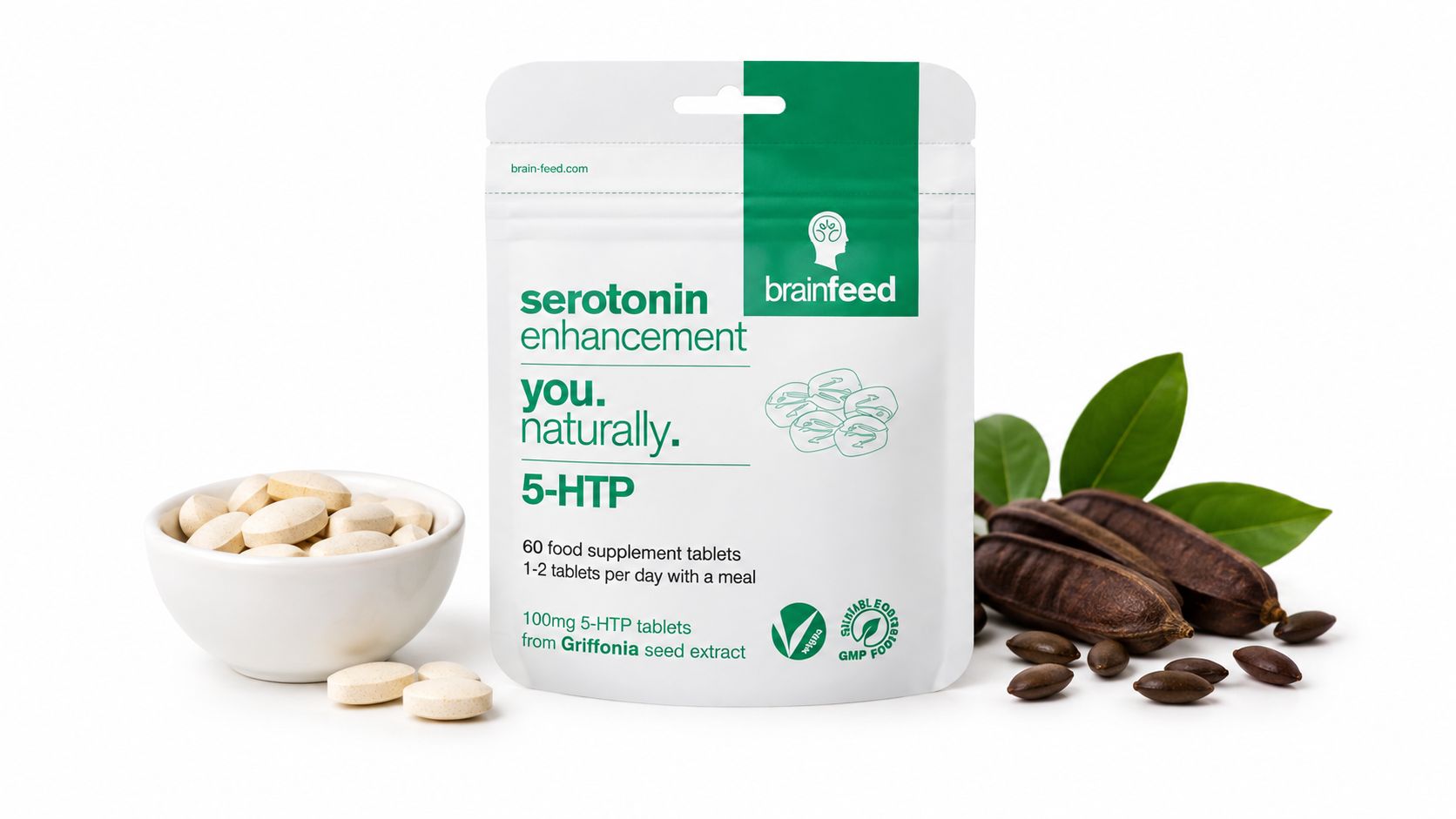
People with IBS or sensitivity to FODMAPs need extra care because inulin is a fructan. Try a much smaller amount, or consider a slower-fermenting option such as acacia fibre. Drink regularly, and take inulin with a meal if an empty stomach feels uncomfortable. A soluble fibre supplement guide can help you compare approaches, while x30 tablets for digestive health represents a different supplement format rather than a substitute for measured inulin powder. The Brain Feed 5-HTP 60 tablet is also a separate Griffonia-derived 5-HTP product, not an inulin or fibre supplement.
How to Use Inulin Powder in Everyday Cooking and Drinks
Inulin works best when it becomes part of a familiar habit. Its mild sweetness can suit a morning drink, while its fine texture makes it easier to hide in soft foods than a coarse fibre. Start with the amount your digestion can manage, not the largest scoop printed on a serving suggestion.
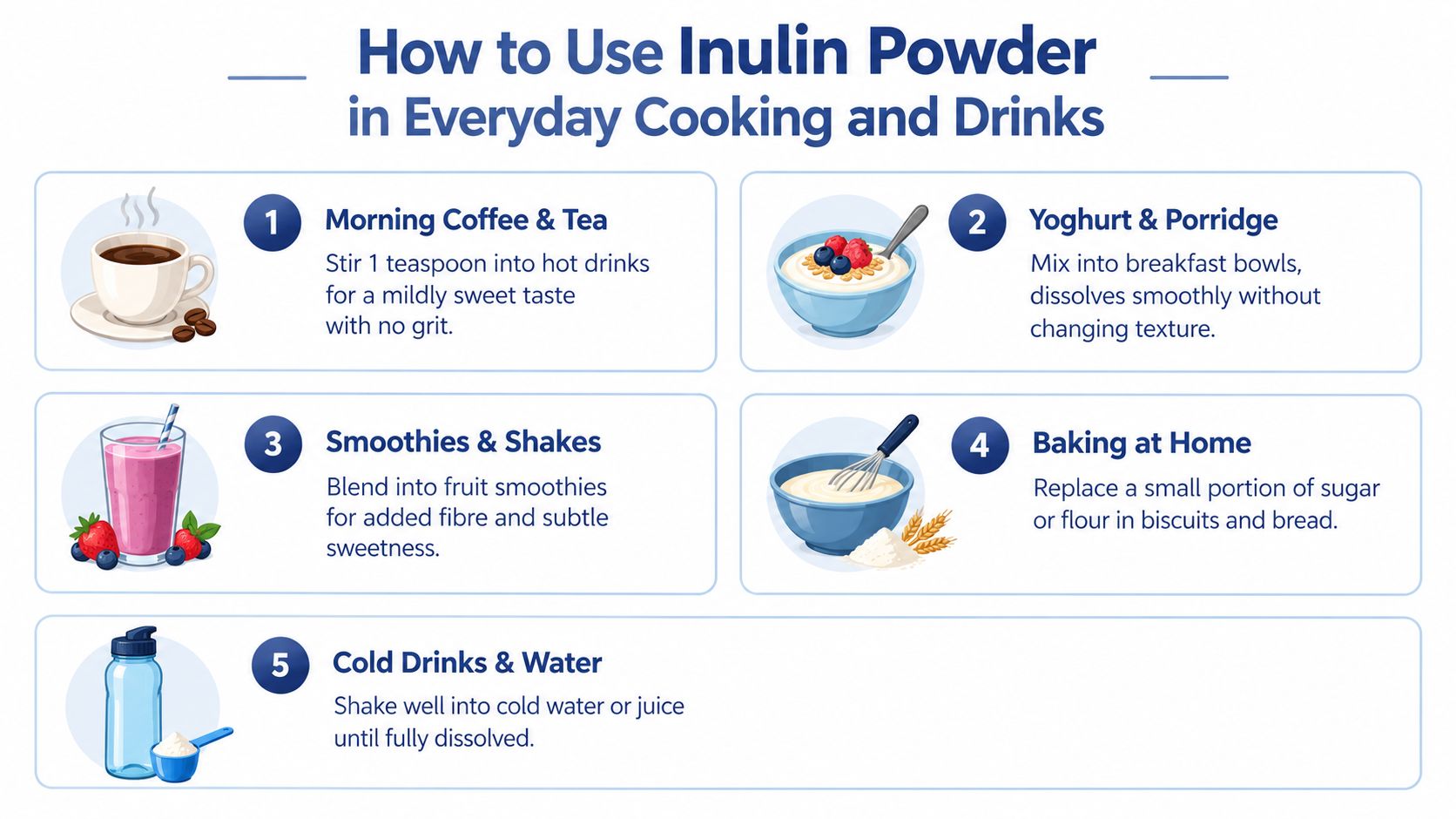
A few ordinary kitchen options are particularly straightforward:
- Tea or coffee: Stir a small measured amount into a hot drink. Warm liquid helps it disperse, and the slight sweetness may reduce the need for some added sugar.
- Yoghurt and berries: Mix it into a yoghurt pot with berries before adding granola. The powder should disappear into the creamy texture.
- Smoothies: Blend it with banana, oats and milk or a dairy-free alternative. Blending distributes the fibre more evenly than sprinkling it on top.
- Pancakes and baking: Fold it into pancake batter, crumble topping or banana bread. It can brown slightly in the oven and may replace a modest portion of flour in some recipes.
- Cold drinks: Shake it thoroughly into water or juice, then drink it soon after mixing. Acidic drinks can make the mild sweetness more noticeable.
Inulin doesn't behave like flour. It won't create the same structure or gel, and using too much can leave a bake softer or looser. Make small adjustments rather than replacing a large share of flour in a favourite recipe.
For a simple overnight oats jar, combine oats, yoghurt or milk, berries and a small measured amount of inulin. Stir thoroughly, refrigerate overnight, then check how your stomach responds before increasing the portion on another day. If your wider routine includes joint-focused products, Bonemax Collagen 400mg Supplement for Bone Health - 60 Capsule is a separate collagen supplement with joint and mobility positioning, so it shouldn't be confused with inulin's fibre role.
Inulin vs Other Fibres and Prebiotics
Choosing a fibre depends on the job you want it to do. Inulin and FOS are strongly associated with fermentation and prebiotic activity, while psyllium is better known for absorbing water and adding bulk. Acacia tends to suit shoppers who want a gentler, slower-fermenting option.
| Fibre | Solubility | Fermentation speed | Prebiotic strength | Taste and use |
|---|---|---|---|---|
| Inulin | Dissolves well in many foods and drinks | Relatively quick | Strong prebiotic role | Mildly sweet, useful in drinks, yoghurt and baking |
| FOS | Usually dissolves easily | Quick | Strong prebiotic role | Mild sweetness, but can be noticeable in larger amounts |
| Psyllium husk | Forms a thick, gel-like mixture | Limited compared with fermentable fibres | Less selective as a prebiotic | Neutral to earthy, useful for stool bulk and texture |
| Acacia fibre | Dissolves gradually and usually blends smoothly | Slow | Gentler prebiotic effect | Mild and flexible for drinks or food |
Inulin's advantage is concentration in a small serving and a clear prebiotic purpose. Its trade-off is that fast fermentation can produce more gas, especially when someone moves from a low-fibre diet to a large dose. FOS has a similar trade-off, so a product described as “prebiotic blend” deserves a close look at the actual ingredients.
Psyllium suits a different objective. It absorbs water and changes stool bulk, so it may be more appropriate when the priority is physical regularity rather than selectively feeding fermenting microbes. It also needs careful mixing and enough fluid. This guide to psyllium powder in the UK provides useful context for that alternative.
Match the fibre to your tolerance: choose inulin for a concentrated fermentable prebiotic, psyllium for water-holding bulk, and acacia when a slower, milder introduction matters more than maximum fermentation.
A shopper who enjoys baking and tolerates fermentable foods may find inulin convenient. Someone with IBS symptoms may prefer to test acacia first, while someone focused on stool texture may find psyllium more logical. There isn't one universally superior fibre, and combining products isn't automatically better.
Buying Inulin Powder in the UK
Start with the source. A clear label will usually identify chicory-root inulin or another specific plant source, such as agave. A vague phrase such as “plant fibre” doesn't tell you whether the tub contains pure inulin, FOS, a blend, or a product with additional carriers.
The ingredient list should be short. “Inulin” alone is the simplest formulation, while some products may include a flowing agent such as rice concentrate. That isn't automatically a problem, but the label should state it clearly and give you enough information to judge what you're buying.
The label checks worth making
- Fibre declaration: Look for a stated fibre amount per serving and per 100 g. UK buyers should remember that the legally supportable declaration depends on the recognised analytical method for fructans, not a generic carbohydrate calculation. The Food Standards Agency adopted AOAC 997.08 for analysing fructans such as inulin, enabling inulin and oligofructose to be labelled as dietary fibre in the UK (UK inulin analysis and labelling reference).
- Serving size: A typical chicory-root benchmark is roughly 4.4 to 4.5 g of fibre per 5 g serving (UK inulin product benchmark). Use the actual label rather than assuming every brand matches it.
- Allergen information: Check allergen and cross-contamination statements, particularly if you have a diagnosed allergy or follow a restricted diet.
- Dietary suitability: Many plain inulin powders are suitable for vegan and vegetarian diets, but confirm the manufacturer's statement.
- Packaging and dates: Choose a resealable pouch or tub with a visible batch reference and best-before date. Powder absorbs moisture, so a secure closure matters.
Pack sizes vary across UK retailers, commonly from 100 g to 500 g. Compare the cost per 100 g and the stated fibre per serving, not just the headline tub price. Be cautious with overseas sellers offering unusually cheap products, vague delivery details or long shipping windows. A UK-based retailer may offer clearer labelling and tracked domestic fulfilment, but the ingredient panel still deserves the final say.
Your Practical Plan and Common Buyer Questions
If your first serving leaves you bloated, the answer is usually to reduce it, not push through. Start with 2 to 3 g once daily for a week. Increase by 2 to 3 g only when your digestion feels settled, working gradually towards 10 to 15 g daily. Split the powder between meals if that feels more comfortable, drink regularly, and review the routine after four weeks.
Use inulin to add fibre to meals, not to replace whole foods. If your diet already contains plenty of fibre, you may need less powder. Treat the dose like a volume control: increase it slowly, then turn it down if symptoms appear.
Common questions from UK shoppers
How much inulin should an adult take?
There is no suitable amount for everyone. Begin with 2 to 3 g daily, then increase gradually towards an amount your digestion handles comfortably.
Does inulin count towards the UK fibre target?
Yes. A correctly analysed and labelled product can contribute dietary fibre. The UK target is 30 g daily, so count inulin alongside fibre from ordinary foods, rather than using it as a substitute (UK fibre and inulin evidence summary).
Is inulin suitable for a low-FODMAP or IBS diet?
Inulin is a fructan and may trigger symptoms in sensitive people. Consider professional guidance, especially during an elimination diet. A smaller serving or a slower-fermenting fibre such as acacia may be easier to test.
Can it interact with medicines?
Ask a pharmacist or clinician if you take regular medicines, have a digestive condition, are pregnant, or manage a significant health problem. Do not use inulin to replace prescribed treatment.
What does it taste like?
Most powders are mild and slightly sweet. The flavour may stand out more in acidic drinks or larger servings.
How should I store it?
Keep the pouch or tub tightly closed in a cool, dry cupboard. Keep moisture out and use the powder before its best-before date.
Are UK-made products better than imported ones?
Not automatically. Check source transparency, testing, fibre analysis, allergen information and fulfilment. The country named on the front of the pack is only one part of the decision.
Vitamin Planet lists vitamins, supplements, food products and health essentials in the UK. Visit Vitamin Planet to compare available products and check whether an inulin powder's ingredients, serving guidance and labelling fit your routine.