

Probiotic for Constipation: An Evidence-Based UK Guide
A probiotic can be a useful addition for some people with constipation, but it won't work for everyone. The benefit depends on choosing a specific, clinically studied strain and testing it for a defined period, rather than guessing with a generic product.
Constipation affects approximately 1 in 7 UK adults, or about 14%, and as many as 1 in 3 UK children, or about 33%, at any one time, according to NHS inform. That makes interest in a probiotic for constipation understandable, but a large number of people with symptoms doesn't prove that probiotics are suitable or effective for everyone.
The practical question isn't just whether probiotics “help digestion”. It's whether a particular strain, at a relevant dose, used for long enough, improves your own bowel pattern. If symptoms are persistent, severe, or accompanied by warning signs, the priority is assessment, not prolonged supplement experimentation.
Table of Contents
- Understanding the Scale of Constipation in the UK
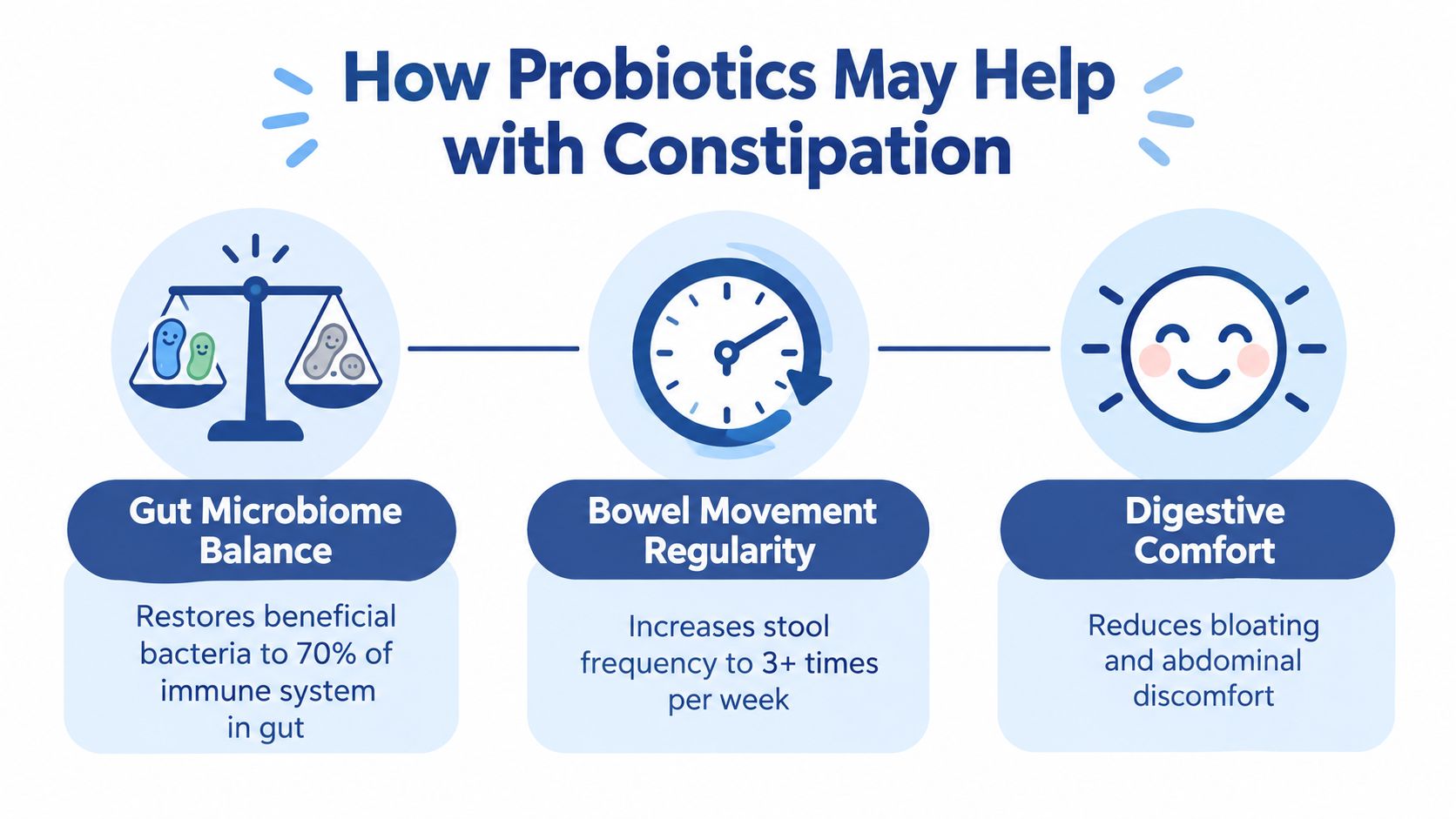
- How Probiotics May Help with Constipation
- Reviewing the Clinical Evidence for Probiotics
- Comparing Strains with and without Evidence
- How to Use Probiotics Safely and Effectively
- Safety Considerations and General Risks
- When to Seek Medical Advice Instead
- Making an Informed Choice for Your Gut Health
Understanding the Scale of Constipation in the UK
Constipation is one of the most common digestive problems affecting people in the UK, according to the British Dietetic Association. Prevalence rises with age, and older adults are more likely to be affected because reduced mobility, several medicines, and lower fluid intake can all slow bowel function.
These figures describe reported symptoms and prevalence estimates, not a confirmed diagnosis in every case. Constipation may involve hard stools, straining, infrequent bowel movements, or a feeling of incomplete evacuation. Someone with a short-term change after travel needs different advice from a person with ongoing symptoms, medicine-related constipation, or a new alteration in bowel habit.

A common problem does not have one solution
Consider two people asking about the same probiotic. One has mild constipation after a change in routine and is otherwise well. A time-limited trial could be a reasonable optional step. The other has persistent symptoms, takes medicines that may slow bowel function, and has pain or bloating. That person needs a structured review of causes and treatment rather than indefinite supplement testing.
Diet, fluids, movement, toileting habits, and medicines all influence bowel function. NHS inform's constipation guidance supports addressing these practical factors, with pharmacist advice appropriate when self-care has not helped. A probiotic should complement those measures, not replace them.
Practical rule: The scale of constipation explains the interest in probiotics. It does not show that probiotics treat every case.
Age and personal circumstances also change the decision. Constipation in children, during pregnancy, or in later life may require individual advice rather than a standard supplement routine. If self-management is suitable, choose a product that names its strain, check whether that strain has evidence for constipation, and set a defined review point. Stop reassessing indefinitely if there is no clear improvement. Persistent, severe, or unusual symptoms warrant medical advice instead.
How Probiotics May Help with Constipation
Think of the gut as an ecosystem rather than a single machine. Different microbial communities interact with food residues, intestinal contents, the gut lining, and signalling pathways involved in movement. Adding live bacteria may influence that environment, but the result depends on which organism is used and how it behaves in that particular host.
A probiotic may potentially support bowel function through several connected routes:
- Changing fermentation activity. Some bacteria use undigested carbohydrates and produce metabolites that can affect the local gut environment.
- Influencing motility. Certain strains may interact with intestinal signalling involved in propulsion and transit.
- Altering stool characteristics. Changes in water handling, fermentation, and transit may affect stool consistency.
- Supporting digestive comfort. Some studied strains have been associated with changes in wind, bloating, or abdominal discomfort.
Those mechanisms are plausible, but they don't turn every capsule into an effective treatment. A product containing a large number of organisms may have no useful evidence for constipation if the exact strain hasn't been studied for that outcome.
Why strain identity matters
A label that says Bifidobacterium lactis is more informative than a vague “friendly bacteria” claim, but even the species name may not be enough. Research can relate to a particular strain, such as HN019 or NCC2818, and those strains may behave differently despite belonging to the same species.
The same principle applies to prebiotic fibres. If you're considering a fibre product alongside a probiotic, review practical guidance on inulin powder in the UK, especially if bloating is already an issue. Fibre can be useful, but increasing it quickly may worsen discomfort for some people.
Other food-based approaches are also discussed in broader gut-health resources. For example, Herbswell's turmeric guide considers turmeric in the context of gut health and general wellbeing. That's separate from evidence for a probiotic for constipation, so it shouldn't be treated as proof of a constipation benefit.
The useful conclusion is modest: probiotics may influence the gut ecosystem and bowel function, but the product's strain, dose, formulation, and intended outcome matter more than the word “probiotic” on the front of the packet.
Reviewing the Clinical Evidence for Probiotics
The clinical evidence doesn't support a simple statement that probiotics reliably relieve constipation. It shows signals of benefit in some analyses, but the size and consistency of those effects vary between trials and products.
A 2014 meta-analysis of 14 randomised controlled trials involving 1,182 participants reported that probiotics reduced whole-gut transit time by 12.4 hours, with a 95% confidence interval from 2.5 to 22.3 hours, and increased bowel movements by 1.3 per week, with a 95% confidence interval from 0.7 to 1.9. These findings are reported in the Nutrition Society review of probiotics and constipation.
That result sounds encouraging, but an average across multiple products can conceal important differences. The trials may use different strains, doses, populations, definitions of constipation, and follow-up periods. An average benefit doesn't tell you that the product on a shop shelf will reproduce the result.
Why later analysis changed the picture
A later synthesis of 21 trials involving 2,656 people found that, after adjustment for publication bias, the increase in stool frequency was only 0.3 bowel movements per week and wasn't statistically significant. The same evidence summary is discussed in the King's College London research record.
Publication bias can make positive results easier to find than neutral or disappointing results. That doesn't mean the earlier trials were worthless. It means consumers should avoid treating one favourable pooled result as a guarantee.
UK-linked research also found that probiotic use was common among people with constipation. In a survey of 2,557 members of the general population, 37% of respondents with constipation had tried probiotics, compared with 11% of those without constipation, a statistically significant difference with P < 0.001. The survey also included 411 general practitioners and 365 gastroenterology specialists, making it relevant to both consumer behaviour and healthcare attitudes. These figures describe use, not effectiveness.
A product such as Bio-Kult Mind 60 capsule contains live bacteria alongside bioavailable flavonoids, grape and wild blueberry extracts, and zinc. Zinc contributes to normal cognitive function, protection of cells from oxidative stress, and normal immune function, but those product details don't establish that the formulation treats constipation.
The practical reading of the research is clear: probiotics may help selected people, but the category is too inconsistent for blanket claims.
Comparing Strains with and without Evidence
A product label should identify the organism and, where available, the exact strain. “Multi-strain” claims and a high CFU count do not prove a constipation benefit. The relevant question is whether that formulation, at its stated dose, has human evidence for the symptom being treated.
The comparison below separates strain-specific findings from broad category claims.
Probiotic strains for constipation evidence at a glance
| Strain | Evidence status | Key notes |
|---|---|---|
| Bifidobacterium lactis | Possible benefit for selected products | Cambridge University Hospitals identifies evidence for shorter gut-transit time and improvements in related symptoms, including abdominal pain, wind, and bloating. |
| Bifidobacterium animalis subsp. lactis HN019 | Strain-specific positive trial evidence | A dose-ranging trial reported shorter transit time with supplementation. That finding cannot be applied automatically to every B. lactis product. |
| Bifidobacterium lactis NCC2818 | No demonstrated benefit in one relevant trial | A King's College London trial found that four weeks of this strain did not outperform placebo for mild chronic constipation. |
| Bacillus coagulans Unique IS2 | Possible benefit in UK dietary guidance | The British Dietetic Association identifies possible benefit from this particular strain. |
| Lactobacillus casei Shirota | No demonstrated benefit in the cited UK guidance | Its evidence should not be treated as interchangeable with evidence for Bifidobacterium strains. |
| Synbiotic supplements | No consistent demonstrated benefit | Adding a prebiotic to a probiotic does not guarantee better constipation outcomes. |
The British Dietetic Association's guidance on chronic constipation helps distinguish possible benefits from products where no benefit was demonstrated. It also supports caution around multispecies products, which have not been shown to outperform single-strain formulations.

A consumer resource such as Yuve's best probiotic for constipation overview can help compare labels. Apply the same test to any product: look for the full strain designation, relevant human evidence, the studied dose, storage instructions, and a defined review point.
Not every gut-adjacent supplement is a probiotic. BioBees Fresh Royal Jelly Capsules contain 750mg fresh royal jelly, 10mg propolis extract, and 20mg bee pollen, but they are not a strain-specific constipation intervention. A named strain and a time-limited trial provide a more meaningful basis for choosing a probiotic.
How to Use Probiotics Safely and Effectively
Start with the label, not the marketing headline. Choose a product that names the strain and follow the manufacturer's recommended dose. If a clinical trial supports a particular strain at a particular dose, a product using a different dose or combination shouldn't be assumed to produce the same result.

Build a simple baseline
Before starting, record what you're trying to change. Note bowel movements per week, stool form using the Bristol Stool Form Scale, straining, pain, bloating, and any feeling of incomplete evacuation. You don't need an elaborate app. A brief daily note is enough if you can compare the same measures later.
NICE guidance for IBS recommends that people who choose to try probiotics use them for at least 4 weeks while monitoring their response, as reflected in Cambridge University Hospitals' constipation resource. The same resource advises using a product containing Bifidobacterium lactis at the manufacturer's dose and stopping or reassessing if no benefit appears after 12 weeks.
That creates a sensible range for decision-making. Give the product enough time to show whether it helps, but don't continue indefinitely without a meaningful change.
- Record your starting pattern. Include stool form, frequency, straining, pain, and bloating.
- Use one main change at a time. Otherwise, you won't know whether the probiotic, fibre, diet, or another intervention made the difference.
- Take the stated dose consistently. Follow storage instructions and don't assume that more capsules will work better.
- Review at four weeks. Look for a meaningful improvement, not just a transient change.
- Stop or seek advice if there's no useful response. Cambridge University Hospitals provides a longer reassessment point for a Bifidobacterium lactis trial, but indefinite use without benefit isn't a sound strategy.
If you're also considering fibre, review guidance on a soluble fibre supplement and introduce changes cautiously, particularly if gas or bloating is prominent.
Use this video as general educational context, not as a substitute for individual medical advice.
Safety Considerations and General Risks
For generally healthy people, probiotics are often well tolerated, but “natural” doesn't mean universally suitable. Some people notice temporary gas, bloating, or changes in bowel comfort after starting a product. If symptoms are marked, persistent, or clearly worse, stop the trial and ask a pharmacist or clinician for advice.
The larger safety question is whether constipation has been assessed properly. A supplement may distract from inadequate fluid intake, low fibre, inactivity, medicine effects, or an underlying condition. It also isn't a rapid laxative, so it shouldn't be used to delay appropriate treatment.
Take extra care if you have a serious underlying illness, a weakened immune system, or complex medical needs. Ask a healthcare professional before starting rather than relying on general online advice. The same applies during pregnancy, for children, and when constipation begins after a medicine change.
Keep the claim proportionate
A probiotic label may contain several species, added fibres, herbs, or vitamins. Each additional ingredient creates another reason to check suitability, interactions, and the purpose of the product. A simple, named-strain formulation may be easier to evaluate than a complex blend whose individual contribution is unclear.
Stop if you develop a concerning reaction. Seek urgent advice for severe symptoms rather than trying another brand.
When to Seek Medical Advice Instead
A higher CFU count or a longer strain list doesn't make a product the right answer. The product label matters because constipation evidence is strain-specific, but the person's symptoms matter even more.
Seek pharmacist or clinician advice rather than continuing self-treatment if constipation is persistent, severe, or accompanied by rectal bleeding, unexplained weight loss, severe pain, vomiting, or a marked change in bowel habit. These warning features require assessment, not a trial of increasingly elaborate supplements. The NHS-linked patient guidance on adult constipation also supports attention to red flags and situations requiring professional input.
Medication-related constipation deserves a separate review. Medicines can alter bowel function, and the correct response may involve checking the treatment, timing, dose, or an alternative approach with a prescriber. Don't stop prescribed medicine without advice.
Situations needing tailored care
Children need age-appropriate assessment and management. Advice for an adult probiotic for constipation shouldn't be transferred directly to a child. Pregnancy, older age, new constipation, repeated episodes, and significant abdominal symptoms also warrant a more individual approach.
NICE's evidence review found that available data didn't support probiotics for constipation and highlighted conflicting results from small trials with short follow-up. More recent dietetic guidance is more nuanced, because particular strains may help while others and some synbiotics show no benefit. That is precisely why medical assessment and product-specific evidence should come before broad claims.
More bacteria isn't automatically better. A relevant strain, a suitable person, and a clear review point matter more than a crowded label.
If you're unsure whether your symptoms are suitable for self-care, speak to a pharmacist. They can help identify medicine-related causes, discuss lifestyle measures, and advise when further assessment is needed.
Making an Informed Choice for Your Gut Health
A sensible decision about a probiotic for constipation follows four questions:
- Is self-treatment appropriate? Check for persistent symptoms, medicine effects, age-related considerations, pregnancy, and warning signs.
- What exact strain is present? Look beyond the species name and generic “friendly bacteria” wording.
- What outcome is being measured? Increased bowel frequency, faster transit, easier evacuation, and reduced bloating are different outcomes.
- When will you stop or reassess? Use a defined trial, monitor your response, and don't continue without benefit.
The evidence supports a cautious, strain-specific approach. Some Bifidobacterium lactis products and Bacillus coagulans Unique IS2 have relevant support, while other strains, including Lactobacillus casei Shirota in the cited guidance, haven't shown the same benefit. A higher CFU number, a multi-strain formula, or attractive digestive-health wording can't replace clinical evidence for the exact product.
For broader context, see this guide to probiotics for gut health in the UK. Keep expectations realistic, address diet and lifestyle factors, and ask a pharmacist or clinician for help when symptoms don't settle or warning signs appear.
Vitamin Planet offers UK consumers a broad range of probiotic products, vitamins, minerals, and related health essentials through its online store. Visit Vitamin Planet to compare formulations, check strain and product details, and choose supplements that fit a considered, time-limited approach to gut health.