

Whey Protein Benefits: What the Evidence Actually Shows
You've bought a tub of whey, started a training plan and added a shake after the gym, yet you're still wondering whether it's making a difference. The label promises muscle, recovery and performance, while your results seem to depend on much less exciting details, such as what you eat across the whole day and whether you train consistently.
The most useful way to understand whey protein benefits is to treat whey as a practical food supplement, not a shortcut. It can help you reach a suitable protein intake, particularly when meals are inconvenient, but it can't replace progressive resistance training, adequate energy or a balanced diet.
Table of Contents
- Why Most People Misunderstand Whey Protein Benefits
- How Whey Protein Works in the Body
- Whey Protein Concentrate vs Isolate vs Hydrolysate
- How Much Whey Protein You Should Take and When
- What Research Shows About Whey and Muscle Growth
- Who Should Consider Whey Protein and Who Might Skip It
- Making Smarter Choices with Whey Protein Supplements
Why Most People Misunderstand Whey Protein Benefits
A typical UK shopper stands in front of a shelf of large tubs, comparing words such as “isolate”, “recovery” and “advanced formula”. They may have seen gym videos suggesting that a shake after training is the difference between gaining muscle and wasting a workout. The more important question is simpler: Does whey solve a protein gap in this person's diet?

Suppose you train three times a week but eat little protein at breakfast and often rush lunch. A whey shake could make your routine more practical. Now suppose you already eat adequate protein from yoghurt, eggs, fish, beans, meat or tofu, and you add several shakes on top. The powder may increase your intake, but it won't automatically create more muscle, improve your programme or compensate for inconsistent training.
Convenience is the main benefit
Whey is popular because it's quick to prepare, portable and easy to measure. That matters when appetite is low, work disrupts meals or cooking after training isn't realistic. It also provides a concentrated source of essential amino acids, which makes it useful when a normal meal isn't available.
The mistake is turning convenience into a promise. Whey supplies building material, while resistance training provides the stimulus that tells muscle to adapt. Without that stimulus, additional protein doesn't become a guaranteed increase in muscle size.
Practical rule: Decide how much protein you need from your whole diet first. Use whey only for the part that food, time or appetite doesn't cover.
The same principle applies to weight management. A shake may fit into a structured eating plan, but it isn't a fat-loss product by itself. It can add calories if you consume it alongside an already sufficient diet, and it doesn't replace the fibre, vitamins and minerals found in varied meals.
A sensible expectation is therefore modest and useful. Whey can make it easier to distribute protein across the day and support training adaptation when your total intake would otherwise be too low. It won't guarantee muscle gain, erase poor recovery or make resistance exercise unnecessary.
This short video gives a visual introduction to the role of protein in an active routine:
How Whey Protein Works in the Body
A whey shake can reach the bloodstream quickly, but speed is only one part of its value. Whey provides a high proportion of essential amino acids, including leucine, which helps signal the start of muscle-protein synthesis. In practical terms, the protein supplies raw materials, while leucine helps indicate that those materials are available for repair and assembly.
Resistance exercise supplies the other important signal. Training creates a demand for adaptation, and protein provides amino acids that the body can use during that process. Whey without training still contributes protein, but it does not reproduce the stimulus created by progressive loading.
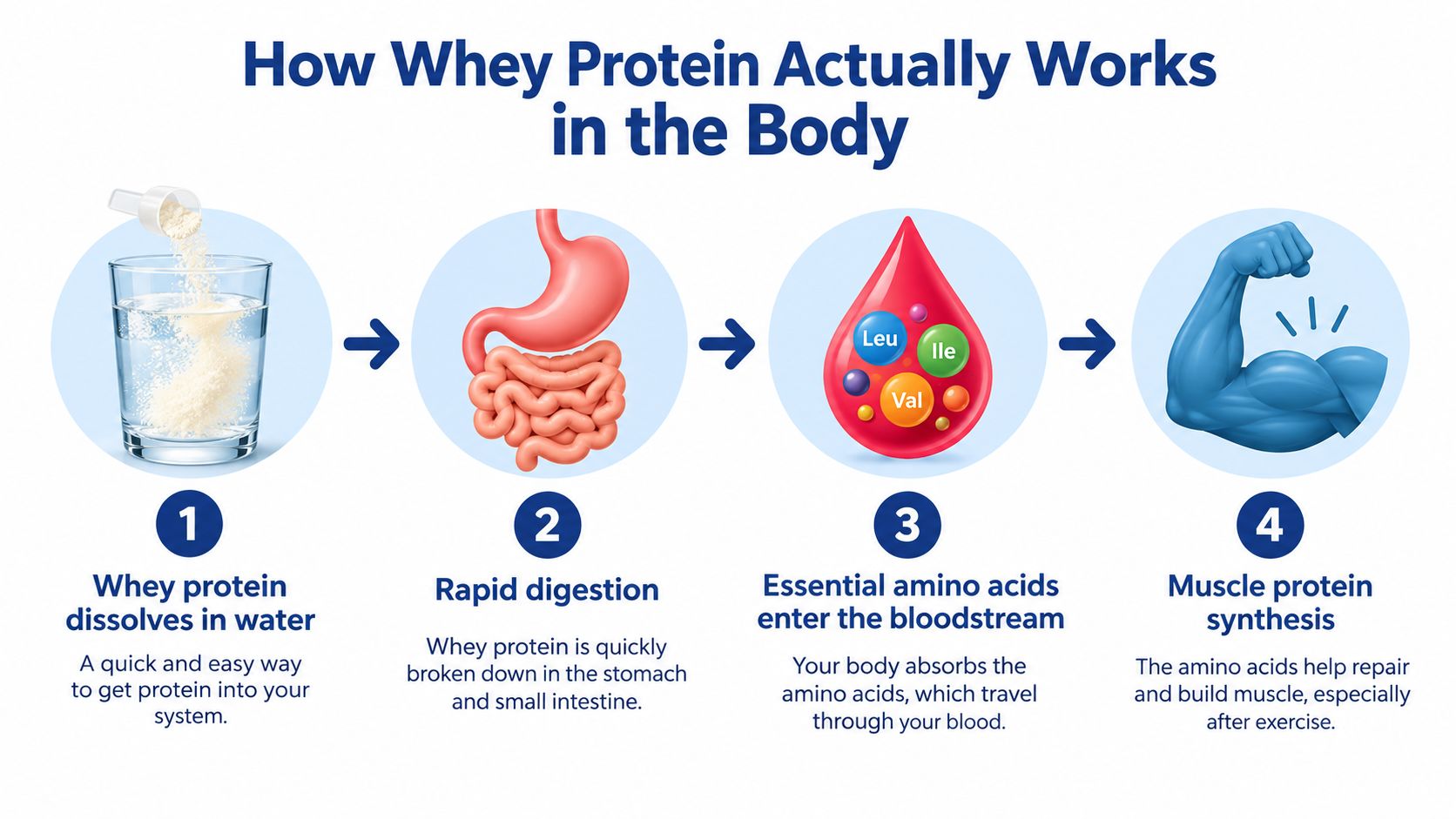
From digestion to muscle protein synthesis
The process has four connected stages:
- Digestion: Whey is broken down in the stomach and small intestine.
- Absorption: Essential amino acids pass into the bloodstream.
- Signalling: Leucine helps activate pathways involved in translation initiation.
- Assembly: Muscle cells use available amino acids during myofibrillar muscle-protein synthesis.
A University of Birmingham study in older men compared 0, 10, 20 and 40 g of whey isolate after unilateral resistance exercise. Muscle-protein synthesis rose by approximately 65% above fasting values with 20 g and approximately 90% with 40 g. The 10 g dose did not produce a significant increase over basal fasting rates, as described in the British Dietetic Association's sport and exercise nutrition guidance.
Those findings do not make 40 g the correct serving for everyone. The larger dose produced more synthesis in that specific setting, while also increasing amino-acid oxidation and urea production. Body mass, age, training load, recent meals and total daily protein intake all influence the useful amount.
Whey is one protein option, not a complete nutrition plan
Whey helps when you need protein with little preparation. A shake may suit a busy morning or the period after training, but it can provide less fibre and fewer micronutrients than yoghurt, pulses, fish or eggs, depending on the product.
The practical sequence matters. Establish your protein intake from ordinary food first, then use whey to cover a shortfall created by time, appetite or access to a meal. Not every protein-containing supplement serves the same purpose as whey. BioBees Fresh Royal Jelly - Natural Energy & Immune Support is marketed for energy and immune support rather than as a protein source.
Whey Protein Concentrate vs Isolate vs Hydrolysate
Choosing a whey powder starts with the problem you need it to solve. The three main forms differ in how extensively whey is filtered and processed. That changes protein concentration, lactose content and cost, while your total daily protein intake matters more than the most detailed label.
| Type | Protein Content | Lactose Level | Best Used For |
|---|---|---|---|
| Concentrate | Lower than isolate, with more original whey components retained | Higher than isolate | Active adults who tolerate dairy |
| Isolate | Higher protein concentration after further filtration | Lower than concentrate | People managing lactose intake or wanting a more protein-dense option |
| Hydrolysate | Partly broken down into smaller peptide fragments | Usually low, depending on processing | Specific clinical or specialist uses where rapid digestion is relevant |
Concentrate suits many people
Concentrate generally contains more lactose and some fat than isolate. That does not make it an inferior choice. If you digest dairy comfortably and want a straightforward way to add protein, concentrate may provide what you need without paying for additional processing.
Read the nutrition panel rather than judging a product by its name. The protein-per-100g figure shows how much of the powder is protein, while the serving size shows how much you would receive in a shake. A product with a larger scoop is not automatically more useful. Compare the protein amount with your existing food intake and the gap you are trying to fill.
Isolate becomes more relevant when lactose causes digestive symptoms or when you want a more protein-dense product. Lower lactose does not make isolate suitable for someone with a milk-protein allergy, because whey remains a milk protein. Persistent symptoms after dairy deserve proper assessment rather than repeated product switching.
Hydrolysate has already been partly broken down into smaller peptide fragments, so it can be digested quickly. For healthy adults, that speed is unlikely to matter as much as consistent training and an appropriate overall protein intake. Hydrolysate may have a role in specialist nutrition, but faster digestion does not automatically produce better muscle results.
Choose the form that solves your problem
Use the label to answer a practical sequence. Do you tolerate concentrate? If so, it may be enough. Do you experience symptoms after dairy? An isolate may be worth considering, although the cause should be assessed if symptoms persist. Do you have a diagnosed milk allergy? All whey forms require professional advice before use.
For a broader comparison, compare whey, casein and pea protein before deciding whether dairy protein fits your diet. Vitamin Planet also explains the characteristics of whey protein concentrate. Choose the least processed option that meets your dietary needs, tolerability and practical routine.
How Much Whey Protein You Should Take and When
A shake makes sense after you know what your meals already provide. Athlete protein needs are roughly 1.4 to 2.0 g per kilogram of body weight per day, while non-athletes need about 0.75 g per kilogram per day. These figures are starting points, not automatic targets for every gym-goer.
Someone exercising occasionally may need less than a competitive athlete managing frequent, demanding sessions. Body size, age, training goals and the rest of the diet also affect the amount that is useful. Use this guide to how much protein you need per day to estimate your baseline before choosing a powder.
A practical calculation
A useful serving benchmark is approximately 0.3 to 0.4 g of protein per kilogram of body mass. Adjust it for your meal pattern, age, training load and total daily intake. This describes the protein in the serving, not a fixed amount of powder for every situation.
Follow a simple sequence:
- Estimate your food intake. Review an ordinary day, including meals and snacks.
- Find the gap. Whey has more value when breakfast is mainly carbohydrate, lunch is irregular or food is unavailable after training.
- Match the serving to the gap. A smaller serving may be enough when your next meal is close.
- Review the whole day. A convenient shake does not justify adding more protein without a reason.
A post-training shake can suit someone who trained before breakfast or will not eat soon. For many people, the exact minute matters less than reaching a suitable daily total and spreading protein sensibly across meals. A shake is a bridge between meals, not a replacement for assessing the whole diet.
Why more isn't automatically better
The body uses protein for many purposes, and extra intake does not guarantee extra muscle. Once your meals already provide enough, another scoop may add calories and cost without solving a nutritional gap.
The practical decision is therefore straightforward: calculate your usual intake, identify when food is inconvenient, then use whey only for the remaining amount. This approach also prevents a common mistake, treating the serving size printed on a tub as a personal requirement.
Include ordinary foods first, such as dairy, eggs, fish, meat, beans or tofu. Whey can then make the balance easier to reach on busy days, around training or when appetite is low.
What Research Shows About Whey and Muscle Growth
The strongest evidence doesn't support the simple claim that whey builds muscle on its own. It supports a narrower conclusion: protein supplementation can improve resistance-training outcomes when it helps people reach a suitable total protein intake alongside training.
A major systematic review led by researchers at McMaster University, published in the British Journal of Sports Medicine, evaluated 49 controlled studies involving 1,863 healthy adults undertaking resistance exercise. Protein supplementation, which could include whey, produced statistically significant improvements in outcomes including fat-free mass and one-repetition-maximum strength. The pooled improvement in 1RM strength was 2.49 kg, with a 95% confidence interval of 0.64 to 4.33 kg and p=0.01, as reported in the systematic review published by the British Journal of Sports Medicine.
These figures describe protein supplementation broadly, not whey alone. They shouldn't be used to claim that whey is superior to every other protein source, or that each person will experience the same result.
The plateau changes the buying decision
The same analysis found that additional muscle and strength benefits weren't apparent once total daily protein intake exceeded approximately 1.6 g per kilogram of body weight per day. That doesn't make higher intake automatically harmful, but it does challenge the assumption that more powder creates proportionally more progress.
Consider two lifters. The first eats little protein and uses whey to make a reasonable daily target achievable while following progressive resistance training. The second already reaches that target through meals and adds several shakes without changing training quality. The first has a clear practical reason to use whey. The second may just be adding an expensive convenience to an already adequate diet.
Protein powder can close a gap. It can't create the training stimulus that makes muscle adapt.
UK research adds important caution
A Kingston University study in older adults with mobility limitations compared resistance training with and without whey-protein concentrate. Lean mass increased by 1.3% in the whey group and 0.6% in the control group, while muscle cross-sectional area rose by 4.6% and 2.9%, respectively. Muscle strength increased by 16% to 50% in both groups, but differences between the groups weren't statistically significant for the measured outcomes, according to the Kingston University study record.
The researchers concluded that, at the dose tested, whey didn't provide a statistically demonstrated benefit beyond resistance training in that population. This doesn't mean whey is useless. It means its value depends on whether it corrects inadequate intake or makes a realistic protein target easier to achieve.
A separate 2026 trial involving 141 adults aged over 65 found that 24 weeks of whey supplementation didn't materially improve muscle performance, power, body composition or physical function compared with placebo. The interpretation was that healthy older adults already meeting recommended protein intakes shouldn't expect a large benefit from powder alone. Strength training remains the better-supported intervention.
Who Should Consider Whey Protein and Who Might Skip It
Whey is most useful when it solves a genuine practical problem. That might be a high training load, an inconvenient work schedule, a low-protein breakfast or reduced appetite. It's less useful when your meals already provide enough protein and the shake just adds more on top.
A 2026 UK survey found that 40.4% of participants were unsure whether protein supplements could cause harm, while only 25.8% correctly identified the UK protein reference nutrient intake of 0.75 g per kilogram of body weight per day, according to the published UK survey and evidence review. That uncertainty makes a short suitability check more valuable than a blanket recommendation.
Whey may fit when
- Training is structured: You're using progressive resistance exercise and need a convenient way to support your total protein intake.
- Meals are difficult: Work, travel, appetite or recovery makes a protein-rich meal impractical.
- You're recovering: After surgery or illness, appetite can be limited. A supplement may help, but post-operative needs should be managed with a clinician or registered dietitian.
- You're older and eating less: Whey may make protein intake easier, but it isn't a substitute for strength training or adequate overall nutrition.
Professional advice matters when
NHS-linked guidance warns that excessive protein may worsen existing kidney problems and advises using supplements alongside a balanced diet without exceeding label directions. Anyone with kidney disease should speak to a GP or registered dietitian before adding whey.
A milk allergy is different from lactose intolerance. A lactose-free isolate may be tolerated by some people with lactose intolerance, but it still contains milk protein and isn't automatically suitable for someone with a milk allergy. Pregnancy, diabetes, medication-related dietary restrictions and post-operative nutrition also deserve individual advice.
Use whey protein lactose free information to understand the distinction, but don't treat a product label as a diagnosis. If a supplement causes persistent digestive symptoms, swelling, breathing difficulty or other concerning reactions, stop using it and seek appropriate medical help.
Making Smarter Choices with Whey Protein Supplements
Return to the shopper in the first section. Instead of choosing the largest tub or the most dramatic promise, they can ask four questions.
- What does my normal diet provide? Estimate protein from meals before buying a supplement.
- Where is the practical gap? Breakfast, post-training food and busy workdays are common places.
- Which form suits my digestion? Concentrate may be enough for many people, while isolate can be more suitable when lactose is an issue. Hydrolysate is a specialist choice, not a default upgrade.
- What outcome am I tracking? Look at training consistency, recovery, meal quality and progress over time, rather than expecting an immediate visible change.
Check the ingredient list and serving information. Avoid treating claims about immunity, fat loss or automatic muscle gain as established whey benefits. A protein powder is a food supplement, not a treatment, and it should sit alongside varied meals, sleep and a well-designed exercise programme.
Vitamin Planet offers sports nutrition products alongside vitamins, minerals and other dietary supplements, so UK shoppers can compare options in one online catalogue. If you're considering whey, start with the evidence and your own dietary context, then choose a product that fits the gap rather than letting the packaging define your goal.
Visit Vitamin Planet to explore whey and other sports nutrition options alongside everyday vitamins and supplements. Use the product information to compare formats, check suitability and choose a convenient protein source that supports your routine without replacing balanced meals or professional advice.