

Vitamin D3 Pregnancy: UK Doses, Safety and Testing
In the UK, the routine dose for Vitamin D3 pregnancy care is 10 micrograms (400 IU) a day. It's a prevention dose, not a treatment dose for confirmed deficiency.
Adults shouldn't take more than 100 micrograms (4,000 IU) a day unless a doctor directs it. That ceiling matters because the gap between the routine dose and the limit is wide, and most problems don't come from a standard pregnancy supplement on its own.
So why do so many women end up unsure whether they're taking too little or too much? Usually it's because labels use different units, multivitamins already contain vitamin D, and high-dose adult products sit on the same shelf. If you check your total first, the rest of the decisions get much simpler.
Table of Contents
- UK Vitamin D3 Doses in Pregnancy at a Glance
- Why Vitamin D3 Matters for You and Your Baby
- Who Is Most at Risk of Low Vitamin D
- Where Your Vitamin D Actually Comes From
- Too Much Vitamin D and When to Get Tested
- Vitamin D3 When Planning, Breastfeeding and Beyond
- Build Your Routine and Confirm It With Your Midwife
UK Vitamin D3 Doses in Pregnancy at a Glance
The routine target is 10 micrograms daily, equivalent to 400 IU, and the UK government statement on vitamin D in preconception, pregnancy and lactation describes the Scientific Advisory Committee on Nutrition reference nutrient intake as inclusive of pregnant and breastfeeding women. That intake is intended to maintain bone and muscle health, rather than treat confirmed deficiency. Vitamin D3 is also called colecalciferol on some labels.
Labels don't always use the same unit, so learn one conversion and you can read either format. 1 microgram equals 40 IU, which means 10 micrograms multiplied by 40 gives you 400 IU. If a product says 25 micrograms, that's 1,000 IU, more than twice the routine pregnancy amount.
Reading the Table Row by Row
| Situation | Daily vitamin D3 | Who sets it | What to do |
|---|---|---|---|
| Pregnant, October to March | 10 micrograms (400 IU) | NHS routine advice | Take a daily supplement that provides this dose |
| Pregnant, year-round, with dark skin, mostly indoors or covered skin | 10 micrograms (400 IU) | UK clinical guidance | Continue the daily dose through the whole year |
| Already taking a pregnancy multivitamin | Total from all products | Product label | Add up every source and avoid stacking past the upper limit |
| Confirmed deficiency | About 1,000 to 2,000 IU daily | Clinician, NHS Specialist Pharmacy Service | Take only as prescribed or medically supervised |
| Any intake above the limit | Over 100 micrograms (4,000 IU) | NHS | Don't take unless a doctor directs it |
From October through March, UK sunlight is generally insufficient for skin to make vitamin D, so a supplement fills that seasonal gap. Year-round use suits women with dark skin, limited sun exposure or skin-covering clothing, because those factors reduce how much vitamin D skin produces even in brighter months.
The multivitamin row catches people out most often. Say your pregnancy multivitamin already provides 10 micrograms and you add a separate high-dose Vitamin D3 tablet without checking. You haven't doubled your benefit, you've just moved closer to a dose that needs a medical reason.
Label check: If a product doesn't state micrograms or IU per daily serving, you can't confirm the dose, so ask a pharmacist before you buy it.
Confirmed deficiency sits in a different category from routine prevention. A clinician may use around 1,000 to 2,000 IU daily under supervision, but that decision follows a blood test and a clinical assessment. Don't copy a treatment dose because you feel tired or because winter has been long.
Why Vitamin D3 Matters for You and Your Baby
Your baby's calcium demand peaks in the third trimester, when most of the skeleton is being mineralised, and that demand is met through your diet, your stores and the vitamin D system that regulates absorption. Vitamin D works like a gatekeeper for calcium: food can supply plenty of calcium, but with low vitamin D less of it crosses from gut to blood and reaches the bone-building work happening in you and your baby.
This short visual shows that handover from mother to baby in simple terms.
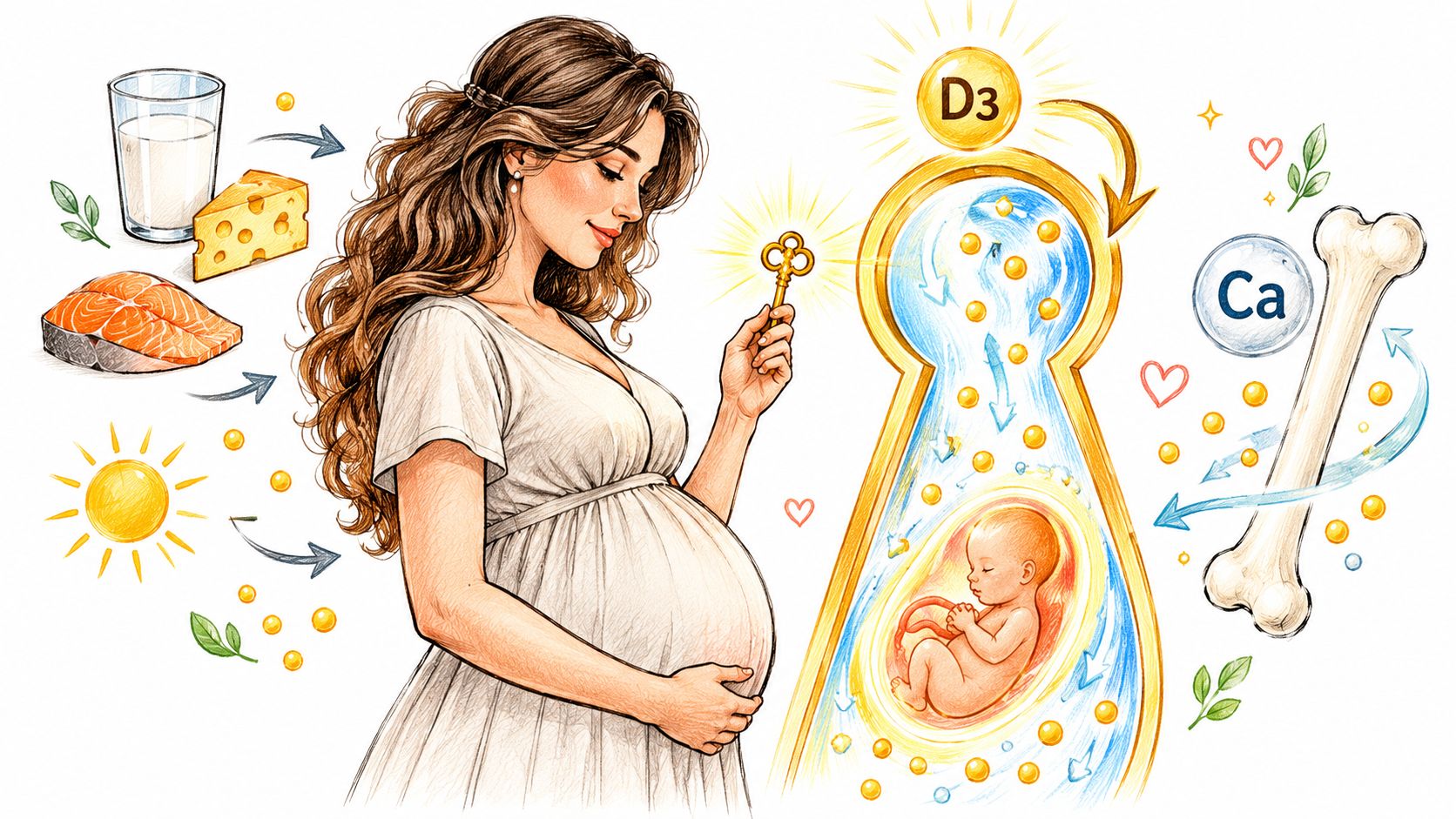
During pregnancy you maintain your own bones and muscles while supplying a growing baby. Your body adapts by absorbing calcium more efficiently, yet that adaptation still depends on raw materials arriving regularly. Steady intake matters more than occasional large doses, because the transfer is continuous rather than a one-off top-up. A guide on why prenatal vitamin D matters sets that supportive role in the wider pregnancy context.
What Your Baby Draws From You
The baby draws on the same circulating supply you use yourself, so the aim is consistency across weeks, especially as skeletal growth accelerates later in pregnancy. Vitamin D and calcium work as a pair, and each depends on the other.
Vitamin D and calcium work as a pair, and each depends on the other.
Vitamin D also supports immune function, which is why it is discussed beyond bone health. The strongest case in pregnancy remains nutritional: preventing low status and supporting normal calcium use. Links with pre-eclampsia, preterm birth and later childhood conditions rest mainly on observational evidence, where associations appear in some studies and not others, so routine supplementation is sensible prevention while treatment of those conditions stays clinical.
For the calcium half of the pair, this explainer on how calcium supports bones and absorption covers food sources and absorption in practical terms. It shows why the two nutrients are discussed together while doing different jobs.
The video below gives another plain-language walkthrough of vitamin D in pregnancy, useful if you prefer hearing the explanation before you check your own labels.
Vitamin D status changes over weeks because your body stores and uses it gradually. Choose a daily amount you can confirm on every label, keep the routine boring, and leave dose changes to your midwife or clinician.
Who Is Most at Risk of Low Vitamin D
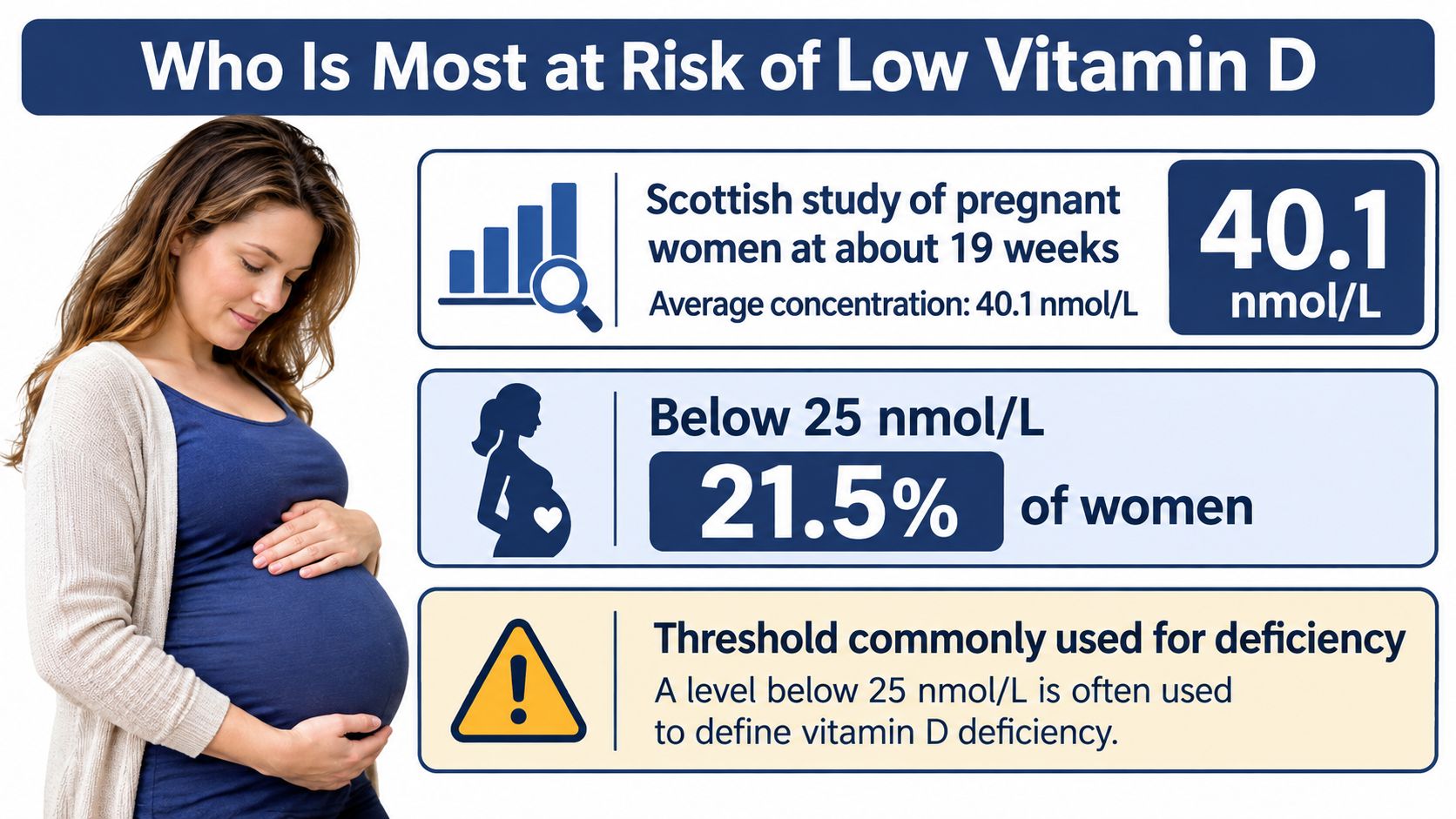
Low status is common in UK pregnancy, but the headline figure changes with the threshold, season and group being measured. Always ask which cut-off a figure uses before comparing it with your own situation. In the British Journal of Nutrition analysis of UK pregnancy vitamin D status, Scottish pregnant women measured at approximately 19 weeks had a geometric mean concentration of 40.1 nmol/L, 21.5% were below 25 nmol/L, and only 21.0% reported supplement use.
That low uptake helps explain why measured status can look worse than advice suggests. It also shows the limit of population data: thresholds are measurement lines, so moving the line changes the percentage even when women's actual levels have stayed the same.
Why Local Figures Differ
UK reports can land in different places even when researchers use a similar cut-off, because geography, daylight, skin tone, diet and supplement habits all shift the measured share. Studies in Aberdeen and Southampton have produced different deficiency estimates while using a closely related threshold, which is why one city's figure should be read as context rather than personal probability.
| Population | Threshold | Share with low status |
|---|---|---|
| Scottish cohort, measured at about 19 weeks | Below 25 nmol/L | 21.5% (mean 40.1 nmol/L) |
| Aberdeen pregnancies | Below 27.5 nmol/L | Reported above the Southampton comparison |
| Southampton study | Below 27.5 nmol/L | Reported below Aberdeen at the same cut-off |
| UK pregnant women with obesity, 2024 (1,089 women) | Below 50 nmol/L | 67% |
| UK pregnant women with obesity, 2024 (1,089 women) | Below 25 nmol/L | 26% |
| UK pregnant women, review of European pregnancy data, 2024 | Low vitamin D status | 35% |
The obesity rows need their full scope. In 2024, King's College London researchers reported that 67% of 1,089 UK pregnant women with obesity had serum 25-hydroxyvitamin D concentrations below 50 nmol/L, while 26% were below 25 nmol/L. Separately, a 2024 review in the Cochrane Database of Systematic Reviews reported that 35% of pregnant women in the UK had low vitamin D status, based on European pregnancy data.
Check yourself against the practical risk factors rather than chasing a single percentage:
- Dark or black skin: More melanin reduces vitamin D production from sunlight.
- Skin-covering clothing: Less skin reaches daylight outdoors.
- Little time outdoors: Indoor work and winter routines limit exposure.
- Obesity: Low status is particularly common in this group.
- Pregnancy through winter: UK sunlight can't reliably make vitamin D then.
A risk factor is a prompt to check whether the routine 10 micrograms is already covered across a multivitamin, a separate D3 tablet and fortified foods, then ask your midwife whether testing or a prescribed treatment dose is appropriate. Do that totals check before symptoms; stacking products or self-escalating is where the avoidable risk sits.
Where Your Vitamin D Actually Comes From
Your skin is the main natural source when UK sunlight is strong enough, broadly in spring and summer. From October to March, the sun's angle means skin can't make vitamin D reliably, even on a bright lunchtime walk. That seasonal switch is the reason routine supplement advice is tied to the calendar.
Food helps, but each source has a limit that stops it being the whole answer in a Vitamin D3 pregnancy plan:
- Oily fish: Salmon, sardines and mackerel contain useful amounts, but pregnant women are advised to eat no more than two portions of oily fish a week, avoid shark, swordfish and marlin, and limit tuna.
- Eggs: They contribute a little vitamin D, mainly in the yolk, but you'd need an unrealistic number to cover the daily target alone.
- Fortified spreads: Some contain added vitamin D, yet the amount per serving is usually small and differs by product.
- Breakfast cereals: Fortification varies widely by brand, so the label per serving matters more than the front-of-pack claim.
- Plant milks: Some are fortified with vitamin D and calcium, while organic versions often aren't, so don't assume every carton is equal.
Why Food Alone Usually Falls Short
Reaching 10 micrograms every day from food alone would mean eating large, impractical amounts of oily fish daily, which would also clash with pregnancy fish limits. A varied diet still matters for calcium, protein and omega-3 fats. It just isn't a precise vitamin D measuring tool.
Sunlight needs the same balanced thinking. Short, regular exposure without burning is different from sunbathing, and skin should never be allowed to redden. Sunscreen protects skin but reduces synthesis, so you can't calculate a dependable dose from time outdoors.
Food and daylight support your status, but a labelled supplement is the only source you can measure to the microgram each day.
That measurability is valuable in pregnancy, where guesswork creates anxiety. You can enjoy salmon on Tuesday and a walk on Saturday, then rely on your supplement for the consistent baseline. The sources work together, but they don't carry equal weight.
Too Much Vitamin D and When to Get Tested
The safety boundary is clear. The NHS guide to vitamins and supplements in pregnancy states that adults should not take more than 100 micrograms, or 4,000 IU, of vitamin D per day unless medically directed, because excessive intake can be harmful. Too much vitamin D can raise blood calcium, and high calcium is what drives most symptoms of excess.
A standard 10 microgram pregnancy supplement sits well below that line. Risk usually builds when you stack a pregnancy multivitamin, a separate Vitamin D3 tablet and perhaps a fortified product without adding them up. Self-escalating after reading about high-dose adult supplements creates the same problem.
Warning Signs in Order of Concern
| Sign | What it can indicate | What to do |
|---|---|---|
| Confusion, severe tiredness or abdominal pain | Possible serious high calcium from excess vitamin D | Stop extra vitamin D and seek urgent medical help the same day, using 111 or 999 if symptoms are severe |
| Nausea, vomiting or constipation | High calcium from excess vitamin D | Stop extra vitamin D products and contact your GP or midwife the same day |
| Excessive thirst or passing urine often | Calcium affecting the kidneys | Contact your GP or midwife the same day |
| Bone pain or muscle weakness | Possible low vitamin D status | Ask for a blood test reported in nmol/L |
These symptoms aren't unique to vitamin D problems, which is why guessing from symptoms alone can mislead you. Nausea is common in pregnancy, for example, so context matters, including what you've been taking and for how long. Bring every bottle or a photo of each label to the conversation.
Routine vitamin D blood testing isn't standard for every healthy pregnancy in the UK. Testing is more relevant if you have risk factors, symptoms such as bone pain or muscle weakness, a medical condition affecting absorption, or a clinician advises it. Our guide to vitamin D deficiency symptoms in the UK can help you separate vague tiredness from signs worth raising promptly.
Results are usually reported in nmol/L, and the number needs interpretation alongside your history, diet, supplements and stage of pregnancy. If you've used private testing for another nutrient, guidance on understanding B12 results after private blood testing from Vital iQ Health shows why a standalone number still needs clinical context. The same caution applies here.
If deficiency is confirmed, a clinician may recommend supervised oral vitamin D at around 1,000 to 2,000 IU daily, rather than a dose you choose yourself. They may also check calcium or repeat bloods after treatment. The sequence is test, interpret, treat, then review.
Same-day rule: If symptoms suggest excess, stop extra vitamin D products and contact your midwife or GP, and use 111 or 999 when symptoms are severe.
Vitamin D3 When Planning, Breastfeeding and Beyond
Routine prevention stays at 10 micrograms (400 IU) through planning, pregnancy and breastfeeding. The reference intake covers all three stages, so your daily foundation stays the same when your baby arrives.
The timing is what shifts. If you're planning a pregnancy between October and March, start the daily 10 micrograms when you start planning rather than waiting for a positive test, because the earliest weeks of development often begin before you know you're pregnant. Before conception, check for dark or black skin, skin-covering clothing, substantial time indoors or obesity. Any of those points toward year-round use and a GP conversation about whether testing is worthwhile.
The new decision arrives with your baby. Ask your health visitor whether your baby needs a separate infant vitamin D supplement once feeding is established, and use a product formulated for infants. Never give adult products to infants. Your own dose stays at prevention level: postpartum tiredness can tempt women to raise it on their own, but a larger dose belongs to confirmed deficiency under clinical supervision, not routine recovery.
Our round-up of the best prenatal vitamins in the UK can help you compare formulations if you're rebuilding your routine after birth. For aches that continue beyond the early weeks, Restore Osteopathic Medicine's postpartum pain guide offers useful context on recovery and when to seek hands-on assessment. Persistent pain shouldn't be blamed on vitamin D without assessment.
Build Your Routine and Confirm It With Your Midwife
A reliable routine starts with your labels. Memory misses the multivitamin you take at breakfast and the standalone tablet you added months ago. Paper doesn't.
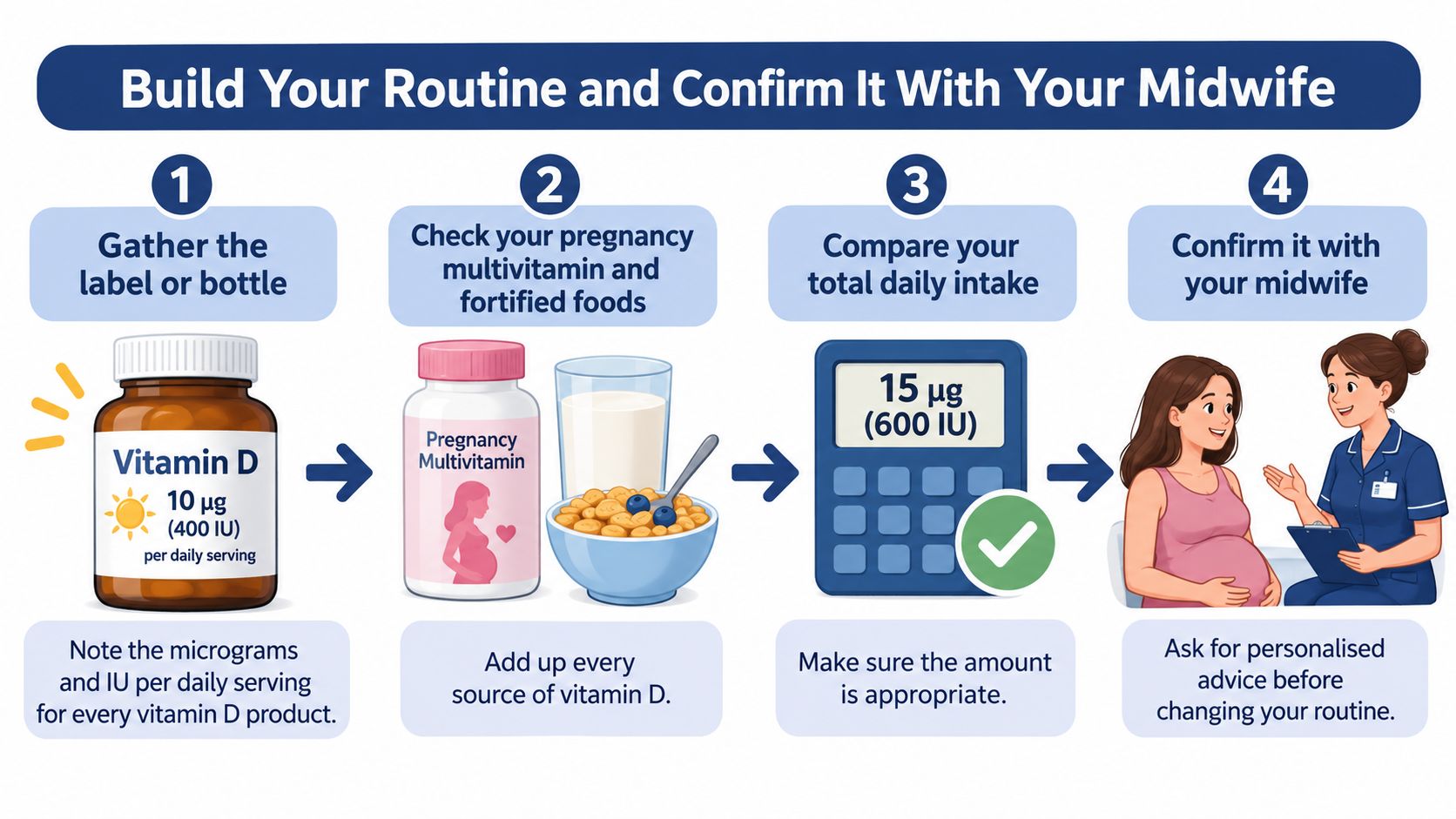
Your Six-Step Check
- Gather every bottle: Note micrograms and IU per daily serving for each vitamin D product, including your pregnancy multivitamin and any fortified food you rely on daily.
- Write down one daily figure: Combine the per-serving amounts into a single total so any overlap between products shows up on paper before it shows up in your bloodstream.
- Take it with food: Choose the same meal each day with some fat, because vitamin D is fat-soluble and absorbs better that way.
- Match the season to your risk: Continue from October to March at least, and all year if you have dark or black skin, cover most skin outdoors, spend substantial time indoors or have obesity.
- Check standards: Look for clear labelling, GMP manufacturing and independent testing, and be wary of any product that hides its per-serving dose.
- Tell your midwife: At your first antenatal visit, list exactly what you take so your notes match your real routine.
The common slips are predictable. Women miss vitamin D already inside a multivitamin, buy a high-dose adult product meant for a different purpose, or take tablets irregularly and then double up. If you miss a day, take the next one as normal. Doubling a dose to catch up is how a modest routine becomes a large one.
Unrelated products can muddle the basket too. BrainQuick Brain Support Supplement (30 Capsules) serves a different purpose entirely, so leave it out of your pregnancy vitamin D calculation and check suitability before adding it in pregnancy. Keep each product in its own category and ask before combining blends.
All our products are manufactured and packaged in the UK to ISO9001 standards following GMP (Good Manufacturing Practice), which gives you a clear standard to look for when you compare suppliers. We deliver in the UK via Royal Mail Tracked, giving you visibility from dispatch to door. If you buy online elsewhere, still check the delivery method and returns policy, and reorder before you run out so winter supply doesn't lapse.
Three Questions for Your Appointment
Ask your midwife or GP whether 10 micrograms fits your risk group, whether your skin tone, clothing, weight or symptoms call for a blood test, and whether any medicine you take affects vitamin D or calcium. Write the answers next to your label totals. Set a calendar reminder for early October so the seasonal start doesn't rely on memory.
Your clinician sets the dose. Your basket follows.
That final rule protects you in both directions. It stops you staying on too little when testing shows deficiency, and it stops a well-meaning extra tablet becoming an unsupervised high dose. Your routine should feel boring, measurable and easy to explain at every antenatal appointment.
Visit Vitamin Planet to browse clearly labelled vitamin D and pregnancy support products, check the dose per daily serving before you buy, and build a routine you can confidently confirm with your midwife. Choose the product that fits your clinician's advice, keep your daily total in one place, and reorder in good time so your 10 microgram routine stays consistent through the months you need it.