

Vitamin D Drops Guide: Doses by Age and How to Choose
Nearly 1 in 5 adults aged 19–65 had low vitamin D levels in a 2025 UK Government survey, according to the British Heart Foundation's summary. That helps explain why vitamin D isn't just a concern for newborns. It's a practical consideration for the whole family.
For a parent, though, the immediate question is usually simpler: does my baby need drops, and how much should I give? The safest answer starts with the whole day's intake, not just the bottle of supplement.
Table of Contents
- What Vitamin D Drops Are and Why the UK Relies on Them
- Daily Vitamin D Drops Dose by Age and Feeding
- Feeding Cases for Babies on Breast Milk or Formula
- Which Adults and Children Are at Risk of Low Vitamin D
- How to Give Vitamin D Drops Step by Step
- Safe Limits, Overdose Risks and Side Effects
- Choose the Right Strength and Buy Vitamin D Drops Safely
What Vitamin D Drops Are and Why the UK Relies on Them
Vitamin D drops are a liquid concentrate, usually containing vitamin D3, also called cholecalciferol. A dispenser, pipette or measuring device delivers the dose. Products for babies, children and adults may look alike while containing different strengths, so check the label before using a dropper.
The label may state vitamin D per drop or per daily serving. For example, if it lists 10 micrograms in one drop, that drop provides 10 micrograms; if 10 micrograms is listed for two drops, each provides 5 micrograms. Check the serving size as well as the amount.

A measured top-up rather than a bucket
Summer sunlight can help the skin make vitamin D. From October to April, UK sunlight is generally less dependable for this, so drops can provide a measured top-up. The amount from a supplement is only one part of the day's intake.
Add together vitamin D from drops, formula, multivitamins and fortified foods. Cod-liver oil can contribute too, so check its label. For instance, if a child has vitamin D drops and a multivitamin, count both listed amounts before deciding whether the day's intake is covered. Formula volume also matters, since formula contains added vitamin D.
Vitamin D helps the gut absorb calcium and phosphate, which the body needs for bones, teeth and normal muscle function. Read more about how calcium supports bone health. Calcium and vitamin D work together, but they are not interchangeable.
Oily fish and eggs provide some vitamin D, and manufacturers add it to some fortified foods. Vitamin D drops may contain vitamin D alone or include other vitamins. If a child already takes a multivitamin, compare the ingredients and amounts across both labels to avoid overlooking a second source. Check age, feeding pattern and risk group when working out what is suitable.
Daily Vitamin D Drops Dose by Age and Feeding
Daily vitamin D drops dose by age and feeding status
| Group | Daily amount | IU equivalent | Key condition |
|---|---|---|---|
| Breastfed babies, birth to 12 months | 8.5–10 mcg | 340–400 IU | Given whatever the breastfeeding parent takes |
| Formula-fed babies drinking over 500 ml formula a day | No extra drops needed | None additional | Formula is fortified with vitamin D |
| Formula-fed babies drinking under 500 ml formula a day | 8.5–10 mcg | 340–400 IU | Supplement still advised |
| Children aged 1 to 4 years | 10 mcg | 400 IU | Usually drops or an age-appropriate supplement |
| Children over 5 and adults | 10 mcg | 400 IU | Autumn and winter, or year-round if at higher risk |
| Pregnant and breastfeeding women | 10 mcg | 400 IU | Routine advice; check before taking a higher dose |
The infant and young-child amounts and formula-volume threshold in this table follow NHS guidance on vitamins for children, which recommends 8.5–10 micrograms daily for breastfed babies and 10 micrograms for children aged 1 to 4.
For older children and adults, the BMJ Open analysis discussing Scientific Advisory Committee on Nutrition guidance describes a daily recommendation of 10 micrograms for people over 5, particularly between October and April. Pregnancy and breastfeeding don't justify choosing a higher-strength product without individual advice.
Read the units before counting drops
Micrograms describe an amount of vitamin D; international units, abbreviated IU, express the same amount using a different scale. Labels may show micrograms as “mcg” or “µg”.
Using the equivalent amounts in the NHS guidance, a microgram corresponds to forty IU. To compare an IU-only label with a microgram recommendation, divide the IU amount by forty. A pharmacist can check the calculation if the label is unclear.
Just as important, check what the amount refers to. The front of the pack might advertise the vitamin D in the full daily serving, while the side panel gives the amount in each drop or millilitre. Those aren't necessarily the same thing.
Maintenance isn't deficiency treatment
These are routine maintenance amounts, not instructions for treating a low blood-test result. A prescribed treatment course may use a different strength and schedule, with a clear end date or review plan.
Find the relevant row, then match it to the product's daily serving instructions. Don't assume an adult preparation becomes suitable for a baby just because you can calculate a smaller volume.
For a child at an age boundary, someone taking prescribed supplements, or a baby whose formula intake sits close to the threshold, ask a pharmacist to check the exact recommendation rather than rounding the dose yourself.
Feeding Cases for Babies on Breast Milk or Formula
Match the drops to what your baby actually drinks
Breast milk only. Your baby needs their own infant vitamin D preparation. The breastfeeding parent's supplement supports the parent's intake; it doesn't reliably replace the baby's supplement.
Breast milk plus some formula. Count the formula your baby drinks, not the amount you prepare. In the mixed-feeding examples described by NHS Somerset's infant-feeding guidance, breast milk plus 300 ml formula remains below the 500 ml daily threshold, while a baby drinking 650 ml formula generally doesn't need additional vitamin D drops.
Moving towards formula feeding. The answer can change as formula intake increases. Don't stop drops merely because you've introduced a bottle, and don't continue automatically once fortified formula consistently covers the relevant feeding threshold.
Keep a useful feed record
Mixed feeding rarely follows a perfectly tidy pattern. A baby may drink more formula during a working day and less when the breastfeeding parent is home.
Record the daily amount actually consumed and note any substantial change in feeding. Looking across a typical week can help a health visitor understand the pattern, but a weekly average isn't a substitute for the daily feeding rule.
If intake regularly falls either side of the threshold, ask for an agreed plan. Avoid inventing a changing partial dose or estimating extra drops after individual feeds.
Bring useful details to the conversation:
- Feed log: Record formula consumed, alongside breastfeeding and any recent changes.
- Supplement bottle: Show the exact preparation and its measuring device.
- Other vitamins: Include any infant multivitamin already being given.
A parent's vitamin D supplement and a baby's vitamin D drops are separate decisions.
The mistake to avoid is judging need by the words “breastfed” or “formula-fed” alone. For mixed feeding, the amount of fortified formula matters.
Don't switch formula brands solely to manage vitamin D without discussing feeding needs. Prepare formula exactly as directed, and never make it stronger or weaker to alter nutrient intake. If you're unsure what to do today, a health visitor, pharmacist or GP can check the feeding record with you.
Which Adults and Children Are at Risk of Low Vitamin D
Low vitamin D can be hard to recognise from how someone feels. Even a balanced diet may not make up for limited opportunity to produce vitamin D through the skin.
Risk factors tell you when to ask about year-round supplementation. They don't confirm a deficiency or show that treatment-strength drops are needed.
Recognise the pattern
Darker skin contains more melanin, which reduces vitamin D production from the same sunlight exposure. Time outdoors, clothing, season and some health conditions also affect how much vitamin D the body can make.
People who spend little time outdoors, including those who are housebound or have restricted mobility, should ask a pharmacist or GP whether year-round supplementation is appropriate. If you cover most of your skin for cultural, religious or personal reasons, mention this at a routine pharmacy or healthcare appointment.
Night-shift workers may have limited daylight exposure despite being active and otherwise well. Ask about year-round drops at your next pharmacy visit. People with darker skin can also ask a pharmacist or GP whether they should take a supplement throughout the year.
For older adults, reduced outdoor activity and changes in skin production can affect vitamin D levels. Raise supplementation at a routine medication review. If you have a gut condition or take treatment that could affect absorption, ask your GP or pharmacist for an individual plan rather than choosing a higher-strength product yourself.
Pregnancy is another reason to review supplements. If you already take a pregnancy multivitamin, ask your midwife, pharmacist or GP to check its ingredients before adding drops. Include any other supplements, fortified foods and cod-liver oil in that conversation, so the decision considers the whole day's intake rather than one product alone.
Use the checklist without turning it into a diagnosis
One substantial risk factor, such as being housebound, is enough to ask a healthcare professional about year-round supplementation. You do not need to wait until several factors apply.
Risk can affect whether supplementation is needed throughout the year. It does not automatically mean you need stronger drops. Conditions affecting absorption, kidney function or calcium balance call for individual assessment before choosing a product or dose.
If you're concerned about tiredness, muscle weakness or bone discomfort, read about vitamin D deficiency symptoms in the UK and discuss your concerns with a healthcare professional. These symptoms can have other causes, so they cannot confirm deficiency on their own.
Before speaking to a pharmacist or GP, note the risk factors that apply, your current supplements and any persistent symptoms. This gives them practical details to consider when advising you.
How to Give Vitamin D Drops Step by Step
Accurate administration starts before the bottle is opened. Set out the product and its supplied measuring device somewhere clean, with enough light to read the markings.
Use this visual reminder alongside the instructions printed on your particular bottle.
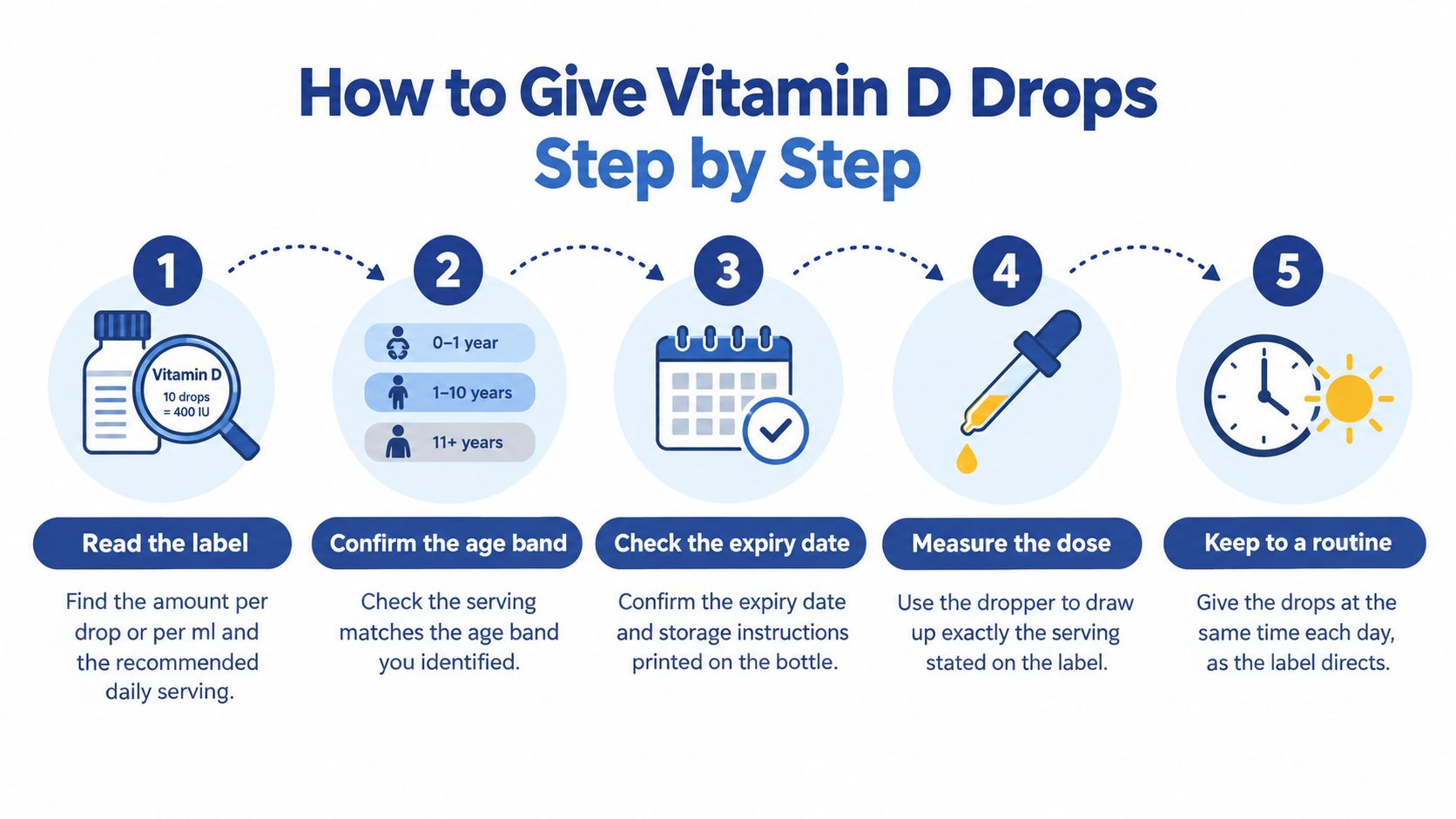
Measure and give the dose
- Read the whole dosing panel. Identify the amount per drop or per millilitre, then find the recommended daily serving. Don't use the front-of-pack strength as the administration instruction.
- Confirm who the product is for. Check that the age range includes the person receiving it and that the serving matches the intended maintenance or prescribed dose.
- Check expiry and storage. Follow any after-opening instructions and write the opening date on the bottle if needed. Refrigerate only when the manufacturer directs you to.
- Use the correct measuring device. With a marked pipette or oral syringe, measure at eye level and check for large air bubbles. With a drop dispenser, hold the bottle at the angle specified by the manufacturer rather than assuming every design works upright.
- Give it by an approved route. If direct administration is permitted, place the measured liquid gently inside the baby's cheek without pushing the device deep into the mouth. If the label permits application to a teat or mixing with milk, use an amount you're confident the baby will take, never a full bottle they might leave unfinished.
- Attach it to an existing routine. A morning feed or toothbrushing time can help you remember. Keep the bottle safely out of children's reach, rather than leaving it beside food where it could be mistaken for something else.
- Handle a missed dose calmly. Follow the leaflet's missed-dose advice; generally, give it when remembered unless the next dose is nearly due. Never double the next serving to catch up.
Avoid the measuring shortcuts
Common slips include borrowing a dropper from another product, counting drops when the instruction is in millilitres, and leaving part of the measured dose clinging to a spoon. A household teaspoon isn't an accurate substitute for an oral dosing device.
If a baby spits out some drops, don't automatically repeat the full serving. You can't reliably judge how much was swallowed, so ask a pharmacist if you're unsure.
For an additional visual demonstration, watch the video below and compare any technique with your own product's instructions.
Safe Limits, Overdose Risks and Side Effects
A concentrated vitamin D preparation may be prescribed for a limited course to treat deficiency. That treatment plan is different from routine family supplementation. Follow the agreed dose and duration, and seek a review before continuing beyond them.
Too much vitamin D can cause hypercalcaemia, an excess of calcium in the blood. This can weaken bones and damage the kidneys and heart.
Upper limits are ceilings, not goals
Use the table to compare the total vitamin D from all supplements and other products with the upper limit for the person's age. The NHS regional vitamin D prescribing guidance sets out these age-specific ceilings.
UK tolerable upper intake levels for vitamin D
| Age group | Upper limit (mcg) | Upper limit (IU) |
|---|---|---|
| 0 to 6 months | 25 mcg | 1,000 IU |
| 7 to 11 months | 35 mcg | 1,400 IU |
| 1 to 10 years | 50 mcg | 2,000 IU |
| 11 years and over, including adults | 100 mcg | 4,000 IU |
The IU column expresses the same limits in another unit. These values are ceilings, not target doses. A lower dose may be the appropriate daily amount; don't increase a supplement just to approach the limit.
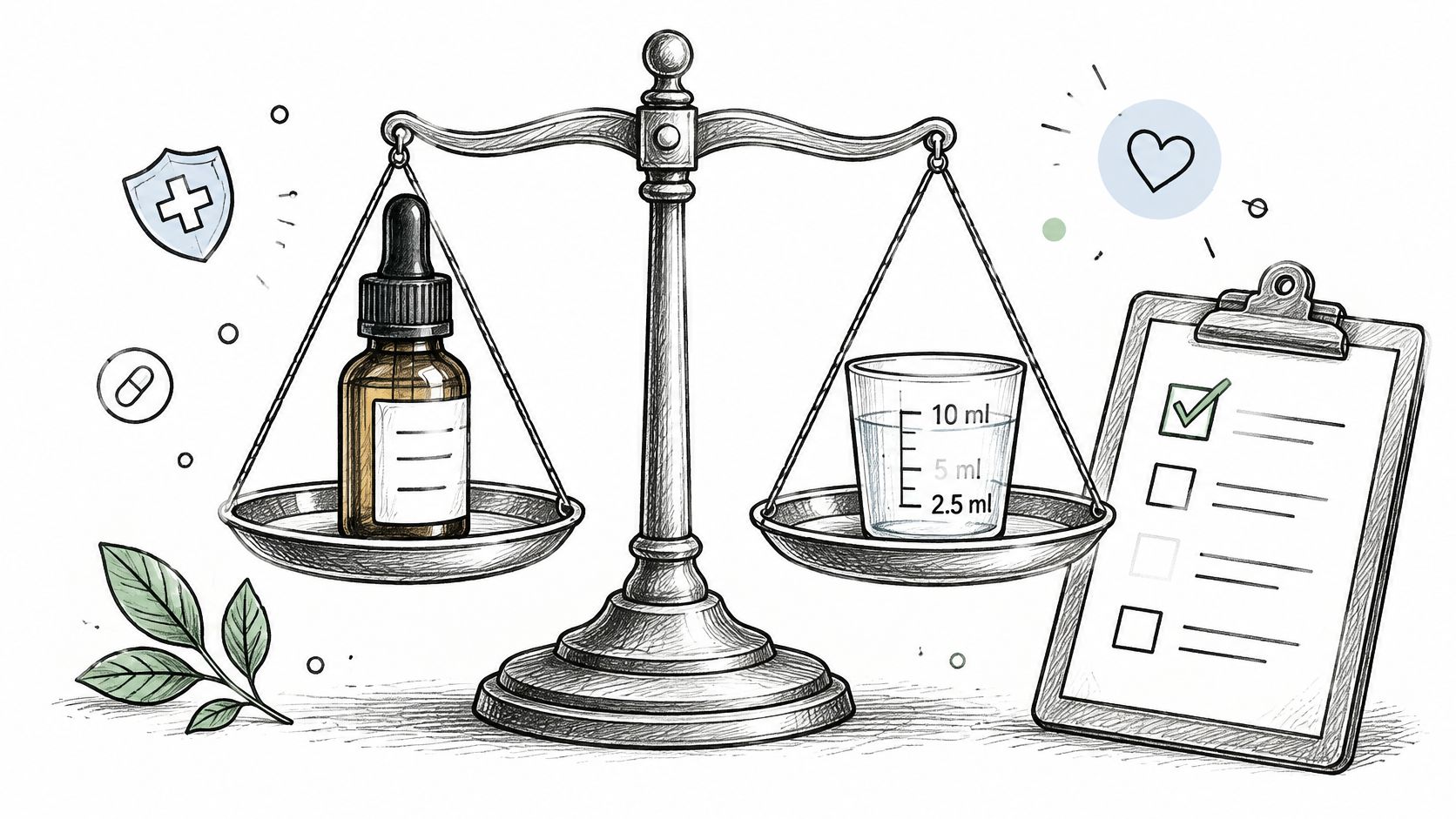
Check the total from all products against the ceiling for your child's age. Include vitamin D from drops, multivitamins, fortified foods and cod-liver oil, rather than judging safety by the size of one drop. If you're considering a combination product, read about vitamin D3 and magnesium, and ask a pharmacist whether it fits with the rest of the day's intake.
Recognise when to seek help
Vitamin D is fat-soluble, so repeated excessive doses can build up in the body. Symptoms alone can't show whether a dosing error was harmless.
Possible warning signs include:
- Digestive changes: nausea, vomiting, constipation or poor appetite.
- Fluid changes: unusual thirst or passing urine more often.
- General changes: weakness, marked tiredness or a baby feeding poorly.
Correctly measured routine doses are usually well tolerated. Stomach discomfort may also relate to other ingredients. If symptoms persist, seek an assessment instead of assuming the supplement is the cause.
After a dosing error: Keep the bottle and packaging, note what was taken and when, and seek advice rather than waiting for symptoms.
If more than the label allows has been taken, contact a pharmacist, GP or NHS 111 promptly the same day, particularly if a child is involved. Seek emergency help for severe illness, collapse or difficulty waking. Don't take another nutrient to try to counteract an excessive dose.
Choose the Right Strength and Buy Vitamin D Drops Safely
Vitamin D drops strengths and forms compared
| Product type | Typical strength per daily dose | Best for | Watch out for |
|---|---|---|---|
| Infant liquid drops | An infant maintenance serving | Babies within the pack's stated infant age range | Per-drop and per-ml amounts aren't interchangeable |
| Child liquid drops | A child maintenance serving | Children within the labelled age band | Check suitability when changing products |
| Standard adult tablets or drops | A routine adult maintenance serving | Adults following seasonal or year-round advice | Count other vitamin-containing products |
| High-strength adult drops | A higher dose specified by the product or prescription | Adults advised by a clinician | Requires a reason, duration and review plan |
| Prescription concentrate | Concentration and serving specified on the prescription | Clinician-directed deficiency treatment | Never assume the bottle's concentration is the daily dose |
These categories aren't standardised strengths across every manufacturer. The right choice is the preparation that delivers the intended serving accurately, with the fewest unnecessary overlapping products.
The UK Committee on Toxicity statement on excess vitamin D intake warns that higher-strength supplements combined with dietary vitamin D or other supplements may exceed tolerable upper levels. A product being available to buy doesn't establish that it's appropriate for you.
Add the whole day before adding another bottle
Make a single-column list of vitamin D from drops, multivitamins, cod-liver oil and fortified foods. For infants, use the feeding guidance and actual formula volume rather than trying to redesign the supplement dose yourself.
Say an adult already takes a multivitamin containing vitamin D and eats a fortified breakfast cereal. Adding drops means counting all those contributions, not treating the drops as their only intake.
Compare these practical situations:
- Drops replacing a multivitamin: Check which other nutrients you'd stop receiving before making the switch.
- Drops added to a multivitamin: Add the vitamin D amounts from both daily servings.
- Cod-liver oil added as well: Read its vitamin panel, including vitamin A, particularly during pregnancy.
- Fortified foods eaten regularly: Use the amount in the portion you really consume, not automatically the amount printed for a different serving size.
This checklist summarises the purchasing decisions.
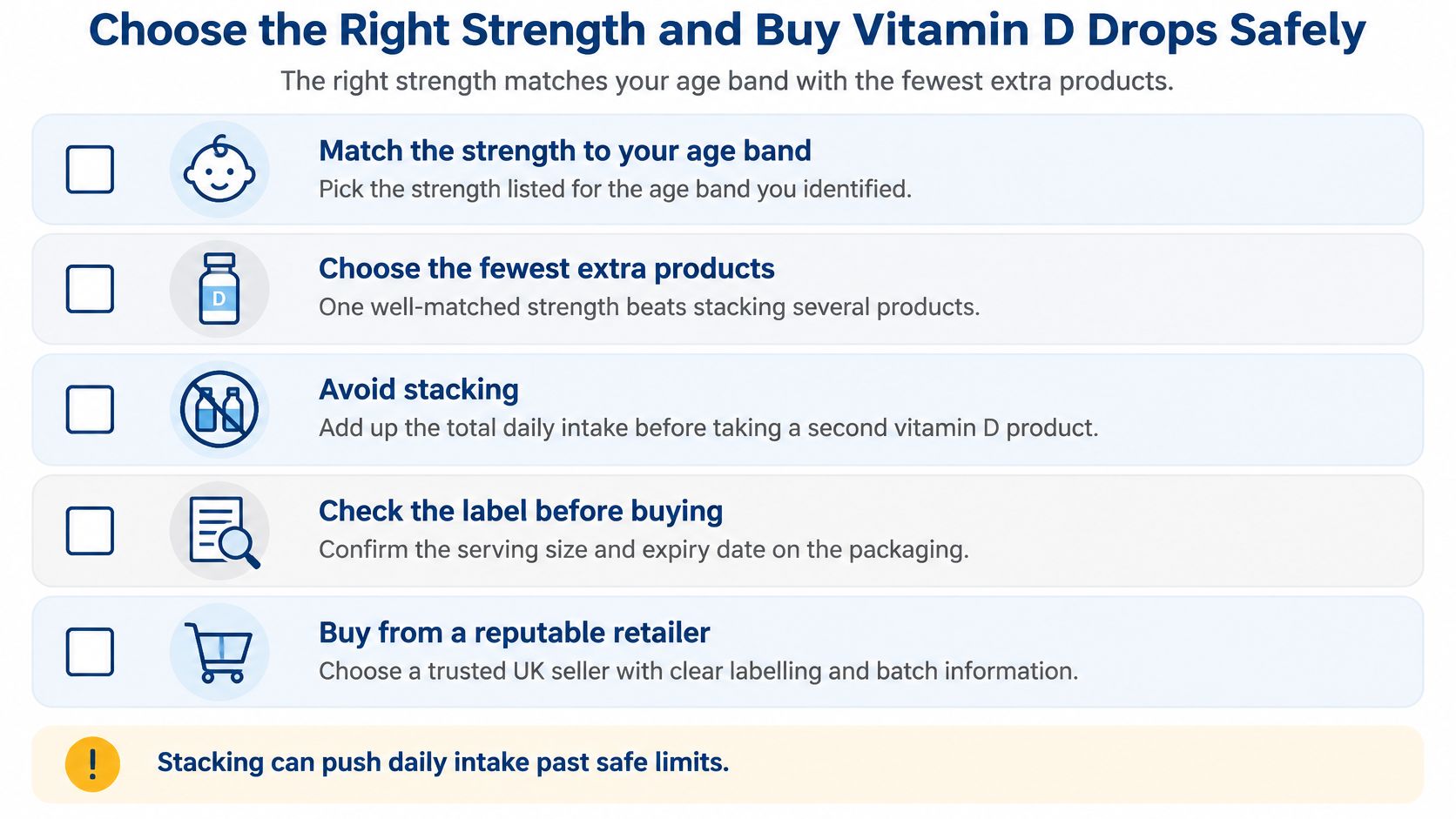
Check the supplier as well as the supplement
Look for a UK supplier with a clear business address, contact details and returns policy. Check delivery information before ordering, especially if you're replacing a prescribed or regularly used preparation.
On the product itself, look for:
- Clear units and serving instructions: Prefer labels showing both micrograms and IU.
- Traceability: A batch number, expiry date and identifiable manufacturer.
- Manufacturing information: A clear statement about good manufacturing practice, rather than vague quality claims.
- Age suitability: Infant instructions for an infant product, not improvised adult dosing.
- Ingredient details: Check allergens, carrier oils and dietary requirements.
Choose the age-appropriate preparation, total the overlapping sources, and ask a GP or pharmacist to confirm any high-strength plan. Keep a written dose record if different family members use different products.
Vitamin Planet offers vitamins, minerals and related family health products, including vitamin D options. Visit Vitamin Planet to compare product labels, age suitability and serving instructions, then check your choice against your household's existing supplements before ordering.