

Pregnancy Care Tablets Guide for Safe Daily Use
Standing in front of a shelf of prenatal products can feel oddly stressful. One box says “complete”, another says “advanced”, a third lists a long string of vitamins and minerals that sounds reassuring until you realise you don't know which parts matter and which parts are just there because they look impressive on the label.
That confusion is common, especially if this is your first pregnancy or you're trying to conceive and want to “get things right” early. Many people assume the best pregnancy care tablets are the ones with the longest ingredient list. In UK practice, it's often the opposite. The most important question isn't “Which tablet has the most in it?” It's “Which tablet matches what's recommended for me?”
Pregnancy care tablets are there to support a balanced diet, not replace food, antenatal care, or personalised advice from your midwife, GP, or pharmacist. Some nutrients are widely recommended. Others are only useful in specific situations. Knowing the difference can save you money, reduce side effects, and make your routine much simpler.
That matters before pregnancy, during pregnancy, and after birth too. If you're already thinking ahead to recovery and everyday wellbeing after delivery, this guide to postpartum care with organic products can be a useful companion read alongside your supplement planning.
Table of Contents
- Introduction to Pregnancy Care Tablets and What They Do
- Understanding How Pregnancy Care Tablets Work
- Essential Nutrients Found in Pregnancy Care Tablets
- When to Start and How Timing Changes by Trimester
- Safe Dosing Contraindications and Common Misconceptions
- How to Choose Pregnancy Care Tablets in the UK
- Your Next Steps for Confident Pregnancy Nutrition
Introduction to Pregnancy Care Tablets and What They Do
You are in the pharmacy aisle, holding a box that says it supports pregnancy with a long list of nutrients. The front sounds reassuring. The back is harder to decode. A common question follows. “Do I need all of this?”
Often, the honest answer is no.
Pregnancy care tablets are sold as if more ingredients automatically means better cover. UK guidance is narrower than many retail labels suggest. The routine starting point is usually much simpler: folic acid before conception and in early pregnancy, plus vitamin D during pregnancy. Other nutrients, such as iron or iodine, may be helpful in some circumstances, but they are not automatically needed by everyone.
That difference matters because a shop label is built to sell a broad product, while NHS advice is built around what is routinely recommended for most pregnant people in the UK. The two can overlap, but they are not the same thing.
A useful way to look at it is this. Pregnancy tablets work like a packed hospital bag. You start with the things you are most likely to need, not every item in the house. In UK practice, folic acid and vitamin D are the usual basics. Extras are added for a reason, such as diet, symptoms, blood test results, or advice from a midwife, GP, or pharmacist.
This is why a tablet can be well made and still be the wrong fit for you personally.
A broad prenatal may include iron, iodine, vitamin C, B vitamins, and other nutrients. That does not make it harmful by default, but it does change the questions you need to ask. Do you need each ingredient? Are you already getting some elsewhere? Could one part upset your stomach or duplicate another supplement? Those are practical safety questions, not small print.
The goal is not to find the product with the busiest label. The goal is to match the tablet to your actual needs.
By the end of this guide, you should feel clearer about:
- which nutrients are routinely advised in UK pregnancy care
- why folic acid and vitamin D sit at the centre of that advice
- when extras such as iron or iodine may make sense
- how to choose without paying for ingredients you may not need
That calmer, narrower approach can make supplement decisions feel much less intimidating. If you are already thinking beyond pregnancy too, this guide to postpartum care with organic products can be a useful companion read alongside your supplement planning.
Understanding How Pregnancy Care Tablets Work
You pick up a pregnancy supplement and the label reads like a shopping list. Folic acid, vitamin D, iron, iodine, B vitamins, zinc. It is easy to assume your body uses all of them in the same way, every day, just because they sit in the same tablet.
In practice, pregnancy care tablets work more like a measured refill. They add selected nutrients in small, steady amounts when there is a known reason to do so. That reason might be standard UK advice, a stage of pregnancy, your diet, or something your midwife or GP has picked up from your history or blood tests.
That narrower UK approach matters. Retail labels often suggest broader cover than NHS guidance starts with.
A tablet adds to your diet. It does not replace it.
Food still does most of the heavy lifting. Meals provide energy, protein, fibre, fluids, and a wider mix of nutrients than any tablet can pack into one dose. Tablets fill gaps. They do not build the whole picture on their own.
That is why a tablet can be useful without being dramatic. Folic acid has a specific role. Vitamin D has a specific role. A multivitamin may include other nutrients that are sensible for some people, but the extra ingredients are only helpful if they match a real need.
Practical rule: Choose a supplement that fits your care plan, your diet, and your advice from UK maternity care, rather than the busiest label on the shelf.
One tablet can contain several jobs
It helps to separate products by what they are trying to do.
- Single-nutrient tablets: These focus on one ingredient, such as folic acid or vitamin D. They often match UK routine advice most closely.
- Prenatal multivitamins: These bundle several vitamins and minerals into one product. They can be convenient, but convenience is not the same thing as necessity.
- Fortified foods and drinks: Breakfast cereals, milks, and nutrition drinks may add vitamins and minerals. They can contribute to your intake, but they are harder to track accurately than a clear supplement routine.
A simple comparison helps here. A single-nutrient tablet works like adding one missing battery to a device. A broad prenatal works more like buying a mixed pack of spares. Useful sometimes, unnecessary at other times, and worth checking before you add it to what you already have at home.
Your body uses different nutrients in different ways
Some nutrients are taken to prevent a predictable gap. Others are added because a person may be more likely to run low, or because test results show they already are low. This is one reason UK guidance is more selective than supplement marketing.
Folic acid is the clearest example of a targeted nutrient. It matters most in a defined early window, so the benefit comes from the right dose at the right time. Vitamin D is different. It tends to be used as a steady background supplement across pregnancy.
Iron shows why more is not always better. Many prenatal products include iron automatically, but routine iron supplementation is not advised for everyone in UK pregnancy care. Iron is often guided by symptoms, diet, risk factors, and blood results. It can also cause side effects such as constipation, stomach upset, or nausea, which is one reason clinicians usually prefer a more individual approach, as reflected in NHS guidance on vitamins, supplements and nutrition in pregnancy.
Tablets work best as part of antenatal care
Pregnancy supplements make most sense when they are tied to the rest of your care.
- Blood tests can show whether iron or anaemia needs closer attention.
- Dietary review helps you spot what food already covers well.
- Clinical advice matters more if you have had a previous pregnancy complication, take prescribed medicines, or follow a restricted diet.
A good supplement routine should feel clear and manageable. You should know what you are taking, why you are taking it, and whether it is there because the NHS recommends it routinely or because your own situation calls for something extra.
Essential Nutrients Found in Pregnancy Care Tablets
A prenatal label can look a bit like a packed suitcase. Some items are there because you will almost certainly need them. Others are included because they might come in handy, or because shoppers expect to see them. That difference matters in the UK, where routine advice is narrower than many retail labels suggest.
The clearest way to read a pregnancy care tablet is to sort nutrients into three groups: what is routinely recommended, what may be added for some people, and what is usually better covered by food unless there is a specific reason to supplement.
The two routine essentials
For most pregnant women in the UK, the routine starting point is small.
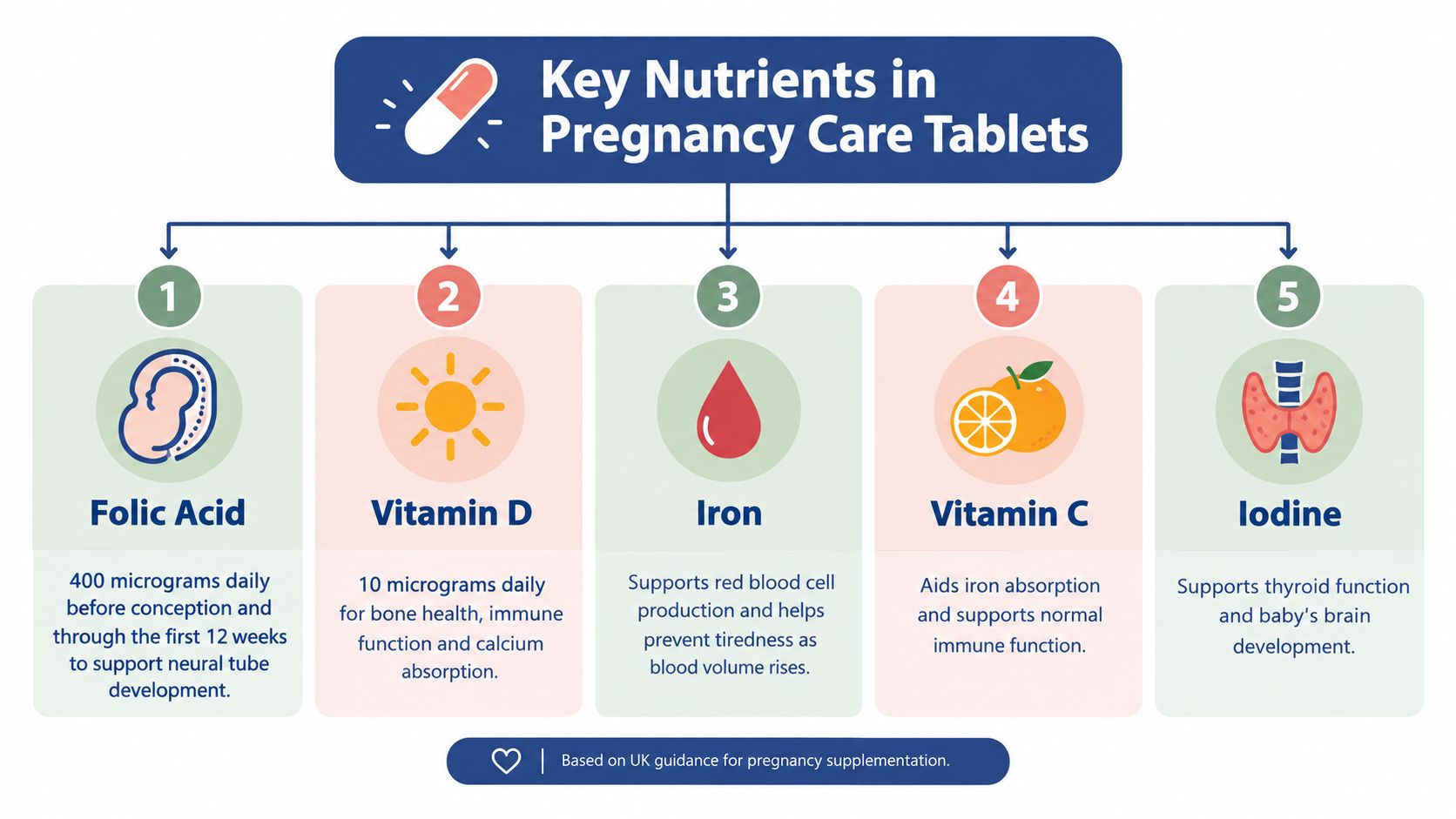
Folic acid has the most defined role. Earlier in the article, we covered the usual advice to take 400 micrograms daily before pregnancy and through the first 12 weeks. Its job is time-sensitive, so it belongs in the "must not miss" category rather than the "nice to have" one.
Vitamin D is the other routine supplement. Earlier guidance in this article also covered the usual 10 micrograms daily recommendation in pregnancy. Unlike folic acid, vitamin D is usually taken as steady background support rather than for a short early window.
Those two nutrients are the NHS-style core. Many shop-bought products contain far more, but more ingredients do not automatically mean better coverage.
Nutrients you'll often see on labels
Once you look past folic acid and vitamin D, retail formulas start to vary a lot. That is where many first-time parents get mixed messages. A label may suggest that every added nutrient is standard for everyone, but UK clinical advice is usually more selective.
Iron is a good example. It is common in all-in-one pregnancy tablets, yet it is not routinely advised for every pregnant woman. Iron is often added because some women do need it, especially if blood tests or symptoms point that way. If you do not need extra iron, taking it by default can mean more side effects without clear benefit.
Iodine is another nutrient that often makes labels look more reassuring than the official advice is. It matters for thyroid function and your baby's development, so manufacturers often include it. Even so, it does not sit in the same routine category as folic acid and vitamin D in mainstream UK advice. That is an important distinction.
B vitamins are also common in prenatal blends. Their inclusion is not necessarily a problem, but a long list of B vitamins can make a product seem more complete than it really is. For pregnancy planning and early pregnancy, folic acid remains the B vitamin with the clearest specific purpose.
If you are also comparing extra minerals beyond standard prenatals, this guide to magnesium supplements in pregnancy can help put those products in context.
Food still carries much of the load
Many nutrients linked with a healthy pregnancy still make most sense as part of the wider diet. Calcium, omega-3 fats, vitamin C, and trace minerals usually belong in that food-first picture. A tablet can fill a gap. It does not replace the basics of eating regularly and as well as you can.
One useful question to ask is simple: is this nutrient in the tablet because it is routinely advised, or because it may help some people in some situations?
That question can save a lot of confusion.
The same caution applies to products that sound wholesome or "natural". For example, BioBees Fresh Royal Jelly - Natural Energy & Immune Support is described as a nutrient-dense supplement with proteins, amino acids, essential fatty acids, and B-vitamins for daily energy and immunity, and it isn't suitable for individuals allergic to bee products. That may suit general adult wellness in some cases, but it is not a substitute for pregnancy-specific advice or for the core supplements discussed above.
This short video can also help if you prefer hearing the topic explained aloud before comparing products:
When to Start and How Timing Changes by Trimester
You buy a pregnancy supplement, read the front of the box, and it sounds as if one tablet does the whole job from trying to conceive right through to birth. That is often where the confusion starts. In UK practice, timing matters because the list of routinely advised supplements is narrower than many retail labels suggest.
Before pregnancy and early pregnancy
The first key point is folic acid. It is most useful when it is already part of your routine before conception, because early development begins before many people know they are pregnant. A simple way to picture it is setting out what you need the night before an early train. Waiting until morning is still better than nothing, but earlier is better.
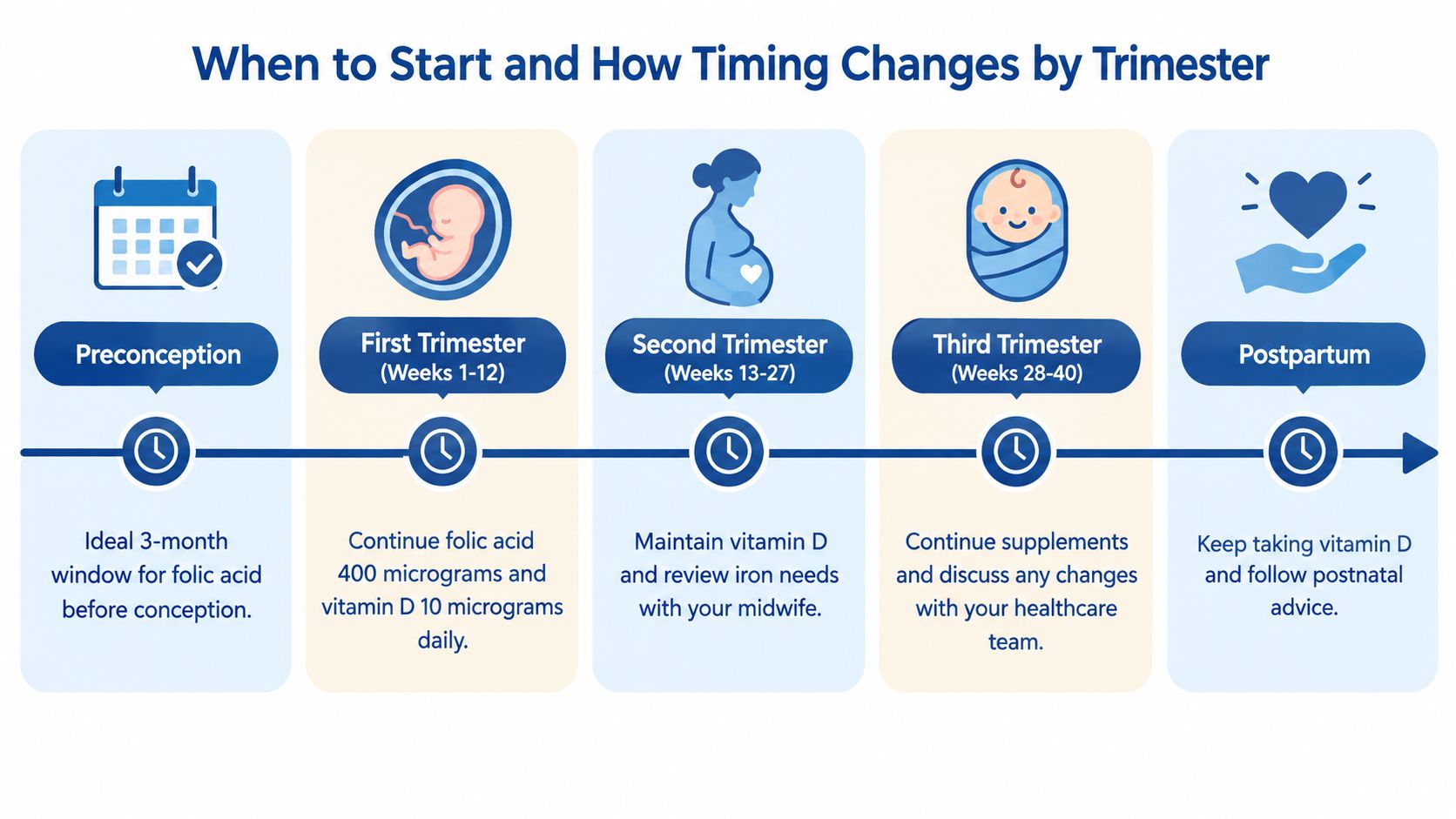
UK advice focuses on folic acid before pregnancy and in the first trimester, rather than treating a broad prenatal formula as automatically necessary from day one. The recommendation commonly given is 400 micrograms daily before conception and through the first 12 weeks. Some people need a higher dose, so it is worth checking with your GP or midwife if you have been told you are in a higher-risk group. Tommy's explains the timing clearly in its guide to folic acid in pregnancy.
If you are already pregnant and have not started yet, start now. Late does not mean pointless.
The middle and later trimesters
After the first 12 weeks, the supplement conversation usually becomes simpler in one sense and more individual in another. Simpler, because folic acid is no longer the routine headline for everyone. More individual, because later pregnancy is the stage where symptoms, diet, blood results, and tolerance often matter more than the marketing on the label.
Vitamin D often continues throughout pregnancy. Other ingredients that appear on shop shelves, such as iron or iodine, are not automatically needed by every pregnant person just because they are included in an all-in-one tablet. That is one of the biggest gaps between UK guidance and retail messaging. The label may suggest broad cover for every stage, while actual care often separates what is generally advised from what is added only if there is a reason.
Some people stay on the same product throughout because it suits them and does not create overlap. Others switch to a simpler routine or add something specific after a blood test or clinical advice. Both can be appropriate.
Building a routine you will actually remember
Pregnancy tablets only help if you take them regularly. The best plan is usually the one that fits into an ordinary Tuesday, not just a well-organised weekend.
A few habits make that easier:
- Keep it visible: store tablets somewhere safe but easy to notice, such as near the kettle or toothbrush.
- Link it to a daily habit: breakfast or brushing your teeth is easier to remember than a vague plan to take it "later".
- Check the label again if you change brands: a new box can contain different amounts, or add extras you are already taking separately.
If your supplement routine feels hard to follow, a simpler plan is often safer and easier.
After birth
Once the baby arrives, it helps to review your tablets rather than carrying on by habit. Some people continue vitamin D. Some need iron reviewed if deficiency was an issue in pregnancy. Some stop a prenatal product altogether.
The key message is simple. Pregnancy timing is not a straight line from preconception to postnatal life with one product doing the same job throughout. In the UK, the routine advice is relatively focused, and extras are often decided case by case.
Safe Dosing Contraindications and Common Misconceptions
You are standing in the supplement aisle, holding a prenatal multivitamin in one hand and a separate iron tablet in the other. The boxes both sound reassuring. The part that matters is simpler than the marketing suggests. In UK practice, the routine advice is quite narrow, and many of the extra ingredients on retail labels are only useful in certain situations.
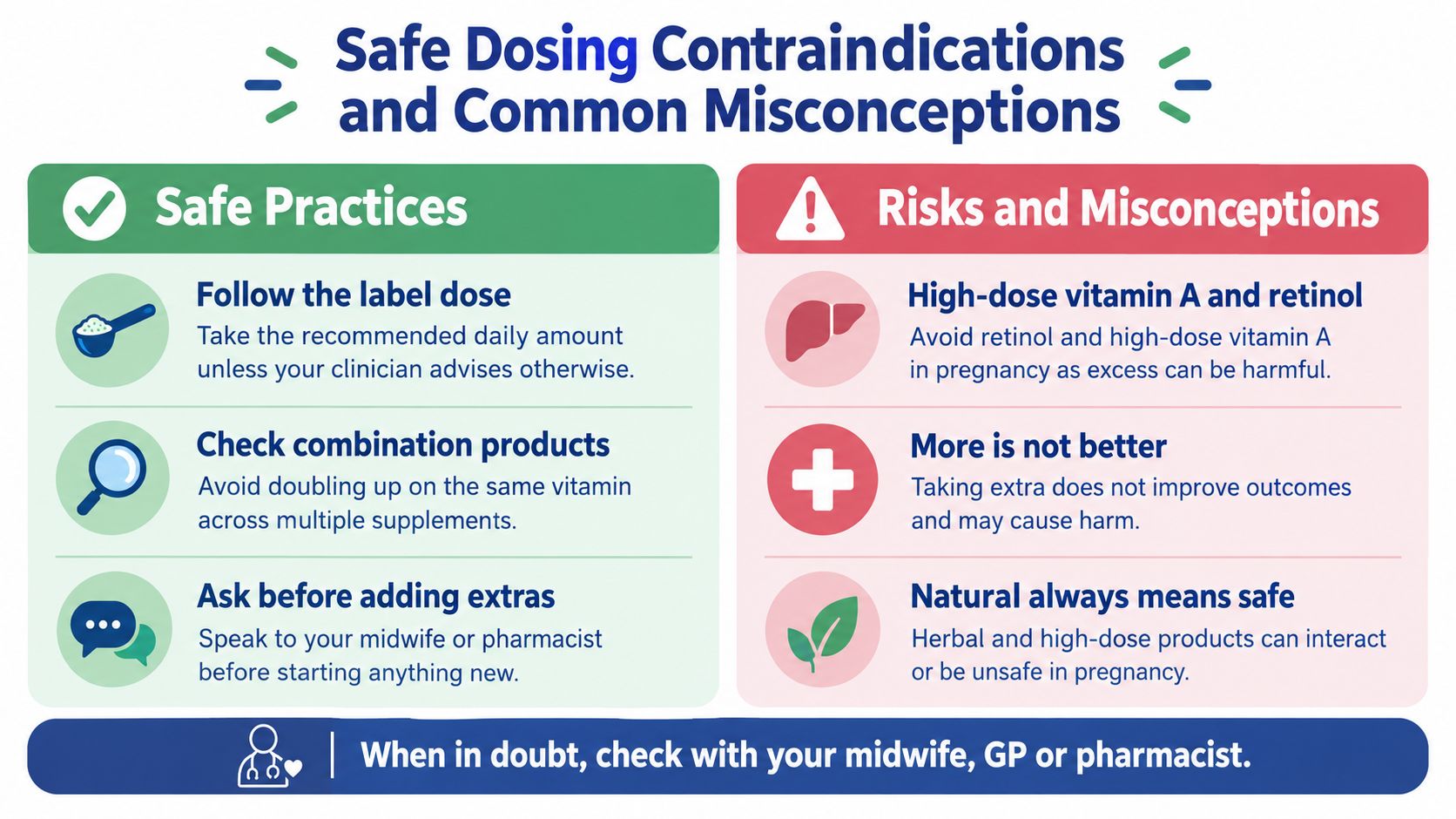
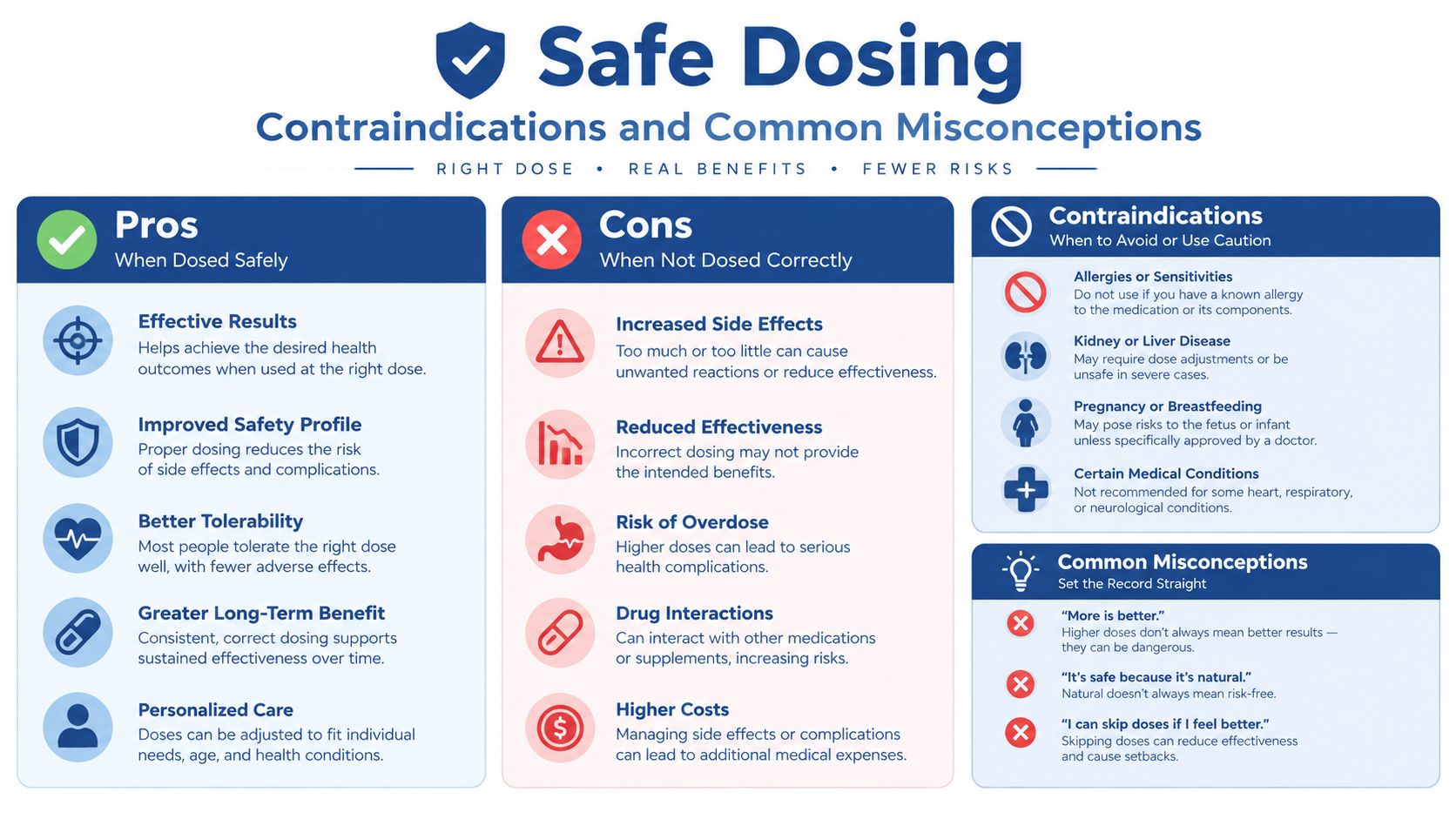
Pregnancy care tablets are a bit like packing for a trip. More items do not automatically make you better prepared. They can just make the bag heavier and harder to sort through. The same applies to supplements. If you combine a prenatal multivitamin with separate folic acid, iron, or a general “beauty” supplement, you can end up doubling up without meaning to.
Iron is a good example of why labels can overpromise
Iron often causes the most confusion. Many shop-bought pregnancy tablets include it as standard, which can make it seem like everyone needs it. In the UK, iron is usually treated more selectively. If blood tests show iron deficiency or anaemia, iron may be recommended or prescribed. If they do not, a routine iron tablet may add side effects without adding much benefit.
Those side effects are not trivial. Iron can upset the stomach, worsen constipation, and make heartburn harder to live with. For someone already dealing with pregnancy nausea or bowel changes, that can be the difference between a tablet they keep taking and one they stop.
If iron has been advised for you, how you take it matters as well. Iron is absorbed better in some settings than others, and tolerability varies a lot between formulations. A practical guide to iron bisglycinate vs ferrous sulfate can help you understand why one type may feel easier on the stomach than another.
Common misconceptions that cause trouble
“A prenatal with more ingredients must be safer.”
A longer ingredient list does not mean a better fit. It often just means more chances of overlap, especially if you also take separate supplements.
“If it is sold for pregnancy, I can take it alongside anything else.”
Always check the label against what you already use. Folic acid, vitamin D, iron, and vitamin A are the ingredients people most often duplicate by accident.
“Natural products are gentle, so they are fine in pregnancy.”
Herbal blends and high-strength wellness products can still be unsuitable. “Natural” describes where something comes from. It does not confirm safety in pregnancy.
“A higher BMI automatically means I need high-dose folic acid.”
That is not something to assume from a shop shelf or social media post. Higher-dose folic acid is used in some higher-risk situations, but the decision should come from your midwife, GP, or pharmacist based on your personal risk factors. The NHS advice on vitamins, supplements and nutrition in pregnancy is a good reference point for the routine UK position.
Simple safety checks before you buy
Use the box like a checklist, not a promise:
- What is this tablet for? Look for its main job, not the longest list of ingredients.
- Am I already getting this elsewhere? Check any separate folic acid, vitamin D, iron, or general multivitamin you take.
- Was this suggested for me personally? Iron and other extras are often situation-specific rather than routine.
- Do I know how long I am meant to take it? Some nutrients are time-sensitive, and others need review if your circumstances change.
If the label feels crowded or confusing, that is a useful warning sign in itself. A simpler plan is often easier to take correctly, and usually closer to the focused UK advice than the broad formulas sold on the shelf.
How to Choose Pregnancy Care Tablets in the UK
Once you know that UK guidance is narrower than many retail labels, choosing becomes easier. You stop shopping for the “most complete” box and start shopping for the most appropriate one.
Start with the purpose, not the branding
When you pick up pregnancy care tablets, ask the plainest possible question first. “Why am I taking this?” If the answer is “for folic acid before and in early pregnancy,” a single-ingredient tablet may be exactly right. If the answer is “to cover vitamin D daily,” again, a simple product may suit you better than an all-in-one.
All-in-one tablets can still be useful. They often suit people who want convenience and are comfortable with a broader formula. But convenience isn't the same as necessity.
A helpful outside perspective on label comparison and practical selection is this guide to prenatal vitamin advice for expectant mothers, especially if you're trying to narrow down a crowded shortlist.
A practical label checklist
Use this in the shop or when comparing products online:
- Check the core nutrient first: if you need folic acid or vitamin D, confirm the product clearly provides that purpose.
- Scan for iron carefully: if you haven't been advised to take iron, decide whether you really want it built into your daily tablet.
- Look for combination overlap: many people accidentally stack a prenatal with another multivitamin.
- Keep the routine realistic: a product only helps if you can take it consistently.
- Choose trusted supply routes: look for clear product information, ingredients, and sensible fulfilment details.
For broader context on women's supplement shopping outside pregnancy-specific products, multivitamins for women is a useful comparison point.
NHS essentials versus common retail extras
| Nutrient | NHS Guidance for Most Pregnancies | When Extra Supplementation May Be Considered |
|---|---|---|
| Folic acid | Recommended when trying to conceive and through the first 12 weeks | Higher-dose folic acid may be used for higher-risk groups on clinical advice |
| Vitamin D | Recommended during pregnancy | Ongoing use may be reviewed individually after birth |
| Iron | Not routinely recommended for everyone | When blood tests or clinical review suggest deficiency or anaemia |
| Iodine | Not routinely singled out in the same way as folic acid and vitamin D in mainstream UK guidance | May appear in prenatal formulas or be considered in individual dietary review |
| Extra B vitamins | Often not the main reason a pregnancy product is chosen | May be included in multinutrient products where there's a specific rationale |
Buying in the UK without overcomplicating it
A UK-based retailer with a broad supplement catalogue can be useful when you want to compare formats, brands, and single-nutrient versus multivitamin options in one place. Vitamin Planet, for example, is a UK-based retailer that ships from London using tracked services and carries pregnancy support alongside wider vitamin and mineral ranges. That matters less as a selling point than as a practical convenience. It's easier to compare products calmly when you're not jumping between several shops.
The key is to choose from a position of understanding. If a label includes extras, you should know why they're there and whether they're relevant to you.
Your Next Steps for Confident Pregnancy Nutrition
If you remember one thing, make it this. Pregnancy care tablets should match need, not marketing. In UK guidance, that usually means starting with folic acid and vitamin D, then only adding other nutrients if there's a clear reason.
Keep the process simple.
A short checklist for your next decision
- If you're trying to conceive: start folic acid promptly and don't wait for a positive test to think about supplements.
- If you're already pregnant: check whether your current product matches what you need, rather than what the front of the box promises.
- If your tablet contains iron: ask whether it's there for a specific reason or just because it's common in retail prenatals.
- If you're taking more than one product: review labels for overlap.
- If anything is unclear: ask your midwife, GP, or pharmacist before adding extras.
Pregnancy nutrition doesn't need to become a full-time project. A clear routine, a balanced diet, regular antenatal care, and a bit of label awareness usually take you much further than chasing the most elaborate product on the shelf.
The calmest approach is often the safest one. Know your essentials. Be cautious with extras. Review your supplements when your situation changes.
If you're comparing pregnancy care tablets, single-nutrient options, or broader women's health products, Vitamin Planet offers a UK-based catalogue that lets you look across different supplement types in one place. You can browse Vitamin Planet to compare folic acid, vitamin D, iron-containing products, and general wellness ranges while keeping your choices aligned with the kind of careful, needs-based approach covered here.