

Multivitamins with Magnesium: Your 2026 Guide
Nearly half of people surveyed in Northern Ireland reported taking vitamin and/or mineral supplements, and multivitamins or minerals were the most common type among supplement users. Magnesium was also reported by a substantial share of users, though less often than multivitamin products, according to the Northern Ireland Food and You 2 survey findings.
That makes multivitamins with magnesium an understandable choice. One product can provide a broad range of micronutrients while adding magnesium to a daily routine. But the important distinction is this: a combined multivitamin is usually a maintenance supplement, not a high-dose treatment for diagnosed magnesium deficiency.
The right way to judge one is to compare its magnesium content with your diet, your personal daily requirement, your medicines and your tolerance. UK guidance also places a practical limit on how much magnesium you should obtain from supplements, so a larger number on the label isn't automatically better.
Table of Contents
- Why Magnesium Belongs in Your Multivitamin
- What Multivitamins with Magnesium Actually Are
- Health Benefits Worth Knowing
- Optimal Dosages and Daily Targets
- Choosing the Right Magnesium Form and Format
- Who Should Avoid or Be Cautious with These Products
- How to Read a Multivitamin Label Like a Pro
- A Simple Buying Framework for UK Shoppers
Why Magnesium Belongs in Your Multivitamin
Magnesium supports normal muscle and nerve function, energy release and bone health. These roles overlap with the reasons people choose a daily multivitamin, so manufacturers often include magnesium alongside other vitamins and minerals. The result can be practical, provided you understand what the tablet can and cannot do.
A combined product is usually a maintenance supplement. It can help maintain an adequate intake when your diet and routine leave a modest gap, but it is not designed to replace food or act as a high-dose treatment for diagnosed magnesium deficiency.
The maintenance idea
Food remains the starting point. Nuts, seeds, beans, whole grains and leafy green vegetables provide magnesium, yet intake can vary when these foods are not eaten regularly or in much variety. A multivitamin with magnesium can add a convenient amount to an established routine.
Treat the tablet as a top-up on top of meals, not as a substitute for them. It may help with a small shortfall, but it will not supply everything your body needs if your diet is consistently low in magnesium-rich foods.
The figures from Food and You 2 (Northern Ireland), Wave 11, also help explain why the amount on the label matters. Since multivitamins or minerals were the most commonly reported supplement type among users, the magnesium included in that product may be the only supplemental magnesium a shopper takes. The per-tablet amount therefore deserves attention, rather than being treated as a bonus ingredient.
Magnesium's recognised roles include:
- Energy support: It contributes to normal energy-yielding metabolism.
- Muscle function: It supports normal muscle contraction and relaxation.
- Nerve function: It contributes to normal functioning of the nervous system.
- Bones: It contributes to the maintenance of normal bones.
These authorised nutrition claims do not mean a multivitamin will quickly resolve tiredness, cramps or poor sleep. Such symptoms can have several causes, and persistent concerns call for appropriate assessment rather than self-treatment.
UK guidance also places a practical ceiling on magnesium from supplements. A larger figure is not automatically better, especially when you combine products or have a condition that affects how your body handles minerals.
Practical rule: Choose a combined product to support an adequate intake, not to treat suspected deficiency.
Check the magnesium amount, its chemical form and your other supplements before buying. Those details show whether the product fits your daily target and routine.
What Multivitamins with Magnesium Actually Are
A multivitamin with magnesium is a single product containing several vitamins and minerals, with magnesium listed as a defined ingredient. The formula may include vitamins such as A, C, D, E and B vitamins, alongside minerals such as zinc, iron or selenium. The precise blend varies between brands, so “multivitamin” doesn't describe one standard recipe.

A helpful analogy is a packed lunchbox. The multivitamin is the lunchbox, containing several different nutrients, while the added magnesium is the extra snack tucked inside for a known nutritional gap. The snack is useful, but it doesn't turn the whole lunchbox into a dedicated magnesium product.
Combined products versus standalone magnesium
A standalone magnesium supplement focuses its formula and capsule space on one mineral. A multivitamin has to divide space between many ingredients, so its magnesium contribution may be more modest. That difference matters when you compare products.
A combined product may suit you if:
- you already want a broad daily multivitamin;
- you prefer taking one product rather than several;
- your diet is generally balanced but may not provide consistent magnesium-rich foods;
- you want a modest top-up rather than a targeted high-dose product.
It may be less suitable if a clinician has identified magnesium deficiency, if you need a carefully controlled dose or if you want to change magnesium form to improve digestive tolerance. In those situations, a healthcare professional can help choose a more appropriate product.
The same principle applies to children. A general adult formula shouldn't automatically be given to a child because the nutrient amounts, tablet size and other ingredients may not be suitable. Families comparing options may find this parents guide to kids multivitamins useful for understanding why age-specific products need separate consideration.
Don't confuse the product categories
A multivitamin with magnesium isn't the same as a magnesium-only product, a pregnancy formula or a specialist product aimed at a particular life stage. It also isn't interchangeable with every wellness supplement. For example, BioBees Fresh Royal Jelly Capsules are listed as containing fresh royal jelly, propolis extract and bee pollen, so they belong to a different supplement category and don't provide the same nutritional role as a magnesium multivitamin.
Read the Supplement Facts or nutrition panel rather than relying on the front of the pack. The number beside “magnesium” is the amount that helps you compare products, while phrases such as “energy”, “vitality” or “wellness” describe positioning rather than the actual magnesium dose.
Health Benefits Worth Knowing
Magnesium's value comes from its physiological roles, not from dramatic promises. A multivitamin can support several normal body functions when it contributes useful nutrients, but the result is best understood as nutritional maintenance.

Bones need more than one nutrient
Magnesium contributes to the maintenance of normal bones. In a multivitamin, it may sit alongside vitamin D and other minerals that also contribute to skeletal health. That combination makes sense nutritionally, but it doesn't mean that adding magnesium alone can compensate for a poor overall diet or a diagnosed bone condition.
The product's contribution also depends on how much of each nutrient it contains. A formula may include many ingredients while supplying only a modest amount of any one mineral.
Muscles and nerves
Magnesium contributes to normal muscle function and normal functioning of the nervous system. That's relevant to people who exercise, experience occasional muscle tension or want broad nutritional support. However, recurring cramps can also relate to training load, hydration, medicines, circulation or an underlying health issue.
If cramps are frequent, severe or new, don't assume that taking more magnesium is the answer. A combined multivitamin may provide useful background nutrition, but it isn't designed to investigate the cause.
Energy and psychological function
Magnesium contributes to normal energy-yielding metabolism. B vitamins in a multivitamin may also contribute to normal energy metabolism, which explains why these products are often marketed around energy and tiredness.
That claim needs careful interpretation. A supplement can help if it corrects an inadequate intake, but it won't reliably overcome poor sleep, illness, insufficient food or excessive training. Magnesium also contributes to normal psychological function, which is why some shoppers connect it with relaxation or sleep routines. The role is supportive rather than a guarantee of better sleep.
A nutrient can contribute to a normal function without acting like a medicine for every symptom associated with that function.
Heart and blood pressure support
Magnesium contributes to normal muscle and nerve function, and the heart is a muscle. It also contributes to electrolyte balance, so it has a reasonable place in general cardiovascular nutrition. Still, a multivitamin shouldn't be used to manage high blood pressure, an irregular heartbeat or another diagnosed heart condition.
The matrix can dilute the dose. When a single tablet contains numerous vitamins and minerals, the magnesium amount may be appropriate for maintenance but too small for a targeted clinical purpose. Consistent use and adequate food intake matter more than taking an occasional large dose.
A product such as Bonemax Collagen 400mg Supplement for Bone Health - 60 Capsule is positioned around joint support and mobility, which illustrates why shoppers should match a formula to its actual purpose rather than assuming every product marketed for bones supplies the same nutrients.
Optimal Dosages and Daily Targets
Start with the target for your age and sex, then check how much comes from food and how much comes from supplements. The NHS states that adults aged 19 to 64 need 300mg of magnesium per day for men and 270mg per day for women. You can review that guidance in the NHS information on vitamins and minerals.
Those are daily requirements, not instructions to obtain the full amount from a tablet. Food should provide the foundation. A multivitamin then adds whatever its label declares, while other fortified foods or magnesium products may contribute more.
Read the supplement ceiling correctly
The NHS warns that taking more than 400mg of magnesium from supplements for a short time can cause diarrhoea. It also says that 400mg or less per day from supplements is unlikely to cause harm. This is a ceiling for supplemental magnesium, not a target to reach, and it doesn't mean you should ignore your diet or your personal circumstances.
For example, if your daily multivitamin contains 100mg of magnesium and you also take a separate magnesium product, add the amounts together. Then check whether other products, such as fortified drinks or mineral blends, also list magnesium.
A simple calculation is more useful than a front-of-pack claim:
- Estimate food first. Look at your usual meals and identify magnesium-rich foods such as leafy greens, beans, nuts, seeds and whole grains.
- Add the multivitamin dose. Use the declared magnesium amount in milligrams, not the size of the tablet.
- Review other supplements. Include standalone magnesium and any combined mineral products.
- Ask for advice when the target is unclear. Pregnancy, kidney problems, medicines and diagnosed deficiency can change the decision.
The UK dietary recommendations also recognise age- and sex-related differences in magnesium needs, as shown in the government dietary recommendations. Don't assume that one formula is optimal for every adult.
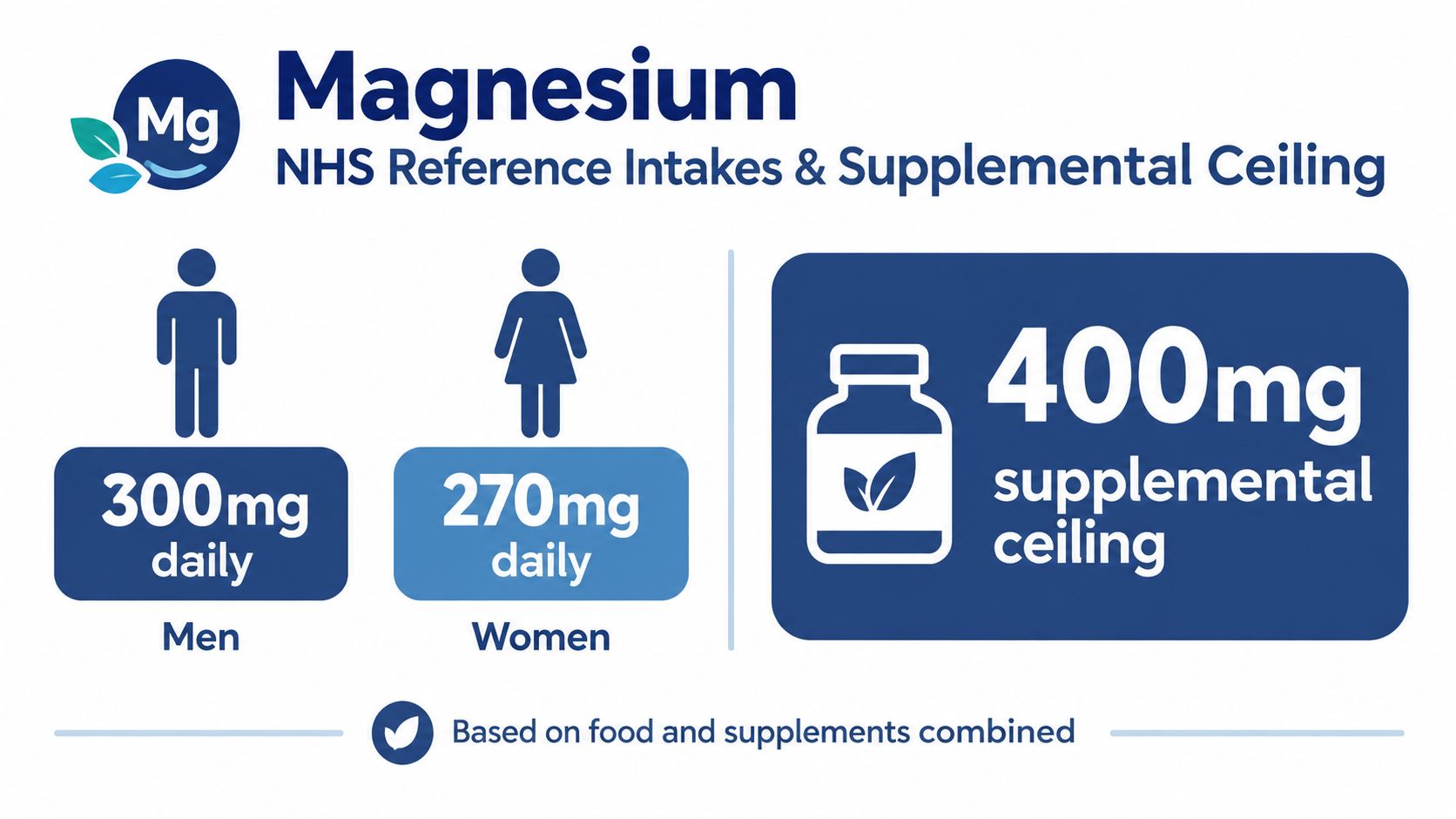
Use this mental order: dietary intake first, multivitamin top-up second, standalone magnesium third. If the final step is necessary because of a confirmed medical problem, involve a clinician rather than increasing products independently.
Choosing the Right Magnesium Form and Format
The magnesium compound affects how a product behaves in the digestive system and how much tablet space it needs. Labels may name oxide, citrate, glycinate, malate or another compound. Don't judge the product from the compound name alone. Check the elemental magnesium amount, which tells you how much magnesium the serving supplies.
| Form | Typical elemental Mg per dose | Tolerance | Best for |
|---|---|---|---|
| Oxide | Varies by product | May be less comfortable for some people | General maintenance when tolerated |
| Citrate | Varies by product | Can have a bowel-loosening effect | People who also experience constipation |
| Glycinate | Varies by product | Often chosen by people seeking a gentler option | Sensitive stomachs and evening routines |
| Malate | Varies by product | Depends on the individual formula | Shoppers comparing alternative forms |
| Marine-sourced magnesium hydroxide | Varies by product | Depends on the product and person | People seeking a marine-sourced ingredient |
The table deliberately avoids assigning invented dose ranges. Manufacturers use different serving sizes and compounds, so the back label is the only reliable way to compare elemental magnesium.
Format matters as much as chemistry
Compressed tablets are usually stable and convenient, but a broad formula can make them large. Capsules may be easier for some people to swallow, while effervescent products suit shoppers who prefer a drink. Gummies can be appealing, but you should still check their magnesium amount, sweeteners and full ingredient list.
Those choosing a vegan product need to inspect more than the word “plant-based”. Look for the Vegan Society trademark, check that the capsule doesn't contain gelatine, and confirm whether vitamin D3 comes from lichen rather than lanolin. Iron and other mineral ingredients may also need checking if your diet excludes animal-derived materials.
For readers comparing sleep-related magnesium products, this guide to magnesium type for deep sleep provides useful background on why different forms are discussed separately. You can also compare practical considerations in Vitamin Planet's guide to magnesium sleep tablets.
“High-strength” deserves caution. It isn't a precise regulated definition in the UK, so treat it as marketing language until you've checked the actual milligramme amount per serving and calculated your total supplemental intake.
Who Should Avoid or Be Cautious with These Products
A magnesium multivitamin isn't automatically suitable for everyone. The biggest safety question concerns kidney function. When the kidneys can't filter effectively, magnesium may accumulate, so anyone with chronic kidney disease, severe renal impairment or dialysis treatment should speak with a healthcare professional before using a magnesium-containing product.
NHS Specialist Pharmacy Service guidance explains that oral magnesium can cause diarrhoea and may be contraindicated in severe renal impairment because of the risk of hypermagnesaemia. It also distinguishes between less severe low magnesium levels that may be managed with oral supplements and severe or symptomatic cases requiring specialist care. Read the NHS guidance on treating acute hypomagnesaemia in adults before treating a suspected deficiency yourself.

Medicines need a separate check
Magnesium can interfere with the absorption of some medicines. This includes certain antibiotics and osteoporosis medicines, so a pharmacist or prescriber should advise you on timing rather than relying on a general rule. Diuretics and long-term medicines that affect mineral balance also deserve a medication review.
Don't stop prescribed treatment because a supplement label looks complicated. Take the product list, including the exact magnesium form and amount, to your pharmacist.
Diarrhoea is another signal to take seriously. If it begins after starting the product, reduce exposure and seek advice, particularly if it persists. Changing to another form may help some people, but it isn't sensible to switch repeatedly without checking the total magnesium intake and the rest of the formula.
Groups needing tailored advice
Children need age-appropriate products. Pregnancy and breastfeeding also call for formulations and doses suited to that stage, rather than an adult product chosen from a general shelf. The guidance on magnesium supplements in pregnancy can help frame the questions to discuss with a midwife, GP or pharmacist.
People with rare metabolic conditions, ongoing bowel problems, diagnosed electrolyte abnormalities or unexplained symptoms should also seek individual advice. A laboratory-confirmed deficiency is a medical issue, not a reason to buy the strongest product available.
How to Read a Multivitamin Label Like a Pro
Turn the pack around and work through four checks. This takes less time than comparing front-of-pack promises.
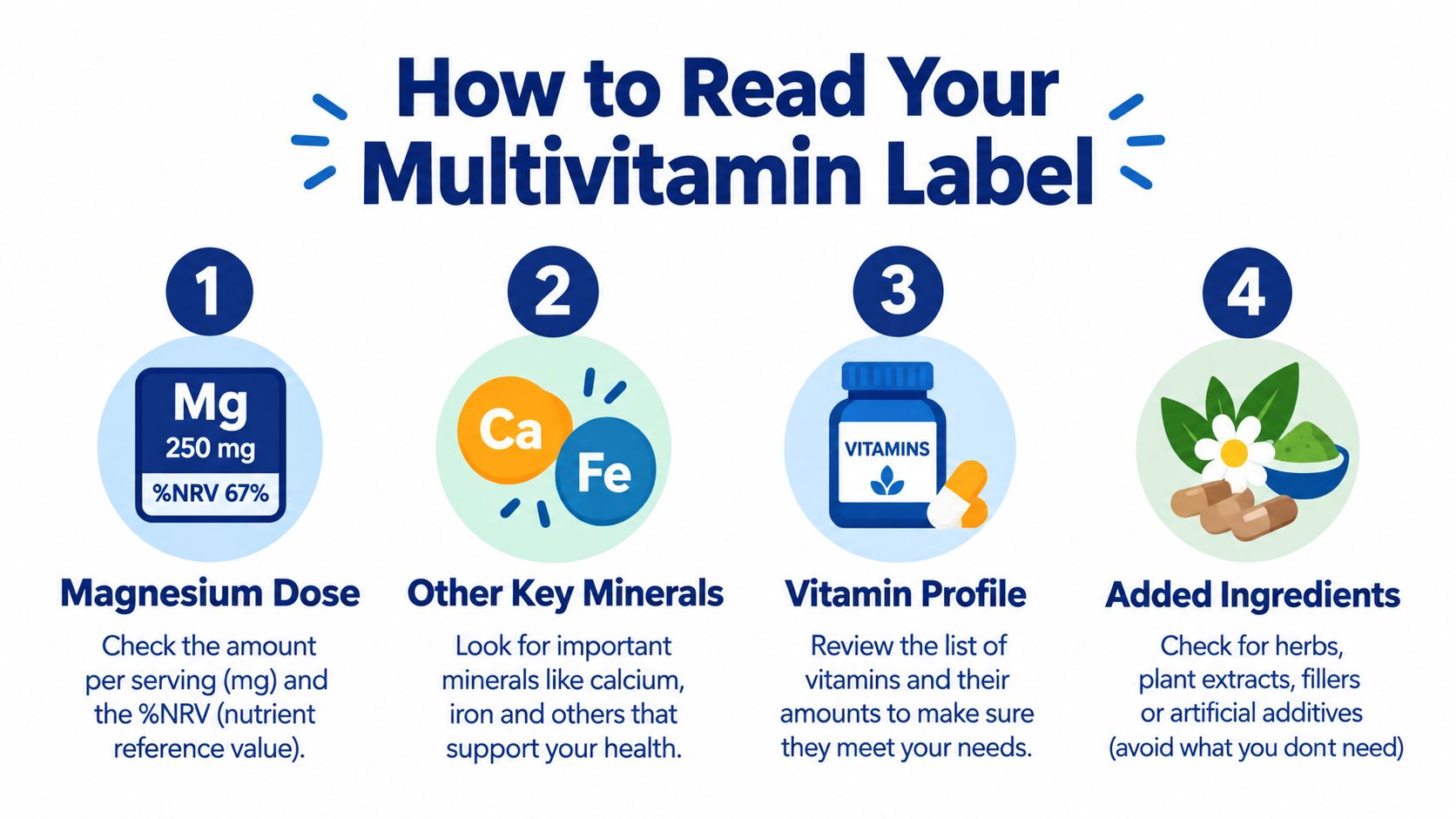
- Find the magnesium amount. Look for milligrams per serving and the percentage of the Nutrient Reference Value, or NRV. A higher NRV isn't automatically better, especially if you also use another magnesium product.
- Name the form. Check whether the label identifies oxide, citrate, glycinate or another compound. If magnesium appears only inside a broad mineral blend without an individual amount, comparison becomes difficult.
- Scan the whole ingredient list. Look for allergens, sweeteners, colourings, capsule materials and ingredients that don't fit your diet.
- Check quality information. Look for transparent manufacturer details and any relevant certification or batch-testing information. Don't assume a logo proves that the formula suits your needs.
The NRV helps you compare the declared nutrient contribution, but it doesn't measure your diet or tell you how much magnesium you personally need. The useful number is the amount per recommended serving, alongside the form and your other sources.
For a wider checklist covering formula balance, see what makes a good multivitamin. In a chemist aisle, follow this order on your phone: magnesium milligrams, magnesium form, other supplements, ingredients and suitability for your age or health history.
A Simple Buying Framework for UK Shoppers
A combined magnesium multivitamin works best as a maintenance choice. It can fill a modest dietary gap, but it is not a treatment for diagnosed deficiency or a substitute for personalised advice.
Start with the target you can realistically maintain. Note the magnesium supplied by the product, then consider how often your meals provide magnesium-rich foods. The product should fit that everyday pattern rather than chase the highest strength on the shelf.
A worked example makes the distinction clearer. A 40-year-old woman who eats two magnesium-rich meals daily and takes a multivitamin supplying 100mg may already have a sensible top-up. A 60-year-old man with a low-vegetable diet who takes a diuretic needs a clinician to help set the target, rather than just choosing a stronger formula.
The format must also suit your routine. Capsules, drinks and smaller servings can make regular use easier. If your bowel is sensitive, the magnesium compound may affect tolerance. Vegans should check capsule materials, vitamin D source and other animal-derived ingredients instead of relying on the front label.
Use the four label checks from the section above, then apply the three filters here: fit with your diet, fit with your routine, and fit with your circumstances. Vitamin Planet is one UK-based retailer where shoppers can compare multivitamins, magnesium products and other health supplements in one catalogue. Compare suitable formulas at Vitamin Planet, using the label framework rather than choosing by strength or marketing language alone.
Before adding a separate magnesium product, check the combined intake and seek advice if your circumstances make self-selection uncertain.