

Best Joint Supplement: An Evidence-Based UK Guide
Most UK “best joint supplement” lists start with glucosamine and chondroitin. That's understandable, but it isn't honest enough. NICE says not to offer glucosamine or chondroitin for osteoarthritis, and NHS-linked guidance says there's very little evidence that either reduces osteoarthritis pain (NICE osteoarthritis guideline NG226). A supplement can still be something you choose to trial, but it shouldn't be presented as a proven treatment.
The better question is: what kind of joint problem are you trying to support, and does the product provide a studied amount of the relevant ingredient? Wear-and-tear aching, inflammatory stiffness, and an acute injury aren't the same problem. Treating them as if they are leads to expensive tubs full of impressive-sounding ingredients and very little clarity.
Table of Contents
- Why the Best Joint Supplement Question Is Harder Than It Looks
- How Your Joints Actually Work and Where Supplements Can Help
- The Main Joint Supplement Ingredients Compared
- Clinically Supported Dosages and Trial Lengths
- Capsule, Tablet, Powder and Liquid Compared
- How to Read a Joint Supplement Label in the UK
- Safety, Interactions and Getting Real Value for Money
Why the Best Joint Supplement Question Is Harder Than It Looks
Glucosamine and chondroitin remain the familiar answer because their names connect easily to cartilage, mobility, and flexibility. They have also been sold through UK pharmacies and health shops for years. That history explains their visibility, not their value as a treatment.
As noted above, UK guidance does not support glucosamine or chondroitin as treatments for osteoarthritis. NHS-linked commissioning guidance also describes the evidence for reducing osteoarthritis pain as poor (NHS-linked commissioning guidance). The practical question is why retail guides still present them as default choices, and how to judge a product without mistaking a familiar label for proof.
Product pages often blur supporting normal cartilage with treating painful osteoarthritis. Those claims describe different expectations. A supplement can be a personal trial, but it should not replace assessment, prescribed treatment, exercise advice, or physiotherapy where those are appropriate.
The evidence depends on the question
Some older reviews reported a small or modest signal for glucosamine sulphate, especially when people used a studied formulation consistently. That does not overturn the UK position. It supports a narrower description: glucosamine is a low-certainty self-trial, not a dependable therapy.
The NHS Dorset briefing records more than £334,000 was spent on glucosamine preparations in England and Wales in one year, based on ePACT data from July to September 2017 (NHS Dorset glucosamine briefing). The figure shows how established the category became. It does not show that the products worked. Earlier UK guidance also questioned their value for NHS prescribing, which helped move glucosamine from routine care towards retail self-purchase.
Practical rule: popularity tells you what people buy. It does not tell you what to rely on.
Match the symptom pattern
Start with the dominant symptom pattern. Inflammatory symptoms, including noticeable swelling, warmth, prolonged morning stiffness, or diagnosed inflammatory arthritis, call for a different approach from mechanical aching after walking or climbing stairs. Omega-3s have more relevance to inflammatory arthritis than to wear-and-tear osteoarthritis, according to Arthritis UK guidance on glucosamine.
For osteoarthritis, exercise, weight management where relevant, and physiotherapy deserve priority over supplements. A product may be an optional add-on, but it should not delay an assessment or displace treatment that has a clearer role.
Use a simple buying framework: identify the pattern, select one ingredient with a plausible fit, check its active amount, and trial it consistently. Set a stopping point before you start. If there is no meaningful change, stop buying it. This approach is less exciting than naming one winner, but it protects your money and keeps expectations realistic.
How Your Joints Actually Work and Where Supplements Can Help
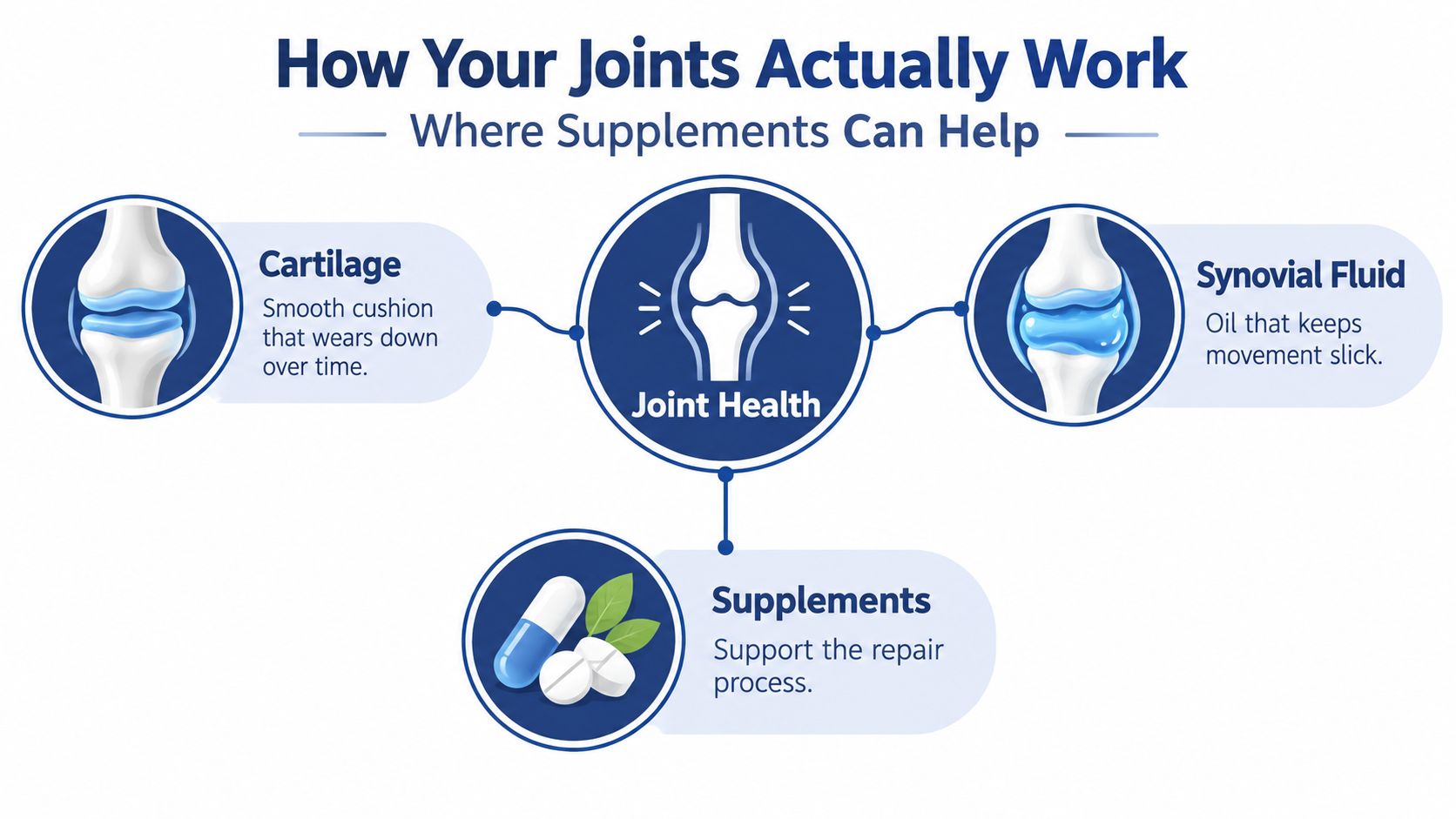
Think of a joint as a moving hinge with several parts working together. Cartilage is the smooth cushion covering the ends of bones. It helps the surfaces glide and spreads pressure, but it isn't a repairable sponge that instantly rebuilds when you swallow a capsule.
Synovial fluid is the joint's oil. It sits inside the joint and helps movement feel smooth. The joint capsule acts like a sealed bag around the moving surfaces, while ligaments, tendons, and structures such as menisci help keep the joint aligned and stable.
What each ingredient is trying to support
Glucosamine and chondroitin are usually positioned as cartilage-support ingredients. Collagen peptides are also marketed around the cartilage matrix and connective tissue. These products make more sense as structural-support trials than as quick pain relief.
Hyaluronic acid is linked with the fluid environment around joints. Omega-3 fats are more relevant to the body's inflammatory response, particularly when stiffness and swelling suggest an inflammatory pattern. Turmeric or curcumin is also used for inflammation support, while MSM provides sulphur associated with connective tissue.
The distinction matters because wear-and-tear osteoarthritis, inflammatory arthritis, and an acute sports injury are different situations. A supplement aimed at general connective tissue won't address a locked knee, a torn ligament, or unexplained swelling.
Use supplements as support, not a diagnosis
A supplement can't tell you why a joint hurts. If pain began after a fall, if the joint is suddenly hot and swollen, or if movement is blocked, seek medical advice rather than choosing a more aggressive formula.
For broader reading on ingredient options and practical considerations, this guide to supplements for joint pain can be useful. Keep the same sceptical filter, though: an ingredient list is not proof that a product suits your symptoms.
The most useful question is not “which supplement rebuilds my joint?” It's “which part of my problem am I trying to support?” That answer narrows the choice considerably.
There's also a short video overview that can help visualise the relationship between joint structures and supplement categories:
The Main Joint Supplement Ingredients Compared
No ingredient deserves an automatic first place for every shopper. Glucosamine sulphate, for example, has a different evidence story from turmeric, and neither should be treated as interchangeable with omega-3 for inflammatory arthritis.
| Ingredient | Evidence strength | Best for | Key caveat |
|---|---|---|---|
| Glucosamine sulphate | Limited and modest | A cautious self-trial for general osteoarthritis symptoms | NICE says not to offer it for osteoarthritis, and the form matters |
| Chondroitin | Limited and uncertain | Shoppers considering a traditional cartilage-support formula | NHS guidance says there's very little evidence of pain reduction |
| MSM | Limited but potentially useful | General connective-tissue and comfort support | Evidence is not strong enough to treat it as a guaranteed option |
| Collagen peptides | Modest | Structural support and everyday mobility | Marine collagen is fish-derived and not suitable for everyone |
| Omega-3 EPA and DHA | More relevant for inflammatory patterns | Inflammatory stiffness and diagnosed inflammatory arthritis support | It isn't a proven standalone treatment for osteoarthritis |
| Turmeric or curcumin | Promising but formulation-dependent | Inflammation-related discomfort | Plain turmeric powder isn't the same as a standardised curcumin extract |
| Hyaluronic acid | Early and uncertain | Shoppers interested in joint-fluid support | Oral evidence remains less established than the marketing suggests |
The familiar options
If you choose to try glucosamine, glucosamine sulphate is the form repeatedly discussed in UK guidance. Glucosamine hydrochloride has weaker support. Chondroitin is often paired with it, but the combination hasn't produced reliable pain reduction in the NHS-linked evidence summaries (NHS-linked glucosamine and chondroitin review).
MSM is a sulphur compound associated with connective tissue. Its evidence is limited, but it may appeal to someone looking beyond the traditional glucosamine formula. Don't buy it because “sulphur” sounds technical. Buy it only if the label provides a meaningful amount and you're prepared to assess whether it changes anything.
Collagen peptides are a structural option rather than an anti-inflammatory one. Hydrolysed collagen is broken into smaller peptides for use in a powder or capsule. Marine collagen comes from fish, so check the source if you avoid fish-derived products.
The more targeted choices
Omega-3 fish oil has a clearer rationale for inflammatory symptoms than for mechanical osteoarthritis. If you have a diagnosed inflammatory condition, discuss supplement use with your healthcare team rather than trying to substitute it for prescribed medicine.
Curcumin is the concentrated compound associated with turmeric. Its usefulness depends heavily on the formulation, because plain turmeric powder doesn't tell you how much curcuminoid it provides. Look for a standardised extract or a delivery system designed to improve absorption, and be particularly careful if you take medicines that affect clotting.
Hyaluronic acid is marketed for lubrication and mobility. It may suit a shopper interested in joint-fluid support, but the evidence is earlier and less decisive than the label language often implies.
For foot discomfort, supplements are only one possible part of a practical routine. If pressure and support are the bigger issue, comfort insoles for arthritic feet may be more directly relevant than adding another capsule.
A useful UK-focused explanation of the traditional ingredient is glucosamine for joints. Keep the conclusion personal and symptom-led: inflammatory stiffness points you towards an omega-3 discussion, while mechanical aching calls for realistic expectations and a broader mobility plan.
The Brain Feed 5-HTP 60 tablet is a separate serotonin-precursor product, not a joint supplement, so it shouldn't be included in a joint-support stack just because it appears in the same catalogue.
Clinically Supported Dosages and Trial Lengths
A familiar ingredient can still be seriously underdosed. Judge the product by its total daily active amount, then set a review date before you start. Unlike the previous comparison of evidence strength, this table focuses only on the daily amount and review point for a disciplined self-trial.
| Ingredient | Daily dose | Trial length | Notes |
|---|---|---|---|
| Glucosamine sulphate | 1,500 mg | About three months for an initial review | This is the commonly discussed UK self-trial pattern (NHS Dorset briefing) |
| Chondroitin | 800 to 1,200 mg | Several weeks to months | Evidence remains uncertain, particularly for osteoarthritis pain |
| MSM | 1 to 3 g | Several weeks | Split the amount if a large serving causes digestive discomfort |
| Collagen peptides | 10 to 15 g, or hydrolysed type II collagen at 40 mg | Several months | Powder often makes a research-level peptide serving easier |
| Omega-3 EPA and DHA | 2 to 3 g combined EPA and DHA | Several weeks to months | Check the EPA and DHA totals, not just total fish-oil weight |
| Curcumin | 500 to 1,000 mg | Several weeks | Use a standardised or enhanced-absorption format and check medicine interactions |
| Hyaluronic acid | 80 to 200 mg | Several weeks to months | Oral evidence is still developing |
The UK benchmark for glucosamine
If you choose to trial glucosamine, use 1,500 mg of glucosamine sulphate per day and assess the result after about three months, in line with UK patient guidance (NHS patient information on glucosamine). That schedule does not show that glucosamine works. It gives you a fair test while respecting the NHS and NICE position that it should not be relied on for osteoarthritis.
Read the serving size carefully. If the product needs several tablets to reach the daily amount, take the complete stated serving rather than assuming one tablet is enough.
Match the schedule to the ingredient
Glucosamine sulphate is commonly taken as one daily amount. Omega-3 is often easier to tolerate with food and can be divided between meals. Curcumin can also suit a meal, but its formulation affects absorption more than increasing the dose.
Do not judge collagen or another structural-support product after a handful of days. Use it consistently for the stated trial period, then review one measure that matters to you, such as morning stiffness, walking comfort, swelling, or ease on stairs. Record the baseline before starting so a good day does not become your entire assessment.
Stop or reconsider if the appropriate trial produces no meaningful change. Continuing indefinitely because the label says “high strength” is poor value.
The useful conclusion is simple: know the active amount, take it consistently, and keep it only when the result gives you a clear reason to continue.
Capsule, Tablet, Powder and Liquid Compared
Format affects whether you'll take the product consistently, but it doesn't rescue an underdosed formula. A liquid with a pleasant taste may still provide less of the active ingredient you wanted, while a large tablet may be inconvenient even when the label is transparent.
Tablets and capsules are the simplest for precise unit dosing. They travel well and usually have a longer shelf life once sealed, but glucosamine and collagen formulas can require several large units to reach a useful serving. Capsules may be easier to swallow than compressed tablets for some people, though neither format suits everyone.
Choose the format around the routine
Powders are the most flexible option for collagen peptides and MSM. You can mix them into yoghurt, porridge, or a drink, and they make larger daily servings less awkward. The trade-off is taste, texture, sweeteners, and the need to measure accurately. Check whether a scoop represents the full daily serving or only part of it.
Liquids and effervescent products can be appealing if swallowing is difficult. Faster absorption is often implied, but the important test remains the actual active dose. Look for added sugar, flavourings, and fillers, especially if the product is used every day.
A convenient format beats a theoretically perfect product that stays in the cupboard.
Think about the whole stack
Powder can make sense when combining collagen with vitamin C or adding MSM to an existing routine. Capsules are tidier when you're taking a single standardised extract. Don't automatically combine multiple products just because each contains a different “joint blend”. You may duplicate ingredients or pay for overlapping extras.
For a different example of how powder products need to be assessed by serving size and preparation, see this guide to psyllium powder in the UK. The same label-reading principle applies: check the amount you consume, not the headline weight of the tub.
A product such as Bonemax Collagen 400mg Supplement for Bone Health - 60 Capsule uses a capsule format and is described as supporting joint health, mobility, flexibility, and bone strength. Its 400 mg collagen amount should be compared with the daily amount you intend to use, rather than judged by the product name alone.
For older shoppers or anyone with swallowing difficulties, powder may be the practical winner. For travel, capsules may win. The right format is the one that delivers a transparent dose without creating a daily nuisance.
How to Read a Joint Supplement Label in the UK
Read the front of the pack last. The front is designed to sell the category. The back tells you whether the product can deliver what you're looking for.
Start with the active form
Look for the exact ingredient, not just the family name.
- Glucosamine: Check whether it's sulphate or hydrochloride. UK guidance has traditionally focused on glucosamine sulphate, while hydrochloride has weaker support.
- Curcumin: Check for a standardised curcuminoid amount or a named enhanced-absorption format. “Turmeric powder” alone tells you very little about curcumin content.
- Collagen: Check whether the number refers to hydrolysed collagen peptides, a specific type II ingredient, or a small amount hidden in a blend.
- Omega-3: Find the separate EPA and DHA amounts. Total fish-oil weight can make a product look stronger than it is.
The serving panel matters more than the front label. A product may state an amount “per capsule” while the recommended daily serving requires several capsules. Work out the full daily dose, then check how many complete servings the pack provides.
Sceptical checks that take a minute
Check the following before buying:
- Allergens: Shellfish-derived glucosamine can matter if you have a shellfish allergy. Fish oil and marine collagen need checking if you avoid fish.
- Unnecessary extras: Look for sweeteners, colourings, bulking agents, and proprietary blends that hide individual amounts.
- Batch information: Find the batch number and expiry date on the tub, label, or blister-pack edge. If either is missing or unreadable, choose another product.
- Independent testing: USP, NSF, Informed Sport, UKAS-accredited testing, or comparable independent validation can provide useful quality information. Certification should relate to the actual product, not just the manufacturing site.
- Regulatory wording: A UK-made supplement is not automatically MHRA-endorsed. Food supplements and medicines are regulated differently.
Red flag: “Cures arthritis” is a treatment claim, not a sensible supplement description.
“Doctor recommended” also needs context. Which doctor, for what condition, and based on what evidence? A credible label should tell you the ingredients, quantities, allergens, directions, and responsible business details without asking you to trust a vague authority.
If the label hides its formula behind “joint complex”, you can't compare it with research or calculate a meaningful daily cost. Put it back.
Safety, Interactions and Getting Real Value for Money
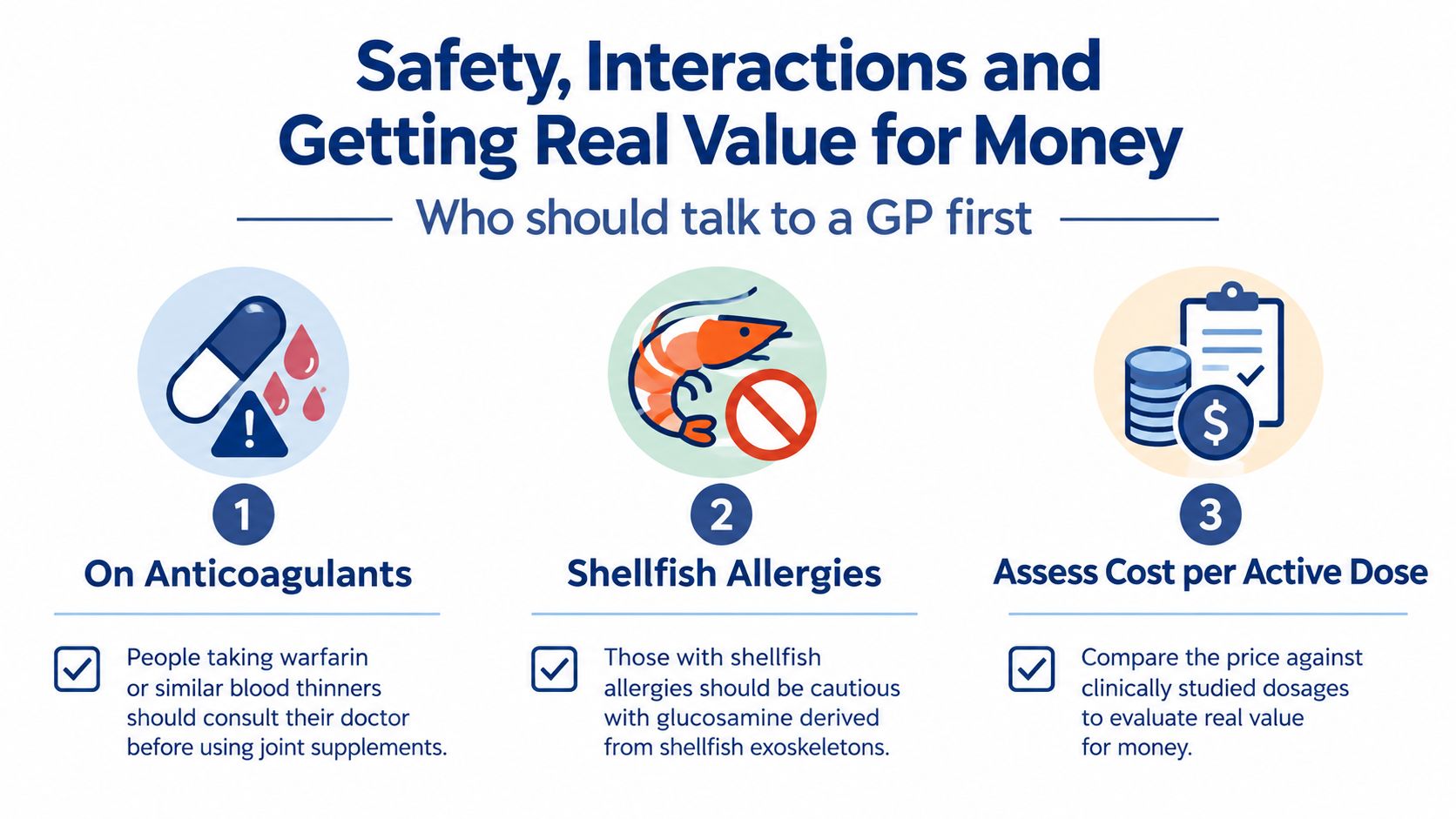
A joint supplement deserves the same medication check as any other supplement. Speak to a GP or pharmacist before self-trialling if you take warfarin or another anticoagulant, have a shellfish allergy and are considering glucosamine, are pregnant or breastfeeding, or monitor diabetes.
Omega-3 at higher doses and turmeric or curcumin may matter when you use blood-thinning medicines. Glucosamine also deserves a medication review if you take regular pain relief such as paracetamol or an SSRI. Don't assume “natural” means interaction-free, particularly when you're combining several products.
Seek medical advice for a locked joint, sudden swelling, marked warmth, or pain that started after an injury. A supplement is not the right first response to a possible ligament injury, fracture, infection, or inflammatory flare.
Calculate the price of the dose you need
Don't compare tubs by pack price or capsule count. Calculate the cost of the complete daily serving at the amount you intend to trial, then multiply it by the realistic trial period. A cheap product can become expensive if it provides a token amount, while a larger pack may be better value if it delivers a transparent daily dose.
Also remove duplicates. If your multivitamin, fish-oil product, and joint formula all contain overlapping ingredients, the extra blend may add cost without adding a clear purpose. Keep a written list of everything you take.
For practical lifestyle support, low-impact movement can be easier to maintain than high-impact exercise. This resource on low-impact cardio for joint pain may help you consider activity alongside any supplement trial.
You can also use this overview of supplement safety myths and facts when reviewing claims about natural products, interactions, and routine use.
Your decision in one minute
If your symptoms suggest inflammatory stiffness, discuss omega-3 or other treatment options with a clinician. If you have mechanical aching and still want to trial a supplement, choose one transparent product, prefer an evidence-matched form, use the full studied-style amount, and set a review date. If the product makes a treatment promise, hides its dose, or costs more than you're comfortable losing on an uncertain trial, don't buy it.
Vitamin Planet offers UK shoppers access to joint, bone, collagen, vitamin, mineral, and wider supplement categories in tablet, capsule, and other formats. Visit Vitamin Planet to compare labels, check active amounts, and choose a product that fits your symptoms, safety needs, and trial plan.