

Hair Skin and Nails: Nutrients That Help
If a splitting nail and extra hair in the plughole meant you were short of one vitamin, a single pastel gummy would sort both. It won't. Brittle nails, shedding and dull skin are nonspecific signs. They can follow a real shortage, ordinary wear, hormones, illness or a skin change that needs a GP. A label can support one of those paths. It cannot diagnose the others, and it cannot do the job overnight.
Hair, skin and nails are built from protein plus cofactors such as biotin, zinc, vitamin C and silica, yet each tissue keeps its own clock. Treat the mirror as a record, not a verdict.
Table of Contents
- What Hair Skin and Nails Products Can Change
- Nutrients That Matter and How Long They Take
- Collagen Types and Vegan Options Compared
- Safe Doses and When More Is Worse
- Hair Loss Brittle Nails and Skin Changes
- Topical Care That Supports the Inside Work
- Choose One Plan and Review It
What Hair Skin and Nails Products Can Change
Could a supplement give you thicker hair, calmer skin and nails that no longer split? The answer depends on the cause. A product claiming to create a new hairline in weeks promises more than a supplement can reliably deliver, because these tissues renew on different timetables.
A fingernail lengthens by about 3 millimetres a month, scalp hair grows about 1 centimetre a month, and the outer skin turns over in roughly four weeks. Judge a personal trial in months, not after the first week. Photograph the area on day one in the same light, then compare it with that picture when you review the product.
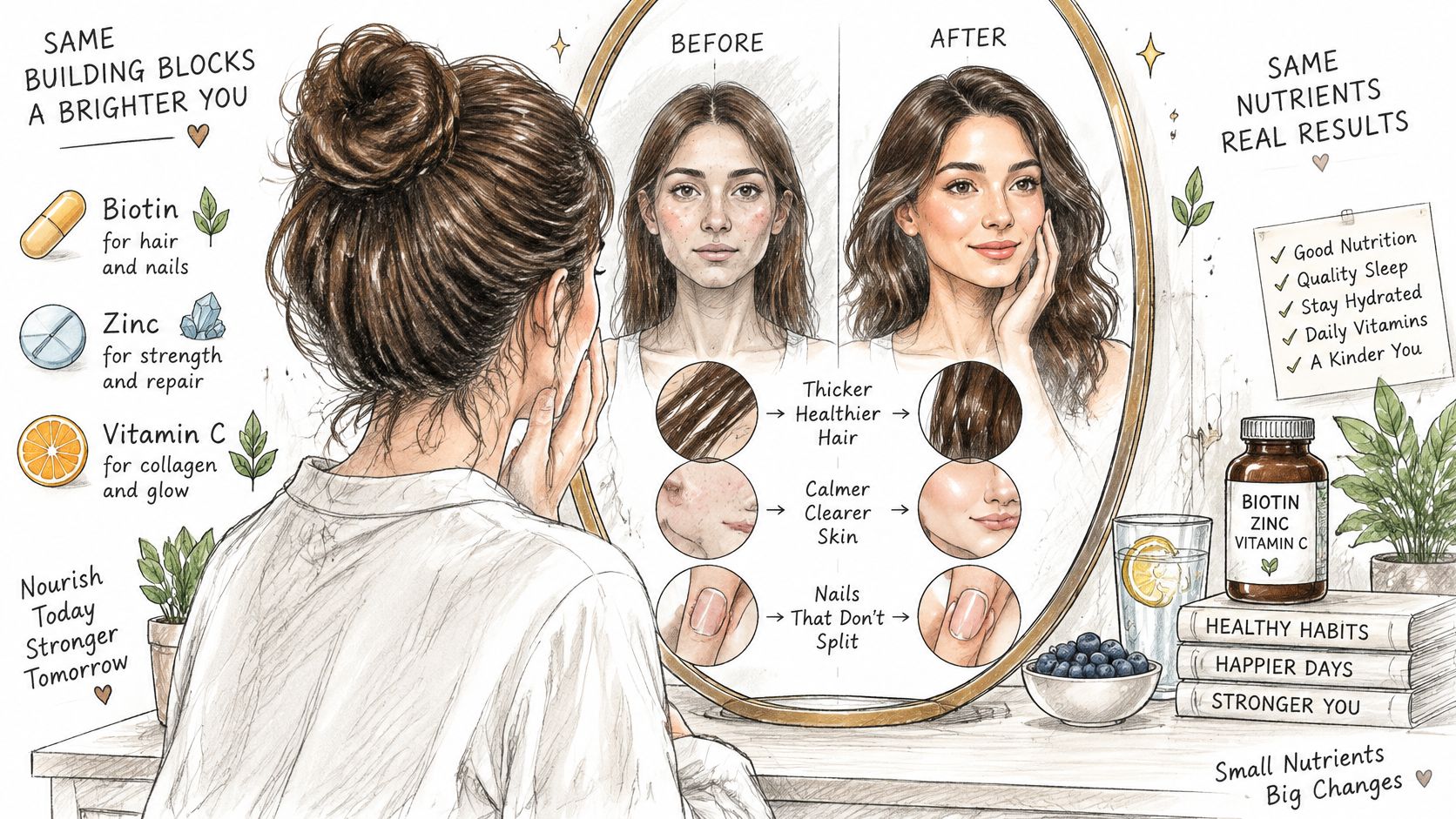
Three readers, three different jobs
Start with the likely cause, not the ingredient list.
Proven shortage. If a blood test has shown low iron, zinc or vitamin D, correcting that shortage may change what you see. The capsule is doing a medical job at a dose set by a clinician or the label, rather than acting as a general beauty treatment.
A steady diet already. Protein at meals, plus fruit and vegetables, supplies many of the nutrients hair, skin and nails use day to day. Adding a beauty multi is unlikely to produce dramatically more hair if your diet already covers those needs. A new hairline is not a realistic expectation.
A pattern that is not a nutrient gap. A widening part, scarring, eczema, psoriasis or a changing mole needs clinical attention. Increasing a supplement dose does not replace a GP appointment.
Tiredness, low mood and changes to hair, skin or nails can have many causes. Food supplies only 27% of recommended vitamin D intake among UK adults, and a 2025 UK consumer survey found that 73% of adults worried they were not getting everything needed from their diet, according to a Professional Beauty report drawing on National Diet and Nutrition Survey summaries. Those figures describe population-level concerns. They cannot show that an individual's peeling nails are caused by low vitamin D or that shedding is caused by low biotin.
People on restrictive diets, those with heavy menstrual bleeding, and people recovering from recent illness or living with malabsorption may benefit from a test before trying a high-dose product. Correcting a genuine deficiency can help; stacking single nutrients “just in case” may be unnecessary or harmful.
Food comes first: eggs, dairy or fortified alternatives, meat or pulses, fruit, vegetables and varied sources of protein. A supplement can support a specific need, but brittle nails, shedding and dull skin still call for different explanations.
Nutrients That Matter and How Long They Take
What can a nutrient realistically change, and how long might it take? Hair, skin and nails renew at different rates, so a useful trial needs a clear target and enough time to judge it. Brittle nails, shedding and dull skin are clues, not proof of a deficiency.
Hair skin and nails nutrients amounts and timelines
| Nutrient | Main job | Amount to know | Judge after | Evidence note |
|---|---|---|---|---|
| Biotin | Brittle nails and true deficiency | 2.5 to 5 mg daily in nail studies | 2 to 6 months | Not a hair-growth treatment if levels are already normal |
| Hydrolysed collagen | Skin elasticity and hydration | 2.5 to 10 g daily | 8 to 12 weeks | Modest skin data; hair results are less consistent |
| Silica as orthosilicic acid | Hair strength and nail quality | About 10 mg silicon daily | About 20 weeks | Small trials only; not a treatment for pattern hair loss |
| Vitamin C | Collagen formation | UK reference intake 40 mg | Weeks to months if diet was poor | Food usually covers it; megadoses are not more beautiful |
| Vitamin E | Antioxidant in skin lipids | Stay with label amounts | Not a quick fix | High doses can matter with blood-thinning medicine |
| Zinc | Follicle and skin repair | 9.5 mg men, 7 mg women | Months if a shortage existed | See Safe Doses and When More Is Worse for cautions |
| Vitamin A | Skin cell turnover | Stay within label | Not for routine hair growth | See Safe Doses and When More Is Worse for cautions |
| Iron | Oxygen supply to follicles | Test ferritin first; no fixed beauty dose | About 3 months after a proven shortage is corrected | Heavy periods, vegan diet or breathlessness warrant a test |
How to use a single line
Biotin at 2.5 to 5 mg daily is the amount used in nail studies. Allow two to six months to assess nail changes. It is not a hair-growth treatment when levels are already normal.
Hydrolysed collagen at 2.5 to 10 g daily has modest evidence for skin elasticity and hydration, with changes usually judged after 8 to 12 weeks. Hair results are less consistent. A topical product works at the skin's surface, while collagen peptides are taken by mouth. The evidence behind hair growth vitamins helps distinguish correcting a nutrient gap from expecting a supplement to treat every cause of shedding.
Choline-stabilised orthosilicic acid providing about 10 mg of silicon daily has been studied for hair and nail quality over about 20 weeks. The evidence is small, and it does not establish silica as a treatment for pattern hair loss.
Vitamin C supports collagen formation. The UK reference nutrient intake is 40 mg, and ordinary food usually provides enough. If your diet has been poor, a top-up may be relevant; a megadose is not a shortcut. Read more about vitamin C's role and benefits.
Vitamin E is an antioxidant in skin lipids. Stick to label amounts rather than treating high-dose capsules as a quick route to better-looking skin.
Zinc, vitamin A and biotin also have specific dose-related cautions. The Safe Doses and When More Is Worse section covers those alongside other supplement risks, so you can assess a product's dose before starting it.
Iron has no fixed beauty dose. A ferritin test can help establish whether a shortage is present; if one is corrected, allow about three months to assess changes. Heavy periods, a vegan diet or breathlessness can be reasons to discuss testing with a GP rather than self-dose.
Choose one nutrient that fits a clear concern, follow its timeline and keep a simple record. A photograph on day one gives you a fairer comparison than memory alone.
Collagen Types and Vegan Options Compared
Collagen is the rope-like protein in skin, bone and nails. A supplement does not inject a tube of that rope into your face. It supplies peptides, short pieces the body can absorb and reuse. Type I dominates skin, tendon and bone. Type III sits alongside it in skin and blood vessels.
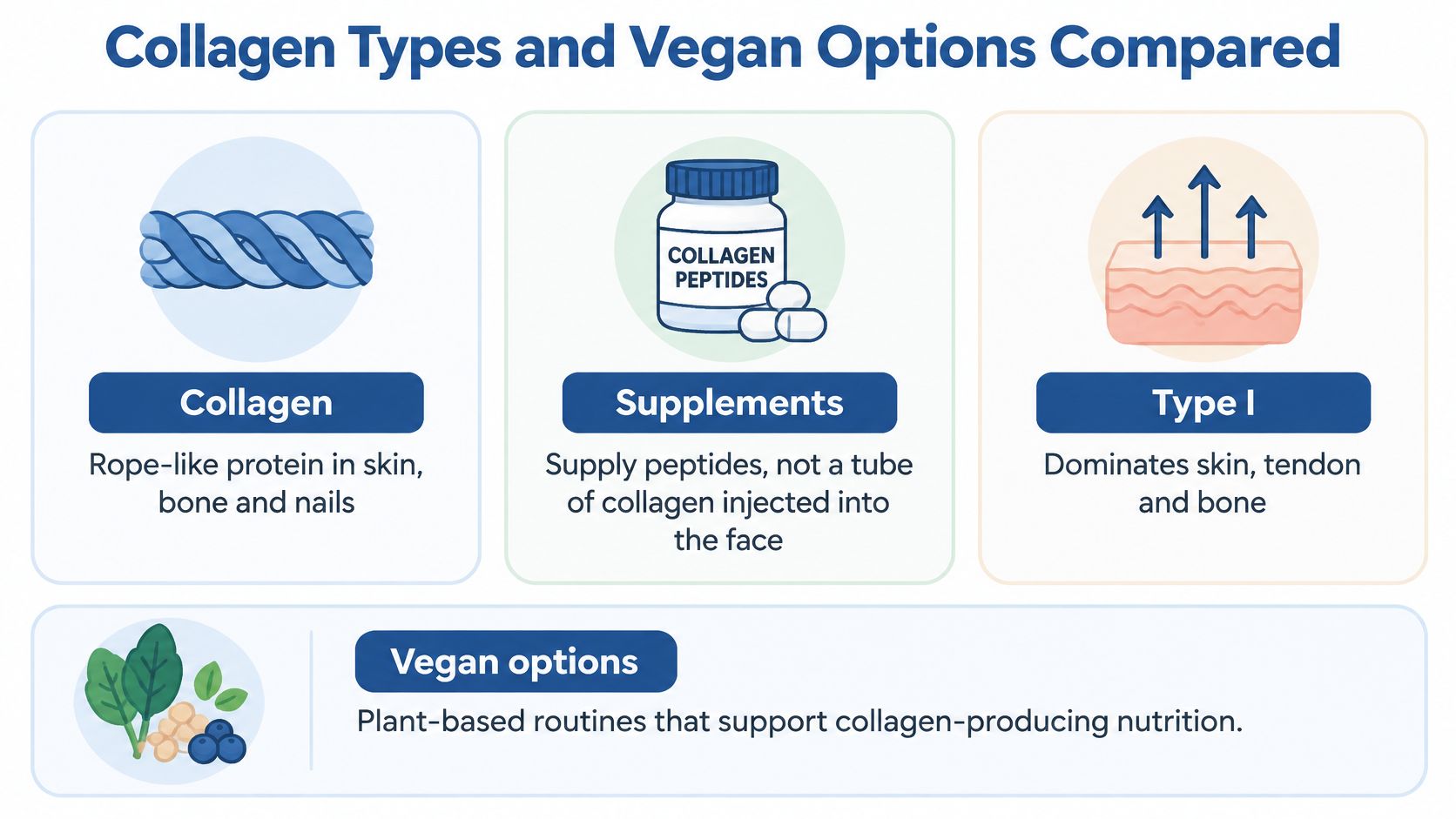
Most bovine powders are rich in types I and III, usually from cow hide. Marine powders are mainly type I from fish skin, which suits some people who avoid beef and fails anyone with a fish allergy. A vegan capsule cannot contain animal collagen. Products labelled collagen-builder usually combine vitamin C, silica, zinc and amino acids such as lysine and glycine, so your body can make its own collagen. That is a different product from 5 or 10 g of peptides. It is not an identical swap.
Think of peptides as pre-cut rope fibres. A vegan builder is the tools and the spare thread. Both can belong in a kitchen. They are not the same dish.
Collagen and beauty formats side by side
| Format | Typical source | Best suited to | Watch-out |
|---|---|---|---|
| Bovine peptides | Cow hide, types I and III | Skin and nail routines needing several grams | Not vegan, and not acceptable to every halal shopper |
| Marine peptides | Fish skin, mainly type I | People avoiding beef who want a studied peptide dose | Unsuitable with a fish allergy |
| Vegan collagen builder | Vitamin C, silica, zinc and amino acids | Vegetarian or vegan diets | Not the same as collagen peptides |
| Beauty gummy | Often biotin with a small collagen dose | People who will not take powders or capsules | Sugar and under-dosed collagen are common |
| Capsule complex | Mixed vitamins, minerals and sometimes silica | Simple once-daily habits | Several capsules may be needed to match a powder dose |
Gummies win on taste and often lose on dose. A sweet may contain biotin and only a token amount of collagen, plus sugar you did not go shopping for. Powders make a useful 2.5 to 10 g serving straightforward to measure. Capsules suit a work bag, yet you may need several a day before the collagen grams match a scoop. Halal, vegetarian and allergy needs pick the row before the marketing does.
Joint formulas are a separate job again. Bonemax Collagen 400mg is sold as high-strength support for joint health, mobility and flexibility in later life, in a 60-capsule pack. Four hundred milligrams is a capsule-scale serving, not the multi-gram peptide dose used in skin trials, so read it as bone and joint support rather than as your skin scoop.
If you want a plain walk-through of what oral collagen can and cannot do for hair, the collagen insights from PRP For HairLoss set expectations without treating a powder as a hair-transplant substitute.
Before you open a pouch, check four things: grams of collagen per daily serving, the animal source, the allergen statement, and whether you can take it for at least eight weeks. Anything shorter is a taste test, not a trial.
A short explainer on how collagen fits everyday skin care sits well beside that label check.
Safe Doses and When More Is Worse
A beauty supplement's dose is a set amount to follow, not a target to beat. Check the daily serving and add together the same nutrient from any multivitamin and separate products. Above the label, extra is risk, not benefit.
Where extra works against you
Zinc above the UK supplemental upper level of 25 mg can interfere with copper balance. Check the combined amount if you take more than one product.
Vitamin A from supplements should stay within the product limit. Avoid retinol supplements during pregnancy unless prescribed by a clinician. Liver-rich meals and a high-strength multivitamin can also contribute vitamin A.
Biotin can affect some thyroid and troponin blood-test results, even though it is water-soluble. Tell your clinician if you take it, and pause it before a test if they advise you to.
Vitamin C from food is enough for the general population. Large doses in powder form can upset the gut without improving collagen.
Iron should follow a blood test, rather than being added as a cosmetic extra. This matters especially if you have heavy periods, follow a vegan diet or feel breathless. There is no fixed cosmetic dose.
Ask a pharmacist or GP to check combinations before adding a hair, skin and nails product if you take anticoagulants, isotretinoin or thyroid medicine, or have kidney disease. The guide to supplement safety myths and facts can help you prepare questions.
Choose one multivitamin or one targeted product, then check its ingredients against anything else you take.
Sun, vitamin D and skin
Vitamin D is a dosing question, not a reason to sunbathe for beauty. A 10 microgram daily supplement is a familiar UK winter amount for many adults. Follow the product directions and count vitamin D from other supplements towards your daily total. Avoid sunburn.
Hair Loss Brittle Nails and Skin Changes
Use this as a sorter, not a diagnosis. Match what you see to a likely story, then decide whether the next step is gloves, a blood test, a GP or none of the supplements on the shelf.
Hair, skin and nail concerns and first steps
| What you see | Often behind it | First step | Supplement role |
|---|---|---|---|
| Sudden all-over shedding | Telogen effluvium after illness, birth or dieting | GP if severe; allow 3–6 months | Only correct a proven shortage |
| Widening part or receding hairline | Pattern hair loss | Ask a GP or dermatology service early | Limited; biotin is not a reversal treatment |
| Peeling, splitting nails | Water, trauma, sometimes biotin or iron gap | Gloves and a blood test if periods are heavy | A biotin trial can be reasonable |
| Dry, itchy midlife skin | Menopause, eczema or both | Emollient and GP review if persistent | No single capsule replaces prescribed care |
| Thinning nails after menopause | Ageing nail plate plus other causes | Mention nails specifically at a review | Supportive only, with a set review date |
| New or changing mole | Possible skin cancer until assessed | Prompt clinical assessment | None; cosmetics do not diagnose or treat it |
Diffuse shedding that starts two to three months after illness, surgery, childbirth or a crash diet often fits telogen effluvium. Many people see it settle over three to six months. A GP visit is still wise if handfuls continue or your eating is very restricted. A widening part or receding temples fits patterned hair loss. Supplements rarely reverse that pattern, and early clinical advice beats another biotin bottle.
Peeling nails are often water, detergents and small injuries from typing or gel removal. A biotin trial has a rationale here. Iron deserves a test rather than a guess when periods are heavy. Dull, dry skin usually improves more reliably with an emollient and daytime sun protection than with a capsule. If hair feels rough from washing rather than from a shortage, ingredient-conscious guidance for softer hair from ALODERMA is a reminder that the conditioner you leave on can matter as much as the tablet you swallow.
Midlife skin, hair and nails
Menopause needs its own row, not a collagen slogan. A 2025 survey of patients attending a UK menopause clinic found that 100% reported at least one skin symptom. Itchiness affected 78% and dryness 76%. Hair symptoms were widespread too: 82% experienced at least one, with thinning reported by 54% and shedding by 44%, as published in a menopause clinic survey. Those figures do not prove a collagen deficiency.
Hormonal shifts, eczema, female-pattern hair loss, medicines and unrelated illness can look the same in the mirror. Evidence for using hormone replacement therapy specifically to treat menopausal hair thinning remains lacking, so HRT is not a beauty capsule by another name, and a beauty capsule is not HRT. Nail brittleness and thinning in midlife deserve the same appointment time as the hair, not a footnote.
Ask a GP about how long it has lasted, the pattern, medicines, menstrual change, and whether blood tests are warranted. If you still use a supplement, keep it inside the timeline for that nutrient and stop it when nothing visible has changed. No beauty product should delay review of a bald patch, a scar or a rapidly widening part.
A sorter tells you who to call. It does not name the disease.
Topical Care That Supports the Inside Work
Anything you swallow is still weeks away from a fair judgement. The outside routine is the part you can do tonight, and it often changes comfort faster than a capsule changes structure.
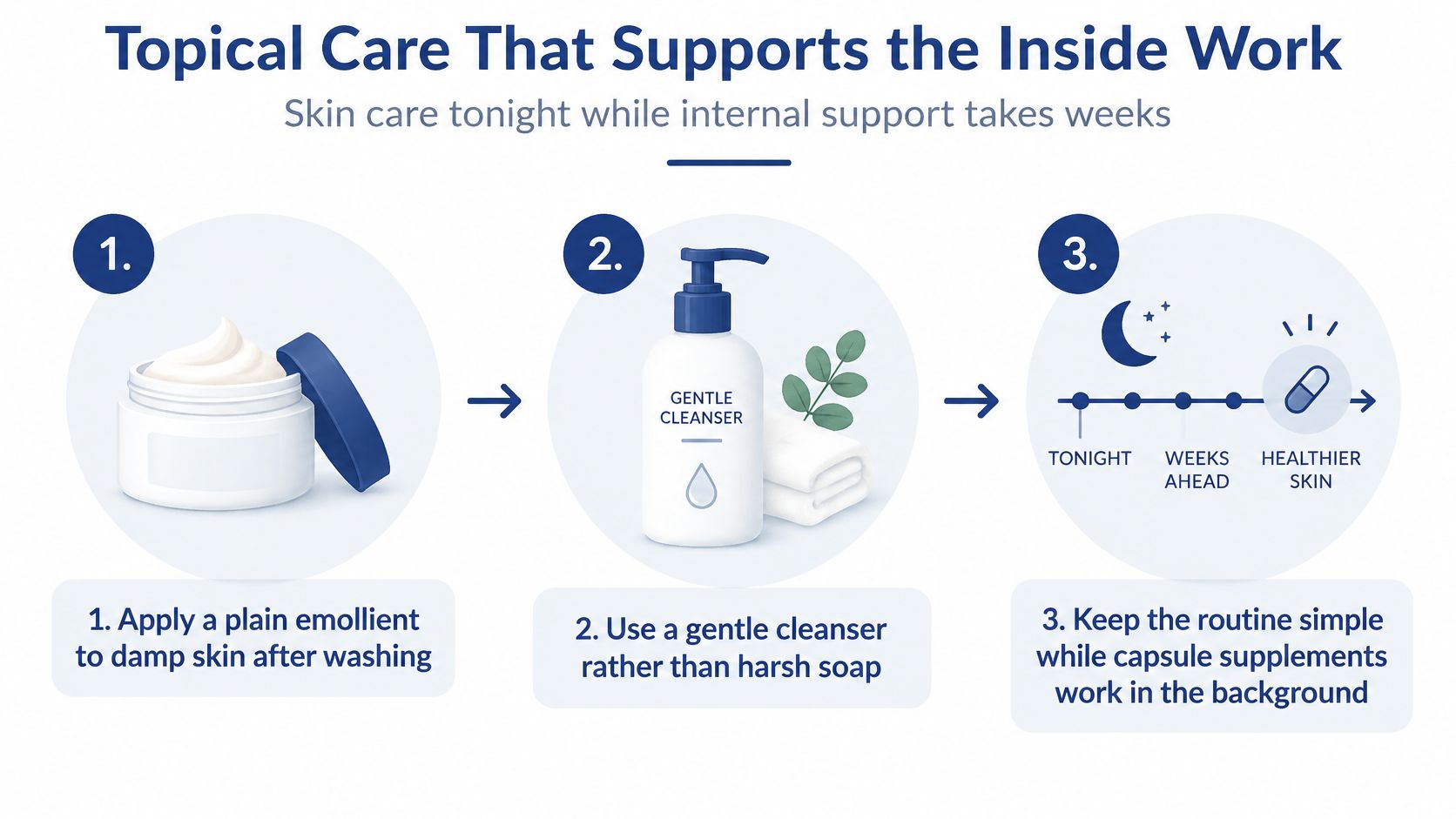
The evening flow is simple on purpose. Skin that is already dry does not need a long menu.
Skin, hair and nails tonight
- Apply a plain emollient to damp skin after washing. Water left on the surface evaporates and takes more moisture with it. The cream traps what is already there. A rich cream and an oral peptide answer different layers: the cream cuts water loss at the surface, while peptides only work if you swallow a meaningful dose for weeks.
- Use a gentle cleanser rather than harsh scrubs. Grit and strong soap strip the film that keeps itch down. If your face feels tight after washing, the cleanser is part of the problem.
- Wear a broad-spectrum SPF every morning. Sun protection is medical as well as cosmetic. It belongs on the face, ears and neck even on a cloudy commute.
For hair, wash as often as the scalp needs, not on a calendar copied from someone else. Avoid very tight styles that pull at the hairline, and limit high heat. For nails, wear gloves for water and detergents, file in one direction, keep the length modest and do not peel gel polish off. Peeling lifts layers of the nail plate that no biotin tablet can glue back that evening.
Daily habits that keep the barrier comfortable are spelled out in this guide to keeping skin healthy around the clock. Pair them with the two-week checklist below rather than with a new active every night.
Why a mole is not a moisturiser problem
A changing mole, irregular colour, bleeding or a sore that does not heal needs a clinician, because no cream can screen or treat melanoma. For people diagnosed in England between 2014 and 2018, age-standardised five-year net survival for melanoma of the skin was 90.1% for males and 94.5% for females, and historical Office for National Statistics figures reported that 57.2% of male and 66.1% of female patients were diagnosed at stage 1, in the cancer survival in England bulletin. Those high figures depend on early assessment. A product marketed for appearance should not delay it.
For the next fortnight: SPF every morning, emollient after washing, gloves for wet work, and a dated photo of any lesion that worries you.
Choose One Plan and Review It
Stop collecting ingredients. Make five decisions, in this order, and write the review date on the box before you break the seal.
- Name a single concern. Brittle nails, dry skin or general maintenance. Ignore any pack that promises all three by next weekend. If the sorter pointed to pattern hair loss, heavy bleeding, sudden bald patches or a changing mole, book the GP before you buy anything.
- Pick one format. Use the collagen comparison for grams per day, allergen statements, vegan or halal needs and added sugar. A powder that you will not mix is a worse plan than a capsule you will take.
- Check the ceiling. If a multivitamin is already open, add the zinc, vitamin A and biotin from both labels. Stay inside the safety limits, especially in pregnancy and if you take blood thinners.
- Set the review date first. Use the timeline for that nutrient, whether that is eight weeks for collagen or several months for nails. Photograph the area in the same light on day one.
- For ordinary maintenance only, then shop. Once red flags are out of the picture, a UK retailer such as Vitamin Planet can supply a straightforward vitamin, mineral or collagen product for that one job, alongside topical basics. A plain facial cream can sit in the night routine as optional surface care. It does not replace SPF, and it does not stand in for an oral trial you are judging with photos.
At the review date, continue only if the photographed change is visible and you tolerate the product. If nothing changed, stop. Doubling the dose is how a careful trial becomes a stack. If symptoms worsened, or a new patch appeared, seek clinical advice rather than a stronger multi.
Vitamin Planet is a UK retailer of vitamins, minerals, collagen and everyday hair, skin and nail care, so you can match one labelled dose to the concern you have. Browse the ranges, check grams and allergen statements on the product page, and keep your GP visit in front of any bottle if a mole, a widening part or heavy bleeding is the issue. Visit Vitamin Planet when you are ready to choose that single next product.