

Maca Root Capsules UK Guide: Benefits, Dosage and Evidence
Feeling tired, curious about “natural” energy support, or overwhelmed by supplement labels? You may have noticed maca root capsules in UK shops, often beside products promising vitality, libido, focus or hormonal balance. The large numbers on the front can make the choice look easy, but a headline milligram figure doesn't tell you everything about the preparation or the strength of the evidence.
Maca can be a reasonable supplement to investigate, provided you approach it with realistic expectations. The useful questions aren't just “How many milligrams does this contain?” but also “What does that number mean?”, “What did clinical trials measure?” and “Is this suitable for me?”
Table of Contents
- What Are Maca Root Capsules
- Evidence for Energy, Libido and Hormonal Support
- Understanding Dosage and Standardisation Claims
- Potential Side Effects and Safety Considerations
- How to Choose Quality Maca Root Capsules
- Final Thoughts on Maca Root Supplements
What Are Maca Root Capsules
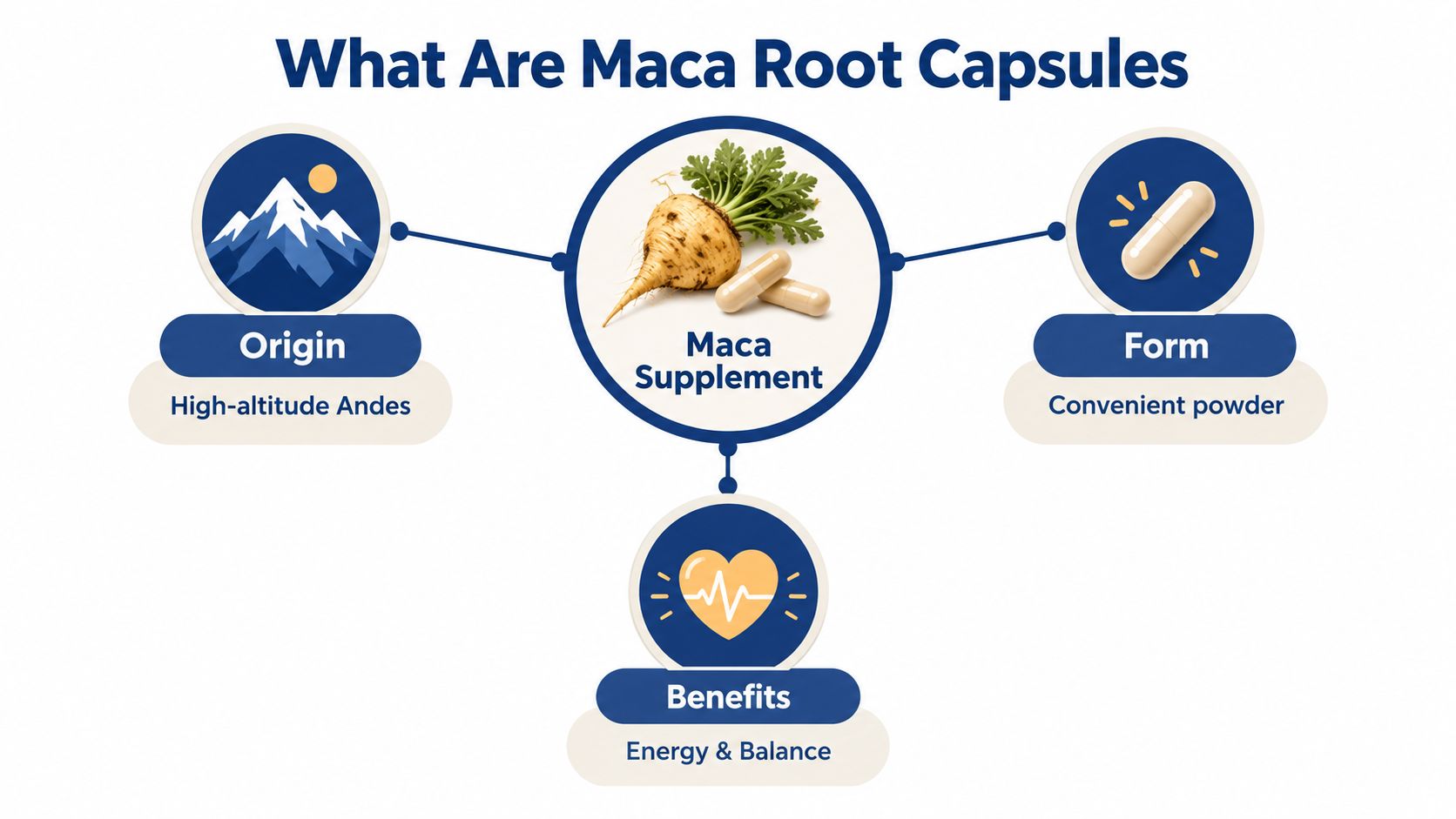
Maca is an Andean root traditionally used as a food and herbal ingredient. Today, manufacturers dry or process the root, turn it into powder, and place that powder or an extract into capsules. The capsule format removes the earthy taste and makes it easier to follow a consistent daily routine than measuring loose powder into food or drinks.
For a shopper in Britain, the journey from traditional root to modern product can feel surprisingly short. You might see maca presented in a bottle beside vitamins, minerals and sports supplements, with a suggested serving printed clearly on the label. That format reflects how a regional herbal ingredient has been adapted for convenience, portability and repeat purchasing.
The word adaptogen is often used around maca. In plain language, it describes a plant that's traditionally associated with helping the body cope with physical or mental stress, rather than acting like a direct replacement for a hormone or a conventional medicine. Think of it less like pressing an accelerator and more like giving your routine another support tool. That analogy is useful, but it shouldn't be treated as proof that every person will experience an energy or mood benefit.
Root, powder and extract are not interchangeable
A label may refer to maca root powder, gelatinised maca or an extract equivalent. These terms describe different forms of processing and measurement. Gelatinised refers to a processing method that changes the powder's starch structure. It doesn't mean the capsules contain animal gelatin, and it doesn't automatically mean the product is clinically stronger.
Capsules can therefore be useful for people who want a tidy, measured format, but they aren't a magical upgrade over the root itself. Their main advantages are consistency, convenience and easier storage. The meaningful question is whether the label explains what has been measured and whether the product's claims match the evidence.
Practical rule: Treat maca as a traditional botanical supplement with a defined role in a wellness routine, not as a guaranteed cure for tiredness, low libido or a suspected hormone problem.
Evidence for Energy, Libido and Hormonal Support
A shopper may see a large milligram claim and expect maca capsules to work like a quick energy stimulant. Clinical research asks narrower questions. Energy, sexual desire, physical performance and hormone levels are separate outcomes, rather than points on one scale. Feeling more energetic does not show that testosterone has changed, and a libido finding does not prove a general performance benefit.
Energy and physical performance
A UK-relevant clinical trial involved healthy, endurance-trained male cyclists who took gelatinised maca at 2,000 mg per day for 2 weeks. It found no statistically significant improvement in sexual desire compared with placebo, as described in the clinical review of maca evidence. The result cannot show that maca will never help an individual. It does show why a short course should not be marketed as a dependable, stimulant-like source of energy.
The trial also shows why a large label number needs context. The preparation, research question, duration and measured outcome all affect what a result means. A capsule described as an equivalent amount of dried root may not match the processed preparation used in a study. Comparing the two without checking the details is like comparing the strength of two drinks without knowing whether one is concentrated.
Libido and sexual desire
Libido is one of the main reasons people look at maca. The evidence is mixed, so the wording on a product or article should remain measured. Some research has examined sexual desire and function, yet the cyclist trial found no statistically significant improvement in sexual desire versus placebo. “Maca guarantees a libido boost” goes beyond that finding.
Sexual wellbeing also depends on the wider context. Sleep, stress, relationship factors, medication, pain and underlying health conditions can all affect desire. Persistent or troubling symptoms deserve assessment, because a supplement may be only one small part of a routine and cannot identify the cause.
Readers who want broader context on supplements discussed in relation to endocrine concerns can consult this hormone balance supplements guide. Women comparing products marketed for hormonal balance may also find this guide to hormone balance supplements for women useful. These resources provide context, not proof that maca changes hormones.
Testosterone and hormone claims
The available UK-relevant evidence does not support presenting maca as a testosterone-raising product for men. One trial gave healthy men 1,500 mg and 3,000 mg per day for 12 weeks and found no difference in serum testosterone or oestradiol compared with placebo, according to the same clinical review cited above.
“Supports vitality” is a broad marketing phrase. “Raises testosterone” describes a specific physiological effect, and the evidence does not justify using maca capsules as a substitute for hormone testing or medical advice. Anyone concerned about low testosterone, persistent fatigue or sexual dysfunction should speak with a healthcare professional instead of judging hormone status by how a supplement feels.
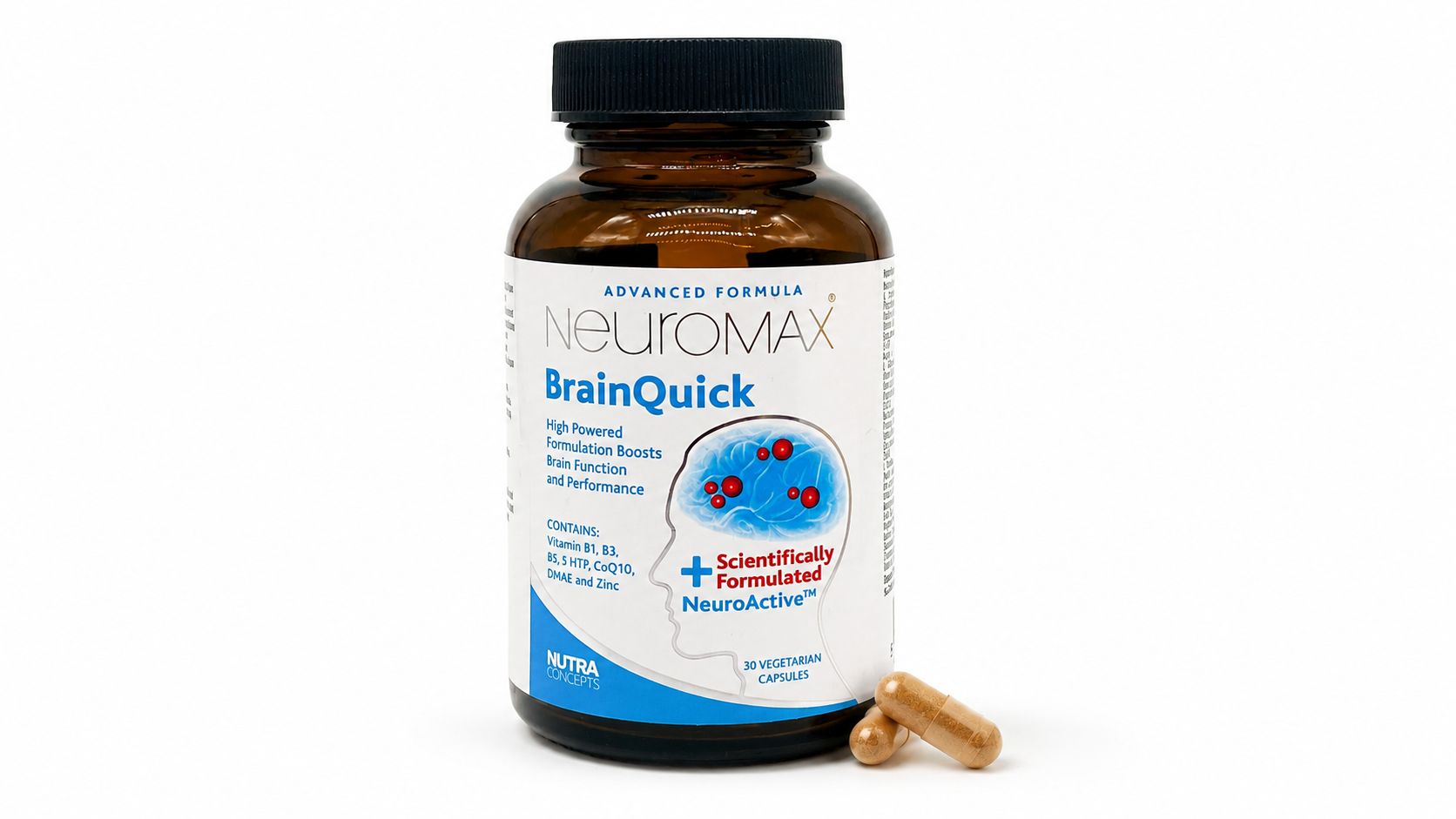
Vitamin Planet lists the BrainQuick Brain Support Supplement as a vegetarian vitamin and mineral blend positioned for focus and brain function. That product category differs from maca, so its positioning provides no evidence for maca's effects.
Understanding Dosage and Standardisation Claims
A bottle of maca capsules can appear stronger only because its front label uses a large milligram figure. UK retail listings include products described as 5,000 mg-equivalent, 10,000 mg and 11,000 mg per serving. Those figures do not always mean that each capsule contains that physical amount of ordinary maca powder.
An extract may be labelled by the amount of dried root it is said to represent. Plain maca powder may instead be labelled by its actual weight. Without the extract ratio, processing details and serving size, comparing the figures is like comparing two bottles by capacity without checking whether one contains a concentrate.
The size of the number also cannot tell you whether the product matches the preparations used in clinical research. Trials measure a defined preparation, daily amount and outcome. Retail labels often compress those details into a prominent claim, so the number is a starting point for questions, not a measure of expected benefit.
UK retail listings show a well-established and accessible category. Products are available in 60-, 120- and 180-capsule packs, including descriptions of six-month and 120-day supplies. Large retail channels also show approximate positioning of £0.09 to £0.21 per capsule. These details come from UK maca retail listings. They describe pack format and pricing, not evidence that one product produces better results.
Read the whole serving statement
Check whether the stated amount applies to one capsule or to the full daily serving. UK product data includes one listing describing 5,000 mg of maca root extract in 180 capsules, while another states 11,000 mg equivalent per daily serving across 180 capsules. The Tesco maca product listing shows why wording such as “per capsule”, “per serving” and “equivalent” deserves careful reading.
A label describes what the manufacturer is selling. It does not rank products by effectiveness, and a larger figure is not automatically a more useful dose.
| Product Feature | Typical Label Claim | Practical Meaning |
|---|---|---|
| Pack size | 60, 120 or 180 capsules, as shown in UK retail listings | Indicates how long the pack may last at the stated serving, but not whether the preparation matches the evidence |
| Strength expression | 5,000 mg of extract or a larger dried-root equivalent, as shown in the Tesco maca product listing | May describe extract equivalence rather than the physical weight of powder |
| Daily serving | 11,000 mg equivalent across 180 capsules, as shown in the UK maca product listing | Requires checking how many capsules make the serving and what “equivalent” means |
| Capsule price | About £0.09 to £0.21 per capsule in large retail channels, as shown in UK maca retail listings | Helps compare value, but price does not establish potency or clinical effectiveness |
What dosage can and can't tell you
The clinical amounts discussed earlier do not map neatly onto every retail label. Do not increase the number of capsules because the bottle displays a dramatic equivalent figure. Follow the manufacturer's directions, and ask a pharmacist or clinician for individual advice if you take medication or manage a health condition.
A high milligram claim is a measurement to interpret, not a result to assume.
Potential Side Effects and Safety Considerations
Maca is generally well tolerated, but “natural” doesn't mean suitable for everyone. A medical reference reports that side effects are uncommon and usually mild, with gastrointestinal symptoms and headaches among the main concerns. The same medical safety reference for maca notes that LiverTox found no convincing link between maca and liver injury in human use.
If you notice stomach discomfort or a headache after starting capsules, stop and consider whether the product is responsible. Don't assume that increasing the serving will solve the problem. Check the full ingredient list too, because a capsule may contain other botanicals or excipients that could be relevant to your symptoms.
Who should take extra care
Pregnancy and breastfeeding are situations where caution is appropriate. Public-health style guidance advises avoiding or carefully discussing maca during pregnancy and lactation because safety information isn't sufficient to treat it as routine self-care.
People with thyroid conditions also need particular care. Maca contains glucosinolates, and excess exposure can contribute to goitre risk, especially when iodine intake is low. If you have a thyroid diagnosis, don't rely on a product label's “natural” wording. Ask your GP, pharmacist or specialist whether maca is appropriate for you.
The same cautious approach applies if you're investigating a symptom rather than adding a general wellness product. Unexplained fatigue, changes in libido or concerns about hormones may need a clinical review. Supplement use can make sense only after more important causes have been considered.
For a broader discussion of common misunderstandings around supplement safety, see this guide to supplement safety myths and facts.
A sensible safety check
Before buying, ask yourself:
- Health conditions: Do you have a thyroid condition, or are you pregnant or breastfeeding?
- Medicines: Have a pharmacist check the product if you take regular medicines or several supplements.
- Symptoms: Are you trying to treat persistent tiredness, sexual difficulties or another symptom that deserves diagnosis?
- Product complexity: Does the capsule contain maca alone, or a blend with additional herbs that change the safety picture?
A cautious decision isn't an admission that maca is dangerous. It's a way to match the product to your circumstances instead of treating a general retail claim as personal medical advice.
How to Choose Quality Maca Root Capsules
You are comparing two maca bottles online. One displays a large dried-root equivalent, while the other lists a smaller amount of powder or extract. The larger figure may catch your eye, but it does not show what clinical trials measured or prove that the product will work better. Start with the back of the label, where the information needed for a fair comparison should appear.
Five label checks for UK shoppers
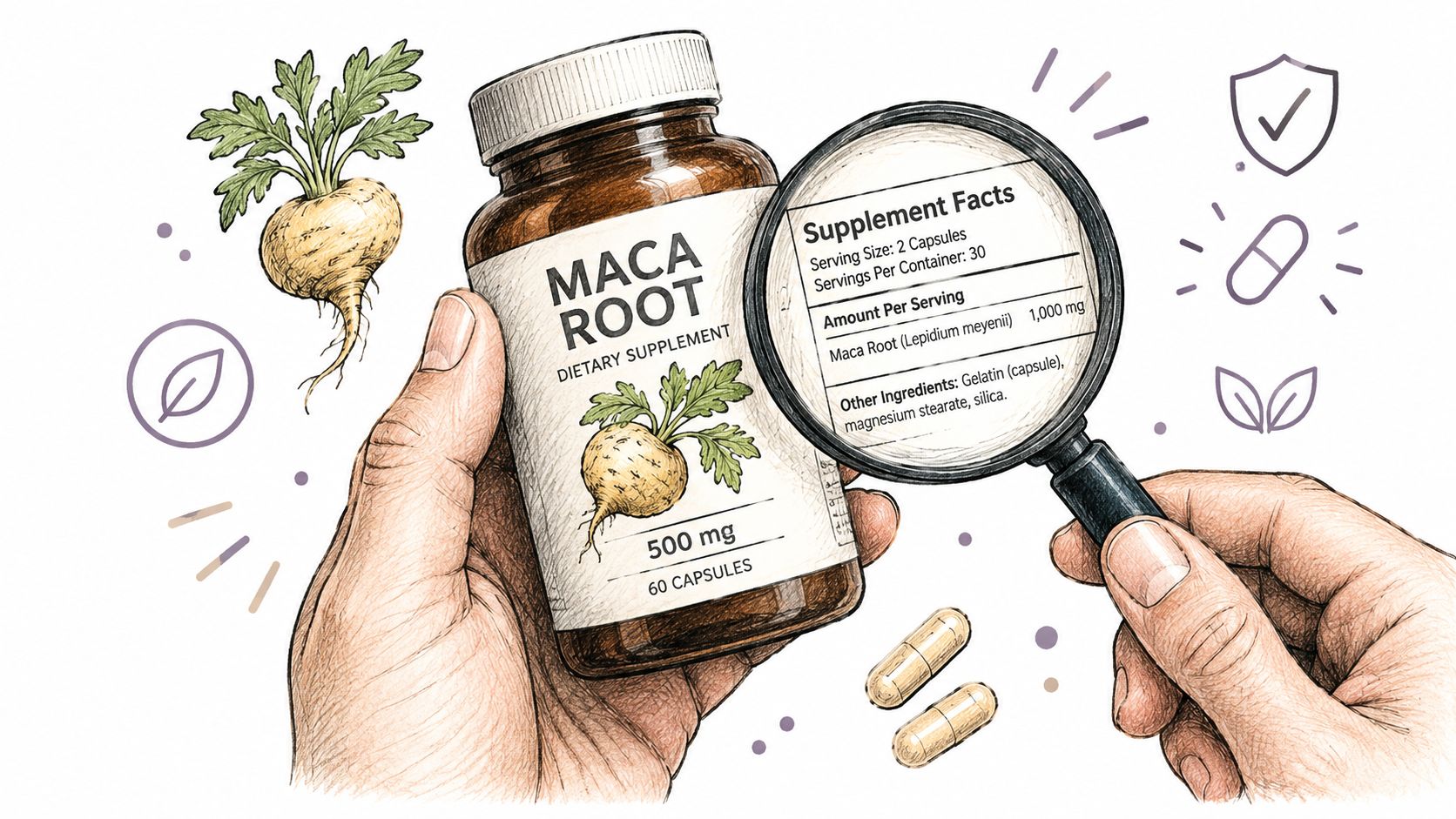
- Identify the form. Check whether the product contains root powder, an extract or an equivalent dried-root amount. These descriptions are not interchangeable. A large equivalent figure is a calculation about the starting material, not a direct measure of clinical strength.
- Check the serving. Confirm whether the stated amount applies to one capsule or the full daily serving. A pack may contain many capsules, but that does not tell you how much maca you take at once or across a day.
- Look for ingredient transparency. The list should separate maca from added botanicals, capsule materials and other ingredients. Proprietary blends are harder to assess because they may hide the amount of each component. A short, readable label makes comparison easier.
- Assess testing information. Choose a manufacturer that explains its quality controls and can provide suitable testing information. Testing cannot prove that maca will deliver a particular benefit, but it can support confidence that the contents match the stated ingredients.
- Match the product to your purpose. General vitality and a specific hormone concern are different goals. A high equivalent number does not turn maca into a treatment for a diagnosed problem. For persistent symptoms, seek professional advice rather than making a supplement the main response.
Processing terms need the same careful reading. “Gelatinised” describes how the root was prepared. It does not mean “clinically proven”, and it does not remove the need to follow the product's safety guidance. Good labelling explains its terms instead of using technical wording as decoration.
A retailer's categories can help you compare formats, but your decision should rest on the individual label. Vitamin Planet is a UK-based online store offering vitamins, minerals, dietary supplements, sports nutrition and related health products. Its range may help you review options, while the ingredient list, serving information and manufacturer details provide the more useful comparison.
Don't confuse neighbouring supplement categories
Maca is often placed beside products marketed for men's energy, vitality or hormonal support. Similar marketing does not make the ingredients interchangeable. A separate shilajit benefits guide for men can help explain why another botanical category raises different questions about preparation, claims and evidence.
Use the video below for general product education. It cannot replace checking the specific label or discussing a health concern with a qualified professional.
A sound buying decision follows a simple sequence: identify the form, confirm the serving, read the full ingredient list and examine the manufacturer's quality information. Treat a giant unexplained number as a prompt to investigate, not as evidence that the capsules are stronger or better.
Final Thoughts on Maca Root Supplements
You may reach for maca capsules after seeing a product with a striking dried-root number and wondering whether bigger means stronger. Maca has a reasonable, limited role in a supplement routine, offering a convenient way to take an Andean root ingredient. Some people use it for vitality or general wellbeing, but the evidence does not support treating it as a guaranteed stimulant, dependable libido treatment or testosterone booster for men.
The clearest takeaway is to separate label strength from clinical evidence. A large dried-root equivalent may describe how an extract was calculated. It does not show that the capsules will outperform a preparation with a smaller number. Clinical trials assess defined outcomes, so compare the product's form, serving, ingredients and manufacturer information rather than milligrams alone.
Safety still needs personal context. People who are pregnant or breastfeeding, those with thyroid conditions, and anyone with persistent or unexplained symptoms should seek individual advice before use. A pharmacist can explain the label, while a GP can investigate symptoms that maca should not be expected to diagnose.
UK shoppers can compare clearly labelled options through Vitamin Planet, which offers vitamins, minerals, sports nutrition and targeted wellbeing products. Use the product details to shortlist maca capsules, then check serving and safety information with a pharmacist if you have health concerns.