

Benefits of Zinc: What It Does and Who Needs It
Girls aged 11 to 18 in the UK take in, on average, 81% of the zinc their bodies need, while boys the same age reach about 90%, according to the National Diet and Nutrition Survey. That gap exists in a country where food is plentiful, and it explains why zinc keeps turning up in conversations about immunity, skin and growth.
Most zinc content online promises more than the evidence supports. The mineral does real, measurable work inside cells, and it also has a dose ceiling that gets far less attention than the benefits. Getting those two things straight is the difference between a useful supplement and an expensive habit.
Table of Contents
- Zinc Daily Targets and Who Is Most Likely to Fall Short
- Zinc Food Sources and How to Get Enough
- What Zinc Does Inside the Body
- Benefits Backed by Evidence and Where Claims Outrun It
- Safe Zinc Limits and When Supplements Make Sense
- Confirm Your Zinc Intake Before You Buy
Zinc Daily Targets and Who Is Most Likely to Fall Short
The UK benchmark is the Reference Nutrient Intake (RNI): the daily amount expected to cover almost everyone in an age and sex group. The 1991 dietary reference values guide sets zinc at 9.5 mg a day for men and 7.0 mg for women aged 15 and over, with the teenage bands sitting close to those adult figures.
| Group | RNI (mg per day) | Note |
|---|---|---|
| Men aged 15 and over | 9.5 | Adult reference value |
| Women aged 15 and over | 7.0 | Adult reference value |
| Boys aged 11 to 14 | 9.0 | Same value as girls in this age band |
| Girls aged 11 to 14 | 9.0 | Same value as boys in this age band |
| Boys aged 15 to 18 | 9.5 | Matches adult men |
| Girls aged 15 to 18 | 7.0 | Matches adult women |
| Children under 11 | Below 9.0 | Requirement steps down through childhood |
Read the table as a screening ruler rather than a personal prescription. The RNI is set high enough to cover most bodies, so one day under it is ordinary. The more serious line is the lower threshold beneath it.
Two thresholds, two different questions
The Lower Reference Nutrient Intake (LRNI) marks the level where intake is very likely inadequate for people in that group. RNI asks, “is this enough for almost everyone?” while LRNI asks, “is this so low that shortfall is likely?” A single low Tuesday proves little; several weeks under the LRNI deserve attention.
Both values are population estimates built from limited absorption and retention data. They can sort groups into risk bands, but they cannot diagnose one person's status from a food diary alone.
Who the surveys show falling short
In the NDNS report covering 2008/09 to 2016/17, 17% of 11 to 18 year olds had intakes below the LRNI, split as 12% of boys and 22% of girls; the same report records a statistically significant average fall of 0.1 mg of zinc a day in children aged 1.5 to 3, girls aged 4 to 10, boys aged 11 to 18 and women aged 65 and over. More than one in five teenage girls sat below the level where inadequacy becomes likely, and older women showed a sharper age pattern: 12% of those aged 75 and over were below the LRNI against 8% aged 65 to 74.
The teenage split matters because appetite, growth and food choice are all moving at once in those years. A group can look “well fed” on average while a sizeable minority still lands under the lower threshold.
The patterns that raise risk
Three situations move a person from “probably fine” to “worth checking”. Restricted diets that cut out meat, shellfish and dairy remove the most concentrated sources. Poor appetite, illness or malnutrition reduce total food intake across the board. Recurrent diarrhoea in a child increases losses at the same time as it reduces appetite.
A capsule cannot create a dietary pattern. If meat, shellfish and dairy are absent and appetite is low, the total still has to come from what is eaten most days.
If you want a plain-language second pass over what the mineral does day to day, this overview of zinc benefits for daily wellness covers the foundations without the sales pitch.
A three-step check you can run this week
- Write down everything you eat in one typical day. Choose an ordinary day rather than an unusually good or bad one.
- Estimate the zinc in each item using typical food values, then add any multivitamin, fortified cereal or sports product.
- Compare the total with your group's row. Your age and sex pick the number, and a general vitamins and minerals overview explains how zinc sits alongside the other micronutrients in a mixed diet.
One low day is not a deficiency. The pattern across a few weeks is what changes your risk, and persistent tiredness, thinning hair or slow-healing skin have many other causes that a food diary won't explain.
Zinc Food Sources and How to Get Enough
A target is only useful if you know what puts zinc on the plate. The table below gives working estimates so you can add up a day's intake instead of guessing at it.
| Food | Portion | Approximate zinc (mg) |
|---|---|---|
| Oysters, cooked | 100 g | about 15 or more |
| Beef mince, cooked | 100 g | about 5 |
| Chicken thigh, cooked | 100 g | about 2 |
| Pumpkin seeds | 30 g | about 2 |
| Cashews | 30 g | about 1.5 |
| Chickpeas, cooked | 100 g | about 1.5 |
| Lentils, cooked | 100 g | about 1.3 |
| Cheddar | 30 g | about 1 |
| Wholemeal bread | 2 slices | about 1 |
| Milk | 200 ml | about 0.8 |
| Egg | 1 large | about 0.6 |
Treat these as estimates. Cooking method, cut, brand and water content all shift the number, and a long-simmered stew concentrates what a quick stir-fry doesn't.
If you'd rather watch than read, this short walkthrough covers the same ground on how the mineral behaves in the body.
Why two people eating the same meal absorb different amounts
Meat, fish, shellfish and dairy deliver zinc in a form the gut takes up efficiently. That's why meat and meat products have traditionally been the mainstay of UK zinc intake for teenagers and adults, with cereals and cereal products doing more of the work in younger children.
Plant foods carry zinc too, but they also carry phytates, the storage compounds in wholegrains, legumes and seeds that bind the mineral and carry some of it straight through. The zinc in a bowl of lentils is real; you absorb less of it than the number on the label suggests.
- Soak overnight before cooking beans and lentils, then discard the water.
- Sprout or ferment where you can, since both break down phytate before the food reaches your plate.
- Choose leavened bread over flatbreads and crackers, because the rise does part of the work for you.
- Pair plant zinc with animal protein or dairy at the same meal, which lifts absorption from the whole plate.
Practical rule: if a meal is built on beans, lentils or wholegrains, add a dairy item or an egg and you'll absorb more of the zinc already there.
A sample day that clears the bar
Start with wholegrain bread, oats or a fortified cereal at breakfast. Put a portion of legumes, seeds or nuts at lunch. Anchor the evening meal with meat, fish, eggs or a generous dairy serving, and you'll usually land near the reference intake without counting anything.
After a week, ask yourself two questions. Have I eaten a zinc-rich food at least twice a day? And did each vegetarian main meal include a legume, seed or dairy source? Two yeses means your diet is doing the work.
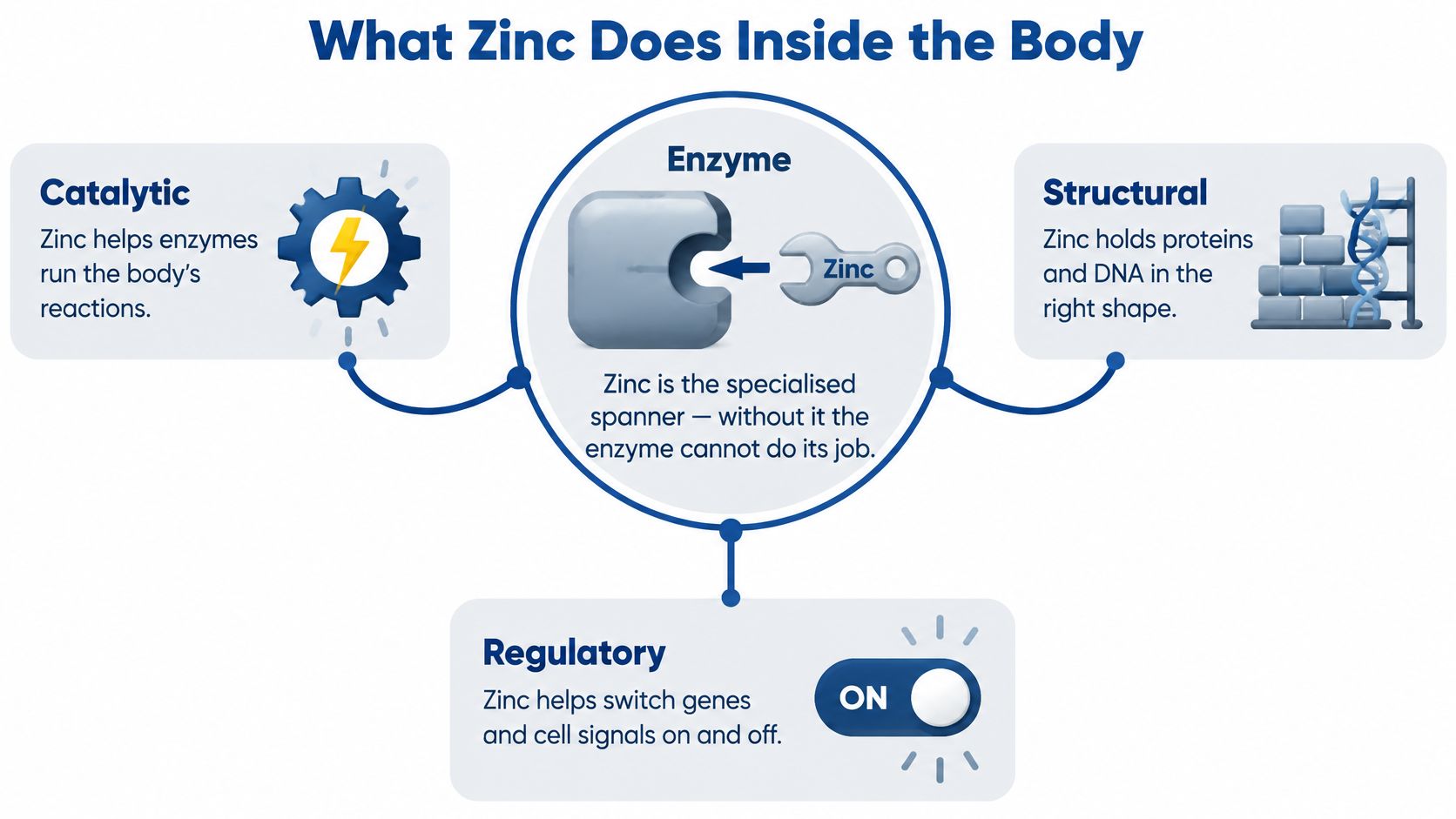
Where that zinc then goes is the part that decides which health claims hold up. The infographic maps the three roles the mineral plays once it's absorbed.
What Zinc Does Inside the Body
Zinc works like a specialised spanner in a workshop full of tools. Many of the body's enzymes are built with a spanner-shaped gap in them, and without the right spanner seated in that gap, the tool cannot turn. Take the zinc atom away and the enzyme still exists, but it does nothing.
Evidence reviews by the UK Scientific Advisory Committee on Nutrition describe three roles for the mineral, and they matter because nearly every marketing claim maps back to one of them. Catalytic roles place zinc at the working centre of an enzyme, where reactions happen. Structural roles use zinc to hold a protein in the right shape, including the zinc-finger proteins that help switch genes on and off. Regulatory roles shape how enzymes and proteins behave once they are built.
The systems those roles touch
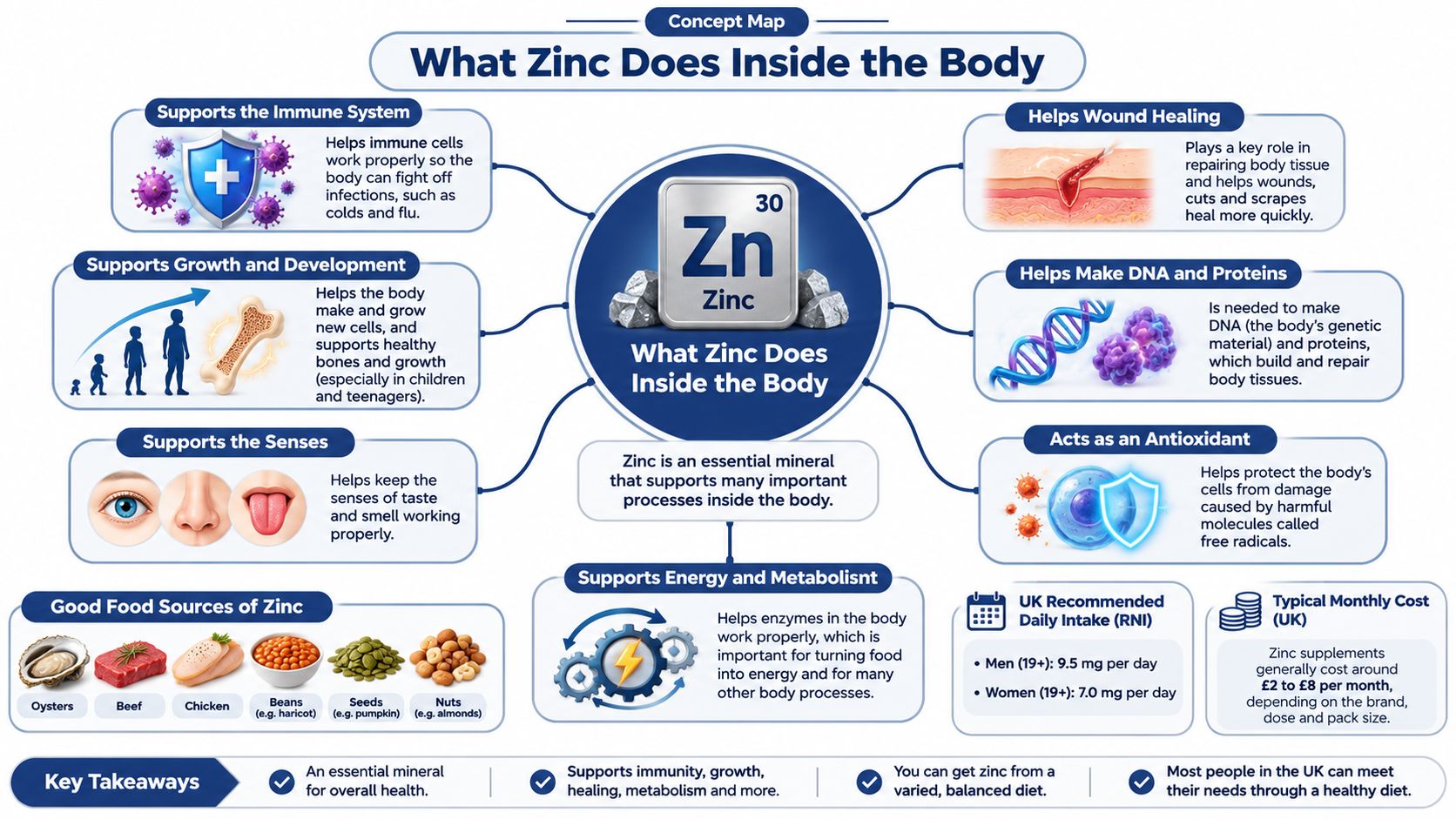
The Scientific Advisory Committee on Nutrition review of nutrition and immune function places zinc in enzymes and proteins involved in nucleic-acid, protein, carbohydrate, lipid and energy metabolism. Read that list plainly: zinc sits inside the machinery that copies DNA, builds proteins and turns food into usable energy.
The same review reports that zinc status influences immune function and respiratory morbidity, and that zinc and selenium may contribute to antiviral defence. It also draws a firm boundary: SACN found insufficient solid evidence that zinc supplements reduce COVID-19 risk or severity, so no product should be sold on that promise.
Where the body keeps it
Most of the body's zinc is held in muscle and bone, with the rest spread through soft tissue and body fluids. Zinc is also a structural element of cell membranes, which is why the mineral shows up across many different systems rather than sitting in a single organ.
There is no large reserve to draw on. The body keeps small stores and recycles what it can, so a steady dietary supply is what keeps the enzymes working.
Why rapid-renewal tissues notice first
Skin, the lining of the gut and immune cells replace themselves constantly, so they depend on a reliable supply of the raw materials for cell division. The first signs of a shortfall tend to appear in exactly those tissues: slower healing, changes in the skin, more frequent infections.
A supplement taken for a week and then forgotten rarely changes that picture.
A real enzyme function is a starting point, not a finished benefit. When a claim appears on a label or an advert, the useful question is which of the three roles it rests on, and whether the evidence describes that role doing what is promised.
Benefits Backed by Evidence and Where Claims Outrun It
Zinc has real biological jobs, but those jobs do not automatically translate into visible benefits from a supplement. Sorting claims into three tiers makes the difference clearer.
Well supported. Zinc is required for normal enzyme activity, cell structure and the maintenance of muscle and bone. That is why the mineral has a reference intake at all, and it is the claim a balanced diet reliably delivers.
Plausible but conditional. Immune support sits here. Zinc status influences immune function and respiratory illness, as the nutrition advisory review sets out. The benefit is most plausible when intake is short, and least plausible in someone already meeting the reference intake from food.
Overstated. Many product claims go further than the evidence. Trials of zinc in childhood illness and growth show benefits mainly in populations that were already short of the mineral. That result cannot be stretched into a promise that extra zinc will produce the same effect in children or adults whose intake is adequate.
The honest version of the immune claim: zinc supports normal immunity, but it does not stop colds in people who already have enough.
Cold lozenges are the clearest example of the gap. They are sold on the strength of zinc's role in immune function, yet the trials behind them come largely from settings and doses that do not match a healthy UK shopper buying a tube at the till.
The test to apply to any claim
Ask two questions in order. First, does the claim describe a role zinc is known to play? Second, does the evidence cover people like you, or only people who were short of the mineral to begin with?
Apply that test to hair, skin and wound healing. Zinc has a structural and catalytic part in protein synthesis and cell division, so the mechanism is real. Whether a supplement improves hair growth in a well-fed adult is a different question, and the evidence is much thinner than the mechanism. If hair and nails are your main concern, this guide to hair, skin and nail support sets out the nutrients involved without overstating any of them.
The same discipline applies elsewhere in the supplement aisle. Research into vitamin D and omega-3 evidence in relation to autism shows how easily findings from defined study groups can be promoted beyond the people and outcomes those studies measured.
This distinction matters because zinc is often marketed as a fix for common symptoms. Frequent colds, tiredness and slow-healing skin all have long lists of possible causes, and a shortfall in one mineral is only one of them. Symptoms alone cannot diagnose a deficiency.
Safe Zinc Limits and When Supplements Make Sense
Set the ceiling before you look at any product. UK food packaging uses a labelling reference value of 10 mg a day for zinc, which you can see in the regulation's nutrition labelling reference values. A labelling value differs from a personal target: the UK Reference Nutrient Intake is 9.5 mg a day for men and 7.0 mg for women, so the figure on a packet sits slightly above what most adults are advised to eat. The number that matters for safety is different again. For a healthy adult, 25 mg a day is the long-term ceiling worth remembering, because sustained high intakes can cause anaemia and interfere with the absorption of copper, a mineral your body also needs.
The accumulation problem nobody quantifies
Zinc arrives from several directions at once. A multivitamin contributes some. A standalone zinc tablet contributes more. A cold remedy, a fortified sports drink or a wellness powder adds another layer. Each looks modest on its own, yet together they can push a daily total past the point where copper absorption suffers.
Labels make this harder than it needs to be, because they quote different things. Some list the weight of the compound, such as zinc gluconate or zinc citrate. Others list elemental zinc, the amount of the mineral itself. Compound weight works like a parcel's shipping weight, while elemental zinc is the contents inside, so only the second number can be compared with a reference intake or a ceiling.
The rule that follows: add up the elemental zinc in everything you take, every day, before you decide you need more of it.
That total is the number to hold against 25 mg.
Duration changes the risk. A short course taken for a specific reason carries a different profile from a daily high-strength habit sustained for months, and the second is where the anaemia and copper warnings start to bite.
| Situation | What the evidence supports | Practical step |
|---|---|---|
| Healthy adult, varied diet | Usually meets needs from food; supplements add little | Count total intake from all products first |
| Vegan or very low-meat diet | Lower absorption from plant sources; intake may fall short | Discuss a suitable amount with a GP or dietitian |
| Recurrent diarrhoea in a child | Zinc is used in treatment where deficiency is common | Seek medical advice before self-treating |
| Cold or fatigue with no other signs | Symptoms have many possible causes and cannot prove a deficiency | Avoid routine high-dose use; see a GP if it persists |
| Long-term intake above 25 mg a day | Risk of anaemia and reduced copper absorption | Stop and seek clinical advice |
The question readers ask most often is how long is sensible. Set the duration with a clinician rather than a marketing page, and stop if your total has sat above 25 mg a day for a long stretch. Unusual tiredness, breathlessness or numbness and tingling deserve a proper look, because anaemia and copper deficiency need diagnosing rather than guessing. Our zinc supplement guide explains how to read the elemental figure on a label before you compare products.
Confirm Your Zinc Intake Before You Buy
Three steps, in this order.
- Log three days of food. Use the food table to estimate zinc in each meal, then add every multivitamin, fortified product and supplement you take.
- Compare the daily average with your group's reference intake and check whether your total from all sources sits above 25 mg a day.
- Choose a product only if the gap is real and persists. Look for elemental zinc per serving, the total daily amount and the intended length of use, then compare those with the ceiling rather than with the weight of the compound.
Quality is a separate question from dose, and it's worth asking. Vitamin Planet sources raw materials and extracts produced in the UK to GMP and EU standards, so the certificate behind a product tells you how it was made. It doesn't change the 25 mg limit, and no manufacturing standard does.
A short course for a specific reason is different from a daily habit, so diary the plan and review it after a few weeks. Write down your group, your three-day total and the reference number you compared it against. That single page tells you whether the next step is a change to your meals or a conversation with your GP.
Zinc sits in our mineral range alongside multivitamins and single-nutrient formulas, so you can compare elemental zinc per serving rather than guess at compound weights. Every product is evaluated in our quality control laboratories before it leaves London, with tracked Royal Mail delivery and free returns on eligible orders. Visit Vitamin Planet to check the zinc options against the reference intake for your age group, and our 100% satisfaction guarantee covers you if a product isn't right.