

Whole Psyllium Husk Benefits Uses and Safe Dosing Guide
You've probably seen whole psyllium husk in a large pouch, stirred it into water, and watched it turn from loose flakes into something much thicker than expected. Perhaps you're trying to increase fibre, manage occasional constipation, improve a gluten-free loaf, or decide whether whole husk or fine powder would suit you better.
In the UK, psyllium is closely linked with ispaghula husk, a licensed bulk-forming fibre used for constipation relief and stool-softening. That clinical background makes it more than a passing wellness ingredient. It also explains why water, serving size and preparation matter so much. This guide covers what the husk does, how whole husk differs from powder, which uses are realistic, and how to handle it safely in drinks, meals and baking.
Table of Contents
- Introduction to Whole Psyllium Husk and Why It Matters
- What Whole Psyllium Husk Is and How It Works
- Whole Husk Versus Powder Key Differences That Affect Use
- Health Uses You Can Realistically Expect
- Safe Dosing Preparation and Hydration Essentials
- Baking Thickening and Everyday Kitchen Uses
- Choosing Storing and Using Whole Psyllium Husk Wisely
Introduction to Whole Psyllium Husk and Why It Matters
A low-fibre day can look ordinary. Breakfast may be toast, lunch a sandwich, and dinner a ready meal with only a small serving of vegetables. Even with reasonable fluid intake, you might notice slower digestion, firmer stools, or meals that leave you hungry again soon afterwards.
Whole psyllium husk offers a practical way to add soluble fibre. It is the outer coating of psyllium seeds. In water, the loose flakes absorb fluid and swell, changing the volume and texture of material passing through the digestive tract. The effect is more like adding a soft, water-holding layer than taking a harsh stimulant.
Fibre also supports the wider work of maintaining a healthy digestive system. UK guidance advises adults to aim for 30 grams of fibre per day, as outlined in UK-facing guidance on psyllium and fibre intake. One teaspoon of psyllium husk, about 5 grams, contains about 4 grams of fibre, according to that guidance. A small serving can therefore help people whose usual meals fall short, although it works alongside food rather than replacing vegetables, fruit, pulses and wholegrains.
The useful question isn't “How much more can I take?” It's “What amount can I mix comfortably, hydrate properly and use consistently?”
Whole husk is also sold within the UK's regulated self-care context. Licensed products commonly describe an adult serving of 3.5 grams twice daily, taken after meals with at least 200 ml of water, for adults and children aged 12 years and over, according to UK pharmacy guidance on ispaghula husk. Instructions vary between products, so the label determines how a particular item should be used.
The choice between flakes and powder is practical. Whole husk gives a more noticeable texture and can feel easier to judge visually, while powder disperses more finely and may thicken faster. Either form needs careful mixing, an appropriate serving, and enough fluid. The rest of this guide explains how those differences affect drinks, meals and baking, so you can choose the form that suits your routine rather than focusing on fibre content alone.
What Whole Psyllium Husk Is and How It Works
Whole psyllium husk comes from the seeds of Plantago ovata. The husk is the light outer layer around each seed. In its whole form, it looks like pale, airy flakes. Powder is the same basic material milled into much smaller particles, so the two forms can behave differently even when they come from the same plant.
A useful comparison is a tiny sponge. Once dry flakes meet water, they absorb it and swell. Instead, they form a slippery, viscous gel that holds water in a soft structure.
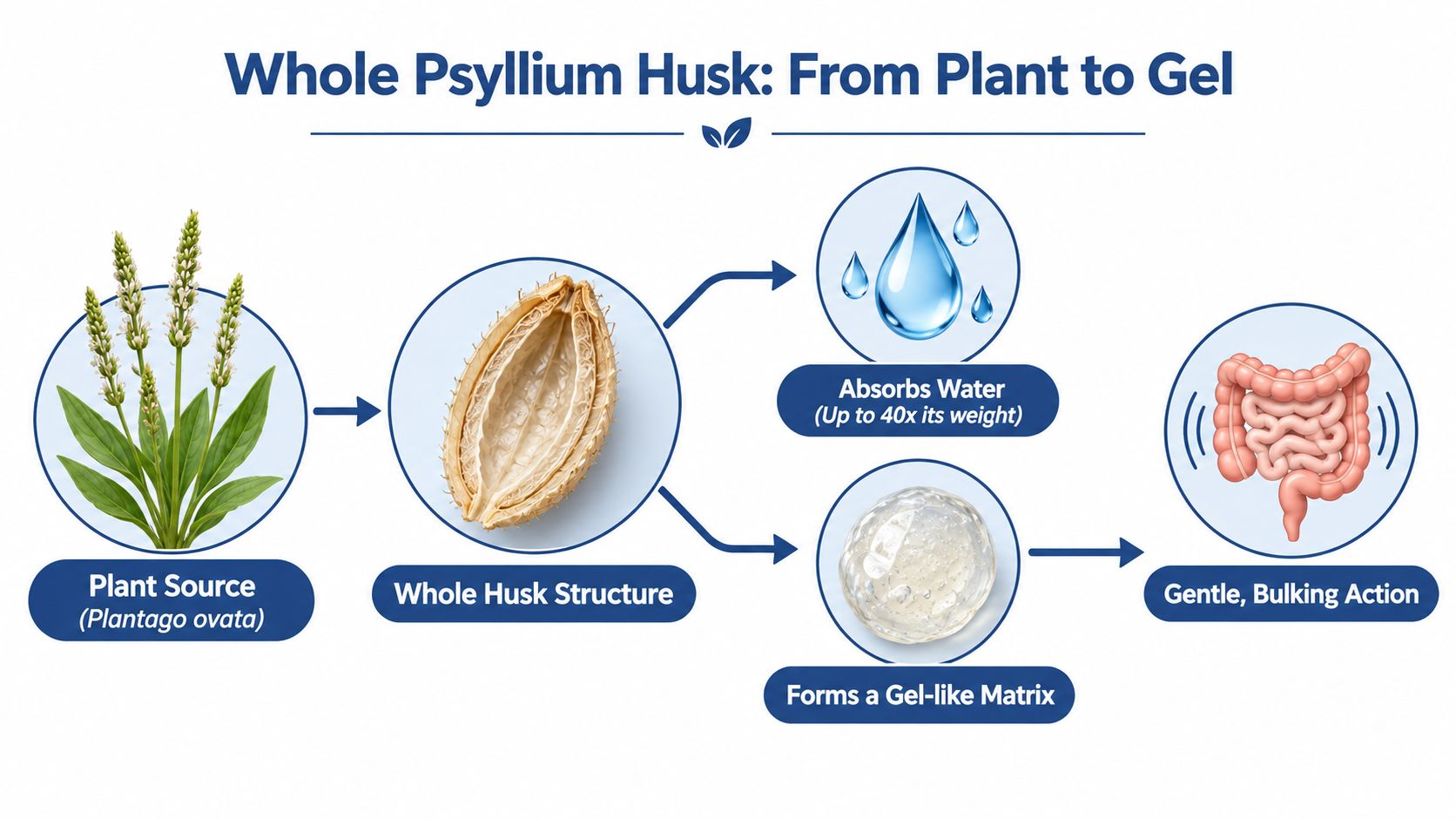
From loose flakes to a digestive matrix
That gel helps explain psyllium's practical effects:
- For stool texture, the water it holds can help soften hard stool.
- For bulk, the fibre adds physical volume as it travels through the gut.
- For transit, the gel can create a more cohesive mass instead of a dry, crumbly one.
- For food texture, the same swelling action thickens liquids and helps bind dough.
Psyllium is commonly described as a soluble fibre because it interacts with water and forms a gel. Insoluble fibre behaves more like roughage, adding structure without dissolving or thickening in the same way. These labels describe different behaviour, not a universal ranking. Both types have distinct roles.
Some psyllium is fermented by gut microbes in the colon. A UK-based randomized crossover trial involving 41 healthy volunteers found that a 15-gram serving changed colonic fermentation markers over 24 hours compared with methylcellulose and maltodextrin, according to the published clinical trial. Psyllium therefore interacts with the gut environment rather than passing through as inert bulk. Gas or bloating can occur while the digestive system adapts.
Why water is part of the mechanism
Water supplies the fluid psyllium needs to swell and form its gel. Dry swallowing removes that safeguard: the material can expand before it has moved safely down the throat. UK guidance therefore warns against taking psyllium dry because of the risk of choking or blockage.
The sponge comparison also clarifies why whole husk and powder need different handling. Coarser flakes generally swell more gradually, while finer particles can thicken faster. A larger serving or a smaller drink changes the result too, even when the label shows the same weight. Texture, dose control and hydration are practical choices, not minor details.
Whole Husk Versus Powder Key Differences That Affect Use
You are choosing between visible flakes and a fine powder, not between two different types of fibre. Both come from psyllium husk, yet they behave differently in a glass, smoothie or mixing bowl. Whole husk has a light, flaky structure and usually swells more gradually. Powder has much smaller particles, so it hydrates and thickens faster.
The practical choice centres on texture, timing, dose accuracy and safety. Whole husk gives more visual warning as the flakes expand, while powder can become dense before you have finished mixing or drinking. Neither form is automatically better. Choose according to the texture you can tolerate, the recipe you are making and how precisely you need to portion it.
Whole Husk vs Powder at a Glance
| Feature | Whole Husk | Fine Powder |
|---|---|---|
| Appearance | Light, visible flakes | Fine, flour-like powder |
| Mixing speed | Swells noticeably and may remain textured | Thickens rapidly and can clump |
| Drink texture | More fibrous or gel-like | Smoother at first, but often denser |
| Dose handling | Scoops can be less uniform because flakes settle and compress | Usually easier to level and portion |
| Baking use | Useful where a little structure and texture are welcome | Convenient for batters and recipes needing even distribution |
| Main practical challenge | It may float or form patches if not stirred well | It can become very thick before you finish drinking |
Whole husk may suit someone who dislikes an immediately floury drink and wants to see how well it has dispersed. It can also fit bread recipes where visible structure is acceptable. Powder is often simpler for smoothies, sauces and batters, as long as it is mixed promptly and the finished mixture is not left to thicken.
A scoop is not a laboratory measure. Flakes can settle or compress, and particle size affects how much fits into a spoon. For that reason, compare products by delivered soluble fibre per serving, rather than relying only on the total mass of powder or capsules. The European dietary fibre evidence guidance explains why fibre labels and serving measures need careful interpretation.
For a closer look at the finer format, read this UK guide to psyllium powder. Whichever form you select, follow the product instructions, mix it with sufficient liquid and drink it promptly. In UK use, the label's serving guidance should take priority over copying a spoon measure from another product.
Health Uses You Can Realistically Expect
A bowl of porridge that keeps you comfortable through the morning, or a bowel habit that becomes easier to manage, reflects psyllium's main practical role. Its gel-forming fibre can affect digestion in several ways, but it is not a cure-all. Whole psyllium husk works best as one targeted addition to regular meals, adequate fluids and a varied diet containing vegetables, fruit, pulses, wholegrains or other fibre-rich foods.
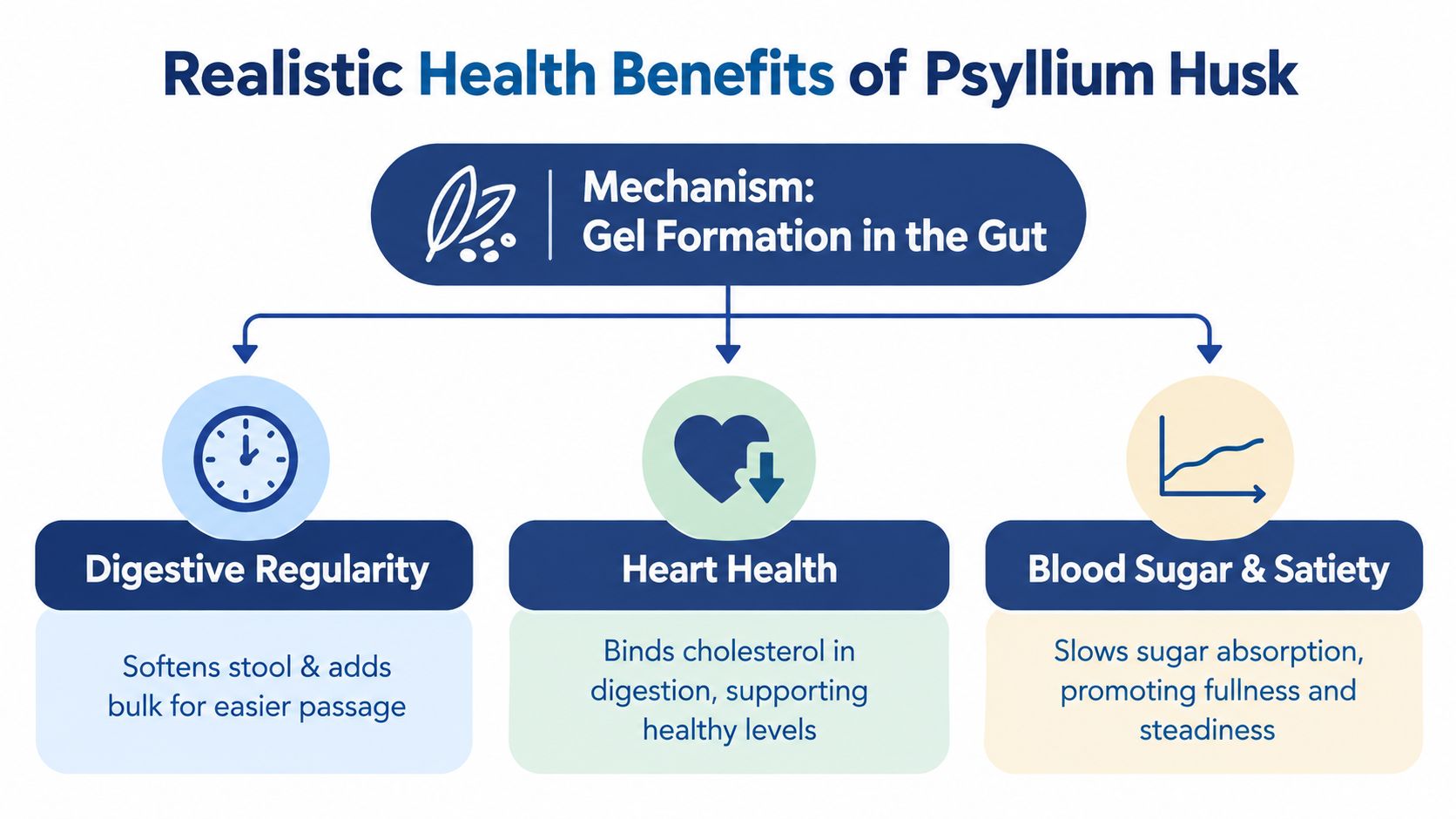
Constipation relief and stool-softening
Constipation relief is the most established everyday use. The gel holds water and increases stool bulk, which can make stools easier to pass. UK licensed ispaghula products describe this action as bulk-forming fibre, rather than a stimulant laxative.
The effect usually develops through a regular routine, not as an instant dramatic result. Increasing the amount too quickly can bring more bloating without making you more comfortable. Whole husk may suit people who prefer visible flakes and a less floury texture, provided it is prepared correctly.
Cholesterol support
Soluble fibre can interact with digestive substances involved in cholesterol metabolism. Psyllium may therefore support a heart-conscious eating pattern when the product provides enough soluble fibre for the relevant health-claim criteria, as outlined in the European dietary fibre evidence guidance noted earlier.
That wording matters. Psyllium can complement a cholesterol-management plan, but it does not replace prescribed treatment or balance out an otherwise poor diet. Follow your clinician's advice if you have been told to manage cholesterol.
Blood sugar steadiness and satiety
The gel can slow the movement and absorption of food components, so a meal may feel more sustaining. Psyllium-containing foods are also discussed in relation to satiety and body-weight control, with evidence reviews referring to modest daily amounts of psyllium seed husk for this purpose.
Use it to support a meal, not to replace one. A little whole husk in porridge or a smoothie may contribute to fullness, while protein, produce and the rest of the meal still determine its nutritional quality.
Joint support is a separate consideration. Bonemax Collagen 400mg Supplement for Bone Health - 60 Capsule is listed as a collagen formulation intended to support joint health and help maintain mobility and flexibility. It is not a fibre product, so consider it separately from psyllium.
Safe Dosing Preparation and Hydration Essentials
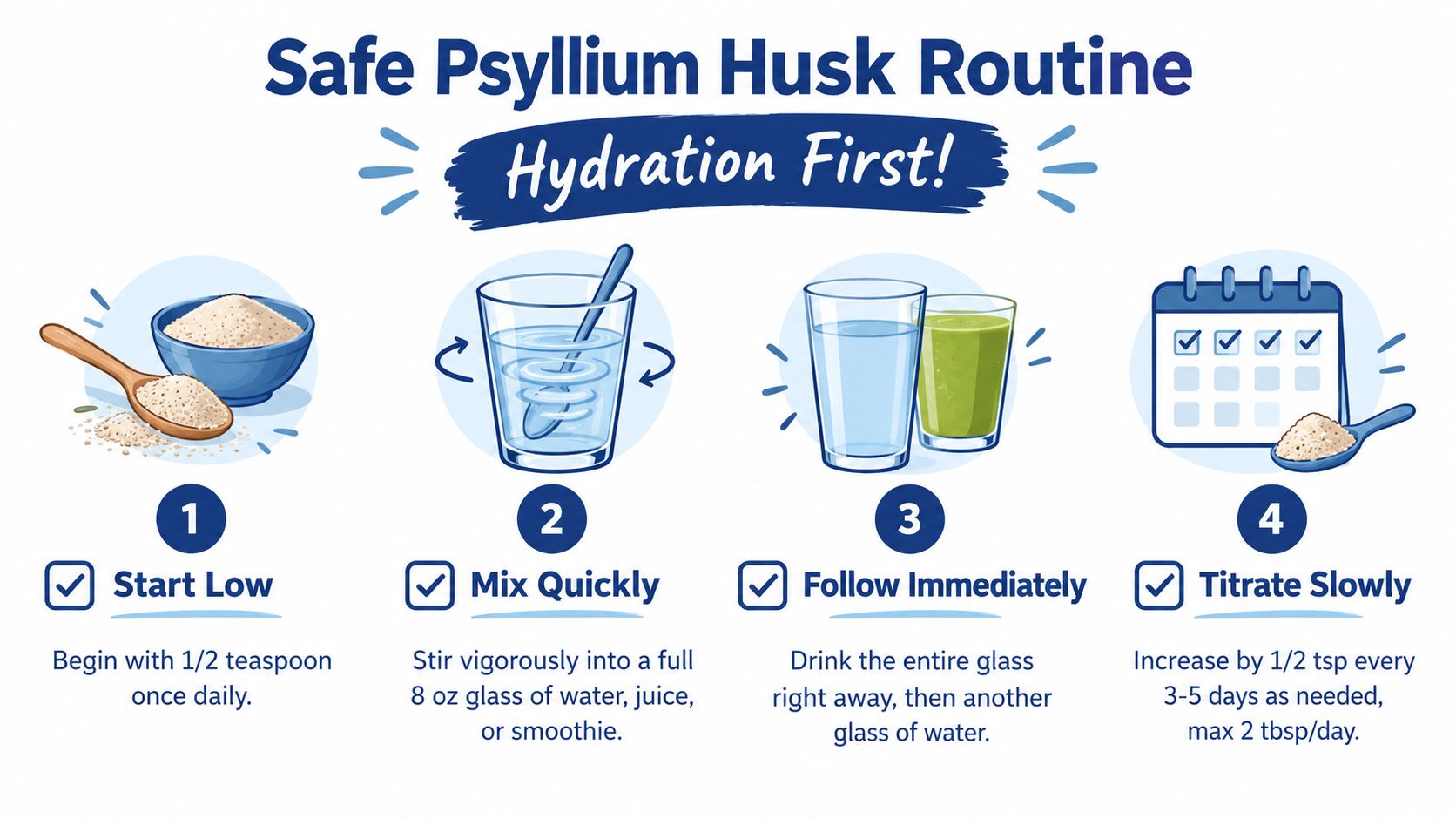
Imagine taking a spoonful of husk without a drink. It can swell before it reaches the stomach, creating a choking or blockage risk. Mix whole psyllium husk with liquid first, and follow the product label rather than assuming every spoonful has the same weight or texture.
UK product directions may differ. One licensed adult routine uses 3.5 grams twice daily after meals with at least 200 ml of water, while other guidance gives 300 ml of water for each 5-gram serving. Treat these as examples, not universal instructions. Your own pack's directions take priority.
A hydration-first routine
- Check the label first. Confirm the serving size, timing and fluid instruction for your product. Whole husk and powder can measure differently by volume, so dosing by guesswork is unreliable.
- Start cautiously. If fibre supplements are new to you, begin with a smaller amount and allow your digestion to adjust. Increase only according to the label or advice from a pharmacist or clinician.
- Prepare it immediately before taking it. Add the husk to the required liquid, stir thoroughly and drink promptly. Waiting allows the mixture to thicken, making it harder to swallow.
- Keep fluids available. Take the full recommended drink, then maintain your usual fluid intake during the day. More fibre without enough fluid can worsen constipation rather than improve it.
The Nottingham trial used 15 grams of psyllium husk and observed fermentation-marker changes over 24 hours. As noted earlier, this supports a gradual approach for tolerance, not a reason to chase a larger dose. clinical trial report
When to pause and ask for advice
Stop and seek medical advice if you develop difficulty swallowing, chest discomfort, severe abdominal pain, vomiting or possible blockage. Do not use psyllium to self-manage unexplained bowel changes without professional guidance.
Fibre may affect the absorption of some medicines. Ask a pharmacist or clinician whether you need to separate psyllium from your medicines. Seek advice before starting if you have swallowing difficulties, known bowel narrowing or a diagnosed digestive condition.
Baking Thickening and Everyday Kitchen Uses
The same gel that changes stool texture can change a recipe. In a gluten-free loaf, whole psyllium husk helps hold water and gives the dough more cohesion, which can make the finished bread less crumbly. In a soup or smoothie, it adds thickness without relying on a flour roux.
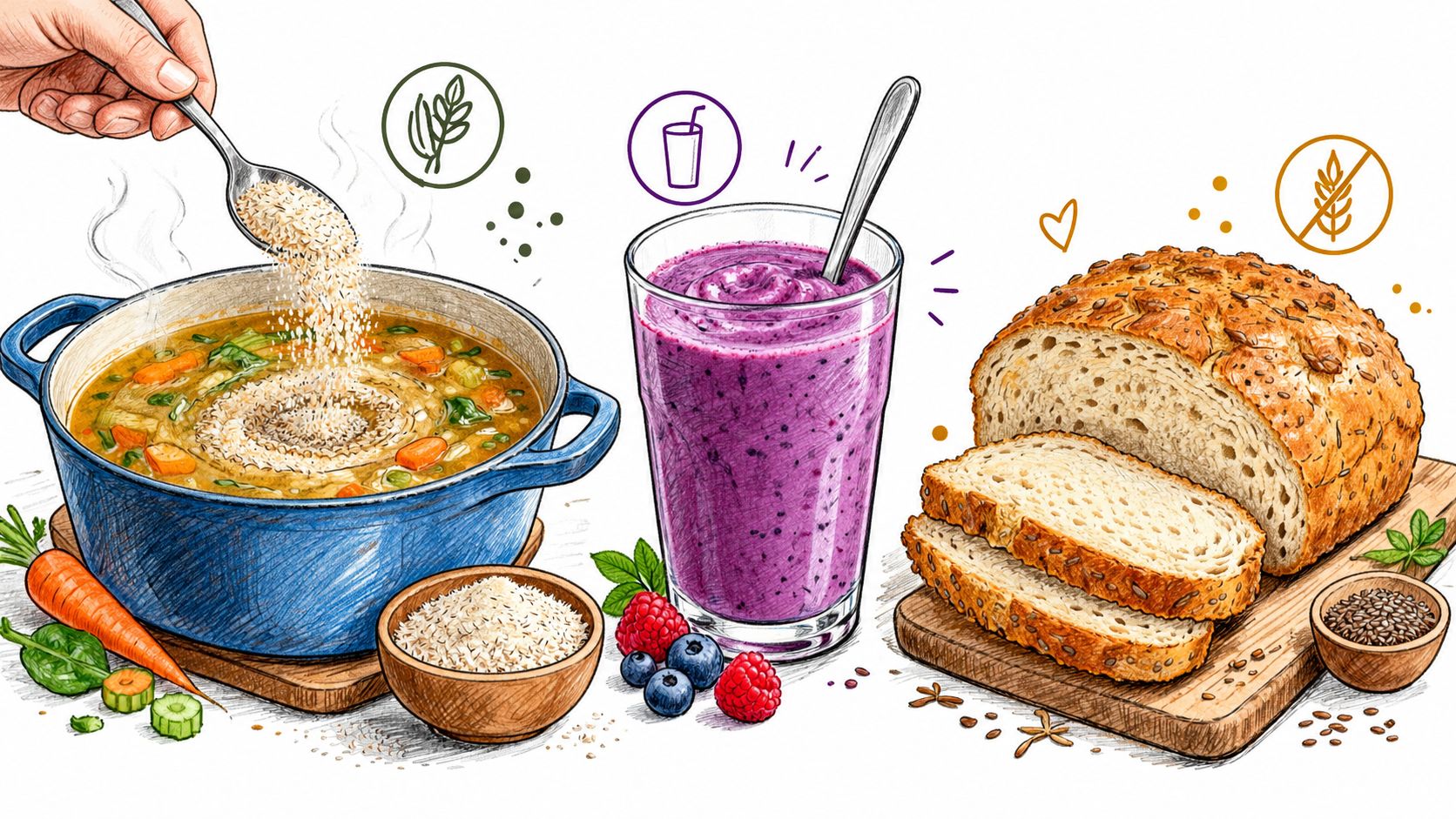
Simple ways to use it
- Porridge: Stir a small amount into finished porridge, then add extra milk or water if the texture becomes too thick.
- Smoothies: Blend it with enough liquid and drink promptly. Powder may disappear more smoothly, while whole husk can leave a lightly textured finish.
- Soup: Whisk a little into a vegetable soup near the end of cooking. Add it gradually because the liquid will thicken as it stands.
- Gluten-free bread: Follow a tested recipe rather than adding psyllium by guesswork. The liquid balance is central to the loaf's texture.
- High-fibre or lower-carbohydrate baking: Use the form specified by the recipe. Whole husk and powder can produce different thicknesses even when the stated spoon measure looks similar.
Hydration before mixing is especially useful in baking. If a recipe tells you to combine psyllium with water and allow a gel to form, don't skip that step. It distributes the binding effect more evenly and reduces dry pockets in the dough.
Kitchen use also highlights an important distinction. You can judge a recipe by whether it slices cleanly, holds together and tastes pleasant. You can't use a successful loaf as proof that a particular supplement dose is suitable for your digestion. Food texture and physiological tolerance are related through the gel property, but they aren't the same test.
Choosing Storing and Using Whole Psyllium Husk Wisely
A good choice starts with the label. Check the fibre amount per serving, serving size, mixing directions and warnings about medicines, swallowing or age. The package should also make clear whether its scoop refers to whole husk or powder, since the same spoon measure can behave differently in water and recipes.
Choose the format that matches how you will use it. Whole husk leaves visible flakes and a more textured drink, while powder blends more evenly into a smooth drink or batter. A bulk pouch suits regular use in drinks and cooking. A smaller pack may be more practical while you test your tolerance or use psyllium only occasionally. Capsules can be convenient, but compare the fibre provided per serving rather than the number of capsules.
A practical buying checklist
- Choose whole husk for visible texture and flexible use in drinks or baking.
- Choose powder when smooth blending and even distribution matter.
- Check the serving basis, because a scoop, teaspoon and gram measurement are not automatically equivalent.
- Follow the water instructions for the product and mix it promptly.
- Avoid dry swallowing. If you take medicines, ask a pharmacist how to space them safely.
Whole husk stores well in a cool, dry place with the container tightly closed. Moisture can create clumps before mixing. Use a clean, dry spoon, and follow the product's date and storage instructions.
For a UK shopping option focused on this ingredient, review Digestamax Psyllium Husk. Whether you choose it or another product, treat psyllium as a repeatable addition to a varied diet, not a quick answer to every digestive problem.
Vitamin Planet sells psyllium products alongside vitamins, minerals, dietary supplements, sports nutrition and pantry goods. Visit Vitamin Planet to compare whole husk and other products, following each item's preparation and safety guidance.