

Whey Isolate Protein Powder: A UK Buyer's Guide
You're standing in a UK supermarket or scrolling through an online supplement shop, comparing tubs labelled whey isolate, concentrate, hydrolysate and vegan blend. Each one promises easy protein, better recovery or a leaner diet. The confusing part isn't finding a powder. It's deciding whether the extra processing and higher price solve a problem you have.
Whey isolate protein powder can be useful, especially if you're limiting lactose, watching the calories that come from a shake, or need a convenient way to raise protein intake. But “isolate” doesn't automatically mean necessary, superior in every situation, or accurately labelled. This guide explains how whey isolate is made, how it compares with other proteins, how to calculate your own need, and what UK shoppers can check before buying.
Table of Contents
- Why Protein Aisles Feel So Confusing
- What Whey Isolate Actually Is
- Isolate vs Concentrate vs Other Proteins
- Do You Need Whey Isolate?
- Timing Dosing and Real-World Use
- Reading Labels and Trusting the Protein Number
- Your UK Buying Checklist and FAQs
Why Protein Aisles Feel So Confusing
The shopper in front of the protein shelf usually starts with a simple goal: buy something that helps support training. Then the labels multiply. One tub highlights “pure isolate”, another emphasises slow-release casein, and a third combines pea and rice proteins. Flavours, sweeteners, serving sizes and claims compete for attention before you've even reached the nutrition panel.
The most important distinction is less dramatic than the packaging suggests. Whey isolate is a more filtered form of whey, so it generally provides a greater concentration of protein and less lactose and fat than less-processed whey. That can matter to someone who gets digestive symptoms from lactose or wants a compact protein serving. It may matter much less to someone who tolerates milk and already gets enough protein from food.
Your first question shouldn't be “Which tub has the most impressive wording?” Ask, “What gap am I trying to fill?” The answer might be a genuine shortfall in your daily intake, a practical breakfast replacement when time is tight, or a preference for a lighter shake. It might also be that you don't need powder at all.
The three decisions behind a sensible purchase
Start with your daily protein target, based on body weight, training and normal meals. Next, consider tolerance. A person with lactose sensitivity may value isolate's lower lactose content more than a person who drinks milk without difficulty. Finally, assess whether the label gives you enough information to judge the product rather than relying on words such as “premium”, “clean” or “advanced”.
That last step deserves more attention in the UK. A protein percentage printed on a tub is useful, but it isn't the whole quality assessment. Ingredient transparency, allergen information, testing evidence and the amount of protein per 100 g all help you compare products more fairly.
The right protein powder is the one that fills a real dietary or practical gap, not the one with the most persuasive front label.
The sections ahead follow that order. First, you'll see what the filtering process changes. Then you'll compare isolate with concentrate, casein and plant proteins, calculate whether you need supplementation, and finish with a UK-focused label checklist.
What Whey Isolate Actually Is
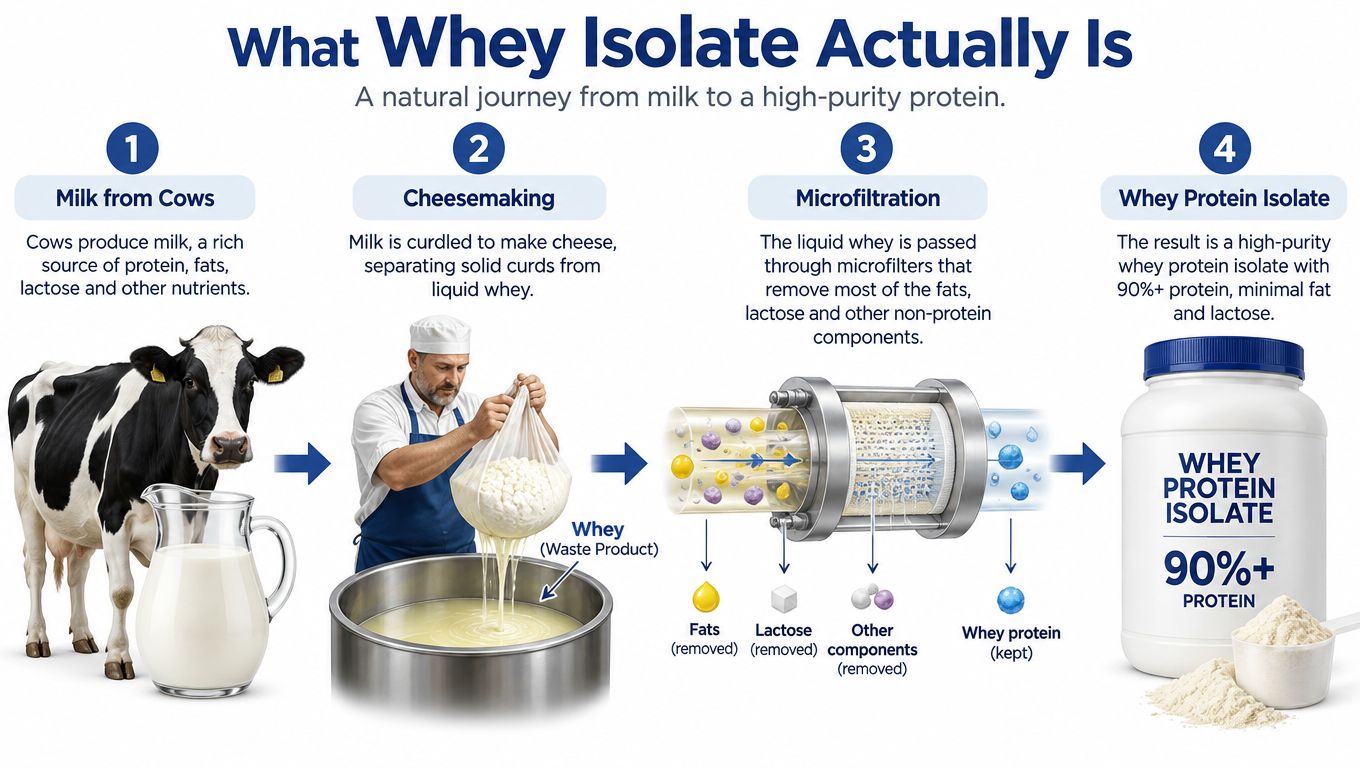
Whey begins with milk. During cheesemaking, milk separates into solid curds and a watery liquid. The curds become the basis of cheese, while the liquid is whey. Manufacturers then process that liquid to concentrate its useful protein.
It is like filtering muddy water through progressively finer screens. The first screen removes larger unwanted material. A later screen removes more of the fat, lactose and mineral content. The remaining powder contains a higher share of protein by weight than the original whey liquid.
What the extra filtering changes
Whey concentrate retains more of the components naturally present in whey. The exact composition varies by product, but it usually contains more lactose and fat than isolate. Whey isolate undergoes further filtration, leaving a powder with a higher protein concentration and very little lactose compared with concentrate.
That difference shows up in ordinary use. Add isolate to porridge and you may get a protein boost without adding as much powder. Mix it with water after the gym and it often produces a lighter drink with less of the milky taste associated with some concentrates. The result still depends on the recipe, sweeteners and manufacturing method, so “isolate” isn't a guarantee of a particular flavour or texture.
Some people confuse isolate with hydrolysate. Hydrolysed whey has been broken into smaller protein fragments through additional processing. It's a separate processing choice, not just a more concentrated version of isolate. Casein is different again. It's another milk protein that digests more slowly and tends to produce a thicker texture.
A simple smoothie illustrates the difference. An isolate can supply concentrated dairy protein alongside fruit or milk. A vegan blend uses plant sources, often combining ingredients to create a broader amino-acid profile. Neither option turns a smoothie into a complete diet, and neither removes the need to consider your total intake.
If you prefer a non-protein addition to a smoothie, Biona Tart Cherry Juice - 200ml is described as organic, not from concentrate, free from added sugar and suitable for vegan diets. It's a juice ingredient, not a protein source, so it shouldn't be treated as a substitute for a protein serving.
The key distinction: “Isolate” describes how whey has been processed and concentrated. It doesn't, by itself, tell you whether you need it, whether you'll prefer its taste, or whether the label claim has been independently verified.
Isolate vs Concentrate vs Other Proteins
Choosing a protein becomes easier when you compare the function you need rather than the product category. Isolate prioritises concentration and lower lactose. Concentrate may offer a more economical route to similar everyday protein. Casein suits people who prefer a slower-digesting milk protein, while plant powders provide dairy-free options.
| Protein type | Protein per 100 g | Lactose | Digestion speed | Best for |
|---|---|---|---|---|
| Whey isolate | Usually higher than concentrate, check the label | Very low compared with concentrate, but not automatically zero | Fast | People seeking concentrated protein or lower lactose |
| Whey concentrate | Varies by product and label | More than isolate | Fast | Everyday use where dairy is tolerated and value matters |
| Casein | Varies by product and label | Milk-derived, check the label | Slower | A thicker shake or longer-lasting milk protein |
| Plant protein | Varies by source and blend | Dairy-free | Varies by source and blend | Vegans, people avoiding dairy, or those wanting plant-based variety |
The table avoids pretending that every tub in a category has the same composition. Read the nutrition panel, because serving sizes and formulations differ. For plant proteins, a blend can combine sources with different amino-acid strengths, while a single-source powder may have a different texture and taste.
When isolate earns its place
Isolate's advantages are practical rather than magical. If lactose gives you digestive trouble, a product with very little lactose may be more comfortable than concentrate, although anyone with a milk-protein allergy still needs to avoid dairy-derived whey. If you're controlling calories tightly, the higher protein concentration can make it easier to reach a target without adding as much powder.
It can also be useful when you don't enjoy large meals around training. A shaker in a work bag or gym kit offers a portable option when yoghurt, eggs or a full meal isn't convenient. For a broader discussion of how different powders can fit a weight-management approach, see whey protein for weight loss, while the explanation of how concentrate differs from isolate is covered in this guide to whey protein concentrate.
Concentrate may be the sensible choice if you tolerate dairy, have a flexible calorie budget and want to spend less on extra filtration. Milk, Greek-style yoghurt, eggs or a meal containing beans and grains can also meet the same broad protein objective. A powder is a convenience tool, not a requirement for a successful training plan.
A product such as BrainQuick Brain Support Supplement (30 Capsules) belongs to a different supplement category, described in its product information as a vegetarian vitamin and mineral formula supporting focus and brain function. It shouldn't be used as a comparison product for protein content.
Shop-floor rule: Choose isolate for a specific benefit you value. Choose concentrate, food or a plant option when it meets your target comfortably and suits your tolerance.
Do You Need Whey Isolate?
A UK shopper may already be eating enough protein before opening a tub of premium powder. Population data report average intakes of about 76.0 g per day for adults aged 19 to 64 and 67.0 g per day for adults aged 65 and over. The general Reference Nutrient Intake is 0.75 g per kilogram of body weight per day, according to the British Nutrition Foundation protein guidance. These averages do not describe every person, but they challenge the assumption that the average shopper needs isolate.
Training can raise the target. Guidance for resistance-trained and endurance athletes places daily protein at approximately 1.2 to 2.0 g per kilogram, with around 20 to 25 g of high-quality protein in one feeding occasion providing a useful framework (see above). Your own requirement depends on body weight, training load and the protein already present in your meals.
Calculate the gap, not the fantasy target
Consider a 70 kg office worker who lifts twice a week. Applying the general baseline of 0.75 g per kilogram gives about 52.5 g per day. Meals may already meet or exceed that amount, making a full scoop unnecessary. A half serving, yoghurt, eggs or another protein-containing meal could cover a smaller shortfall.
Now compare that with a 70 kg endurance athlete. The lower end of the training range gives a target of about 84 g per day, while the upper end gives about 140 g. The athlete should estimate protein from ordinary meals first, then address only the remaining difference. Isolate is one option alongside concentrate, milk, yoghurt, eggs or a plant blend.
These calculations illustrate a method rather than prescribing one serving for everyone. Someone with a medical condition affecting kidney or liver function should seek individual advice instead of applying a generic sports target. Dairy tolerance also changes the choice. People who struggle with lactose may prefer a product described in whey protein lactose-free guidance, while those who digest dairy comfortably may have no reason to pay for extra filtration.
When isolate is useful
Isolate suits a specific combination of needs:
- A measured shortfall: Meals consistently fall below your training target.
- Lactose sensitivity: You tolerate some dairy but want less lactose, remembering that whey remains milk-derived.
- A tight calorie budget: You want a concentrated serving with little additional carbohydrate or fat.
- Limited preparation time: A shake helps you avoid skipping protein when whole food is impractical.
A product such as METABURN 60 Capsules is marketed as a thermogenic weight-management formula. It does not replace protein from food or powder, so it should not affect the calculation. Choose isolate when its filtration, lactose profile or convenience solves a clear problem. Otherwise, concentrate or ordinary food may meet the same target.
Timing Dosing and Real-World Use
Protein timing is often presented as a narrow post-workout deadline. A more useful approach is to place protein where it helps you meet the daily total. A shake after training can be convenient, but breakfast, a gap between meals or a busy commute can be just as practical if those are the moments when your diet tends to fall short.
For a trained athlete, the daily range of approximately 1.2 to 2.0 g per kilogram of body weight and feeding occasions of around 20 to 25 g of high-quality protein provide a useful framework (British Nutrition Foundation protein guidance). The exact amount from powder depends on the protein already present in meals and the product's nutrition panel.
Two routines with different purposes
A strength athlete might eat a protein-rich breakfast, have lunch containing a substantial serving of protein, use isolate after an evening session and finish with a normal dinner. The shake fills a timing and convenience gap. It doesn't need to be treated as a special recovery medicine, and adding more powder won't compensate for inadequate sleep, energy intake or training structure.
Someone managing weight might use a measured serving in porridge or a smoothie at breakfast, especially if mornings otherwise contain little protein. The benefit is consistency and convenience. The drink still contributes calories, so it belongs in the day's overall intake rather than sitting invisibly on top of it.
If body-composition monitoring is part of a longer-term plan, a Manchester DEXA scan can provide a separate assessment of body composition. It doesn't determine your protein requirement, but it may be relevant to people tracking changes alongside training and nutrition.
Make the powder fit Monday morning
- Shaker: Use water or milk, then shake until the powder disperses. A colder liquid may make the drink more refreshing, while milk usually makes it richer.
- Porridge: Stir powder in after cooking, when the oats have cooled slightly, to reduce clumping.
- Smoothie: Blend isolate with fruit, yoghurt or a suitable milk alternative. Remember that additions change the total energy and nutrient content.
- Between meals: Use a serving when work, travel or training makes a normal protein food impractical.
Isolate often mixes cleanly because of its processing, but texture depends on the formula, flavouring and liquid. Check the allergen panel carefully. Whey is made from milk, so it isn't suitable for a milk-protein allergy, and lower lactose doesn't guarantee that every person with lactose intolerance will tolerate every product.
For a broader explanation of daily targets and practical calculation, use this guide on how much protein you need per day. People with kidney or liver disease, pregnancy, breastfeeding or complex medical needs should obtain an individual target from a qualified healthcare professional.
Reading Labels and Trusting the Protein Number
You are comparing two tubs in a UK shop. Both display a large protein percentage, yet one gives little detail about its ingredients or testing. The front label can look precise while leaving unanswered questions about how the number was calculated and whether the stated amount reflects intact protein. That does not make every product unreliable. It means the headline percentage should be one check among several.
A 2025 UK product survey tested 41 protein supplements. After accounting for rounding and analytical uncertainty, 11 products, or 27%, contained less protein than their label claim, while 73% met or exceeded the stated claim (2025 UK protein supplement product survey). The survey also examined protein spiking, in which cheaper nitrogen-containing ingredients or free amino acids can make measured protein appear higher.
What protein spiking means
Tests estimate protein from nitrogen, so added amino acids can inflate the measured figure. The result may suggest more complete protein than the shopper expects from the formula.
Read past the large number on the front. Compare protein per serving and per 100 g, inspect the complete ingredient list, and look for declared amino-acid additions. A high percentage alone cannot confirm that the powder contains the type and amount of protein you want.
A practical UK label check
- Protein quantity: Compare protein per 100 g as well as per serving. Serving sizes can make similar formulas appear substantially different.
- Ingredient disclosure: Look for a complete list, including added amino acids or other nitrogen-containing ingredients.
- Testing evidence: Check whether the manufacturer provides batch testing or a certificate naming the product and explaining the test details.
- Allergens: Confirm the milk declaration and other allergen information, especially if you have an intolerance or allergy.
- Responsible business: Identify who manufactures, imports or sells the product, and look for clear compliance information.
A label is like a recipe card. The protein percentage gives you the headline, while the serving size and ingredient list show how that result is assembled. Testing evidence adds another layer, although shoppers cannot personally confirm every laboratory result.
UK supplements are regulated as foods rather than pre-approved medicines. Responsibility for compliance rests with manufacturers, importers and retailers (WeTestYouTrust 2025 UK survey). That framework makes practical scrutiny useful before paying a premium. Ask what the serving contains, whether additions are disclosed, and whether testing information can be checked.
A strong label is specific: it states the protein per serving, identifies allergens, discloses additions and gives you a realistic way to assess testing.
Your UK Buying Checklist and FAQs
A sensible buying decision follows four questions. What protein target are you trying to reach? How does your body respond to dairy? Does the product fit your budget and daily routine? What evidence supports the number on the label? Answer those before comparing flavours.
Save this checklist for your next shop:
- Calculate the gap: Estimate protein from ordinary meals before choosing a serving size.
- Check tolerance: Look for milk and lactose information, and avoid whey if you have a milk-protein allergy.
- Compare fairly: Review protein per 100 g, serving size, ingredients and total calories.
- Question the claim: Look for disclosed amino-acid additions, batch testing or a certificate.
- Match the format: Choose a powder you will use in porridge, a shaker or a smoothie.
- Keep food central: Use powder to support a varied diet, not to replace every protein-containing meal.
UK shoppers who prefer one retailer for several categories can also compare sports nutrition with other wellness products through a UK-based online retailer such as Vitamin Planet, which lists whey and vegan proteins alongside vitamins and everyday health essentials. The retailer ships from London using tracked domestic delivery, according to the publisher information supplied for this guide.
Is whey isolate suitable for vegetarians?
Yes, whey comes from milk and can fit a vegetarian diet, provided the product's ingredients and the individual's dietary choices allow dairy. It isn't vegan, and a milk-protein allergy is a reason to avoid it regardless of whether lactose is low.
Is whey isolate safe for teenagers?
Teenagers should prioritise regular meals, adequate energy and guidance from a parent, doctor or qualified sports dietitian rather than treating protein powder as essential. A professional can assess growth, training demands, allergies and the overall diet before recommending a supplement.
Can isolate fit a weight-loss plan?
It can, when it helps you meet protein needs within your overall calorie intake and replaces a less suitable convenience food rather than being added on top of meals. Measure the serving and consider the complete shake, including milk, fruit, oats and other ingredients.
Is isolate always better than concentrate?
No. Isolate may be preferable for lower lactose or a more concentrated serving, while concentrate can suit someone who tolerates dairy and values a simpler, potentially more economical option. The better choice is the one that meets your target, agrees with your digestion and has a label you can evaluate.
Vitamin Planet offers whey and vegan sports-nutrition products alongside vitamins, minerals and everyday health essentials, giving UK shoppers a way to compare protein options within a wider wellness order. Visit Vitamin Planet with your protein target and label checklist ready, then choose the format that fits your diet, tolerance and routine.