

Weight Loss Supplements for Women: What the Evidence Shows
In Great Britain, 2.9% of adults, approximately 1.6 million people, reported using a GLP-1 or GLP-1/GIP medicine to support weight loss during the previous year, according to a population study published in BMC Medicine (the study of GLP-1 use in Great Britain). That figure is about prescription medicines, not supplements. It's a useful reminder that weight-management products are not all alike: a capsule sold over the counter isn't equivalent to a medicine prescribed and monitored by a clinician.
For women comparing products, the key question isn't whether an ingredient has a plausible effect in the body. It's how much difference it makes in practice, compared with a placebo, and whether the product's claims are permitted in the UK. Most supplements offer modest or uncertain support. None should be treated as a substitute for medical advice, a suitable eating pattern or activity that you can maintain.
Table of Contents
- Which Weight Loss Ingredients Have Real Evidence
- How These Ingredients Work and Why Effects Stay Small
- UK Rules That Separate Supplements from Medicines
- How to Choose by Goal, Age and Health
- Side Effects, Interactions and Who Should Check First
- Confirm a Clinician Check Before You Buy
Which Weight Loss Ingredients Have Real Evidence
Trials that compare an ingredient with placebo usually find differences of a kilogram or less over several weeks, and many find no clear difference at all. That scale matters more than the mechanism on the label. The table below ranks common ingredients by that practical difference and by UK claim status.
| Ingredient | Confirmed finding, then uncertainty | Typical difference against placebo | UK status |
|---|---|---|---|
| Glucomannan (konjac fibre) | Has an authorised claim; trial effects are small and depend on diet | Small extra loss in energy-restricted trials, often under 1 kg | Authorised conditional claim, only with at least 1 g per quantified portion and an energy-restricted diet |
| Psyllium husk (soluble fibre) | Improves fullness in some studies; independent weight effect is hard to isolate | Little to no sustained weight difference | Food supplement; no authorised weight-loss claim |
| Caffeine | Raises energy use briefly; tolerance reduces the effect with regular use | Short term change only, then fades | Stimulant; weight-loss claims aren't allowed in marketing |
| Green tea extract (catechins) | Trial results are inconsistent; concentrated doses raise liver concerns | Small and variable, often near zero | Food supplement; no authorised weight-loss claim |
| Berberine | Shows small changes in weight and blood sugar in limited trials; interacts with medicines | Small average change, evidence base is limited | Food supplement; not authorised for weight loss |
| Chromium picolinate | Shows no consistent weight effect across trials | No reliable difference | Food supplement; no authorised weight-loss claim |
| Raspberry ketones | Lacks credible human trials for fat loss | No established difference in people | Weight-loss claims rejected for insufficient evidence |
| Garcinia cambogia (HCA) | Produces inconsistent results; rare liver injury reports warrant caution | Inconsistent, average change is minimal | Not authorised for weight loss |
Glucomannan stands out because the permission is narrow. The UK-authorised glucomannan health-claim conditions set the dose at 3 g a day, split into three 1 g doses with water before meals, alongside an energy-restricted diet with at least 1 g per quantified portion. The permission covers weight loss as part of that diet. It does not promise a rate or amount.
Products such as METABURN 60 Capsules are described as a premium thermogenic fat-burning supplement, but a product description does not establish that a formula will deliver a particular amount of weight loss.
Use the table to judge what an ingredient can and cannot promise. A clinician check is sensible when medicines, pregnancy or a health condition are involved, since even a small average effect comes with trade offs for some people.
How These Ingredients Work and Why Effects Stay Small
Each ingredient makes a testable promise. The question is how many extra kilograms it removes compared with placebo, and for how long.
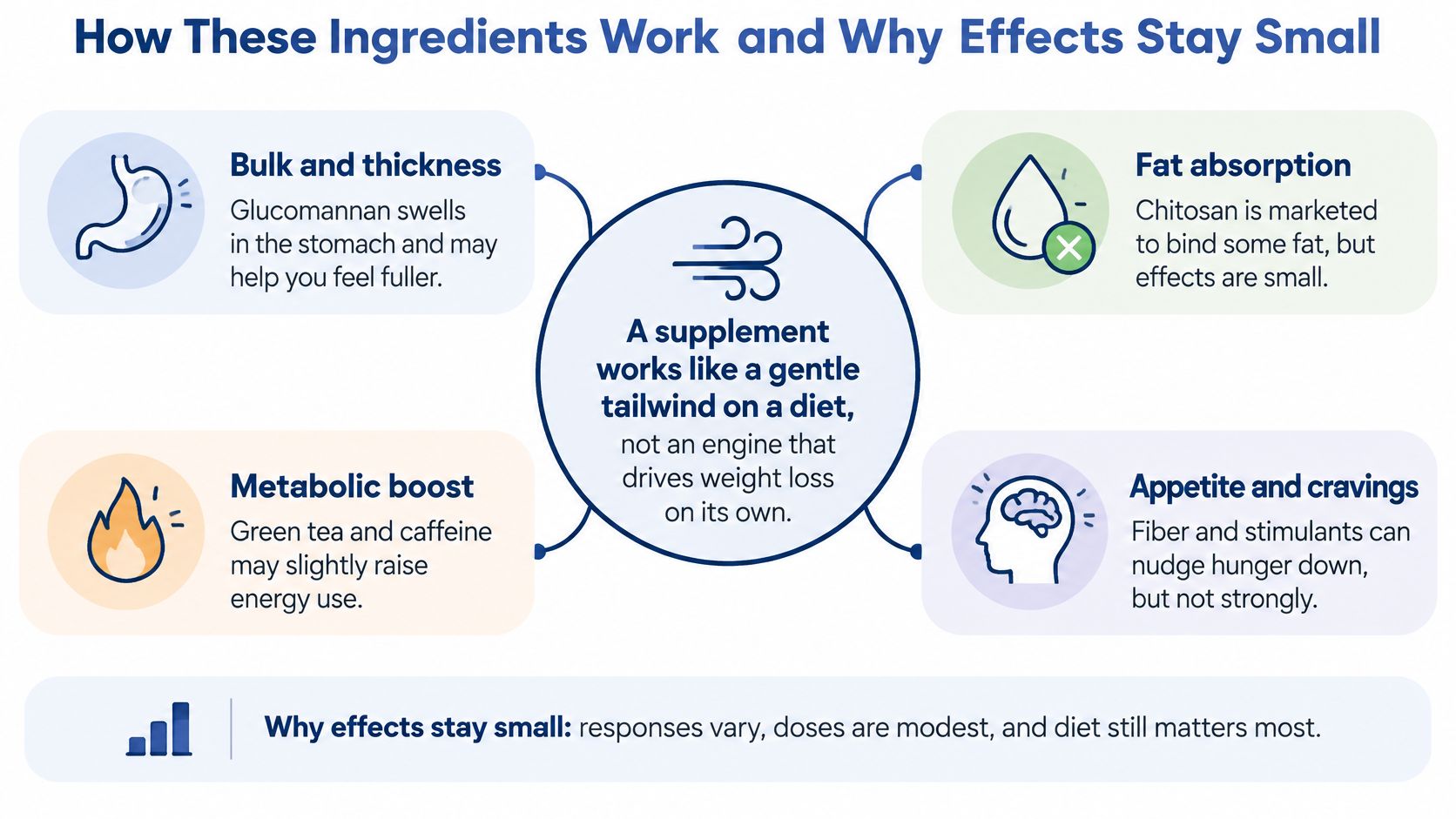
Bulk and thickness: Glucomannan swells in the stomach and adds bulk, which can make a meal feel more filling. That fullness still has to survive contact with snacks, portion sizes and weekends. Over weeks, many people compensate by eating a little more later, so early fullness does not always become lower total intake. Psyllium adds soluble fibre in a similar way, with no established independent fat-loss effect.
Stimulation: Caffeine raises alertness and raises short term energy use while it can dull appetite for a few hours. Tolerance builds with regular use, so the appetite effect fades. Higher doses increase the chance of jitteriness, a racing heart and broken sleep, which makes training and food choices harder the next day.
Metabolic action: Green tea catechins produce a small rise in energy expenditure in trials. Berberine acts on glucose pathways studied in metabolic research. A measurable biological effect is still different from a visible result, because daily shifts in food, drink and movement are larger than the ingredient effect and can hide it completely.
No reliable route to a proven outcome: Raspberry ketones and many multi-ingredient blends use biological language in marketing without showing dependable weight loss in people. UK advertising guidance says unauthorised supplements should not make medicinal claims such as “decrease appetite”, “burn fat” or “speed up metabolism”, and notes that convincing evidence for unlicensed slimming products is lacking (the ASA's guidance on weight-control products).
Ask what changes against a placebo
When a product promises “metabolism support”, ask what the phrase means in measurable terms:
- How many kilograms did people lose compared with a placebo?
- Over how many weeks or months?
- Were the results seen with the dose and formulation on this label?
Those questions separate a plausible mechanism from a meaningful outcome. If a label cannot answer them, the product sells the idea of an effect. Food choices and daily activity set the result. For practical ideas on meals and routines, see this guide to diet and nutrition.
The short video below walks through why small trial effects often disappear outside a controlled diet.
UK Rules That Separate Supplements from Medicines
A food supplement and a medicine are different kinds of product, even when both are marketed for weight management. Supplements aren't medicines and can't claim to prevent, treat or cure disease. Products must not be taken above the dose on their label. The UK government's consumer guidance on food supplements also advises people who are pregnant, breastfeeding, taking prescription medicines or managing a medical condition to consult a healthcare professional before use.
A product's wording matters. Claims that it suppresses appetite, burns fat, speeds up metabolism or treats obesity may put it on the medicinal side of the boundary if its action is pharmacological or metabolic. A seller can't make a product an ordinary food supplement by calling it “natural”.
A practical label check
Use this routine whenever you're comparing products online or in a shop:
- Find the amount of each active ingredient per serving. A list of ingredients without individual amounts makes comparison difficult.
- Check the directions and maximum daily dose. Consider how many servings you'd take in a day, not just the amount in one capsule.
- Read the warnings. Look for advice about medicines, pregnancy, breastfeeding and health conditions.
- Check what the product claims to do. A permitted claim has specific conditions. For glucomannan, that includes taking it within an energy-restricted diet and providing at least 1 g per quantified portion.
Phrases such as “fat burner”, “detox in three days”, “lose weight without changing your diet” and promises of a specific number of kilograms are reasons to be sceptical. The same applies when a product's website gives a dramatic result but the label leaves the ingredient amounts unclear.
Retailers should describe supplements with accurate ingredient and dosage information and avoid claims that imply a product is a medicine. For you as a shopper, the practical question is simple: does the label tell you what's in the product and what it's permitted to claim? If not, don't rely on marketing language to fill the gaps.
How to Choose by Goal, Age and Health
Don't start with the most popular ingredient. Start with what you need, what you tolerate and whether a supplement is suitable for your circumstances. This four-step check can help narrow the options without turning a single product into a weight-loss plan.
Match the option to your routine
Start with tolerance. If caffeine makes you feel jittery, disrupts your sleep or leaves you uncomfortable, skip stimulant-based products and energy blends. A product with a clear, single-ingredient label is easier to assess than a stack of ingredients with unclear amounts.
Think about how you eat. Glucomannan is relevant only alongside an energy-restricted diet, and it needs to be taken with water according to its directions. Psyllium may be worth considering if your diet is low in fibre, but it's a fibre supplement, not a fat burner. Increase dietary fibre through foods as well, and follow the product instructions for taking it safely.
Consider life stage and changes in weight. In younger adults, a clinician can help identify whether a change in weight is connected to health, medication or daily routines. Perimenopause and conditions such as polycystic ovary syndrome can also be reasons to discuss weight changes with a GP rather than trying to manage them with a supplement alone. If you're looking for age-specific medical context, this resource on weight loss guidance for older women may help you prepare questions for a clinician.
Check the format and ingredients. If you're vegetarian or vegan, read the label for capsule shells and other ingredients, not just the active compound. Avoid combining several weight-management products: stacking makes it harder to identify what's causing an unwanted effect and may increase your total exposure to stimulants.
A BMI calculation can be one point of discussion, but it can't decide by itself what approach is right for you. If you want to understand what the number does and doesn't tell you, read this guide to BMI.
Practical rule: Choose for your situation, not for the strongest-sounding promise. The most popular product isn't necessarily the one with the clearest evidence or the best fit for your health.
Side Effects, Interactions and Who Should Check First
A common risk is adding up stimulants without realising it. Caffeine can come from coffee, tea, energy drinks and supplement blends, so check every label rather than considering each product separately. If caffeine affects your sleep, makes you anxious or causes an uncomfortable racing heartbeat, stop using the product and ask a healthcare professional for advice.
Some ingredients also need extra care. Green tea extract in concentrated supplements has been linked with liver damage at high doses. Stop taking a product and seek medical advice if you develop warning signs such as yellowing of the skin, dark urine or unusual tiredness. Glucomannan should be taken with plenty of water, and fibre supplements can affect how some medicines are absorbed if taken at the same time.
Check medicines and health conditions first
Herbal products can interact with prescription medicines. For example, St John's wort can interfere with the combined contraceptive pill and some antidepressants. Berberine may affect blood sugar, so adding it to diabetes medicines could create an additional risk. These are reasons to talk to a GP or pharmacist before buying, rather than trying a product and waiting to see what happens.
| Situation | Main concern | What to do |
|---|---|---|
| Pregnant or breastfeeding | Safety information may be limited and nutrient needs change | Speak to a GP or midwife before taking supplements |
| Taking warfarin or another blood thinner | Herbs and stimulant ingredients may affect treatment or increase risk | Ask your clinician to check the specific product |
| Taking the combined contraceptive pill | St John's wort can reduce its effectiveness | Avoid St John's wort and discuss alternatives |
| Taking antidepressants | Some herbal products may interact with treatment | Check with your prescriber or pharmacist |
| Diabetes or taking metformin or insulin | Berberine or chromium may affect blood sugar | Agree a monitoring plan with your clinician first |
| Thyroid condition | Stimulant or iodine-containing products may not be suitable | Ask for a thyroid review before buying |
| Heart rhythm problems or high blood pressure | Caffeine and other stimulants can be a concern | Seek professional advice before use |
| Perimenopause or polycystic ovary syndrome | Weight changes may need assessment and treatment | Discuss your symptoms and options with a GP |
| Under 18 | Weight management and supplement safety need specific care | Don't start a product without paediatric advice |
People over 65 who take several medicines should also check a new supplement with a pharmacist or clinician. The same applies if you have a diagnosed condition, even if a product is described as gentle or natural. If you're trying a product containing multiple ingredients, consider the full formula rather than assessing only its headline ingredient.
For more on checking common supplement claims and safety questions, see this guide to supplement safety myths and facts. A supplement is not automatically safe because it's sold without a prescription, and a product label can't assess your personal medical history.
Before buying, ask yourself: Are you pregnant, breastfeeding or planning a pregnancy? Are you taking prescription medicines or herbal products? Do you have a diagnosed condition such as diabetes, thyroid disease, heart problems or a hormone disorder? If the answer to any is yes, check with a clinician first.
Confirm a Clinician Check Before You Buy
Small average effects make personal suitability the deciding factor. A product that shows a 1 to 2 kg difference against placebo in trials can still be the wrong choice if it raises blood pressure, irritates the gut or changes how a prescription medicine works.
Use a short appointment to close that gap. Bring the exact label, with ingredient amounts per serving, directions and warnings, plus a list of your conditions. Short sentences help. Ask what interacts, what to monitor and when to stop.
- Check the overlap. “Do any of these ingredients affect my medicines, blood pressure, heart rhythm, blood sugar, thyroid treatment or mood medicines?”
- Ask about alternatives. “Would a structured eating and activity plan, an NHS weight-management service or a prescription option suit me better than this blend?”
- Set a stop rule. “Which symptoms mean I should stop straight away, and how soon should I report palpitations, severe stomach pain, rash or yellowing of the skin?”
Vitamin Planet's Nutritional Research Department evaluates each and every formula. That review describes what is in the bottle. Only a pharmacist or GP can judge how that formula fits your history.
Vitamin Planet offers vitamins, minerals, dietary supplements, sports nutrition and other health essentials, including products for weight management. Browse Vitamin Planet to compare product labels and ingredient details, then check suitability with a healthcare professional before starting a supplement.