

Protein Powder Before or After Workout: A Guide
Immediate pre-workout whey and immediate post-workout whey produced similar short-term muscle amino-acid uptake, about 60 units before resistance exercise and about 63 units after it. An adequate protein serving around the session matters more than the exact minute you drink it.
Popular gym advice still treats the half hour after the last rep as a deadline. Miss it, the story goes, and part of the session was wasted. That stopwatch habit is the wrong starting point for most UK training weeks. The last protein-containing meal, how long and hard you trained, and when the next proper meal arrives decide whether a shake belongs before, after, or not at all.
Table of Contents
- Why the Exact Minute Rarely Decides Results
- Before and After Protein Powder Side by Side
- How Much Protein to Take Around Training
- What the Birmingham Whey Trial Measured
- Choosing a Shake by Meal Gap and Session
- Protein on Long Endurance Sessions
- Set Your Protein Timing Habit
Why the Exact Minute Rarely Decides Results
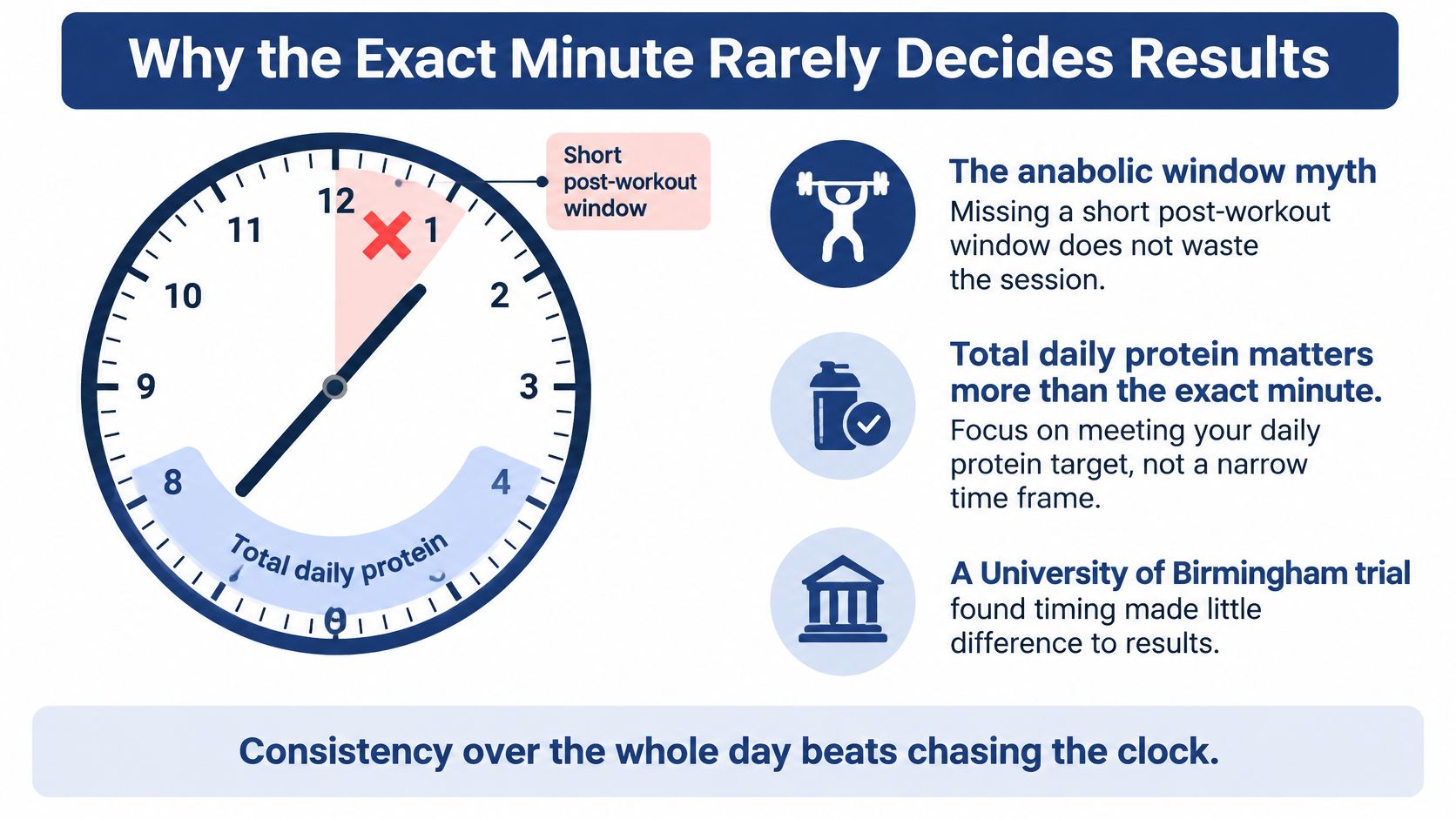
The worry is familiar. You rack the bar, a short post-workout window supposedly opens, and a late shake is said to waste the work. It doesn't.
A serving close to training is still sensible. It is not a rescue mission with a closing time. Muscle keeps responding to protein feedings well beyond the changing-room queue, which is why the exact minute rarely decides the result. Sports nutrition is already ordinary for many younger adults in the UK. In 2025, 75% of UK consumers aged 16–34 used sports-nutrition products, according to Mintel research reported by Asian Trader. The useful question is fit, not whether powder is allowed.
Ignore the stopwatch until three checks are clear.
- Last protein meal: How long has it been since you ate protein, not how many minutes have passed since the last set.
- Session length and demand: A steady hour of weights and a long or repeated bout don't create the same recovery need.
- Next proper meal: If dinner is soon, food can do the job. If the next meal is hours away, a shake covers the hole.
Settle those three, then choose before or after. The clock on the gym wall can wait.
Before and After Protein Powder Side by Side
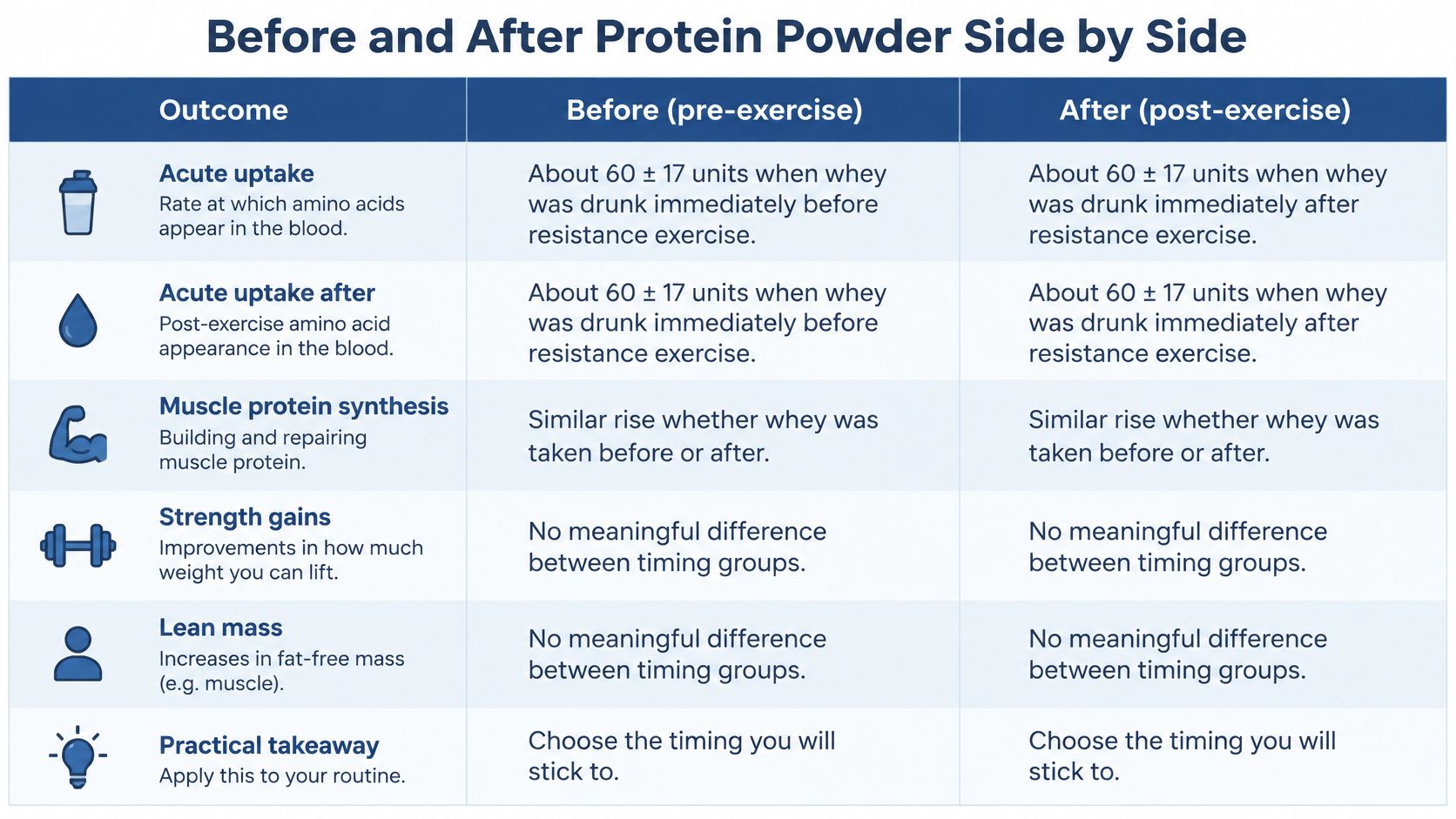
Scan the two timings as alternatives, not as a winner and a loser.
| Criterion | Before the workout | After the workout |
|---|---|---|
| Short-term amino-acid uptake | About 60 ± 17 units | About 63 ± 15 units |
| Best fit | Last meal was several hours earlier | Training finishes before the next meal |
| Typical serving | 15–25 g if covering a meal gap | 15–25 g, or 20–25 g near 80 kg |
| Carbohydrate pairing | Useful when the session will be long | With carbohydrate about 30 minutes to 2 hours later |
| What happens to the protein | Some may be oxidised as fuel | Available for repair after the session |
| If the drink is late | Misses amino acids during training | Still useful for 24 hours, smaller effect if very delayed |
Neither column wins on uptake alone. The gap between those two short-term figures is not a reason to pick a side.
Uptake sits almost level. Drinking whey immediately before resistance exercise and drinking it immediately after both moved the muscle from a negative amino-acid balance into a positive one. Treat that row as a tie.
Best fit is the decision row. Choose before when the previous meal was several hours earlier and you would otherwise train on an empty tank. Choose after when training ends before the next meal and the shake is the bridge.
Serving size for ordinary use sits in the 15–25 g band when the drink is only covering a gap. For an athlete weighing around 80 kg, about 20–25 g of protein after resistance exercise is described as enough for near-maximal stimulation of muscle-protein synthesis in that context, in the practical milestone cited with the BASES expert statement.
Carbohydrate belongs with a long session if you drink before, because the work will draw on fuel. After training, pair protein with carbohydrate in the recovery snack rather than treating the shake as protein only.
Fate of the protein is the quiet difference. Protein taken before or during exercise can still stimulate muscle-protein synthesis, although some of it may be oxidised as fuel while you train. A drink after the session is free for repair.
Delay doesn't erase the serving. The same BASES statement notes that muscle remains responsive to repeated protein feedings for at least 24 hours after resistance exercise, which undercuts the older idea that benefits vanish after only 1–2 hours. Protein close to the end of exercise may augment adaptation and will not impair it. A very late drink can bring a smaller effect, but it still counts.
Circle the column that matches your next meal. Then check the grams in the dose guide below, instead of adding a second shake out of habit.
How Much Protein to Take Around Training
Weigh the serving against the day, not against the clock. UK guidance treats a post-workout portion as recovery management. It does not treat pre-workout protein as a failure.
| Situation | Protein target | How to place it |
|---|---|---|
| Ordinary session, any exerciser | 15–25 g high-quality protein | With carbohydrate about 30 minutes to 2 hours after, or inside the next 24 hours |
| Resistance session near 80 kg | A serving inside that same ordinary band | Place it where the meal gap actually is |
| Larger athlete or repeat sessions | Toward 0.3–0.4 g per kg | More useful after a demanding session |
| Day-long spacing | Protein at each eating occasion | Roughly every 3–5 hours |
| Session under one hour | Regular protein-containing meals first | Don't build the day around a shake |
| 60 kg at 1.6 g/kg example | About 96 g across the day | A 20 g shake only fills a gap |
| 85 kg at 1.8 g/kg example | About 153 g across the day | A 25–30 g shake can cover a real gap |
The British Nutrition Foundation recommends 15–25 g of high-quality protein after exercise, eaten with carbohydrate about 30 minutes to 2 hours later, and spread through the day at roughly 3–5-hour intervals. The British Dietetic Association uses that same 15–25 g added to a post-workout meal or snack to support glycogen storage, reduce soreness and promote muscle repair. That serving can sit at any point in the following 24 hours, with a possibly smaller effect if you delay it.
Scale the serving, then the day
For a larger athlete, or for demanding repeat sessions, move toward 0.3–0.4 g per kg rather than stacking random scoops. A 90 kg lifter at 0.3 g/kg is looking at about 27 g after a hard bout. At 0.4 g/kg that rises toward 36 g. That is a bigger recovery snack, not a second dinner.
Say a 60 kg recreational lifter aims at 1.6 g per kg. That is about 96 g across the day. One 20 g shake is only a gap-filler beside meals. An 85 kg lifter aiming at 1.8 g per kg needs about 153 g. A 25–30 g shake after a long session covers a real hole that toast will not. For the full daily picture, use our guide on how much protein you need per day, and pair the numbers with practical training habits in how to build muscle naturally.
Short sessions
For sessions lasting under an hour, the British Heart Foundation points people back to regular protein-containing meals rather than a pre-versus-post debate. Extra protein after training becomes more useful when the session runs long, especially alongside carbohydrate.
Hit the daily total first, then place one 15–25 g serving in the biggest gap around training.
What the Birmingham Whey Trial Measured
The cleanest head-to-head on this question is a University of Birmingham study published in 2007, not a slogan about a magic window.
Who drank what
Seventeen healthy volunteers were randomly assigned to drink a whey-protein solution immediately before resistance exercise or immediately after it. The pre-exercise group had eight people. The post-exercise group had nine. Both groups did the same style of comparison: one whey drink, placed on one side of the session, with muscle amino-acid balance tracked around that drink.
What changed
In both groups, arterial amino-acid concentrations increased by approximately 50%. Net muscle amino-acid balance changed from negative to positive after the protein was ingested. When uptake was calculated from the moment each drink was consumed, the figures were statistically similar: 60 ± 17 units before training versus 63 ± 15 units after it, as reported in the University of Birmingham whey trial. The researchers found no meaningful advantage for immediate pre-workout whey over immediate post-workout whey in that short-term muscle-protein response.
Use the trial to stop obsessing over minutes. It is not a licence to skip protein for the rest of the day.
What the trial cannot say
This was a small study of acute muscle-protein balance. It did not follow people for months of muscle size or strength. It does not prove that timing never matters. It does undermine treating the exact minute as the main lever.
A pre-workout shake fits when the previous meal was several hours earlier. A post-workout shake is the convenient choice when training finishes before the next meal. Protein taken before or during the session can still stimulate synthesis even if some of it is burned as fuel. Repeated feedings after you leave the gym still do the longer job of adaptation.
The reader rule is simple. Let the trial retire the stopwatch. Then use the size of the daily intake, and the closeness of the next meal, to decide whether a shake is needed at all.
Choosing a Shake by Meal Gap and Session
Protein powder before or after a workout is usually the wrong first question. The British Dietetic Association puts distribution across the whole day first. Athletes generally need about 1.4–2.0 g/kg/day, spread every three to four hours, and adding 15–25 g to a post-workout meal or snack may support glycogen storage, reduce soreness and aid muscle repair at any point in the 24 hours after training, with effects that can decline the longer intake is delayed, according to the BDA sport and exercise nutrition resource. A balanced diet often already supplies enough protein for many exercisers when energy needs are met. Powder earns its place when it covers a gap food will not cover, not when it copies a meal you are about to eat.
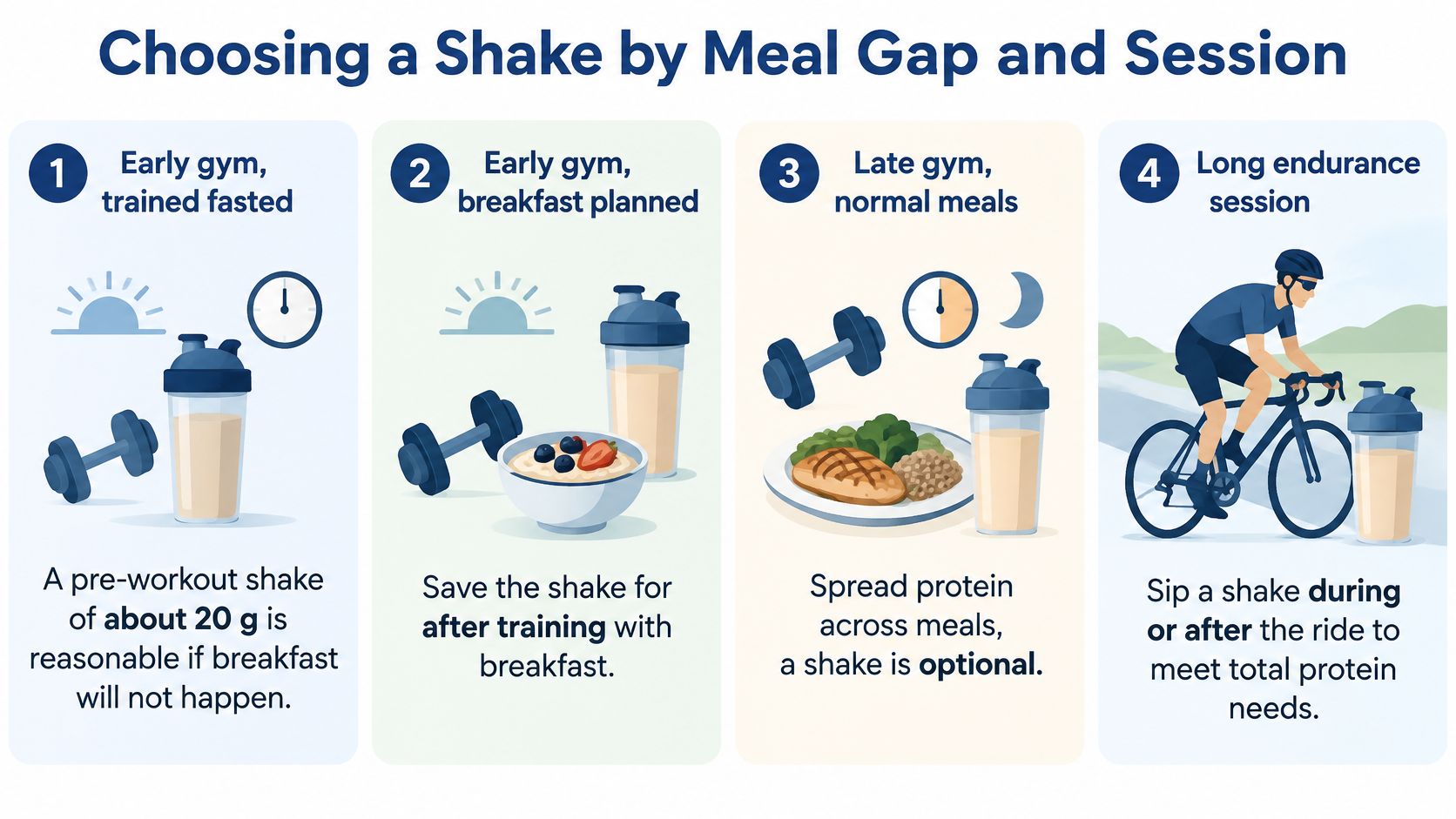
Four UK days
Early gym, trained fasted. No recent protein meal, and breakfast is not happening. A pre-workout shake of about 20 g is reasonable. If appetite is poor at 6am, drink it straight after instead of forcing it down beforehand.
Lunch at 12:30, weights at 18:30, dinner by 20:00. A shake at 18:25 adds little. You ate protein in the early afternoon and another meal is imminent. Eat dinner.
Class ends at 21:30, and the next food would be toast at midnight. Use a 15–25 g post-workout shake as the convenient meal, with carbohydrate, rather than waiting. If you want a fuller pre-session plate on other days, see carbs before a workout.
Two sessions, lunchtime lift and evening team practice. Place a serving after the first session so the gap doesn't stretch past three to four hours. Eat a normal meal after the second.
These four days are resistance or mixed gym sessions. A long ride is a different problem, covered next.
If you ate protein about two hours before training and you can eat again soon, skip the immediate shake.
Protein on Long Endurance Sessions
Most consumer articles assume protein belongs after lifting, then paste that rule onto a four-hour ride. The during-versus-after question for endurance is still open.
A University of Birmingham trial, registered in 2024 and recruiting in the UK from January 2025, is testing whether extra protein during prolonged cycling differs from protein after exercise. A BDA briefing on the registered design sets the comparison at approximately 1.7 versus 1.0 g/kg/day, with muscle-protein synthesis measured across 24 hours that include four hours of cycling. The registered hypothesis is that the higher daily total will raise synthesis, while timing during versus after exercise may not change the response. The work is described as ongoing through 2026. That is an unfinished question, not a result you can quote as proof.
What to do on the bike until then
Carbohydrate stays the fuelling priority on long efforts. Protein is worth considering on rides longer than about two hours when it doesn't upset the stomach or push carbohydrate off the plan. A small serving in a bottle, or a later shake that stands in for the meal you can't face, is a practical choice. It is not a proven advantage for sipping protein all the way round the route.
A post-ride shake is often just a convenient stand-in for the next meal. Chase the daily total and that meal. Carry protein during the ride only if it helps you eat enough without spoiling carbohydrate intake.
Don't copy this unfinished endurance question back onto a 45-minute weights session. The before-versus-after whey comparison for resistance work already covers that shorter bout.
Set Your Protein Timing Habit
Lock one pattern for a normal week. Don't reopen the choice before every session.
- List the week's sessions. Mark a shake only for a real food gap: fasted training, a next meal several hours after you finish, or a second session the same day.
- For each mark, plan one ordinary serving in the 15–25 g band. Take it before training when the last protein meal was several hours earlier, and after training when the session ends before the next meal.
- On a long session or a two-session day, pair that serving with carbohydrate in the recovery snack, using the span of about 30 minutes to 2 hours after training when the shake stands in for food.
- Leave a session unmarked when protein was eaten about two hours beforehand and another meal follows soon. Use ordinary meals for a session under one hour.
- Write it in diary language. A shake after Tuesday's late class. No shake after Saturday morning lifting, because brunch follows.
- Keep the day inside the athlete range, spread every three to four hours. The lighter lifter's 20 g shake only fills a hole. It doesn't replace the meals.
When food can't cover a marked gap, a whey or vegan protein from Vitamin Planet is a straightforward serving. Pick the format you will finish. Score the week by the daily total, not by the minutes after the last rep. Recovery still depends on sleep, the next meal and the rest of the week, which is why these tips to maximise muscle recovery sit beside the shake, not instead of it.
Vitamin Planet supplies vitamins, nutritional supplements, whole foods, health foods and sports nutrition, including whey and vegan proteins you can use around training. The range runs to over 10,000 products, from snacks to vitamins and sports nutrition, so a shake can sit in the same order as the rest of the week's food. Visit Vitamin Planet and choose the protein format you will finish on the days a meal gap is real.