

Magnesium Supplement Gummies: UK Buyer's Guide 2026
Monthly interest in magnesium has grown so sharply that many shoppers now meet it first as a fruit flavoured chew, not as a tablet. That's understandable, but it creates a quiet trap. You can count the gummies in a jar easily, yet still have no idea how much magnesium you're really taking, or whether the product's been checked like a medicine.
Think of magnesium supplement gummies as a delivery format, not a separate nutrient. Once you learn to read elemental magnesium per serving, add up everything else you take, and verify the pack beyond its front label, the choice becomes much clearer.
Table of Contents
- How Much Magnesium a Gummy Really Delivers
- Magnesium Forms Used in Gummies and How They Compare
- Gummies Versus Tablets and Capsules
- Sugar, Calories and Sweeteners Explained
- Kidney Risk and Medicine Interactions to Check First
- How to Start and Adjust Your Gummy Dose
- How to Check a Gummy's Quality Beyond the Label
- Deciding Whether Magnesium Gummies Suit Your Routine
How Much Magnesium a Gummy Really Delivers
In 2024, monthly UK searches for magnesium reached 3.3 million, an increase of more than 480,000 searches from 2023, according to Grocery Trader reporting on UK magnesium search growth. Popularity explains the crowded shelves. It doesn't tell you whether a particular gummy covers a useful part of your day.
Start with one rule. A gummy is just a way of delivering magnesium toward an existing requirement. The figure that matters is elemental magnesium per recommended daily serving, compared with what you already get from food and other products. Two gummies can look identical and deliver very different amounts, and a gummy may contain substantially less magnesium per serving than a tablet or powder.
The UK Figures to Put Beside the Label
NHS guidance on vitamins and minerals including magnesium targets states that men aged 19 to 64 generally need 300 mg a day and women aged 19 to 64 need 270 mg a day. It also says a varied, balanced diet should normally provide enough, with sources including leafy green vegetables, nuts, wholegrain products, beans and lentils.
For supplements, that guidance gives a practical boundary of 400 mg or less per day, described as unlikely to cause harm for the majority of adults. Doses above 400 mg in the short term can cause diarrhoea, and there isn't enough evidence to establish the effects of high supplemental doses over longer periods.
UK daily magnesium figures and what they mean for a gummy
| Group or limit | Magnesium figure | What it means for a gummy label |
|---|---|---|
| Men aged 19 to 64 | 300 mg a day | Total target from food and supplements combined |
| Women aged 19 to 64 | 270 mg a day | Total target from food and supplements combined |
| Supplement level unlikely to harm most adults | 400 mg a day or less | Ceiling for supplemental magnesium without medical advice |
| Short-term dose above 400 mg | Can cause diarrhoea | Reduce servings if loose stools appear |
A Worked Example You Can Copy
Suppose a label declares 100 mg of elemental magnesium per gummy and suggests two a day. That's 200 mg from the supplement, not 100 mg and not whatever larger number describes the whole magnesium compound. For a man aiming at roughly 300 mg in total, about 100 mg would still need to come from food.
Practical rule: Multiply the elemental figure by the servings you'll actually take, then add food and every other magnesium containing product before you judge strength.
Your first action, before comparing flavours or prices, is to total your day. Only then can you tell whether a gummy fills a small gap, covers most of the target, or pushes supplemental intake higher than you intended.
Magnesium Forms Used in Gummies and How They Compare
The number beside a magnesium compound is not always the amount of magnesium your body receives. The magnesium salt is the full compound, while elemental magnesium is the magnesium within it. Like flour inside a bag, the useful amount can be smaller than the package weight. Compare gummies by elemental magnesium per serving, then add that amount to magnesium from your other supplements.
The form can also affect absorption and digestive tolerance. Human comparisons vary in dose and design, so evidence does not establish that one form suits everyone. For more detail on glycinate, see this guide to what magnesium glycinate is used for.
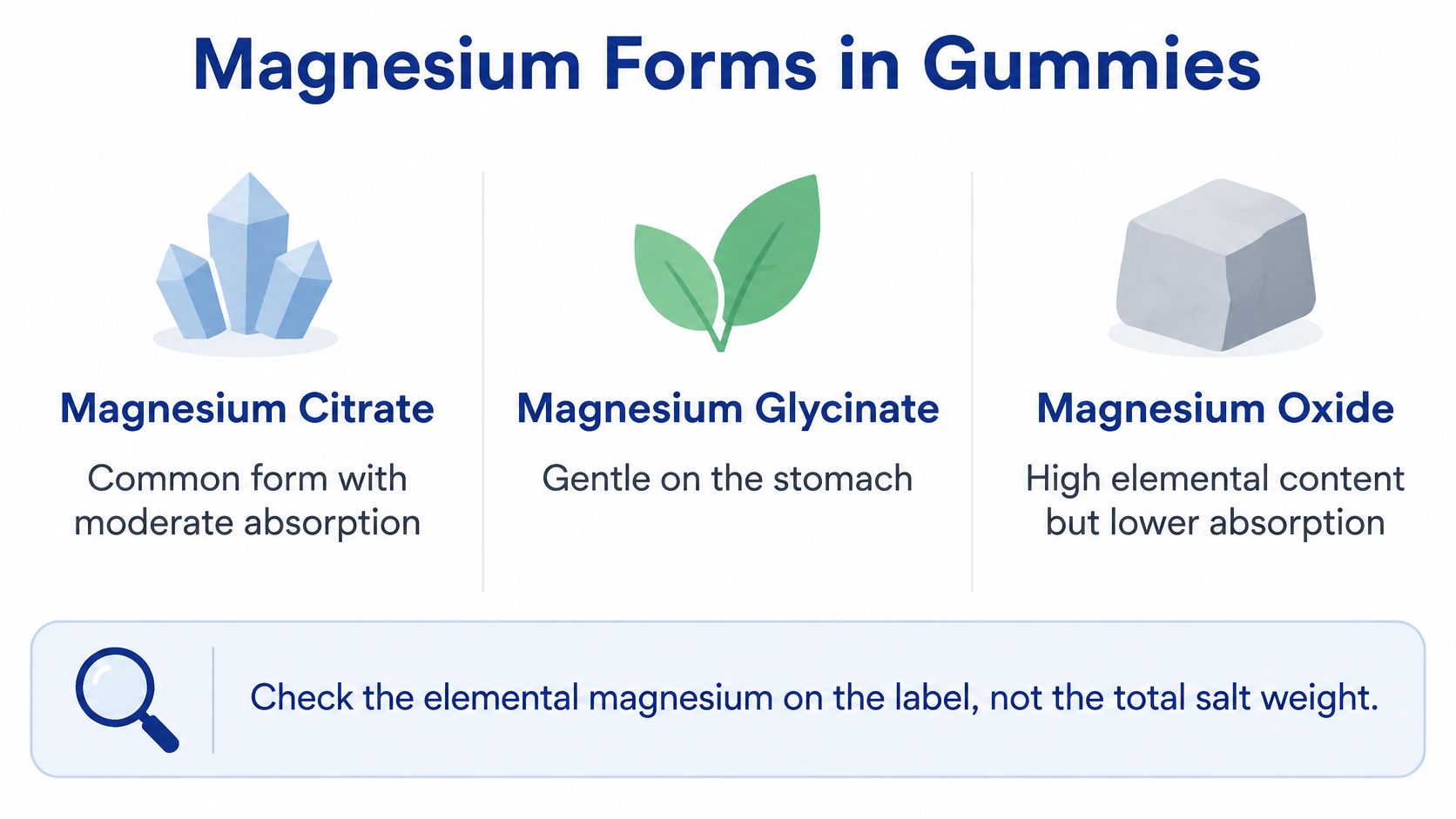
Common magnesium salts in gummies compared
| Form | What the label should show | Absorption and gut notes | Where you see it |
|---|---|---|---|
| Magnesium citrate | Elemental magnesium per serving | Well absorbed; higher doses can loosen stools | Common in gummies, including budget lines |
| Magnesium glycinate | Elemental magnesium per serving | Often chosen for gentler digestive tolerance | Popular in sleep and relaxation products |
| Magnesium malate | Elemental magnesium per serving | Generally well absorbed; may have mild digestive effects | Often in energy-focused blends |
| Magnesium oxide | Elemental magnesium per serving | Poorly absorbed; can have a laxative effect | Cheap tablets, rare in premium gummies |
| Magnesium L-threonate | Elemental magnesium per serving | Human evidence for an absorption advantage is limited | Marketed for memory and cognition |
How the Forms Compare
Citrate is common in gummies, and higher doses may be more likely to loosen stools. Glycinate is often selected by people seeking a gentler option. Oxide can provide a larger elemental share by compound weight, but that does not mean it is better absorbed. It may also have a laxative effect.
L-threonate is marketed for memory and cognition. Limited human data does not establish a proven absorption advantage, so the name alone is not evidence of a benefit.
A magnesium label should identify the elemental amount, not just the compound. Use the salt as a secondary comparison when products provide similar elemental magnesium per serving. Also check how that serving fits with everything else you take. In the UK, supplement enforcement has verification gaps, so a label alone may not confirm a product's composition.
For example, BioBees Fresh Royal Jelly Capsules are a non-magnesium catalogue item, not a source to include in your magnesium total.
Gummies Versus Tablets and Capsules
The format mostly changes convenience, not how magnesium is absorbed. To compare products fairly, check the elemental magnesium per serving, then add it to what you already take. Gummy count and "high strength" on the front label can distract from the amount of magnesium you get.
Where Each Format Helps or Hinders
- Gummies can help with consistency: Their chewable format may suit someone who skips tablets because swallowing them is difficult.
- Gummies can limit the dose per piece: A serving may require several gummies, and the cost per milligram of elemental magnesium is often higher.
- Gummies include other trade-offs: Check the sweetener and shell ingredients, storage advice, and whether children could mistake them for sweets.
- Tablets can offer more magnesium for the cost: They may provide a larger dose per unit, though some are bulky and contain fillers or binders.
- Capsules offer another option: They hold powder or granules, and some can be opened if swallowing is difficult. Many have gelatine shells.
A simple cost comparison uses the label and price: divide the product price by the total milligrams of elemental magnesium in the pack. For example, a tablet pack costing £10 and providing 10,000mg in total works out at £1 per 1,000mg. Compare that with a gummy pack using the same calculation. The example is arithmetic, not a claim about a particular product. Check that serving sizes match, and include any other magnesium supplements in your daily total.
Other supplement formats exist, but format alone says nothing about magnesium content. BetterYou Boost B12 Oral Spray 25ml is a B12 spray, not a magnesium product.
Choose magnesium supplement gummies if swallowing tablets gets in the way of taking a supplement consistently. Tablets or capsules may suit you better if you want more elemental magnesium per serving or a lower cost per milligram. In the UK, enforcement gaps mean a gummy's sweet-like appearance is no guarantee of careful quality checks, so assess its label and verification rather than treating it as harmless confectionery.
Sugar, Calories and Sweeteners Explained
A gummy is mostly a sweet, chewable base carrying a relatively small amount of mineral. That base affects calories, dental risk and digestion, so the sweetener line deserves the same attention as the magnesium line.
Sugar free doesn't automatically mean gentler. In sugar free gummies, sugar alcohols are the main digestive issue, and their laxative effect can add to magnesium's own effect. If stools loosen, the sweetener may be contributing alongside the magnesium salt.
Sweeteners and sugar alcohols in magnesium gummies
| Ingredient | Energy (kcal per gram) | Digestive effect at high intake | What to look for on the label |
|---|---|---|---|
| Sugar or glucose syrup | about 3 to 4 | None at normal amounts; dental risk | Listed as sugar, glucose syrup or dextrose |
| Sorbitol | Lower than sugar | Bloating and loose stools in large amounts | Sugar alcohol, common in sugar-free gummies |
| Xylitol | Lower than sugar | Same as sorbitol; toxic to dogs | Keep gummies away from pets |
| Erythritol | Very low | Better tolerated, though some people still notice bloating | Common in low-sugar lines |
| Stevia | about 0 | Generally none noticed | Listed as steviol glycosides or stevia extract |
| Sucralose | about 0 | Generally none noticed | Listed by name among sweeteners |
Two Label Checks People Miss
Xylitol and pets need a practical household rule. Store gummies out of dogs' reach, in a closed container, rather than leaving a tub where a pet could chew through it.
Vegan status depends on the setting agent. Gelatine is animal derived, so most gelatine gummies aren't vegan. Pectin or other plant based setting agents are used in vegan labelled lines instead.
Don't infer vegan status from the word natural. Look for an explicit vegan statement and check whether gelatine appears in the ingredients.
Use a three ingredient test before you buy. Read the first three ingredients, find the sweetener, then ask whether that sugar or sweetener profile suits something you'll take every day. A product you enjoy but can't tolerate daily isn't convenient in practice.
Kidney Risk and Medicine Interactions to Check First
Magnesium leaves the body mainly through the kidneys, so impaired kidney function is the first check before choosing a gummy or counting a dose. The NHS clinical guidance on oral magnesium supplementation and renal impairment warns that magnesium can build up in severe renal impairment, particularly when estimated glomerular filtration rate is below 30 mL/min/1.73 m². It recommends avoiding supplementation or substantially reducing doses with specialist monitoring for this group.

Excess magnesium can cause hypermagnesaemia. Early effects may include nausea and diarrhoea; severe levels can lead to neuromuscular and respiratory complications. People with kidney disease should not rely on a general food-supplement label alone to decide whether a product is suitable.
Why You May See Two Different Upper Figures
The Food Standards Agency and Food Standards Scotland assessment of magnesium L-threonate notes an EFSA tolerable upper level of 250 mg/day, as described in the assessment of magnesium L-threonate. This figure applies to magnesium from readily dissociable salts in supplements or fortified foods. NHS consumer guidance uses 400 mg/day as a level unlikely to cause harm for the general population.
These figures come from different regulatory and risk-assessment contexts, so they are not interchangeable. The magnesium form matters too, because different salts contribute different amounts of elemental magnesium. If you are unsure which guidance applies to you, ask a pharmacist rather than averaging the figures.
Who needs advice before taking magnesium gummies
| Situation | Action before taking gummies |
|---|---|
| Kidney disease with eGFR below 30 mL per minute per 1.73 m squared | Avoid unless a specialist supervises the dose |
| Milder kidney problems | Ask a GP or pharmacist before starting |
| Tetracycline or quinolone antibiotics | Ask a pharmacist how to separate doses, as magnesium can affect absorption |
| Levothyroxine | Ask a pharmacist about dose timing, as magnesium can affect absorption |
| Bisphosphonates for bone conditions | Ask a pharmacist; timing matters |
| Children | Use only products labelled for their age; never give adult gummies |
| Pregnancy or breastfeeding | Check with a GP or midwife first |
| Nausea, vomiting or persistent diarrhoea | Stop taking the gummies and seek advice |
Some medicines can bind with magnesium in the gut or need to be taken at a different time. Taking all your medicines and supplements together at breakfast may reduce how well a medicine is absorbed. A pharmacist can check the timing for your specific medicines, which is safer than guessing from a general label.
How to Start and Adjust Your Gummy Dose
A sensible gummy dose is built by arithmetic, not by how full the scoop or jar looks. Before step one, complete the kidney and medicine check in the previous section. If that check rules you out, don't start this routine without professional advice.
Independent UK consumer testing summarised in UK government information linked to magnesium gummies and dose context reported assessed gummies supplied roughly 75 to 300 mg per daily serving, commonly around 150 mg, below the UK nutrient reference value of 375 mg for adults. That 375 mg reference value is a labelling benchmark, not the same thing as the NHS daily targets of 270 mg or 300 mg, so don't treat falling short of 375 mg as automatic failure.
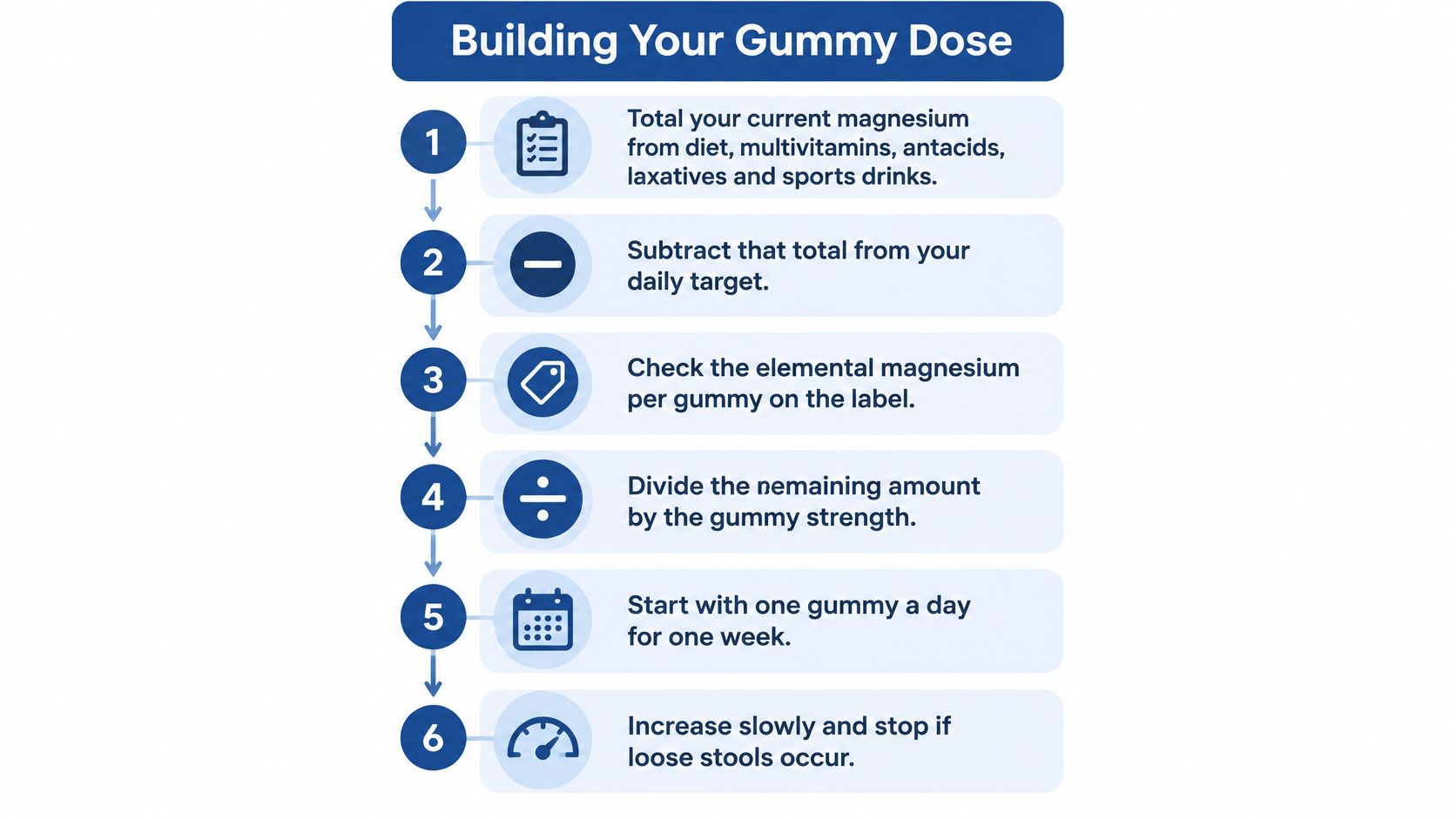
Build the Dose in Seven Steps
- Total what you already take: Add magnesium from diet, multivitamins, antacids, laxatives and sports or sleep products, because stacked products are where totals creep up.
- Find your gap: Subtract that total from about 300 mg for men or 270 mg for women aged 19 to 64.
- Divide by the gummy strength: Divide the remaining gap by the elemental magnesium per gummy to estimate servings.
- Start at half a serving: Stay there for three to seven days to test tolerance before increasing.
- Move up only if settled: Use the full serving when stools and stomach remain normal.
- Take with food and check timing: Food can reduce stomach upset, and medicine spacing still applies. For broader timing principles, see guidance on how to take magnesium supplements.
- Reduce or stop if symptoms persist: Loose stools, nausea or stomach cramps are signals to step back and seek advice if they continue.
A lower dose gummy can be a sensible start, especially if you're sensitive to laxative effects or just topping up your diet. High strength on the front label doesn't automatically mean more effective, and gummies commonly use citrate, which may produce digestive effects for some people.
A successful first fortnight looks undramatic. Your bowels stay steady, you don't feel nauseous, and your supplemental dose sits inside the gap you calculated rather than overshooting it.
How to Check a Gummy's Quality Beyond the Label
In August 2025, the MHRA advised parents to stop using a specific children's magnesium gummy product after testing found undeclared melatonin, a prescription only medicine, at approximately 1.5 to 1.7 mg per gummy in two batches, as described in UK government magnesium information and incident context. One incident doesn't make every gummy unsafe. It does show why treats like sweets still need medicines style checking.
NHS Specialist Pharmacy Service guidance notes that food supplements aren't proactively monitored after reaching the market, aren't manufactured to the more stringent standards required of medicines, and can vary in ingredient quantities or contain undeclared ingredients. Sold online and natural therefore don't equal medicines grade assurance.
An Eight Point Verification Checklist
- Search GOV.UK for MHRA alerts: Check before buying and after opening a new pack, because a recall can apply to a single batch.
- Keep the batch number: Photograph or note it so you can match your pack to any withdrawal.
- Confirm the full ingredient list: Look for any active ingredient beyond magnesium, not just flavourings.
- Read the allergen statement: Check warnings carefully, including whether gelatine is used.
- Find the responsible business: Look for a name and UK address you could contact.
- Verify the dose declaration: Confirm elemental magnesium per serving rather than relying on front label strength claims.
- Store like a supplement, not sweets: Keep the closed pack out of children's sight and reach.
- Ask about manufacturing and testing: Ask the seller whether the product is made to GMP standards and whether independent testing is available.
For a wider framework on separating reassurance from evidence, this overview of supplement safety myths and facts is a useful companion read.
If anyone shows unexpected drowsiness, nausea or other concerning effects after a gummy, stop using it and seek professional advice.
Keep children on age appropriate products only, never adult gummies cut down by guesswork. Adult dosing can't be safely extrapolated to a child by giving half a chew.
Deciding Whether Magnesium Gummies Suit Your Routine
Return to the gap you calculated at the start. If food already supplies most of your target through leafy greens, nuts, wholegrains, beans and lentils, a low dose gummy can be a sensible top up you won't dread taking. If the gap is large, a tablet or powder may give you a clearer, more economical dose.
Some situations change the answer. Kidney disease, interacting medicines, persistent gut sensitivity or symptoms that won't settle are reasons to speak to a GP or pharmacist before you rely on magnesium supplement gummies. Convenience shouldn't outrank that screening step.
What the Adolescent Data Does and Doesn't Show
Analysis drawing on the UK National Diet and Nutrition Survey reports that, from base diet alone, approximately 60% to almost 90% of boys and girls aged 11 to 18 had magnesium intakes below the Estimated Average Requirement, summarised as more than 70% failing to achieve their requirement, in research on UK micronutrient intakes from diet, fortified foods and supplements.
That finding supports improving diet first and choosing only age appropriate products where a supplement is considered. It doesn't prove every teenager needs a supplement, doesn't measure deficiency diagnosed by blood testing, and doesn't show gummies outperform food, tablets or powders.
Your single next step is practical. Work through the dosing steps, then compare each product's elemental magnesium per serving against your personal gap. Vitamin Planet's magnesium range can be compared by elemental dose before ordering, using the same label arithmetic rather than gummy count.
Ready to compare products by elemental dose rather than headline strength? Visit Vitamin Planet to review magnesium options alongside multivitamins, sports and sleep products, so you can add up your full daily total before you order. Bring your calculated gap, check the salt and sweetener, and choose the format you'll take safely and consistently.