

BCAA and Creatine Together: Do You Need Both?
Protein intake, not supplement popularity, should decide whether BCAAs belong in your routine. Pairing BCAAs with creatine does not create a proven synergy, and a larger stack is not automatically better.
BCAAs are three essential amino acids, while complete protein supplies all nine. When meals already provide enough protein, a BCAA drink largely repeats amino acids you have eaten. Its appeal is convenience, not a demonstrated advantage over complete protein. Creatine serves a different purpose, so its value is not determined by whether you take BCAAs.
Start by checking what your diet already covers. Then judge each product on its own evidence and your training needs, rather than buying a bundle because the two are often marketed together. Popularity is not evidence that combining them improves results.
Table of Contents
- Who Actually Needs Creatine, BCAA or Both
- What Each Supplement Does and Where the Evidence Stops
- Safety Checks and Interactions Before You Start
- Dosing and Timing for Creatine and BCAA
- Build Your Stack and Check the Result
Who Actually Needs Creatine, BCAA or Both
If you already eat enough protein, creatine is the better purchase, while BCAAs are optional. BCAAs are only three of the nine essential amino acids. A complete protein already supplies all nine, including leucine, isoleucine and valine.
A Manchester Metropolitan University systematic review screened 2,298 records and included 24 studies of trained participants taking oral BCAAs. Effects on performance and body composition were negligible. Some resistance-training studies suggested less post-exercise soreness, while endurance findings did not agree. The 22% rise in post-exercise muscle protein synthesis from 5.6 g of BCAAs versus placebo still fell short of whole protein, as set out for UK readers weighing BCAA products.
If you want a working target, use about 1.6 to 2.0 g/kg and calculate your daily protein needs before you add another tub.
| Situation | Creatine | BCAA | Why |
|---|---|---|---|
| Protein around 1.6 to 2.0 g/kg a day and regular training | Yes, for strength and repeated high-intensity work | Usually optional | Food already supplies all essential amino acids |
| Protein intake inconsistent or long gaps between meals | Yes | Possible as a gap filler | BCAAs may help where food is sparse |
| Training fasted or short sessions | Yes, timing is flexible | May suit intra-session use | Convenience and routine matter more than a muscle-building effect |
| Plant-based diet with lower total protein | Yes | Review total protein first | Protein quality and quantity come before any supplement |
| Endurance or weight-sensitive event such as swimming or distance running | Limited evidence for sprint and interval outcomes | Inconsistent endurance findings | Neither is a guaranteed performance aid |
Taking both does not create synergy. They do not amplify each other. UK creatine sales were estimated at roughly £36 million in the 52 weeks to 8 June 2025, with category growth of about 40% year on year in secondary Circana reporting. That is popularity, not proof you need a second product.
Find your row. If protein is already covered, creatine is the buy and BCAAs are optional. If food is patchy, BCAAs are a stopgap, not a replacement meal.
What Each Supplement Does and Where the Evidence Stops
Creatine and BCAAs solve different problems, and neither should outrank adequate protein from food. Creatine is stored in muscle as phosphocreatine, which helps regenerate ATP during short, hard efforts. Research supports its use for strength work and repeated sprints. A rise in scale weight early on usually reflects water held inside muscle, not new contractile tissue.
The comparison below shows what each supplement does and where the evidence stops.
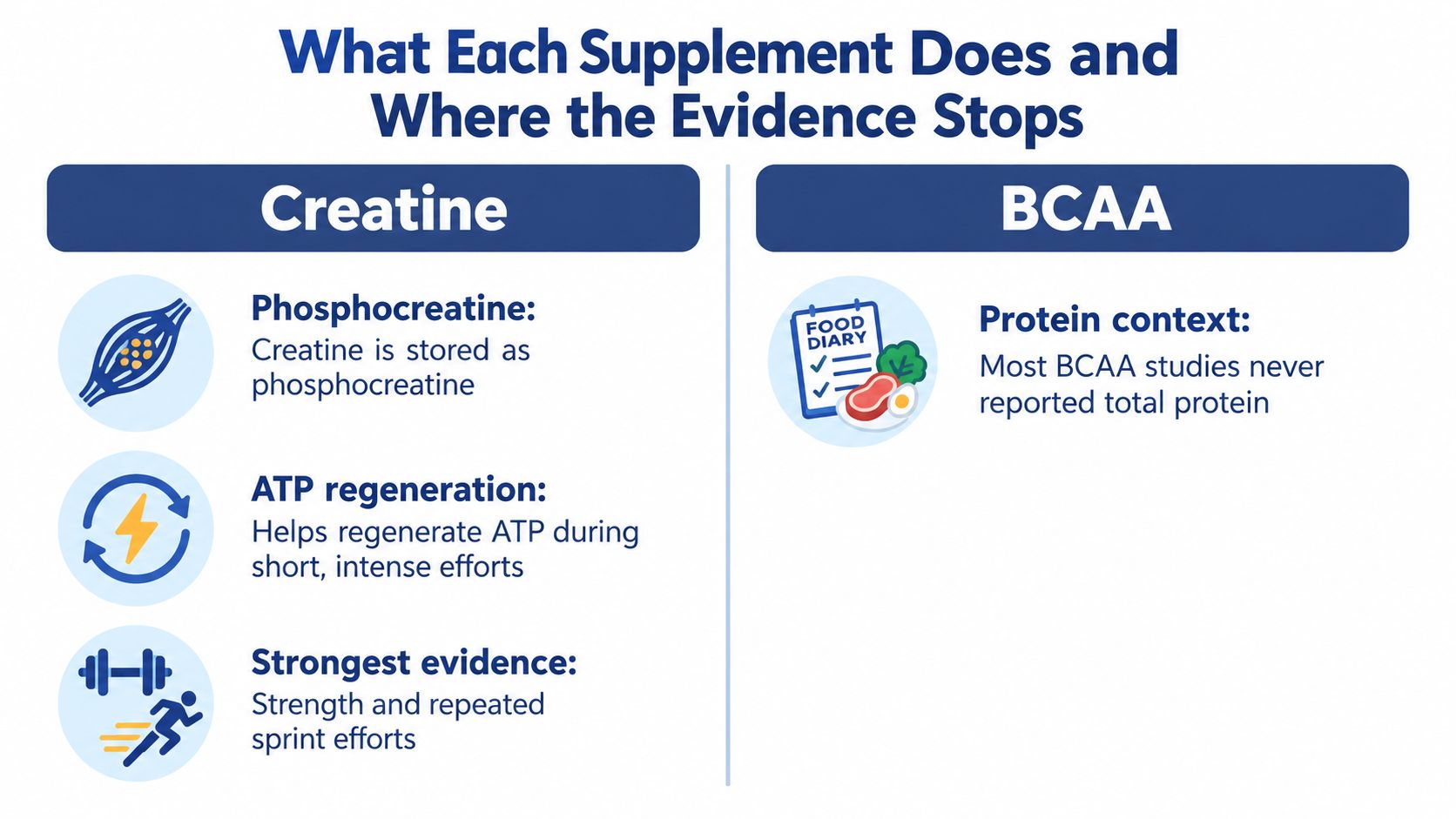
BCAAs are leucine, isoleucine and valine. Leucine helps signal muscle protein synthesis, but the process also needs the other essential amino acids. When your diet already provides enough protein, extra leucine does not independently build bigger or stronger muscles. A complete protein, such as whey, supplies the full set of amino acids. See these whey protein benefits when comparing it with a BCAA product.
Blood levels are not a supplement trial
A cross-sectional analysis of 108,017 UK adults, with a mean age of 56.40 years, found associations between higher circulating BCAA levels and muscle measures. Total BCAA, isoleucine, leucine and valine were positively associated with muscle mass (beta coefficients 0.56 to 2.53). Total BCAA, leucine and valine were associated with muscle strength (beta coefficients 0.91 to 3.44). Higher circulating valine was also linked to 47% lower odds of sarcopenia (odds ratio 0.53, 95% confidence interval 0.30 to 0.94). These are associations in blood samples, not evidence that valine supplements reduce sarcopenia risk, according to UK Biobank research on branched-chain amino acids.
Blood BCAA levels reflect diet, activity, muscle metabolism and health. They cannot establish what a supplement will do.
What you can claim: creatine can support repeated high-intensity training and strength-oriented work. BCAAs can provide a convenient sip when food is unavailable. Neither product can promise muscle gain.
Treat label claims with the same care: check whether they describe evidence for the finished product or merely repeat what an ingredient does in the body.
Safety Checks and Interactions Before You Start
Some people should not start either product on their own. Kidney disease, liver disease, maple syrup urine disease, pregnancy, breastfeeding and being under 18 all sit in that group. Match your situation before you look at a dose.
High single doses of creatine often cause stomach discomfort. Cramps get reported anecdotally. Extra water inside muscle is expected. Splitting the dose and drinking as you normally would usually settles the stomach side. Creatine also raises the creatinine reading on a blood test, so the number can look like a kidney change when it is the supplement. If you have kidney disease, or you take kidney-related medication, speak to a GP first and say you take it.
Maple syrup urine disease is the hard stop for BCAAs, because intake is restricted. Liver disease needs the same medical pause. Pregnancy, breastfeeding and under-18s have no good reason to start either product without advice. Competitors in a tested sport should pick third-party batch testing so contamination risk stays lower. A wider look at supplement safety myths and facts helps before you add anything else.
Weight-management formulas such as METABURN 60 Capsules, a thermogenic blend aimed at fat loss alongside diet and training, do not change these medical checks.
| Condition or situation | Creatine concern | BCAA concern | Action |
|---|---|---|---|
| Kidney disease or reduced kidney function | Raises blood creatinine readings | Ask a GP first | Get medical advice before starting |
| Liver disease | Ask a GP first | Ask a GP first | Get medical advice before starting |
| Maple syrup urine disease | Discuss with a specialist | BCAA intake is restricted | Avoid BCAAs unless a specialist advises otherwise |
| Pregnancy or breastfeeding | No advice for use without guidance | No advice for use without guidance | Speak to a GP or midwife first |
| Under 18 | Seek advice first | Seek advice first | Speak to a GP or qualified coach |
| Competing in tested sport | Check for third-party batch testing | Check for third-party batch testing | Choose certified products and keep labels |
This is a screening step, not a substitute for medical advice.
Dosing and Timing for Creatine and BCAA
Set the dose by the supplement and the purpose. Creatine has a clear maintenance option; BCAAs only make sense if your diet leaves a protein gap. Taking both does not create synergy.
| Protocol | Amount | Timing or duration | Practical note |
|---|---|---|---|
| Creatine monohydrate, maintenance | 3 to 5 g once daily | Any consistent time of day | Works with or without loading |
| Creatine loading, optional | 20 to 25 g a day in four or five doses of about 5 g | 3 to 7 days, then maintenance | Split doses may reduce stomach upset |
| BCAA, typical label dose per session | 5 to 10 g | Around training, before or sipped during | Use only if a protein gap exists |
| BCAA, single trial dose | 5.6 g | Post-exercise | A research reference, not a required target |
For creatine, loading is optional. One saturation protocol uses about 20 to 25 g/day, or 0.3 g/kg/day, split into four or five doses of about 5 g for 3 to 7 days, followed by 3 to 5 g/day. A Great Britain climbing study used 5 g four times daily for five days, then 3 g once daily for 12 weeks. These are research protocols, not personal prescriptions. Meanwhile, a review of 17 studies involving 361 swimmers found no significant overall improvement in sprint swimming, intervals, physiology or body composition. The single-sprint effect was SMD -0.05 (95% CI -0.26 to 0.15), according to this review of creatine and swimming performance.
Match the creatine schedule to your needs
Take maintenance creatine at a consistent time each day. Loading may reach saturation faster, while a lower daily dose takes longer. Split servings if one dose upsets your stomach. Do not mistake an early rise in body mass after loading for new muscle: it can reflect water inside the muscle.
Choose creatine monohydrate as the straightforward option. The other types of creatine differ in form, but that does not make them necessary for a sound dosing plan.
Set BCAA servings by the label
BCAA study protocols vary, and labels often list 5 to 10 g per session. Check the grams per serving rather than relying on the scoop count. A post-exercise trial used 5.6 g, but that is a research dose, not a target you need to match.
First check what your usual diet provides. If complete protein already covers your needs, leave BCAAs out. If there is a genuine gap, decide whether BCAAs address it before buying a powder.
Build Your Stack and Check the Result
Popularity does not make a supplement useful, and combining creatine with BCAAs does not create synergy. Let your food record decide what belongs in the stack. Track your usual intake first, then make one change you can assess.
Record the baseline first
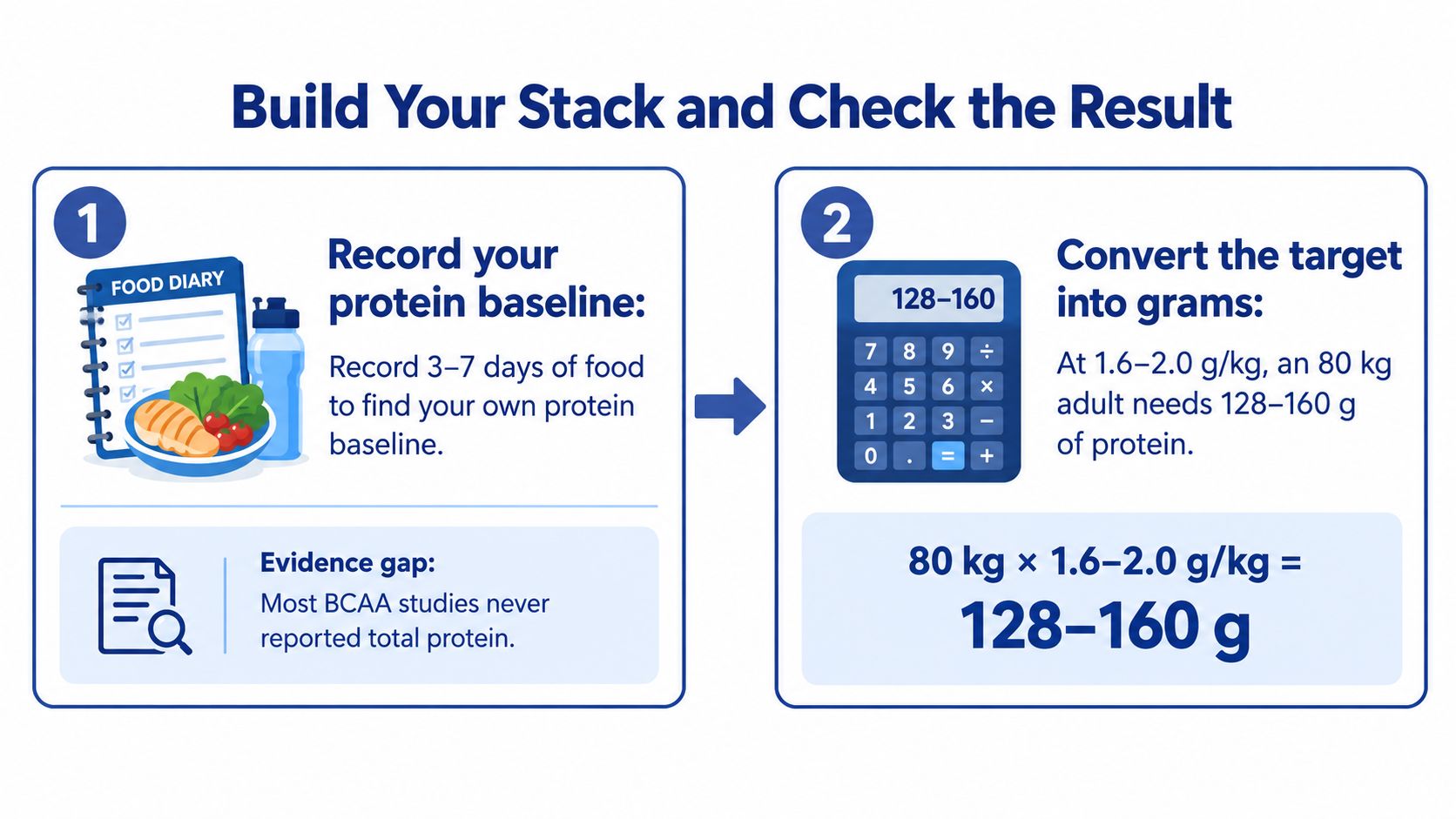
Keep a food log for 3 to 7 days. Include meals, snacks, shakes and training days. Record protein amounts where labels or reliable food data make them clear. Mark training sessions and note when you eat around them. This week's log gives you something concrete to check before buying another product.
The infographic below turns a daily protein target into a food-based check.
Turn the target into grams
At 1.6 to 2.0 g/kg, an 80 kg adult's example target is about 128 to 160 g of protein a day from food or a complete protein supplement. Compare your log with the target. A consistent shortfall is a reason to adjust meals or use complete protein. BCAAs do not supply the full range of amino acids found in complete protein.
If your log already falls within the target band, leave BCAAs out. A plant-based diet can meet protein needs, but the total still needs checking. Add protein-rich foods or a complete protein supplement if the record shows a shortfall. Do not use an isolated amino-acid blend to fill a broader protein gap.
Choose creatine, then test for a real BCAA job
If your training suits creatine, choose plain creatine monohydrate and take the maintenance dose consistently, including on rest days. Loading is optional and only speeds saturation. Keep the dose and routine steady while you assess the result.
Use your log to check whether a BCAA product has a distinct role:
- Fasted sessions: Do you train without a recent protein meal?
- Long gaps: Are there several hours between meals on training days?
- Low-protein days: Does your food record fall short of the gram target?
If none applies, buy creatine alone, if you have decided it suits your training. A combined tub can make the creatine dose harder to check, while adding amino acids your meals may already provide. If a genuine gap remains, read the BCAA grams per serving on the label and check for batch testing. Treat muscle-building claims as marketing, not a reason to buy.
Judge one change over four weeks
Track the same measures once a week, and change only one part of your routine at a time.
- Body mass: Weigh under similar conditions to reduce noise from food and water.
- Session quality: Record loads, reps or interval pace.
- Soreness: Note it separately from performance, since the two can change independently.
Keep sleep, energy intake and training load roughly steady. Otherwise, you will not know whether the supplement or a change in routine explains the result. Give the protocol at least four weeks before deciding whether it helped.
If tiredness is the main complaint, review it as a health concern rather than assuming either supplement will help. Persistent fatigue warrants advice from a healthcare professional.
Use your food log to justify each purchase. Creatine and BCAAs together are not a shortcut to more muscle.
Vitamin Planet stocks creatine, BCAAs, protein and other sports-nutrition products. Start with the food record and choose only what addresses a gap it shows.