

Benefits of Magnesium Supplements: What the Evidence Shows
The popular advice is that magnesium helps almost everything at once, sleep, cramps, mood, blood pressure, brain health and blood sugar, and that you just need the right form. That list treats every claim as equal. It isn't.
When you rank the benefits of magnesium supplements by evidence strength, a clear pattern appears. Correcting a real shortfall has solid support. A small blood pressure effect has moderate support. Sleep, muscle, brain and mood claims are much weaker, narrower, or unproven in people who already get enough.
Table of Contents
- Which Magnesium Benefits the Evidence Supports
- How Much Magnesium You Need and the Safe Ceiling
- Sleep and Muscle Function in Trial Evidence
- Blood Pressure and Heart Health in Practice
- Early Evidence for Brain, Mood, Blood Sugar and Bone
- Deficiency Signs and When to Act
- Choosing a Form and Staying Within Safe Limits
- Confirm Your Intake Before You Buy
Which Magnesium Benefits the Evidence Supports
Magnesium claims deserve different levels of confidence. Correcting a deficiency has a clearer rationale than taking a supplement for general wellness, where benefits depend on the person's starting magnesium status and the outcome being measured.
The Ranked Verdict
| Benefit | Evidence strength | What the research supports |
|---|---|---|
| Correcting low magnesium status | Strongest | Replacing magnesium can address a measured shortfall. |
| Modest blood pressure reduction | Moderate, small effect | Trials suggest a small average reduction; individual results may differ. |
| Perceived sleep onset | Limited | Some trial evidence suggests a possible improvement in insomnia symptoms. |
| Muscle cramps and function | Mainly where intake is low | Benefit is more plausible when magnesium intake is inadequate; a reliable effect in healthy adults with adequate intake is not established. |
| Brain structure | Early, observational | Associations between magnesium intake and brain measures do not show that supplements cause a change. |
| Blood sugar in type 2 diabetes | Early | Supplementation has not consistently improved insulin sensitivity. |
| Mood | Unproven | Evidence does not establish a reliable effect. |
The ranking reflects an important difference: correcting a shortfall addresses a known nutritional problem, while sleep, muscle, brain and mood claims depend on narrower or less certain evidence. A change in a measured outcome also does not automatically mean a supplement will produce a noticeable benefit for everyone.
For any claim, check who was studied, whether participants had low magnesium, and whether the outcome was objective or self-reported. Those details matter more than a broad promise of “wellness”: they show whether a finding applies to people with adequate intake or only to a specific group.
How Much Magnesium You Need and the Safe Ceiling
Start with what you get from food. The NHS guidance on vitamins and minerals recommends 300 mg a day for men aged 19 to 64 and 270 mg a day for women aged 19 to 64. It says a varied, balanced diet should provide enough. For adults, the NHS sets a ceiling of 400 mg a day from supplements; higher short-term doses can cause diarrhoea, and evidence on long-term high doses is insufficient.
| Group | Recommended daily intake | Supplement limit | Notes |
|---|---|---|---|
| Men aged 19 to 64 | 300 mg | 400 mg from supplements | Aim to meet intake mainly from food |
| Women aged 19 to 64 | 270 mg | 400 mg from supplements | The same supplement limit applies |
| Adult nutrient reference value | 375 mg total | 400 mg from supplements | Counts food and supplements together, not a dose target |
| Doses above 400 mg taken short term | 270 to 300 mg total remains the target | Exceeds the supplement limit | Can cause diarrhoea |
Reading a Label Against Those Numbers
Check the amount of elemental magnesium per serving, rather than the total weight of the compound. The compound's weight can be much higher than the magnesium it provides. A higher-strength tablet is not automatically more useful.
For example, a woman who estimates 200 mg from food would need about 70 mg to reach 270 mg. A 400 mg tablet would exceed that gap by 330 mg. The supplement ceiling is a safety limit, not a target dose.
Nuts, seeds, wholegrains, leafy greens and pulses are practical sources to include when estimating intake. If they rarely feature in your diet, a shortfall is more plausible; consider your food intake before choosing a supplement dose.
Practical rule: Estimate your dietary intake, then choose the smallest supplement dose that closes the gap.
Sleep and Muscle Function in Trial Evidence
Sleep is where subjective and objective results diverge most clearly, so it's worth separating what people reported from what devices measured. This illustration summarises the sleep and muscle relaxation claim as it's usually presented.
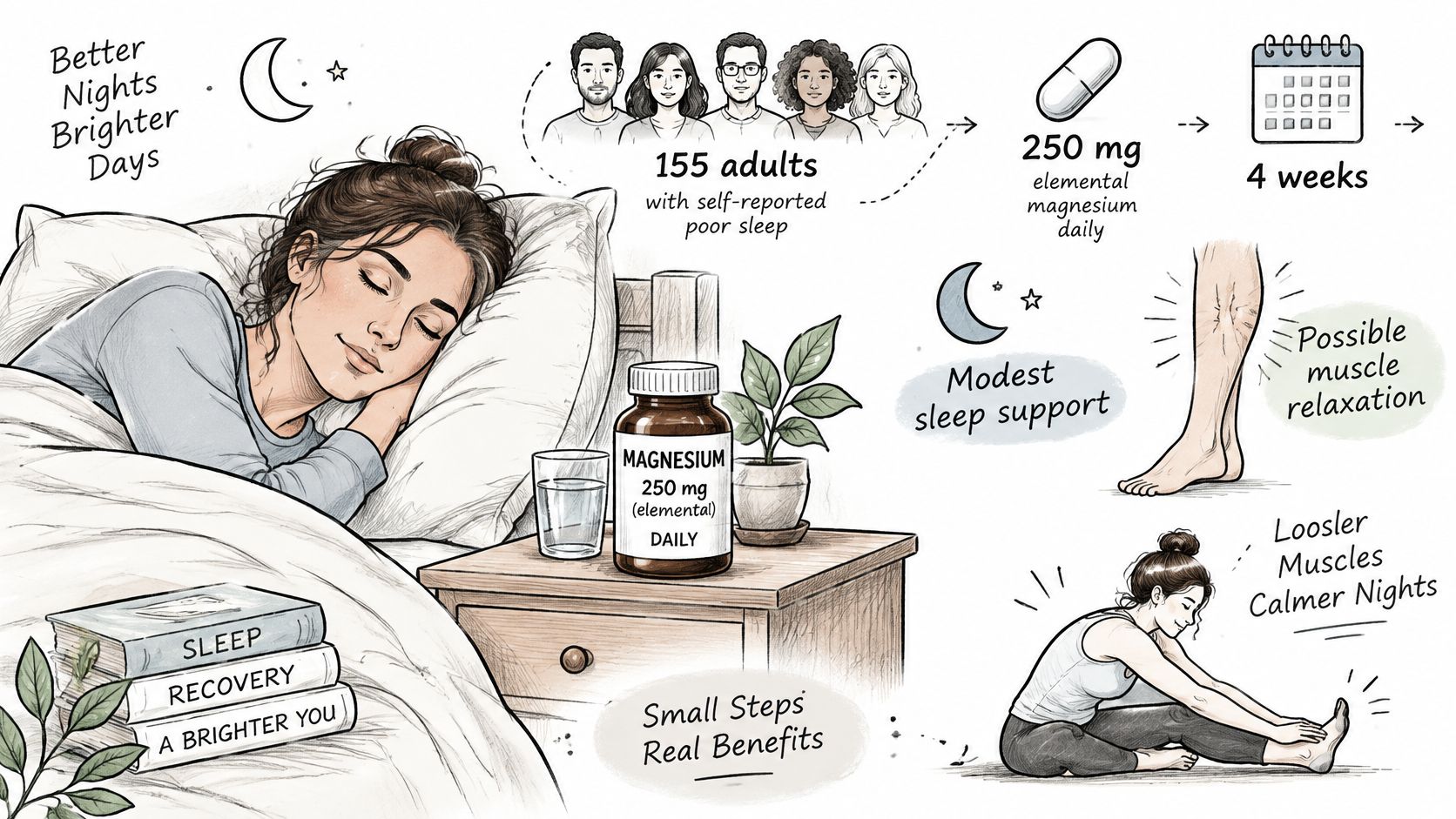
The NHS vitamins and minerals content summary describes a placebo-controlled trial of 155 adults with self-reported poor sleep who took 250 mg of elemental magnesium daily for four weeks. Insomnia severity improved by a statistically significant but small amount, while wearable-recorded sleep outcomes didn't differ significantly from placebo.
In plain terms, magnesium may modestly help perceived sleep-onset difficulty. It isn't a reliable sedative. Pairing any trial with broader guidance on the importance of sleep and practical sleep advice for people managing pain is more honest than implying a capsule alone fixes sleep architecture.
Forms and Muscle Claims
Evidence doesn't establish that glycinate, bisglycinate, citrate or L-threonate has a uniquely superior sleep effect. Paying a premium for a sleep-specific form is therefore a marketing choice, not an evidence-based one.
For muscle, cramps and weakness are classic deficiency symptoms, so benefit is clearest where intake is low. There's no reliable figure for cramp relief in people who are already replete. If cramps come from training load, dehydration or a medicine, magnesium won't correct that cause.
This short video gives useful background on magnesium and everyday use before you judge your own response.
Stop waiting and seek help when insomnia lasts several weeks, daytime tiredness persists despite enough time in bed, or sleep problems worsen. Those patterns warrant a GP visit rather than a higher dose.
Blood Pressure and Heart Health in Practice
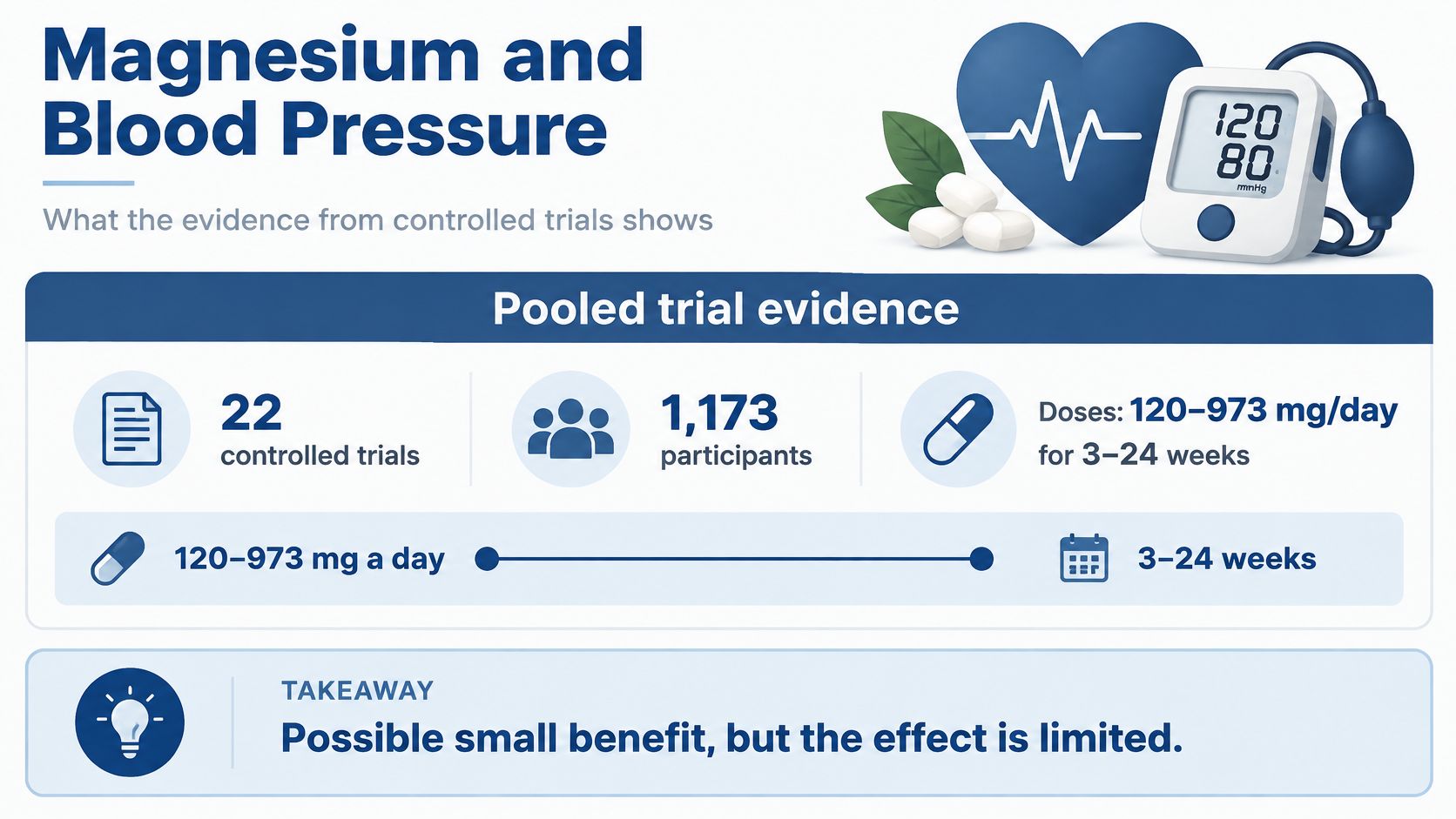
The blood pressure effect is real in pooled data, but it's small. That size is the point most marketing omits.
The UK legislation annex setting the nutrient reference value sits alongside a meta-analysis of 22 controlled trials involving 1,173 participants, testing 120 to 973 mg a day for 3 to 24 weeks, with a mean dose of 410 mg a day. Pooled results showed about 3 to 4 mmHg lower systolic and 2 to 3 mmHg lower diastolic pressure, with stronger effects in crossover trials and above 370 mg a day.
A smaller UK signal looks larger, which is why sample size matters. In the University of Hertfordshire pilot paper, 16 male volunteers received 300 mg of magnesium oxide daily for 14 days, and resting systolic pressure fell by 8.9 mmHg, with habitual dietary intake affecting the response.
What the Numbers Can and Cannot Do
- Mechanism: Magnesium may support vascular smooth-muscle relaxation by regulating calcium influx.
- Who may gain most: People with low baseline intake, rather than everyone equally.
- Limit: Individual trials didn't all show significant reductions, so response isn't guaranteed.
A reduction of a few mmHg can be clinically meaningful at population level, but it doesn't replace prescribed treatment, diet or exercise. Read it alongside wider heart health guidance and treat magnesium as an adjunct only.
If you have kidney impairment or take medicines affecting renal electrolyte handling, get clinical advice first, because reduced clearance raises toxicity risk.
Early Evidence for Brain, Mood, Blood Sugar and Bone
These four areas are often presented as established benefits. They're better described as early signals, negative results, or physiological roles without proven supplement outcomes.
Brain and Blood Sugar
A 2023 UK Biobank analysis summary included 6,001 adults aged 40 to 73 and found higher dietary magnesium intake was associated with larger grey-matter and hippocampal volumes on MRI. That's observational. People who eat more magnesium-rich foods differ in many other ways, so it can't show supplements cause larger brain volumes.
Blood sugar evidence is more directly tested, and less encouraging. A 2024 randomised controlled trial report gave 15 mmol a day for six weeks to 14 insulin-treated adults with type 2 diabetes and low magnesium. Serum magnesium rose, but insulin sensitivity, HbA1c and insulin requirements didn't improve. Raising a blood level isn't the same as improving the outcome patients care about.
Research is continuing rather than settled. A 2025 UK clinical trial listing for magnesium bisglycinate in type 1 diabetes planned 150 participants at St James's University Hospital in Leeds, funded by Diabetes UK. Until results are available, it supports no consumer claim.
Mood and Bone
For mood, evidence is limited and no reliable effect size exists. Presenting it as a proven benefit overstates what's known, particularly for people whose intake is already adequate.
For bone, magnesium supports normal parathyroid function, which underpins its role in UK bone-health guidance. The evidence reviewed here doesn't establish that supplements reduce fracture risk. What's missing across all four areas is the same thing, larger placebo-controlled trials in defined groups, using clinical outcomes rather than blood levels or brain scans alone.
Deficiency Signs and When to Act
A person taking a proton-pump inhibitor long term who develops persistent cramps needs assessment, not a supplement chosen on symptoms alone. Fatigue, weakness and nausea are also non-specific, so a blood test and review of risk factors can help establish whether magnesium is low.
The BNSSG NHS oral magnesium supplementation guide describes mild hypomagnesaemia at approximately 0.5 to 0.7 mmol/L. It says oral replacement may be considered when symptoms or risk factors are present. At levels below 0.4 mmol/L, hospital-based intravenous treatment may be needed.
| Stage or factor | Signs or risk | What to do |
|---|---|---|
| Early deficiency | Fatigue, weakness, nausea, loss of appetite | Review diet and discuss persistent symptoms with a GP or pharmacist |
| Worsening deficiency | Paraesthesia, cramps, muscle contractions, seizures, abnormal heart rhythm | Seek urgent medical assessment rather than self-treating |
| Blood level below 0.4 mmol/L | Severe low magnesium | The BNSSG NHS guide says hospital-based intravenous treatment may be needed |
| Long-term proton-pump-inhibitor use | Increased risk of low magnesium | Ask a GP whether a blood test is appropriate |
The Self-Check Logic
Symptoms alone cannot confirm deficiency. Persistent proton-pump-inhibitor use, or medicines and conditions that increase gastrointestinal or renal losses, can make a low magnesium level more plausible and warrant clinical review.
A supplement is most justified when a GP or pharmacist identifies a shortfall, a relevant risk factor or a low result. Blood-test findings and medical suitability should guide the decision; symptoms such as cramps do not show that magnesium is the cause.
Seek medical assessment for persistent cramps, weakness, palpitations or neurological symptoms. Severe symptoms, including seizures or an abnormal heart rhythm, need urgent care. The priority is to identify the cause and assess whether other electrolyte or medicine issues are involved.
Choosing a Form and Staying Within Safe Limits
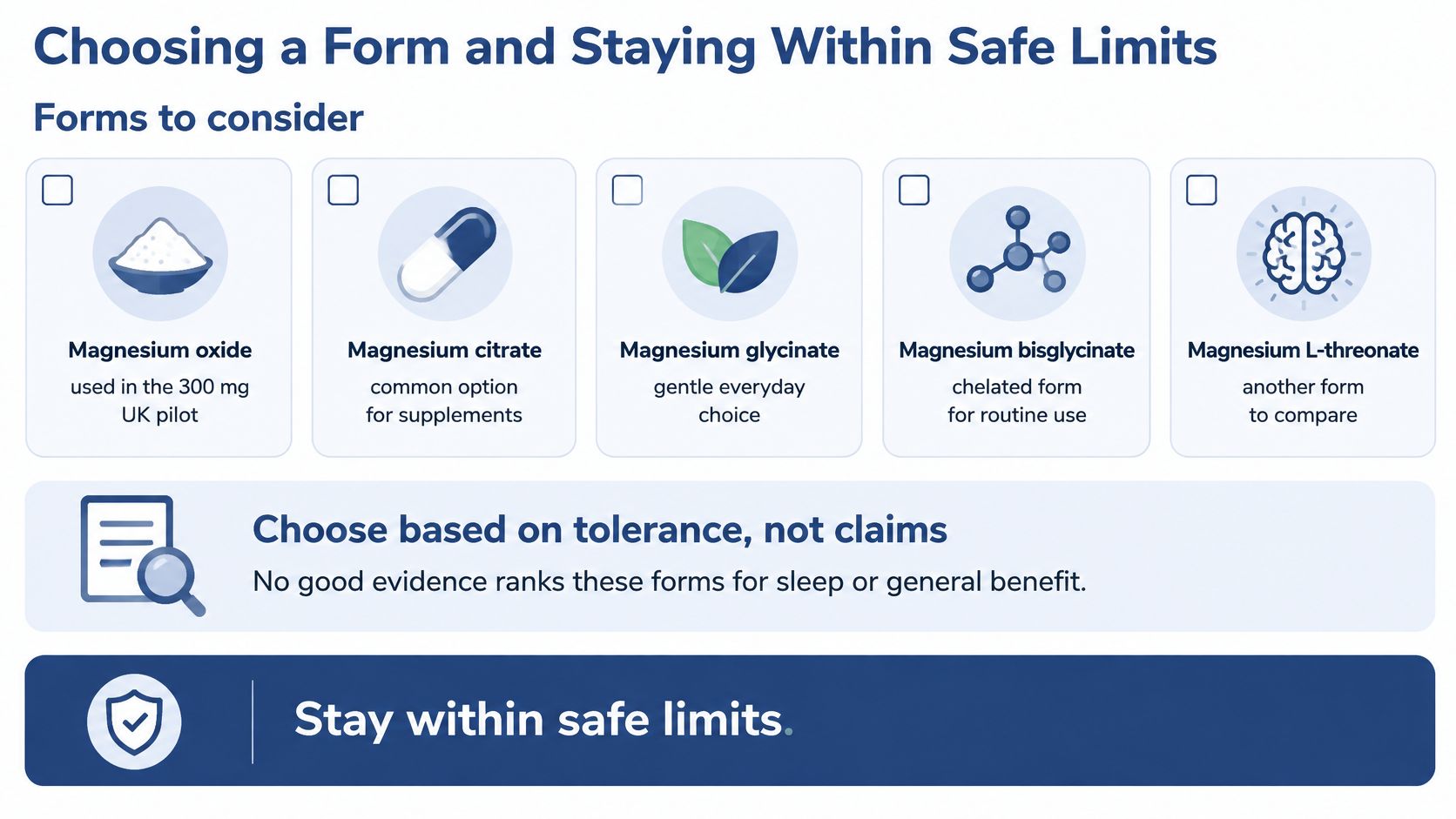
Magnesium forms are not a proven league table. The evidence does not establish one form as best for sleep or general benefits, so compare the elemental magnesium declared per dose and consider digestive tolerance.
| Form | Evidence on sleep or general benefit |
|---|---|
| Magnesium oxide | Used in the 300 mg UK blood pressure pilot, with no ranking for sleep (pilot study) |
| Citrate | No reliable ranking for sleep or general benefit |
| Glycinate | No uniquely superior sleep effect shown |
| Bisglycinate | No uniquely superior sleep effect shown; a UK type 1 diabetes trial was planned for 2025 |
| L-threonate | No uniquely superior sleep effect shown |
Safety Checklist in Order
- Read elemental magnesium per dose: Compare it with the UK adult supplement ceiling of 400 mg a day.
- Split larger amounts: Dividing a dose across the day may improve tolerability.
- Treat loose stools as feedback: Reduce the dose rather than pushing through.
- Add every source together: Include multivitamins, antacids and other products in your total.
- Check medicines with a pharmacist: Pay particular attention to medicines affecting kidneys or electrolytes. The guidance on supplement safety myths and facts also discusses checking supplement use carefully.
- Avoid long-term high doses without advice: Effects of sustained intake above the ceiling are not established.
Check the label for the amount of elemental magnesium, not just the compound's total weight. Product names do not show how much elemental magnesium a serving provides.
Confirm Your Intake Before You Buy
Use your usual weekly diet to estimate whether magnesium from food is likely to meet your needs. Consider nuts, seeds, wholegrains, leafy greens and pulses, then compare the estimate with the targets discussed earlier.
- Check your symptoms and risk factors: Use the signs described above rather than treating tiredness alone as evidence of a shortfall.
- Ask for clinical advice: Speak to a GP or pharmacist if a deficiency seems possible, symptoms persist, or you take regular medicines.
- Read the supplement label: Check the amount of elemental magnesium per serving and choose a form your digestion tolerates.
- Set a review point: Reassess after the trial period described earlier. Stop and seek advice if symptoms persist or new ones appear.
If your diet appears to meet your needs and you have no symptoms or risk factors, a supplement may offer little benefit. Vitamin Planet's Nutritional Research Department evaluates each formula, but that does not establish that you need a supplement.
If your weekly estimate already reaches the relevant target, skip the supplement and reassess in four weeks. If it falls short, discuss the gap with a GP or pharmacist before choosing a clearly labelled magnesium product from Vitamin Planet.